A standard pickleball court measures 44 feet long by 20 feet wide, with a 7-foot non-volley zone on each side of the net. USA Pickleball mandates these dimensions for all sanctioned play.
The official measurements used today are defined and maintained by USA Pickleball, the sport’s national governing body, whose standards are followed across recreational play, instruction, leagues, and competitive events.
Accurate court size and layout ensure consistency across different venues, allowing players to develop reliable positioning, shot selection, and movement patterns that translate across levels of competition.
Official pickleball court dimensions at a glance
A regulation pickleball court is 44 feet long and 20 feet wide. That measurement applies to every format namely recreational, instructional, and competitive.
According to official standards used across recreational and competitive play, the court measures:
- 44 feet long
- 20 feet wide
These dimensions apply universally, regardless of skill level or event type. The court is divided by a net into two equal halves, with service courts, baselines, sidelines, and a non-volley zone precisely marked to support rule enforcement and fair play.
Because the court size remains constant across formats, players benefit from consistent spacing, predictable angles, and repeatable movement patterns. This uniformity is one of the reasons pickleball is accessible to new players while still offering strategic depth for experienced competitors.
Quick reference: all regulation measurements
| Measurement | Feet | Meters | Inches |
| Court length | 44 ft | 13.41 m | 528 in |
| Court width | 20 ft | 6.10 m | 240 in |
| Kitchen depth (each side) | 7 ft | 2.13 m | 84 in |
| Net height at sidelines | 3 ft / 36 in | 0.914 m | 36 in |
| Net height at center | 2 ft 10 in / 34 in | 0.864 m | 34 in |
| Net length | 22 ft | 6.71 m | 264 in |
| Each service court | 15 × 10 ft | 4.57 × 3.05 m |
All measurements per USA Pickleball official standards.
Full pickleball court measurements explained
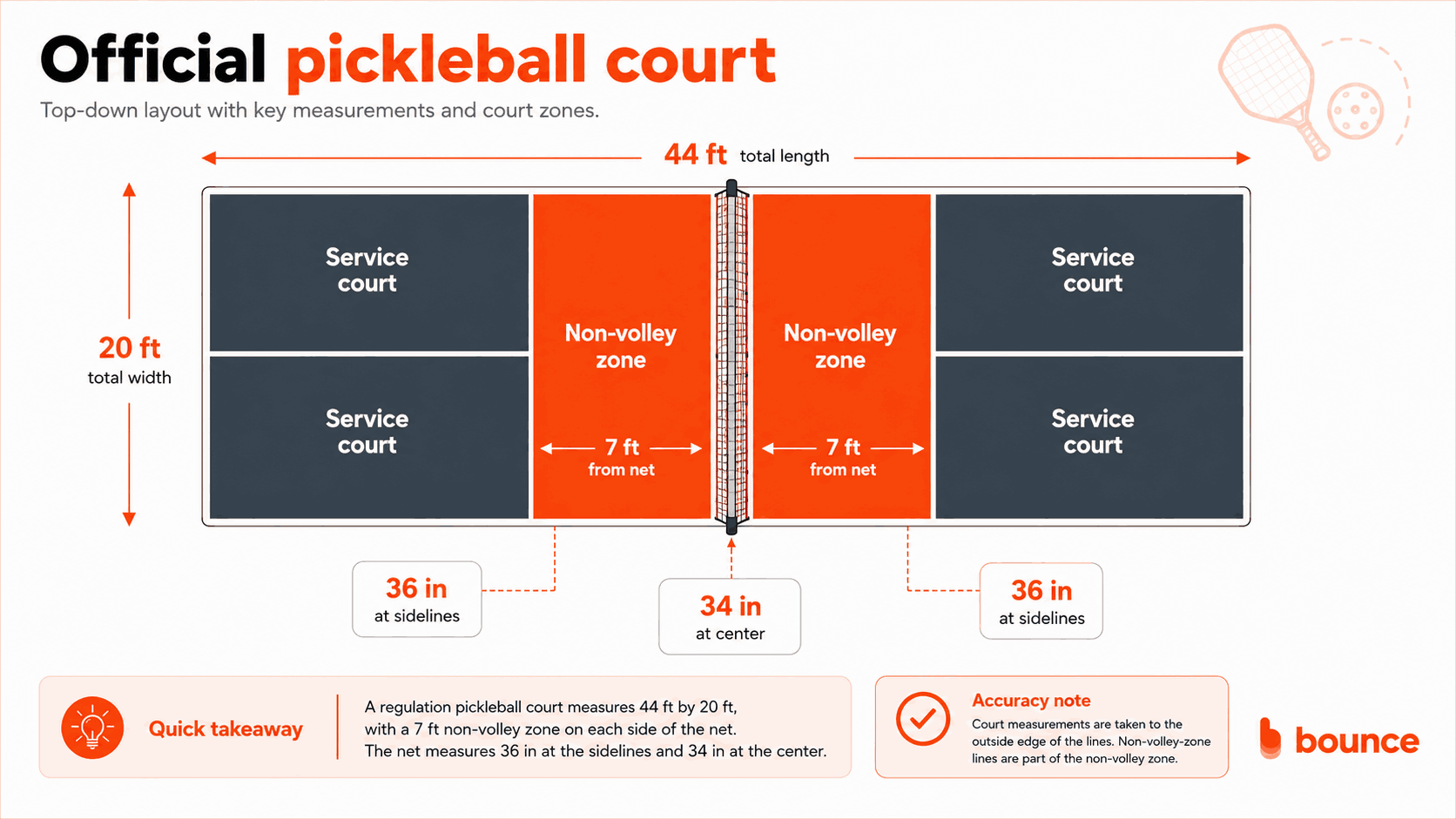
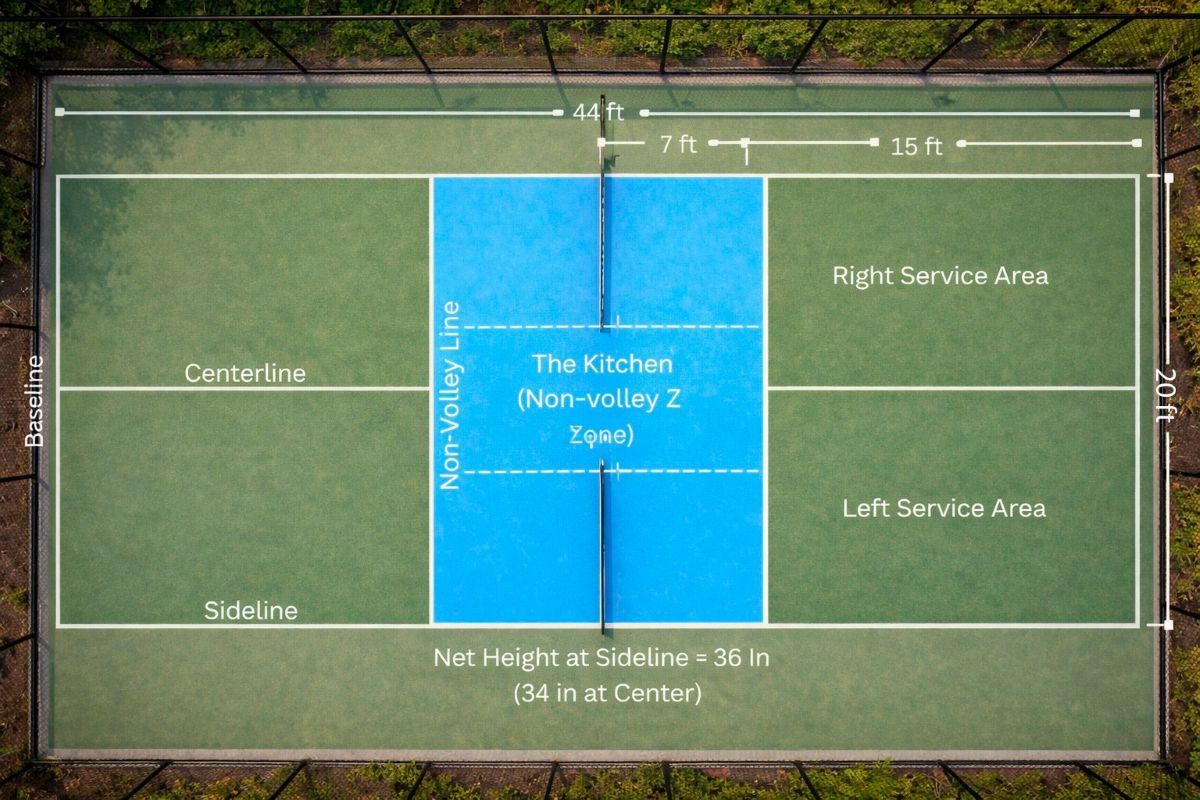
The court is a 44-by-20-foot rectangle split into two equal 22-foot halves by the net, with lines marking the kitchen, service courts, baselines, and sidelines.
Understanding how the full pickleball court is laid out helps players visualize spacing, positioning, and shot selection during live play. Every line and measurement serves a specific purpose in defining legal play and supporting consistent rule enforcement.
- Overall Court Size: A regulation pickleball court measures 44 feet long and 20 feet wide, creating a compact but strategically rich playing surface.
- Court Halves: The net divides the court into two equal halves. Each side extends 22 feet from the net to the baseline, ensuring symmetry and balanced play on both ends.
- Baselines: Baselines run parallel to the net at the back of each side of the court. These lines mark the deepest boundary for legal shots. Any ball landing beyond the baseline is ruled out.
- Sidelines: Sidelines run perpendicular to the net and define the left and right boundaries of the court. Precise sideline placement is essential for accurate line calls and fair point resolution during rallies.
- Centerline: The centerline extends from the non-volley zone line to the baseline on each side. Its primary function is to divide the left and right service courts, ensuring correct serve placement and proper player positioning at the start of each point.
Together, these measurements and markings create a balanced rectangular playing area that supports both controlled net exchanges and baseline shot-making, reinforcing consistency across recreational and competitive play.
The non-volley zone (kitchen) dimensions
The kitchen extends 7 feet from the net on each side, spanning the full 20-foot width of the court. Any contact with the kitchen line during a volley is a fault.
The non-volley zone, commonly known as the kitchen, is one of the most defining and strategically important areas of a pickleball court. Its dimensions are standardized and must be measured precisely to ensure fair and legal play.
- Kitchen Depth: The non-volley zone extends 7 feet from the net on each side, creating a total non-volley zone depth of 14 feet across the center of the court.
- Kitchen Width: The kitchen spans the full width of the court, measuring 20 feet from sideline to sideline, ensuring consistent spacing across all regulation courts.
- Non-Volley Zone Line: The line marking the back of the kitchen is considered part of the non-volley zone. Any contact with this line during a volley results in a fault, making precise line placement essential for correct rule enforcement.
Because non-volley zone violations are common at all levels of play, accurate kitchen dimensions help reduce disputes, improve officiating accuracy, and maintain consistent gameplay standards.
The kitchen directly shapes point construction. Players rely on soft shots, controlled dinks, and disciplined positioning near the kitchen line to force errors and create openings, rather than relying solely on power.
Courts with improperly sized kitchens can alter rally dynamics and encourage poor habits, particularly during instruction or competitive play.
For this reason, organized lessons and drills surfaced through platforms like Bounce often emphasize correct kitchen spacing, helping players develop reliable net play skills that transfer cleanly into real match conditions.
Pickleball net dimensions and placement
A regulation pickleball net stands 36 inches high at the sidelines and 34 inches at the center. It spans 22 feet in total length across the 20-foot-wide court.
The pickleball net plays a central role in shaping shot trajectory, rally length, and overall game flow. To preserve fairness and strategic balance, net height and placement must align precisely with official court dimensions.
- Net Height at the Sidelines: A regulation pickleball net measures 36 inches high at both sidelines, ensuring consistent clearance for shots played wide on the court.
- Net Height at the Center: The center of the net measures 34 inches high, creating a slight dip that encourages controlled shots, dinking exchanges, and patient net play.
- Net Length: The net spans 22 feet in total length, allowing it to extend fully across the 20-foot-wide court with adequate overhang on each side for secure anchoring.
- Net Alignment: Proper setup requires the center of the net to align precisely with the centerline of the court. This alignment ensures equal net height and consistent shot difficulty on both sides.
Nets that are too high or too low can significantly affect serving accuracy, third-shot execution, and volley exchanges. Consistent net setup is essential for maintaining fair play and supporting reliable skill development.
Correct net dimensions reinforce the strategic nature of pickleball, rewarding precision, touch, and controlled aggression rather than power alone.
Service court dimensions and layout
Each service court is 15 feet long and 10 feet wide. On every serve, the ball must land diagonally in the opponent's service court and clear the non-volley zone entirely.
Each side of the pickleball court is divided into two service courts: a left service court and a right service court. These areas define legal serve placement and proper player positioning at the start of each point.
- Service Court Boundaries: Service courts are formed by four lines: the centerline, baseline, sideline, and non-volley zone line, creating clearly defined serving targets.
- Service Court Size: Each service court measures 15 feet long, from the baseline to the non-volley zone line, and 10 feet wide, from the centerline to the sideline.
- Serve Placement Requirements: On every serve, the ball must land diagonally in the opponent’s correct service court and must clear the non-volley zone entirely. Accurate service court dimensions ensure consistent enforcement of serving rules.
Clearly marked service courts help players develop reliable serve accuracy, understand proper positioning, and avoid common faults related to foot placement and serve direction.
Visible, regulation service court markings are especially important in group play, leagues, and instructional settings, where players of varying experience levels rely on consistent boundaries to learn scoring, rotation, and serving order.
Proper service court layout reinforces fair play and supports skill development at every level of the game.
Spacing around the pickleball court (runoff areas)
The minimum recommended clearance is 5 feet behind each baseline and along each sideline. Competitive and instructional venues typically use 8 to 10 feet.
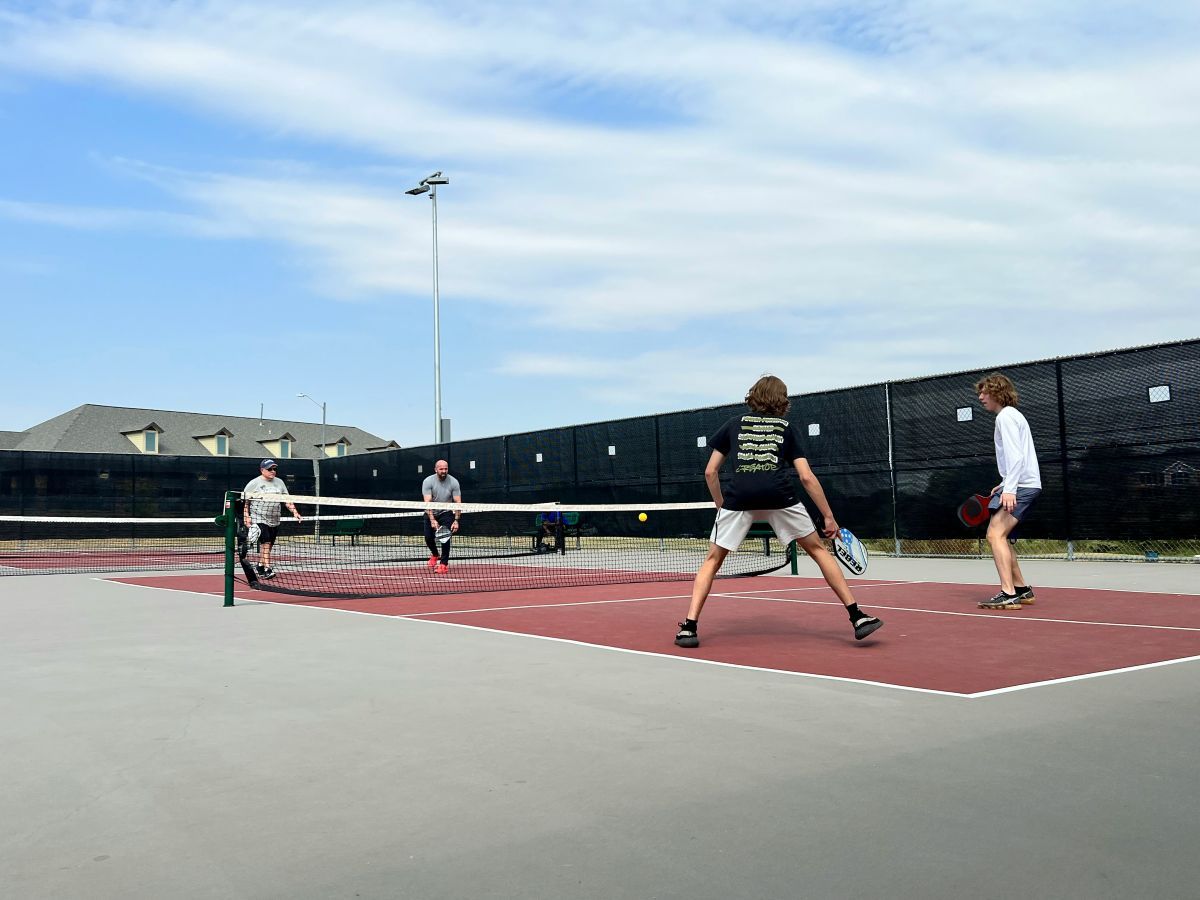
While the official court measures 44 by 20 feet, additional space around the court is strongly recommended for safety and effective movement.
A minimum of 5 feet of clearance behind each baseline and along each sideline allows players to move freely and retrieve shots without risking injury. Ideal playing environments often provide 8 to 10 feet of clearance, particularly in competitive or instructional settings.
Adequate runoff space supports lateral movement, defensive resets, and safe recovery after wide shots. Facilities that host clinics, leagues, and events typically prioritize these spacing guidelines to create better playing conditions and reduce disruptions during play.
Pickleball court dimensions vs. tennis and badminton
A pickleball court is significantly smaller than a tennis court, roughly one-third the size of a doubles tennis court. That size difference is why pickleball spread so quickly through existing tennis facilities: one doubles tennis court (78 by 36 feet) can accommodate two pickleball courts side by side.
| Dimension | Pickleball | Tennis (singles) | Tennis (doubles) | Badminton (doubles) |
| Length | 44 ft | 78 ft | 78 ft | 44 ft |
| Width | 20 ft | 27 ft | 36 ft | 20 ft |
| Total area | 880 sq ft | 2,106 sq ft | 2,808 sq ft | 880 sq ft |
| Net height (center) | 34 in | 36 in | 36 in | 61 in |
Sources: USA Pickleball, ITF (tennis), Badminton World Federation.
Badminton doubles courts share the same 44-by-20-foot footprint as pickleball, making court line conversion straightforward for facilities that already have badminton markings. The net height is the key difference: pickleball nets sit at 34 inches at center, while badminton nets are set at 61 inches. For more on how pickleball and tennis courts compare side by side, see pickleball vs tennis court.
Final Thoughts
Pickleball court dimensions are more than technical specifications. They directly influence how the game feels, how strategies develop, and how players progress over time. Courts that follow official size and layout standards promote fairness, consistency, and meaningful skill development.
From the precise depth of the non-volley zone to the exact height of the net, every measurement plays a role in shaping rallies and enforcing rules. Players who practice and compete on properly sized courts gain a clearer understanding of positioning, shot selection, and movement patterns that transfer across different venues.
Reliable improvement in pickleball starts with accurate courts and structured play. Bounce gives players a practical way to locate instruction, programs, and organized sessions that operate on regulation setups, so practice time mirrors real match conditions. Training and competing in correctly measured environments builds consistency, sharpens decision-making, and reduces the need to adjust when moving between courts or events.
Frequently asked questions
What are the dimensions of a pickleball court?
A regulation pickleball court is 44 feet long and 20 feet wide (880 square feet total). The net divides it into two equal 22-foot halves. A 7-foot non-volley zone runs on each side of the net, and each service court measures 15 feet long by 10 feet wide. All standards are set by USA Pickleball and apply to every level of play.
How much space do I need for a pickleball court?
The court itself is 44 by 20 feet. With the minimum recommended 5-foot clearance on all sides, plan for at least 54 by 30 feet of total space. Competitive and instructional facilities typically use 8 to 10 feet of clearance, putting the ideal footprint closer to 60 by 40 feet.
How high is the pickleball net?
A regulation pickleball net is 36 inches high at the sidelines and 34 inches at the center. The 2-inch dip at center is intentional: it encourages cross-court dinking and controlled net play rather than flat, power-driven exchanges.
Is pickleball court size the same as badminton?
Yes, for doubles badminton. A regulation doubles badminton court is 44 feet long and 20 feet wide which is the same footprint as a pickleball court. Net height differs: pickleball nets sit at 34 inches at center, while badminton nets are set at 61 inches. Singles badminton courts are narrower, at 17 feet wide.
Can you fit a pickleball court inside a tennis court?
Yes. A standard doubles tennis court (78 by 36 feet) can fit two pickleball courts side by side with space between them. Most recreational facilities tape or paint regulation pickleball lines directly onto existing tennis courts. The full breakdown of how the two sports compare on and off the court is in pickleball vs tennis court.
What is the cheapest way to make a pickleball court?
The most cost-effective option is converting an existing hard surface: a tennis court, basketball court, or concrete pad while using court tape or paint to mark the lines, plus a portable net system ($100 to $300). Permanent outdoor courts with resurfacing, fencing, and lighting typically run $15,000 to $40,000 depending on materials and location.