Planning a session or entering your first tournament starts with one practical question: how long is a pickleball game? Most games to 11 points take between 15 and 25 minutes.
A full best-of-three match typically runs between 30 and 75 minutes depending on the format and the players involved.
That range exists because game length depends on several real variables: the scoring format, your skill level, how you and your opponents play, and whether you are in singles or doubles.
A recreational game between beginners can end in 12 minutes. A competitive match between experienced players can stretch past an hour.
This guide gives you the numbers you need, explains what drives the variation, and helps you plan accurately for open play, league nights, and full tournament days.
Game vs. Match: Understanding the Difference
This distinction matters before looking at timing.
A game is a single set of play. It ends when one side reaches the target score, typically 11 points, with at least a two-point margin. A match is a series of games, usually best of three.
You need to win two games to win the match. In tournament play, some formats use one game to 15 or one game to 21, which changes the timing considerably.
When most players ask how long a pickleball game lasts, they often mean the full match. Both figures are covered below.
Pickleball Game to 11 Points: How Long Does It Take?
A standard pickleball game to 11 points takes between 15 and 25 minutes under normal recreational or club play conditions. That estimate applies to both singles and doubles at a moderate pace.
The 11-point format is the default for recreational games, league play, and most tournament matches. It moves fast enough to keep sessions active but gives both sides enough room for momentum swings and strategic adjustments.
The win-by-two rule means a game tied at 10 can extend, but in practice those extensions are usually brief.
Your skill level is the biggest variable inside that 15-25 minute window. More on that in the factors section below.
How Long Does a Pickleball Match Last?
A full best-of-three match typically lasts between 30 and 75 minutes. That accounts for time between games, side switches, and timeouts within each game.
According to USA Pickleball's official rules, each team is entitled to two one-minute timeouts per game when playing to 11 or 15 points, plus up to two minutes of rest between games.
Those structured breaks add up across a three-game match and push the total toward the higher end of the range.
Matches decided in two straight games usually finish under 45 minutes. Matches that go the distance to three tight games can approach 75 minutes or beyond.
Most facility operators and tournament directors block 60 to 90 minutes per match slot to accommodate the variation.
Average Pickleball Game and Match Times
| Format | Target Score | Estimated Time |
| Single game | 11 points (win by 2) | 15-25 minutes |
| Single game | 15 points (win by 2) | 25-40 minutes |
| Single game | 21 points (win by 2) | 40-60 minutes |
| Best of 3 match | 2 games to 11 | 30-75 minutes |
| Best of 3 match | 2 games to 15 | 50-90 minutes |
| Single match | 1 game to 21 | 40-60 minutes |
Pickleball Singles vs Doubles Game Length
Singles and doubles play at noticeably different speeds. If you have only played one format, the other will feel like a different game rhythm entirely.
Singles Game Length
Singles games move faster in terms of how points end. You cover the entire court alone, which means one well-placed shot frequently wins the rally. There is no partner to cover the open court, so attacking players can end points early and efficiently.
A singles game to 11 typically finishes in the lower part of the 15-25 minute window, often closer to 15 to 20 minutes.
Athletic and experienced singles players can produce extended baseline exchanges that push game time higher, but the general pace is quicker than doubles.
Doubles Game Length
Doubles games run slightly longer. Four players on a 20 by 44 foot court means less open space to attack.
Court coverage is better, rallies extend through more exchanges, and the soft game near the kitchen produces longer point constructions with multiple dinks and resets before a winner appears.
A doubles game to 11 typically lands in the 18 to 25 minute range. The coordination between partners, serve rotation, and the slower pace of kitchen-heavy exchanges all add time.
Understanding how pickleball scoring works in doubles helps you follow the flow of these exchanges and track the game accurately.
Singles vs Doubles: Estimated Game Length
| Format | Game to 11 | Best-of-3 Match | Key Factor |
| Singles | 15-20 min | 30-55 min | More decisive points, higher error rate |
| Doubles | 18-25 min | 40-75 min | Longer rallies, kitchen exchanges |
Factors That Affect Pickleball Game Duration
Several things push a game shorter or longer. Most of them come down to who is on the court and how they play.
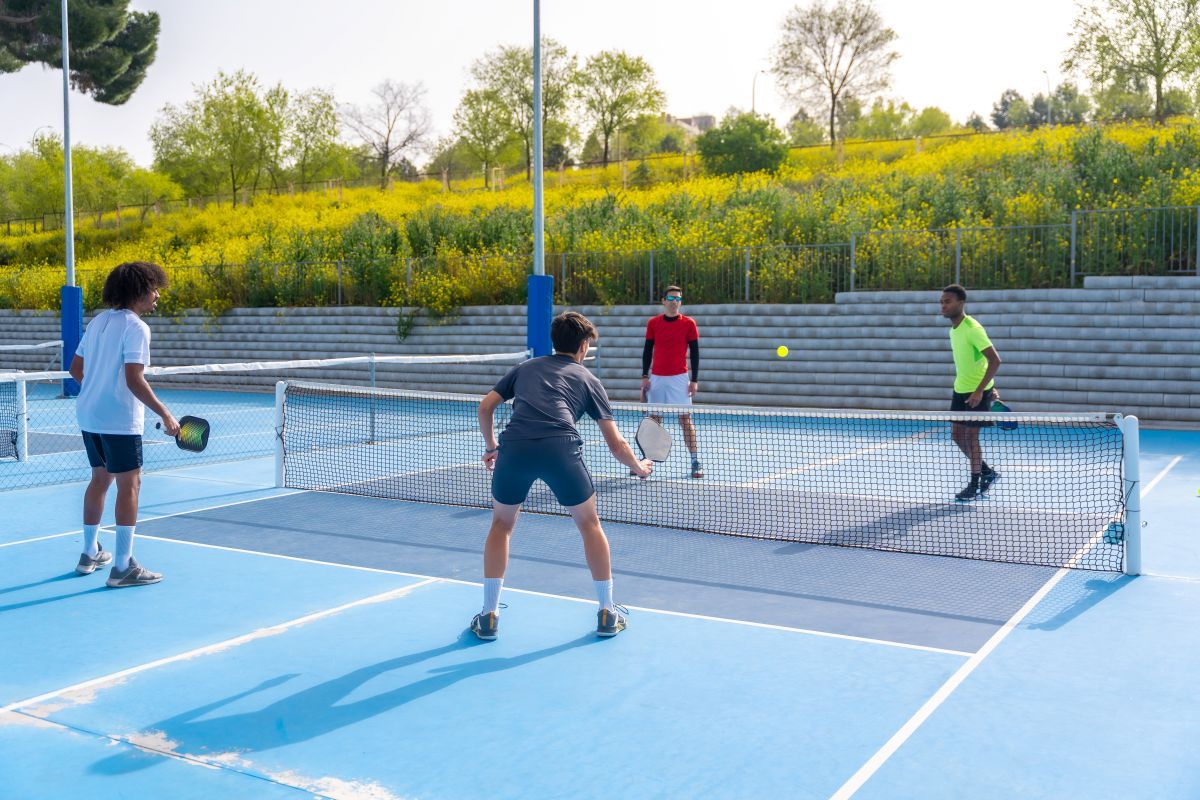
Skill Level
Your skill level shapes rally length more than anything else. Beginners make more unforced errors, so points end faster. But pauses to sort out scoring, serve rotation confusion, and mid-game rule questions offset the shorter rallies.
Research on racket sports published in PMC confirms that rally duration increases consistently with skill level, with beginner-level players averaging significantly shorter exchanges than competitive-level players.
The same pattern holds in pickleball. Intermediate and advanced players keep the ball in play longer, especially in soft-game kitchen exchanges, which adds meaningful time per point.
Playing Style
Aggressive players who drive the ball and attack early cut rally length. Patient players who reset, dink, and wait for a mistake create longer exchanges.
A match between two defensive players at the kitchen will consistently run longer than one between two attacking players trying to end points with power.
A study on rally length and playing patterns in racket sports found that court positioning and shot selection are the primary drivers of rally duration, with defensive play consistently producing longer points than attacking play.
That dynamic plays out directly in pickleball kitchen-heavy matches.
Scoring Format
This is the most direct variable. Games to 15 or 21 simply take more time because more points need to be played. Rally scoring formats, used in some recreational and league settings, also affect pace because every rally produces a point regardless of who served.
If you want to understand how rally scoring compares to traditional side-out scoring, the difference in game flow is worth knowing before you show up to a session using it.
Timeouts and Breaks
Each team gets two one-minute timeouts per game in standard play. In a close, competitive match, teams often use both. That adds up to four minutes per game in timeouts alone, plus side switches and the break between games.
These structured pauses are short individually but significant across a full match.
Score Closeness
The win-by-two rule means a game tied at 10 can extend. In practice, most tied games resolve within one or two extra exchanges. But in a competitive match, both sides can trade points at 10-10, 11-11, and beyond for several additional minutes before someone pulls ahead.
If you are looking for structured league play with consistent game formats and time slots, Bounce lists local leagues, clinics, and organized formats by city so you can find sessions that fit your schedule.
How Long Is a Pickleball Tournament?
Tournament scheduling follows a completely different timeline than a single recreational session. Going in without understanding the structure means a lot of waiting or showing up underprepared.
What the Format Looks Like
Most USA Pickleball sanctioned tournaments use a best-of-three games to 11 format in pool play, followed by a single or double elimination bracket. Every entrant is guaranteed at least two scheduled matches. Larger events guarantee three or more.
A typical pool play round at a mid-size tournament includes three to four matches per player or team before the bracket begins. With rest time, court transitions, and potential delays, most players are at the venue for six to eight hours on a full tournament day.
Day-by-Day Breakdown
Small local tournaments run in a single day. You arrive in the morning, complete pool play and bracket matches, and finish by late afternoon. Larger regional or national events span two or three days, with players competing in multiple events across different divisions.
Multi-day tournaments let you enter different events such as singles, doubles, and mixed doubles. Each event adds another full match schedule. If you enter three events, expect to be competing across the entire tournament window.
Time Between Matches
Most tournament schedules allow 15 to 30 minutes between matches. That window accounts for court transitions, warm-up, and rest. Delays are common when earlier matches run long.
Stay near your assigned courts and watch the schedule board so you do not miss your match call.
Typical Pickleball Tournament Time Breakdown
| Tournament Type | Matches Guaranteed | Total Time at Venue |
| Local one-day event | 2-3 matches | 4-6 hours |
| Regional tournament | 3-5 matches | 6-8 hours per day |
| Multi-day national event | 6-10+ matches | 2-3 full days |
| Pro-level event | Varies by bracket | 3-5 days |
How to Manage Your Time on Court
Understanding game length helps you plan your day. It also makes you a better playing partner at open play.
- Agree on the format before you start: Are you playing to 11 or 15? Best of three or one game? Clarifying this upfront prevents confusion midway through and helps everyone plan their time on court.
- Use timeouts strategically: Timeouts exist for a reason in competitive play. Taking one to break your opponent's momentum or reset your own focus is a legitimate tactical decision, not a delay.
- Keep the pace moving at open play: In drop-in sessions where courts rotate, slow play holds up the entire queue. Call your score clearly before each serve and move between points without extended pauses.
- Know the scoring format you are in: Rally scoring moves faster than side-out scoring because every rally ends in a point. If you are unfamiliar with the fundamentals, reviewing them before a session saves time for everyone.
If you are still building your foundational understanding of the game, the complete guide to getting started in pickleball covers the rules, scoring, and court etiquette that make session flow smoother from day one.
If you want to find a local coach who can help you play more efficiently, reduce unforced errors, and get more out of each session, Bounce connects you to certified pickleball coaches by city so you can book a lesson and focus on what matters most to your game.
Conclusion
Most pickleball games to 11 points take between 15 and 25 minutes. A full best-of-three match runs 30 to 75 minutes depending on the format, skill level, and how competitive the score stays.
Singles games finish slightly faster than doubles, and tournament days typically run six to eight hours from arrival to final match.
The more clearly you understand game length, the better you can plan your sessions, respect the time of others on court, and make smart decisions about which formats and events fit your schedule.
If you want to find courts, leagues, or coaches in your area, Bounce connects players to local racket sport opportunities by city so you can get on court more often and make the most of the time you have.
Frequently Asked Questions
How long is a pickleball game to 11?
A pickleball game to 11 points typically takes between 15 and 25 minutes. The exact time depends on skill level, playing style, and how close the score stays. A game tied at 10 that requires extra points to settle will push past the 25-minute mark.
How long does a pickleball match last?
A best-of-three match in pickleball usually lasts between 30 and 75 minutes. Matches decided in two straight games come in under 45 minutes.
Matches that go to three games, especially close ones, can approach 75 minutes or beyond when timeouts and breaks are included.
Is pickleball singles or doubles faster?
Singles games tend to finish slightly faster because one player covers the full court and points end more decisively. Doubles games run a few minutes longer on average because four players produce better court coverage and longer rallies, particularly in kitchen exchanges.
How long is a pickleball tournament day?
Most players spend six to eight hours at a full tournament day. That includes pool play matches, bracket play, rest time between matches, and court transitions. Smaller local events can wrap up in four to six hours. Multi-day national tournaments extend across two or three full days.
What is the longest a pickleball game can go?
There is no official time cap on a pickleball game. The win-by-two rule means a game tied at 10 can theoretically continue indefinitely. In practice, these extensions resolve quickly because one small run of points ends the deadlock.
Most tied games add only a few minutes before one side pulls ahead.
Does rally scoring make pickleball games faster?
Yes. Rally scoring awards a point on every rally regardless of who served, which reduces time spent on scoreless exchanges. Games under rally scoring formats tend to finish in a tighter window than traditional side-out scoring games.
Some recreational facilities and leagues use rally scoring specifically to keep court rotation moving.