

Pickleball participation continues to expand across parks, clubs, schools, and private facilities. In many cities, demand for court space has outpaced the construction of dedicated pickleball courts.
As a result, tennis courts have become the most practical and accessible solution for players who want consistent access to the game.
Understanding how to play pickleball on a tennis court allows beginners, tennis converts, and facility operators to create a functional setup without sacrificing rule integrity.
Can You Play Pickleball on a Tennis Court?
Yes, pickleball can be played on a tennis court with proper preparation. The primary differences between the two sports involve court dimensions and net height, not the surface itself.
Most tennis courts provide ample space to accommodate one or multiple pickleball layouts. The hardcourt surface commonly used for tennis is also suitable for pickleball, offering consistent bounce and durability.
Tennis courts measure 78 feet long and 36 feet wide for doubles, while a pickleball court measures 44 feet long and 20 feet wide. Here's a more in-depth guide on pickleball vs tennis court differences.
This size difference creates enough flexibility to stripe temporary lines within the existing footprint. Because the pickleball court is significantly smaller, it fits comfortably inside a tennis court without interfering with perimeter fencing.
Net height presents the most important adjustment. A tennis net stands 36 inches high at the center, whereas pickleball requires 34 inches at the center and 36 inches at the sidelines. Lowering a tennis net slightly or installing a portable pickleball net ensures compliance with official standards.
For recreational play, temporary solutions are often sufficient. For clubs and municipalities experiencing steady pickleball demand, permanent dual striping provides clarity and long-term usability. Both approaches support structured and casual play when executed correctly.
Tennis Court vs Pickleball Court: Key Differences
Understanding structural differences prevents confusion during setup and gameplay. While both sports share rectangular layouts and net-based scoring systems, their dimensions and strategic dynamics vary significantly.
| Feature | Tennis Court | Pickleball Court |
| Total Length | 78 ft | 44 ft |
| Total Width (Doubles) | 36 ft | 20 ft |
| Net Height (Center) | 36 in | 34 in |
| Non-Volley Zone | None | 7 ft on each side |
The most distinctive element of a pickleball court is the non-volley zone, commonly referred to as the kitchen. This 7-foot area on both sides of the net prohibits volleying and plays a critical role in strategic exchanges. Tennis does not have an equivalent space restriction, making accurate kitchen measurement essential.
Because the pickleball court is narrower and shorter, positioning becomes more compact. Players engage in faster reflex exchanges and rely heavily on soft control shots.
When playing on a tennis court, ensuring that pickleball boundaries are clearly marked prevents accidental use of tennis baselines or service boxes.
Surface material typically remains consistent between the two sports. Acrylic hardcourts provide predictable bounce patterns for pickleball. However, tennis courts often include extra run-off space, which can influence depth perception for players transitioning between sports.
How to Set Up Pickleball Lines on a Tennis Court
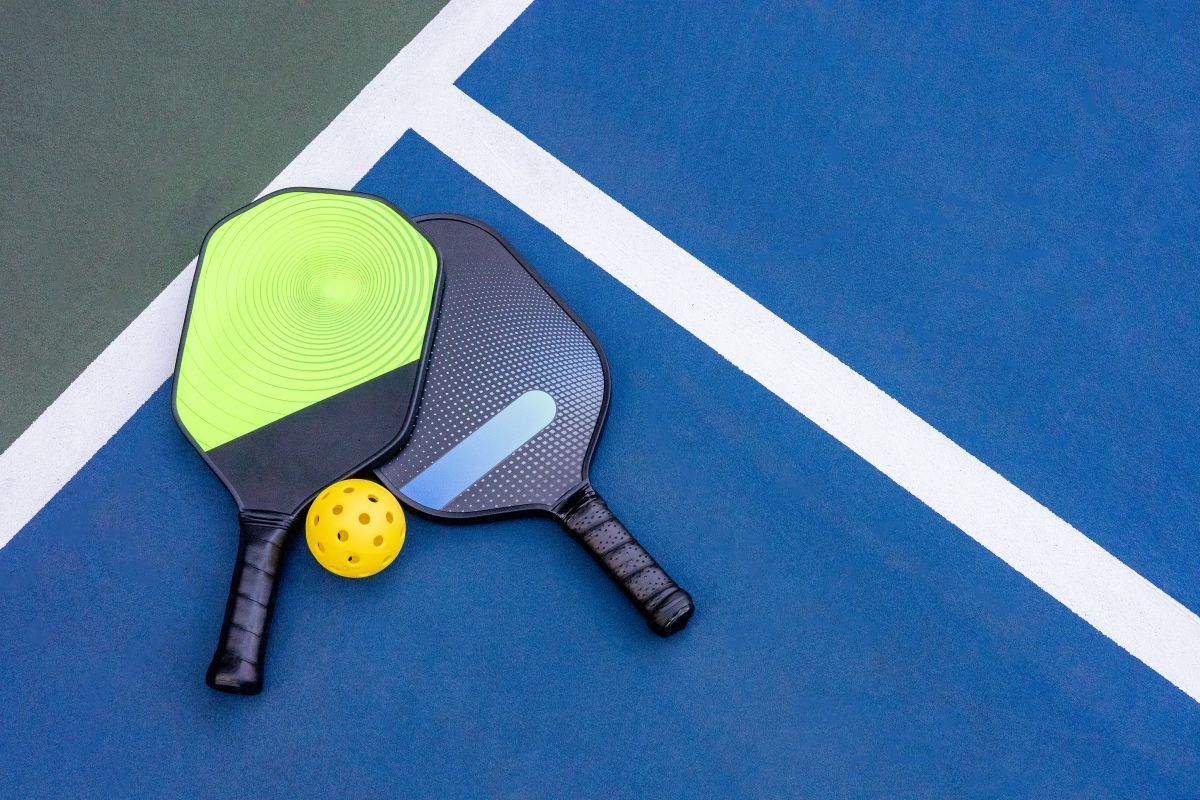
Creating a regulation pickleball layout inside a tennis court requires precision. A measuring tape, court tape, and clear planning ensure accuracy.
Temporary Court Tape
Temporary court tape offers a flexible solution for parks, schools, and recreational players.
The first step involves measuring a 44-foot length and 20-foot width within the tennis court boundaries. Mark the baselines and sidelines carefully to form a rectangular shape.
Next, measure 7 feet from the net on both sides to establish the non-volley zone. Add a centerline dividing the service boxes from baseline to kitchen. Each line should be straight and securely applied to avoid peeling during play.
Temporary tape works well for open play and clinics. It allows facilities to remove markings if tennis demand increases. Proper removal techniques prevent adhesive residue from damaging the surface.
Chalk or Portable Markers
Chalk provides a quick setup option for short-term play. While less durable than tape, it allows players to visualize boundaries without committing to semi-permanent lines. Chalk works best on dry surfaces and should be refreshed as needed.
Portable corner markers can also outline the court perimeter. These markers do not create continuous lines but give visual guidance for friendly games and practice sessions.
Permanent Dual-Lining
Facilities experiencing sustained pickleball participation often invest in permanent striping. Dual-line courts use contrasting colors to differentiate tennis and pickleball boundaries. For example, white lines may remain dedicated to tennis, while blue or green lines designate pickleball dimensions.
Permanent layouts allow for multiple pickleball courts per tennis court. This increases participation density and maximizes facility usage. Professional striping ensures accurate measurement and reduces disputes during competitive matches.
Step-by-Step: How to Play Pickleball on a Tennis Court
Once the court is properly marked, gameplay follows official pickleball rules. Execution and clarity are critical to preserving fairness.
1. Adjust or Install the Net
Lower the tennis net to 34 inches at the center. Use a measuring tape to confirm accuracy. Many tennis nets include adjustable center straps that can be tightened or loosened accordingly.
Portable pickleball nets provide a simpler alternative. These freestanding systems are built to regulation height and eliminate adjustment guesswork. Proper net tension ensures consistent ball rebound during volleys and dinks.
Net height influences serve trajectory, drop shots, and passing angles. Ensuring compliance maintains the integrity of practice and competition.
2. Confirm Court Boundaries
Double-check that the 44-foot by 20-foot rectangle is clearly defined. Verify that the centerline divides service courts accurately and that kitchen lines measure exactly 7 feet from the net.
Clear boundaries reduce interruptions and disagreements. Players should verbally confirm which lines are active before beginning play, especially if tennis lines remain visible.
3. Follow Official Gameplay Rules
Pickleball rules remain unchanged regardless of court origin. Key gameplay principles include:
- Underhand serves below the waist
- Diagonal service pattern
- The double-bounce rule (ball must bounce once on each side after serve)
- No volleying inside the kitchen
- Points scored by serving team in traditional scoring format
Both traditional side-out scoring and rally scoring formats can be used depending on league or social structure.
4. Adjust Positioning for Larger Surroundings
Tennis courts provide extended run-off space behind baselines. Players may need to recalibrate depth perception when hitting lobs or deep returns.
Extra space can benefit advanced players practicing defensive resets or overhead retrievals. However, beginners should remain mindful of fencing and adjacent courts to avoid collisions.
Tips for Beginners Learning on a Tennis Court
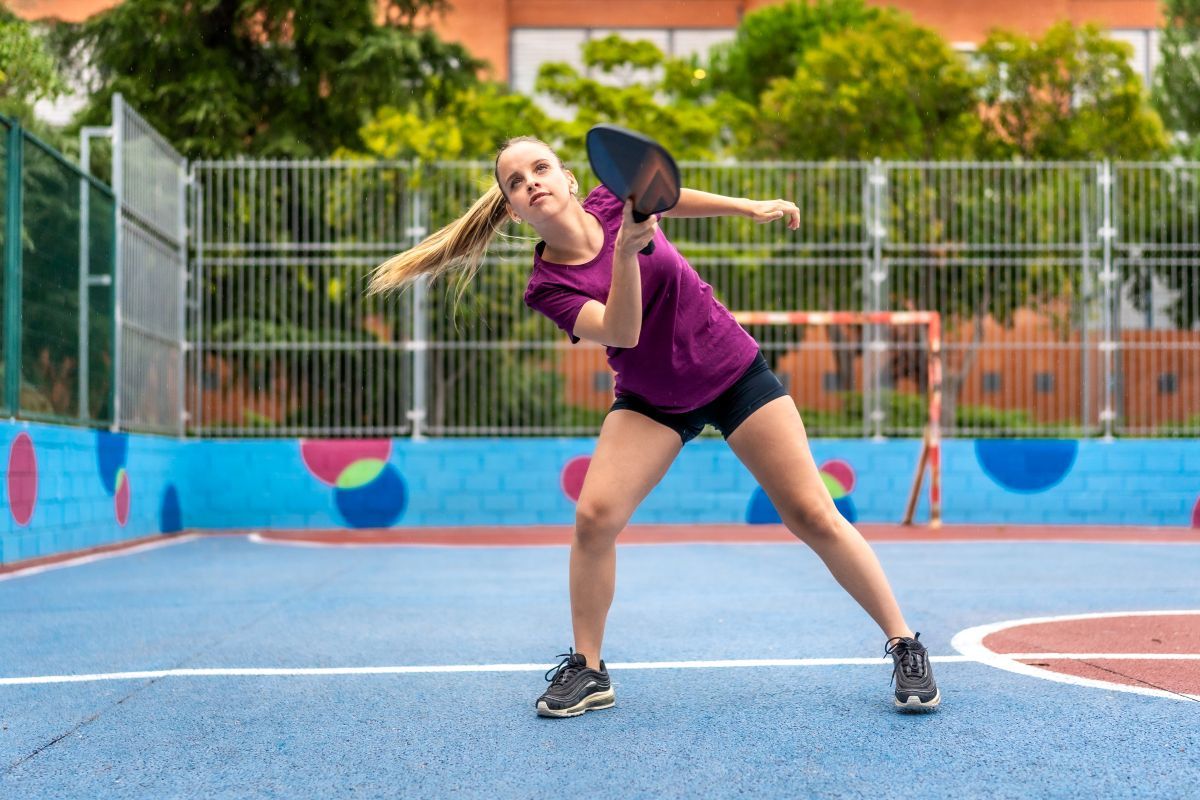
Starting on a converted tennis court provides easy access to the game, but improvement depends on discipline and intentional practice.
Because tennis courts offer more surrounding space and visible extra lines, beginners must focus on fundamentals and clarity.
- Emphasize control over power.: Pickleball rewards placement and consistency far more than raw speed. Especially near the kitchen line, soft touch shots reduce unforced errors and extend rallies. Developing feel on dinks and controlled drives builds confidence and match stability.
- Prioritize serving accuracy.: A dependable serve sets the tone for every point. Focus on depth and directional placement rather than velocity. Consistent serves limit easy returns and help establish rhythm early in games.
- Master the non-volley zone (kitchen).: Kitchen control determines tempo and strategic advantage. Practice dinks, resets, and patient exchanges close to the net. Comfort in this area forces opponents into low-percentage shots and increases point control.
- Improve footwork and positioning.: Because tennis courts have extra visible lines and extended run-off space, beginners can drift too deep or misjudge boundaries. Stay compact, move with balance, and reset positioning after each shot.
- Communicate clearly with partners.: Doubles requires coordination. Call shots decisively, establish forehand coverage before play, and maintain consistent spacing. Clear communication reduces confusion caused by overlapping tennis lines.
Consistent focus on these principles ensures that starting on a tennis court becomes a stepping stone toward long-term improvement rather than a limitation.
Conclusion
Playing pickleball on a tennis court is both practical and effective when executed with precision. Accurate measurements, correct net height, and clearly marked boundaries allow players to recreate a regulation experience without dedicated infrastructure.
This approach expands access, supports growth, and provides a reliable pathway for beginners entering the sport.
For players ready to move beyond informal games and into structured lessons, leagues, and recurring formats, Bounce connects everything locally in one place. Search your city, book a clinic, join a league, or find a certified coach through Bounce and turn occasional play into consistent progress.
If you want to play, learn, and connect through pickleball in your area, start with Bounce and build your game the right way.


