Running your first tournament is harder than it looks. Most organizers know the sport. They book the courts. Then format decisions, bracket logic, and registration gaps start compounding.
Knowing how to run a pickleball tournament well comes down to locking in your format, venue, and timeline at least six to eight weeks out. Those three decisions made early prevent the majority of problems that surface on the day.
Knowing how to organize a pickleball tournament also means thinking in layers: pre-event planning, player management, bracket structure, and day-of execution. This guide walks through each layer in order so nothing gets missed.
Step 1: Plan Your Event Six to Eight Weeks Out
Start with the three things that constrain everything else: date, venue, and scope.
Choose Your Venue and Confirm Court Availability
Court availability is your single biggest constraint on tournament size. Each court handles roughly four to six matches per hour in a timed format. Work backwards from your target player count to determine how many courts you need.
Courts must measure 20 feet wide by 44 feet long, with net height at 34 inches at center and 36 inches at the sidelines. Verify these dimensions before committing to a facility, particularly if the venue uses converted tennis courts.
Research on tournament design and scheduling fairness consistently identifies venue constraints as one of the primary factors that determine bracket structure and player satisfaction in organized competition.
Confirm restrooms, parking, and a space for check-in before booking. These feel minor until 40 players arrive at the same time with nowhere to go.
Set a Realistic Player Cap
A safe planning baseline: eight players per court for a three-hour event. Four courts and four hours gives you 32 to 40 players comfortably. Exceeding that compresses matches or delays your schedule.
Build a waitlist of 10 to 15 percent of your cap. Cancellations will happen. A waitlist keeps your bracket full without overcommitting the venue.
Define Your Divisions
Group players by skill level and age division from the start. Mismatched levels produce one-sided matches that frustrate both players.
The standard club structure uses the USA Pickleball self-assessment scale: 2.0 to 2.5 for beginners, 3.0 to 3.5 for intermediate, and 4.0 and above for advanced.
For smaller events under 20 players, combining adjacent skill levels into a single open division is more practical than forcing small brackets that cannot be filled.
Choosing the Right Pickleball Tournament Format
The pickleball tournament format you choose shapes everything else: how many matches each player gets, how long the event runs, and how competitive the experience feels.
There are three formats used at the vast majority of pickleball events. Each fits a specific situation.
Single Elimination
One loss and the player is done. It is the fastest format to run and requires the fewest total matches. A 16-player bracket produces 15 matches. With four courts and 12-minute caps, that runs under an hour.
The drawback: losing players may get only one match before they are out. That works in large competitive events but frustrates players who traveled for an afternoon of court time.
Double Elimination
Every player needs two losses before being eliminated. A loser's bracket runs in parallel to the winner's bracket, giving everyone at least two guaranteed matches.
The trade-off is complexity. Bracket management requires more attention, especially when the loser's bracket champion meets the winner's bracket champion in the final. If the winner loses that match, a second final may be required. Build that time into your schedule.
Round Robin
Every player or team competes against every other participant in their group. No one is eliminated. This is the most common format for recreational and social events because it maximizes court time for everyone and keeps players engaged through the final round.
| Format | Guaranteed Matches | Best For | Complexity |
| Single Elimination | 1+ | Large competitive events | Low |
| Double Elimination | 2+ | Competitive club events | Medium |
| Round Robin | Equal for all | Social and recreational | Low to medium |
How to Set Up a Pickleball Tournament Bracket
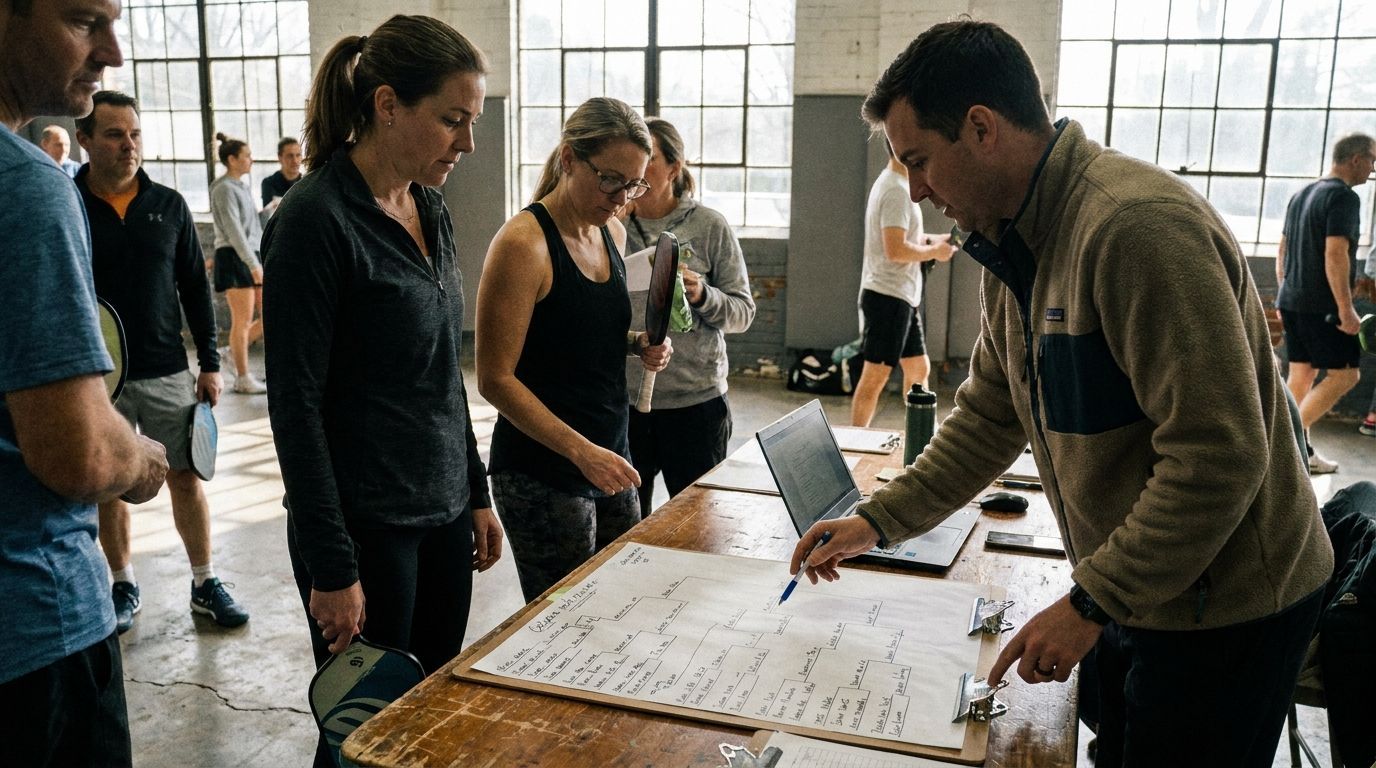
A clean pickleball tournament bracket means players always know who they play next, which court they are on, and when to be there.
Seeding Your Bracket
Seed players using verified rating data wherever possible. DUPR ratings reflect actual match results, not self-reported estimates, which reduces sandbagging and produces more balanced draws. VAIR, available at vairified.com, offers an additional performance-based rating option for clubs that want a supplemental verification tool.
For events where players lack DUPR ratings, use self-assessment and split seeds evenly across bracket quadrants. Top seeds should never share the same half of the draw. Seed 1 and Seed 2 belong on opposite sides so the best potential match happens in the final, not the semifinals.
The article on how DUPR rating brackets are structured is a useful reference if this is your first time using rating-based seeding.
Handling Byes
A bye is assigned when the player count does not produce a clean power of two: 8, 16, 32, 64. With 10 players in a bracket, the top two seeds receive byes and advance to the second round automatically.
Byes always go to the highest-seeded players. It is earned, not arbitrary. Mark byes clearly on the bracket printout so players understand why some first-round slots are empty.
Bracket Software
Managing a bracket by hand introduces errors as soon as you are tracking multiple divisions. Bracket software handles seeding, byes, court assignments, and score entry automatically.
Using bracket software also lets you print updated standings between rounds, which reduces questions at the director's table and keeps players engaged throughout the event.
Managing Players: Registration, Communication, and Divisions
Setting Up Pickleball Tournament Registration
Open pickleball tournament registration four to six weeks before the event. That window gives you time to finalize the bracket, identify gaps in divisions, and bring in waitlisted players if spots open.
Collect the following from every registrant at minimum:
- Full name and contact information
- Skill level or DUPR rating
- Division preference: singles, doubles, or mixed doubles
- Partner name for pre-registered doubles pairs
- Emergency contact for full-day events
Use early-bird pricing to reduce last-minute cancellations. A discounted entry fee for players who register three or more weeks out creates a financial incentive to commit. Players who register two days before the event cancel at a significantly higher rate. Early registration also gives you a reliable headcount before you finalize the bracket.
Communicating With Registered Players
Send three communications: a confirmation immediately after registration, a logistics email one week out with the schedule, court location, and what to bring, and a reminder the evening before with any final updates.
Include the bracket draw and format explanation in the week-out email. Players who arrive already informed ask fewer questions and start rounds on time.
Managing Withdrawals
Lock your bracket 48 hours before the event. Withdrawals after that point should be filled from the waitlist or treated as byes depending on timing. State your withdrawal and refund policy clearly at registration to prevent disputes close to game day.
Establishing Rules and Scoring Standards
Every player should know the format, scoring system, and dispute process before the first match. Ambiguity at the start compounds into conflict by the final round.
Match and Game Format
The standard competitive format per USA Pickleball's official rules is best two of three games to 11 points, win by two. For events with tighter schedules, one game to 11 with a 12-minute time cap is practical and widely used at the club level.
Rally scoring, where every rally produces a point regardless of who served, shortens games and increases throughput when you need to move a large group through multiple rounds.
Referee and Line Call Policy
Most recreational and club tournaments use player-managed line calls on each player's side of the court. The default rule when a call is disputed: replay the point. Set this expectation explicitly before round one so players are not waiting for a referee who will not arrive.
For competitive events with prize money or ranking implications, assign a referee or line judge per court. The consistency is worth the added coordination.
Dispute Resolution
Designate one person as the authority on disputes. Players should never spend five minutes arguing across a net. They call the director, the director decides, play resumes.
State this at the player meeting. Without it, disputes stall matches and collapse your schedule.
Pickleball Tournament Checklist: What to Prepare Before Game Day
Use this pickleball tournament checklist to verify everything before players arrive. Tag any printed or visual version of this list with the alt text 'pickleball tournament checklist day of event' for image SEO.
| 4 to 6 Weeks Before |
| ☐ Venue confirmed and court count verified |
| ☐ Player cap set and waitlist ready |
| ☐ Format decided: single elimination, double elimination, or round robin |
| ☐ Divisions defined by skill level and age group |
| ☐ Registration open with skill level and contact fields required |
| ☐ Early-bird pricing active with a clear deadline |
| 1 to 2 Weeks Before |
| ☐ Bracket finalized with seeding complete |
| ☐ Byes assigned to top seeds |
| ☐ Logistics email sent with schedule, court map, and format |
| ☐ Scoring system confirmed and communicated to all players |
| ☐ Bracket software configured and tested |
| ☐ Volunteer and referee assignments confirmed |
| ☐ Score sheets or digital scoring set up per court |
| Day of Event |
| ☐ Courts marked and net heights verified (34 in. center, 36 in. sidelines) |
| ☐ Bracket printouts posted at each court and check-in |
| ☐ Check-in table staffed 30 minutes before first round |
| ☐ Water station and basic first aid kit in place |
| ☐ Player meeting completed before round one begins |
| ☐ Dispute resolution process communicated to all players |
| ☐ Score collection system running between rounds |
| ☐ Backup plan ready for late cancellations |
Running the Event: Day-of Management
The Player Meeting
Cover everything essential in under five minutes. Format, scoring, dispute handling, schedule location, and round changeover timing. Anything else goes in your written pre-event communications.
Starting on Time
Start the meeting at the posted start time. Not five minutes after it. Every delayed round compounds. A three-minute slip per round adds over 20 minutes to a seven-round event.
If your venue has a hard end time, that pressure falls back on your final matches.
Tracking Scores and Standings
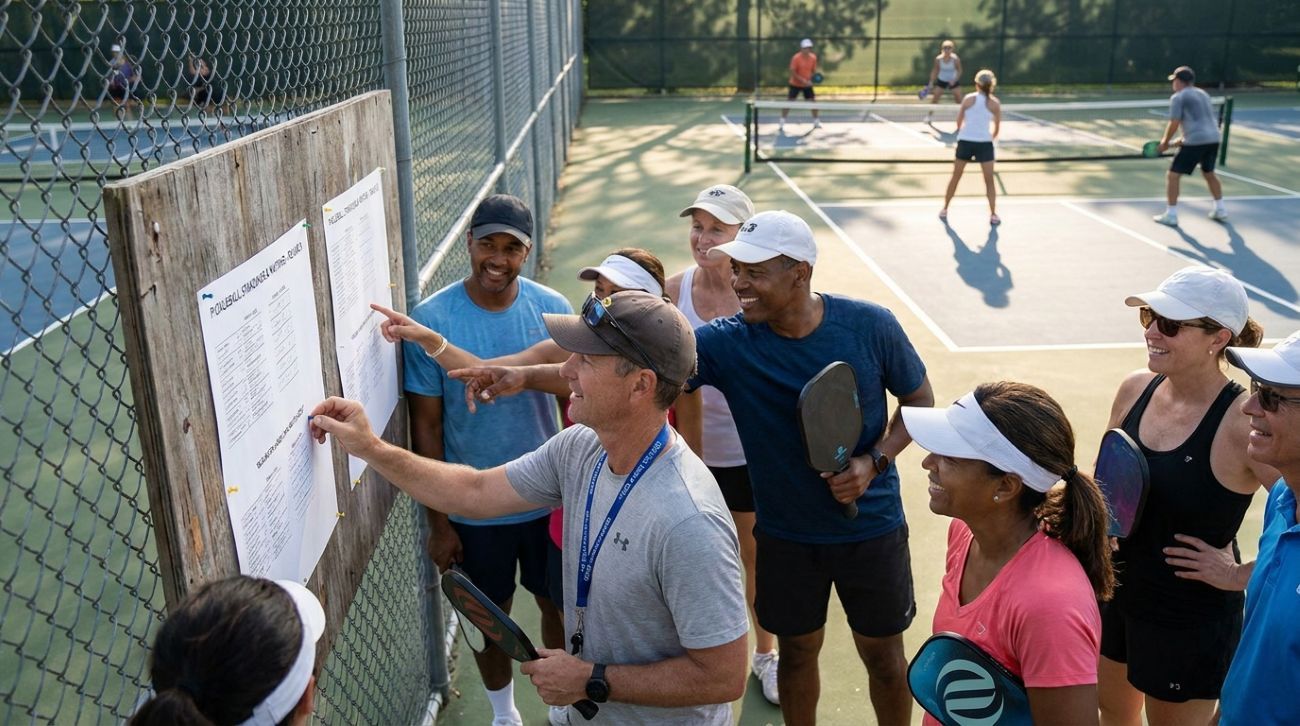
Collect score sheets at the end of every round before sending players to their next court assignment. Post updated standings between rounds. Players who see their position in real time stay more invested through the back half of the event, especially in formats where final standings determine placement.
Managing Courts and Timing
Use a visible timer at each court or a central horn to signal round changeovers. When players track their own time, matches drift long. A central signal removes that variable.
Keep one or two players available at the director's table throughout the event. If someone exits early or gets injured, you need a replacement ready without a long search.
Building Community Around Your Tournament
A well-run tournament builds long-term player retention more efficiently than almost any other club initiative. Players who have a good experience return for the next event, bring others, and engage more consistently year-round.
A national survey published in PubMed Central found that pickleball participants reported significantly lower perceived loneliness and reduced social isolation compared to non-players.
A structured tournament puts players in contact with more people in a single day than a month of open play typically does.
Small details improve the social experience without adding cost: post-event photos shared with participants, a brief awards moment for each division winner, and a one-question feedback form that tells you specifically what to fix next time.
For clubs that want to go beyond single events and build recurring programming, Bounce connects organizers with players actively looking for structured play in their city making it easier to list events, fill registrations, and grow a consistent competitive calendar.
Preparing Your Players for a Structured Event
Not every player in your tournament has competed in an organized format before. A short prep brief shared before the event saves you questions on the day.
Cover the format, scoring system, and what to bring. For players entering their first structured event, sharing what to expect at a competitive pickleball tournament gives them the physical and mental context they need before they show up.
Remind first-timers that the format protects them. In a round robin, no one exits after one bad game. In double elimination, everyone gets at least two matches. The structure is designed so a single bad result does not end their day.
For players planning to compete beyond your event, pointing them to how to prepare for competitive pickleball play covers what to practice, what gear to bring, and how to approach the mental side of structured competition.
A Note on Doubles Rules for Tournament Play
Most pickleball tournaments run doubles formats. Players who are unclear on serving rotation, three-number scoring, or kitchen rules create delays that slow your schedule.
In your pre-event communication, link players to a clear reference on official doubles rules and serving sequence so they arrive knowing the structure. Rule confusion is almost always a preparation problem, not an intelligent one. Give players the resource and most of it disappears.
Conclusion
Learning how to run a pickleball tournament well is mostly a sequencing problem. Format first, then bracket, then registration, then day-of execution. Each layer depends on the one before it.
Most tournament problems are planning problems that showed up too late. Lock in your format early, cap your player count honestly, and communicate your bracket and scoring structure to players before they arrive. That alone eliminates the majority of issues.
Start on time, collect scores between rounds, and post standings as they update. Do those things consistently and the event manages itself.
For clubs building consistent competitive programming beyond individual events, Bounce provides the platform to list tournaments, manage registrations, and reach players in your city who are actively searching for structured play.
FAQs
How far in advance should you plan a pickleball tournament?
Six to eight weeks minimum for a club or recreational event. Larger events with 60 or more players benefit from 10 to 12 weeks, particularly for venue coordination and bracket logistics.
What format works best for a first pickleball tournament?
Round robin is the most forgiving format for first-time organizers. It does not require a bracket, eliminates exit frustration for players, and adapts naturally to uneven group sizes.
How do you handle skill mismatches in a pickleball tournament?
Create separate divisions using DUPR ratings or self-assessment scores. For events too small to support multiple divisions, communicate clearly that the event is open-level so all players arrive with the right expectation.
Do you need a referee for a pickleball tournament?
Not for most recreational and club events. Player-managed line calls with a designated dispute director is the standard approach. For events with prize money or ranking points, assign referees per court.
What software should you use for a pickleball tournament bracket?
Several platforms integrate directly with DUPR for rating-based seeding. USA Pickleball maintains a list of sanctioned event management tools. The right choice depends on your event size and whether DUPR score reporting is required.
When should you open tournament registration?
Four to six weeks before the event. Earlier registration combined with early-bird pricing gives you more reliable headcount data and reduces last-minute cancellations.