Quick answer: You can enter the kitchen any time. You cannot volley while touching the kitchen or kitchen line. If your momentum carries you into the kitchen after a volley, it is a fault.
Step in, stay as long as you like, return any ball that has bounced. The moment you attempt to volley while your feet are in or touching the zone, that is a fault.
This rule trips up more players than almost any other in the game. The mental model most beginners carry, that the kitchen is hot lava and touching it costs you the point, is simply wrong.
Understanding what the rule actually says changes how you position yourself, how you move near the net, and how you call violations.
This guide covers the full non-volley zone rule set from the official definition through the most disputed element of the rule, the momentum clause, to advanced shots that use the kitchen boundaries as a tactical tool.
Pickleball Non-Volley Zone Explained
Before getting into the specific rules, you need a clear picture of exactly what the non-volley zone is and where it starts and stops.
The 7-Foot Zone
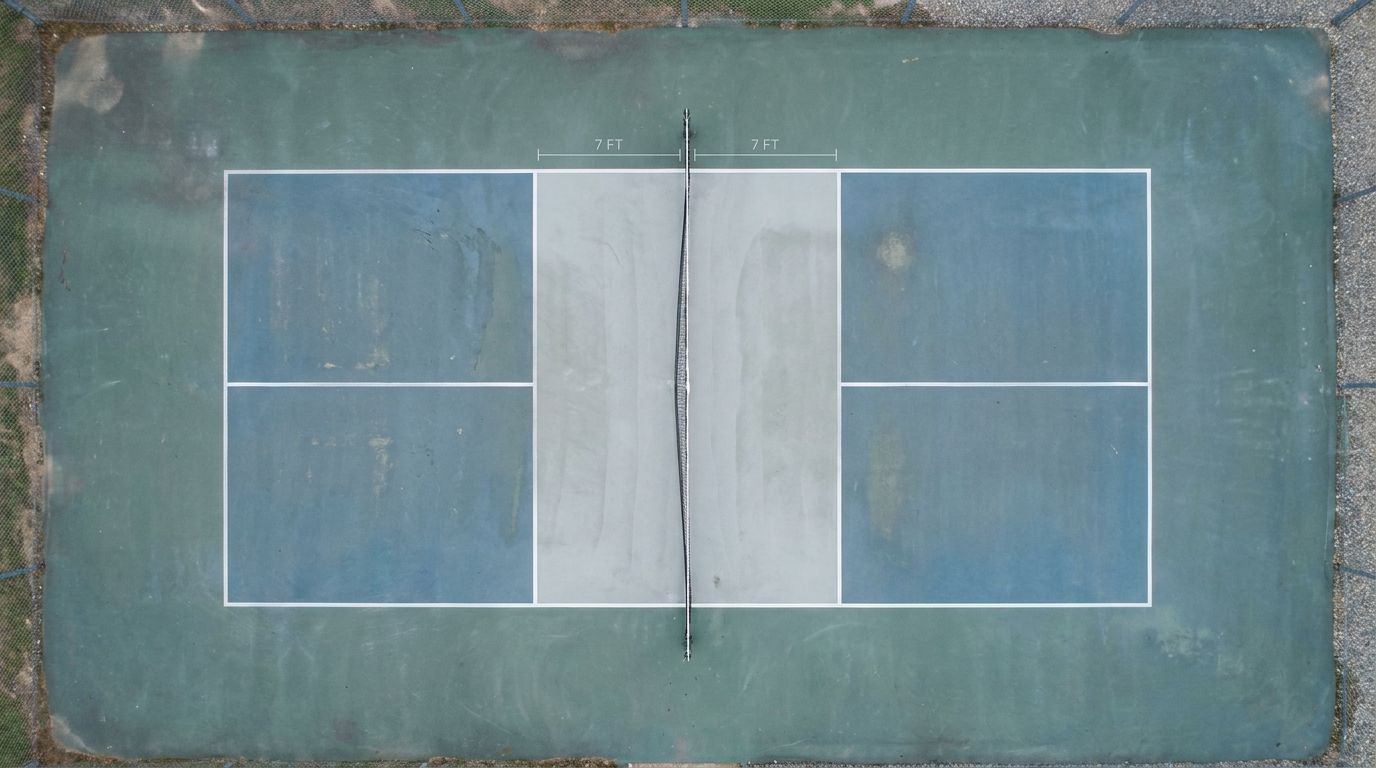
The non-volley zone extends 7 feet from the net on each side of the court, spanning the full 20-foot width from sideline to sideline. It is a rectangle, 7 feet by 20 feet, on each side.
The kitchen line is the back boundary of this zone. Anything between the kitchen line and the net, including the kitchen line itself, is part of the non-volley zone.
The Line Is Part of the Zone
This is where beginners most often get it wrong. The kitchen line counts as kitchen. If your foot touches the line during a volley, it is a fault. Not almost a fault. Not borderline. A clean fault. You need both feet fully behind the line before volleying again once you have stepped in.
Two-Dimensional, Not Three-Dimensional
The non-volley zone applies to the court surface only, not the airspace above it. You can swing your paddle through the air above the kitchen without a fault, as long as your feet stay outside the zone.
This matters for understanding shots like the Erne, where the paddle makes contact with the ball over or near the kitchen but the player's feet land outside the court boundary.
Non-Volley Zone: Key Facts
| Element | Detail |
| Depth from net | 7 feet on each side |
| Width | Full court width, 20 feet |
| Kitchen line | Included in the zone, not outside it |
| Airspace above kitchen | Not part of the zone |
| Surface below the net | Part of the zone |
Pickleball Kitchen Rules: The Four Things You Must Know
The full USA Pickleball rulebook covers the non-volley zone under Section 9. The four rules below cover everything you will encounter in actual play.
Rule 1: No Volleying in the Kitchen
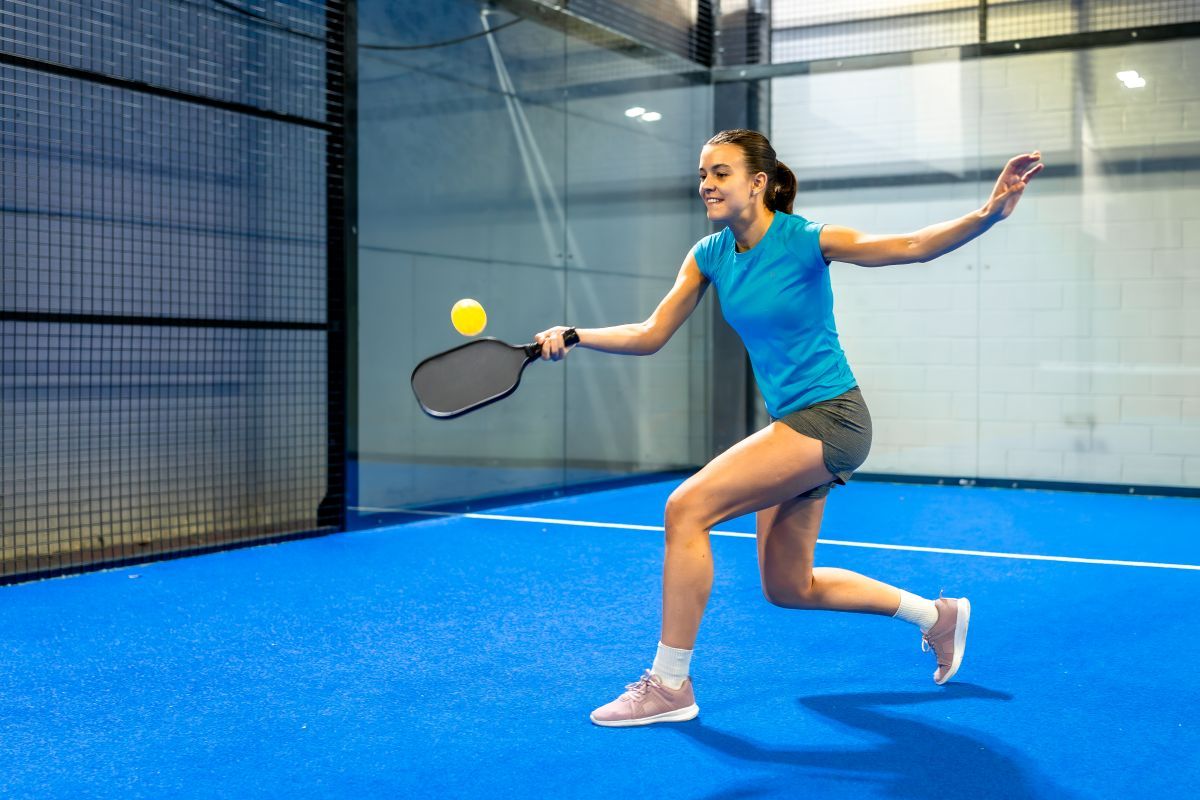
You cannot volley the ball while standing in or touching the kitchen. A volley is any ball struck before bouncing. This is the core rule. Everything else in the non-volley zone rule set builds from this one sentence. If the ball has bounced first, you can hit it from anywhere inside the kitchen. If it has not bounced, you cannot volley it from inside the kitchen.
Rule 2: Anything You Wear or Carry Counts
The kitchen fault does not only apply to your feet. If your paddle, clothing, hat, or anything you are wearing or carrying touches the kitchen during the act of volleying, it is a fault.
A paddle that scrapes the kitchen line during the follow-through is a fault. The rule covers your entire person and anything attached to it.
Rule 3: Your Partner Counts
In doubles, your partner is included in the fault. Your momentum can fault your partner if it causes them to enter the kitchen after your volley.
If you stretch wide for a ball and your follow-through pushes your partner forward onto the line, your team committed a fault. Communication and court spacing between partners directly affects how often this happens.
Rule 4: You Must Re-Establish Outside Before Volleying Again
Once you have entered the kitchen for any reason, both feet fully outside first before you can volley again. One foot out is not enough. Standing with your heel on the line is not enough.
Both feet, entirely behind the kitchen line, before the next volley. This rule catches players who step in to return a bounced ball and then immediately try to volley the next shot.
Kitchen Rules: What Is Legal and What Is a Fault
| Situation | Legal or Fault? |
| Stepping into kitchen to return a bounced ball | Legal |
| Standing in kitchen waiting for ball to bounce | Legal |
| Volleying while feet are in or on kitchen line | Fault |
| Paddle touches kitchen during a volley | Fault |
| Momentum carries you into kitchen after a volley | Fault |
| Volleying after one foot is back but the other is still in | Fault |
| Airspace above kitchen during a volley swing | Legal |
| Partner pushed into kitchen by your momentum after a volley | Fault |
Building clean kitchen habits early saves you from years of correcting deeply ingrained faults. Working with a coach who watches your footwork and positioning near the net is the fastest way to do that. Bounce connects you to certified pickleball coaches by city so you can get structured feedback without guessing at what you are doing wrong.
Can You Stand in the Kitchen in Pickleball?
Yes. You can stand in the kitchen in pickleball. The hot lava misconception is the single most common beginner misunderstanding about this rule. The kitchen does not punish presence.
It punishes volleying. You can walk in, stand there between points, crouch down to return a dink that has landed inside it, or reset your position from it. None of that is a fault.
When Stepping into the Kitchen Makes Sense
Stepping into the kitchen is not just legal. It is sometimes the right play. A dink that lands short and close to the net may be unreachable without stepping forward past the kitchen line.
Short balls demand forward movement. When you step in to return a bounced ball, do it with purpose, make clean contact, and then exit the zone before the next exchange develops.
The mistake players make is lingering. They step in, return the ball, and stay inside the kitchen while their opponent prepares the next shot. Now they are in a position where they cannot legally volley the next ball if it comes in the air.
Stepping in is fine. Staying in without awareness of what is coming next is the problem.
The Strategic Downside of Being in the Kitchen
When you are in the kitchen, your opponent knows you cannot volley the next ball if it comes to you in the air. Skilled opponents will exploit that. They will speed up the next ball intentionally, knowing it must bounce before you can return it.
That time delay, small as it is, shifts the exchange in their favor. Get in, do what you need to do, get out.
Pickleball Momentum Rule Kitchen: The Most Misunderstood Fault
The momentum rule is where most kitchen disputes happen in recreational play. Players understand the basic volley restriction. They do not always understand that the fault continues after contact.
What the Rule Says
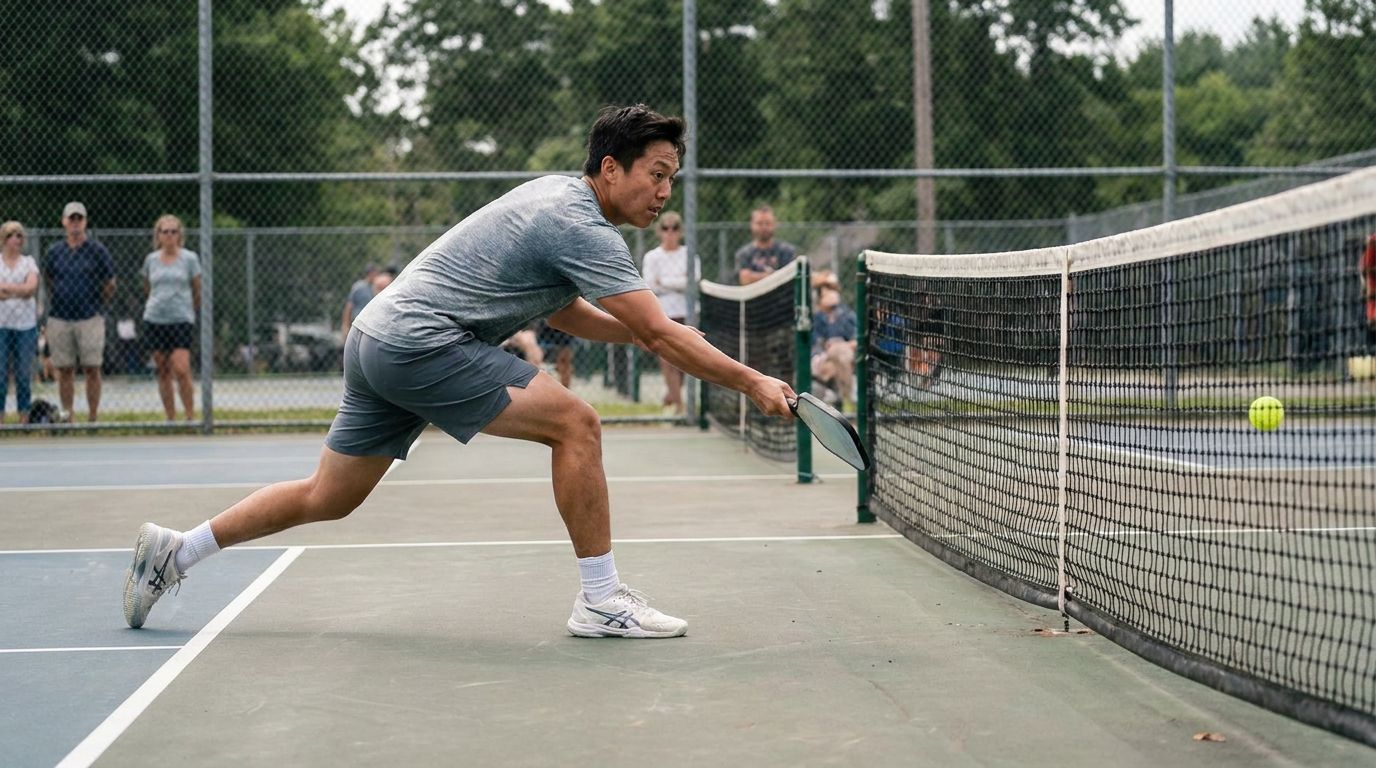
Rule 9.C of the USA Pickleball rulebook states that if your momentum after volleying causes you to contact the kitchen or the kitchen line, it is a fault. The ball being dead does not matter.
You can volley cleanly, win the point, watch the ball bounce twice, and then step into the kitchen as part of your follow-through. That is still a fault. The ruling applies regardless of what happened to the ball after you struck it.
The PPA Tour's explanation of pickleball kitchen rules and the momentum clause makes this clear: even if you execute a legally clean volley outside the kitchen, any forward movement that carries you into the zone directly after is a fault.
The volley mechanics and the post-volley movement are judged separately.
Where It Happens Most
Aggressive volleys are the primary cause. You step back from the line to create room, take a swinging volley at a high ball, follow through, and your momentum carries you forward one step onto the line.
The harder your swing, the more momentum you generate, and the more you have to actively decelerate to stay behind the line.
It also happens on speed-ups at the kitchen. You are in a dink rally and you attack a high ball with a fast punch volley.
The compact swing generates less follow-through than a full swing, which is actually why speed-up volleys at the kitchen are lower risk for momentum faults than wide, full swings taken from further back.
How to Avoid It
The fix is deceleration awareness. After any aggressive volley, bend your knees and sit into your feet as the paddle finishes its path. The bending motion absorbs your forward momentum and plants you behind the line.
Players who stand upright through their volley have nothing to stop the forward drift. A lower, wider athletic stance solves most momentum fault situations without requiring you to consciously think about stopping every time you volley.
Calling the Momentum Fault in Recreational Play
This fault is the most likely to cause disputes because it happens fast and the sequence of events matters. The ball lands, play stops, and then someone notices the player stepped into the kitchen. The fault stands even if called late.
In recreational play, be honest about your own momentum and give opponents the benefit of the doubt when they call it on you. The momentum rule exists specifically to prevent aggressive net rushing from dominating the game.
If kitchen faults are costing you points in competitive play, the complete breakdown of pickleball dink strategy and kitchen positioning covers how to develop controlled net positioning that reduces fault exposure while building a stronger soft game.
Advanced Kitchen Shots: The Erne and Beyond
Once you understand what the non-volley zone allows and restricts, a set of advanced shots become available that use the kitchen boundaries to create angles and pressure that normal court positioning cannot produce.
The Erne Shot
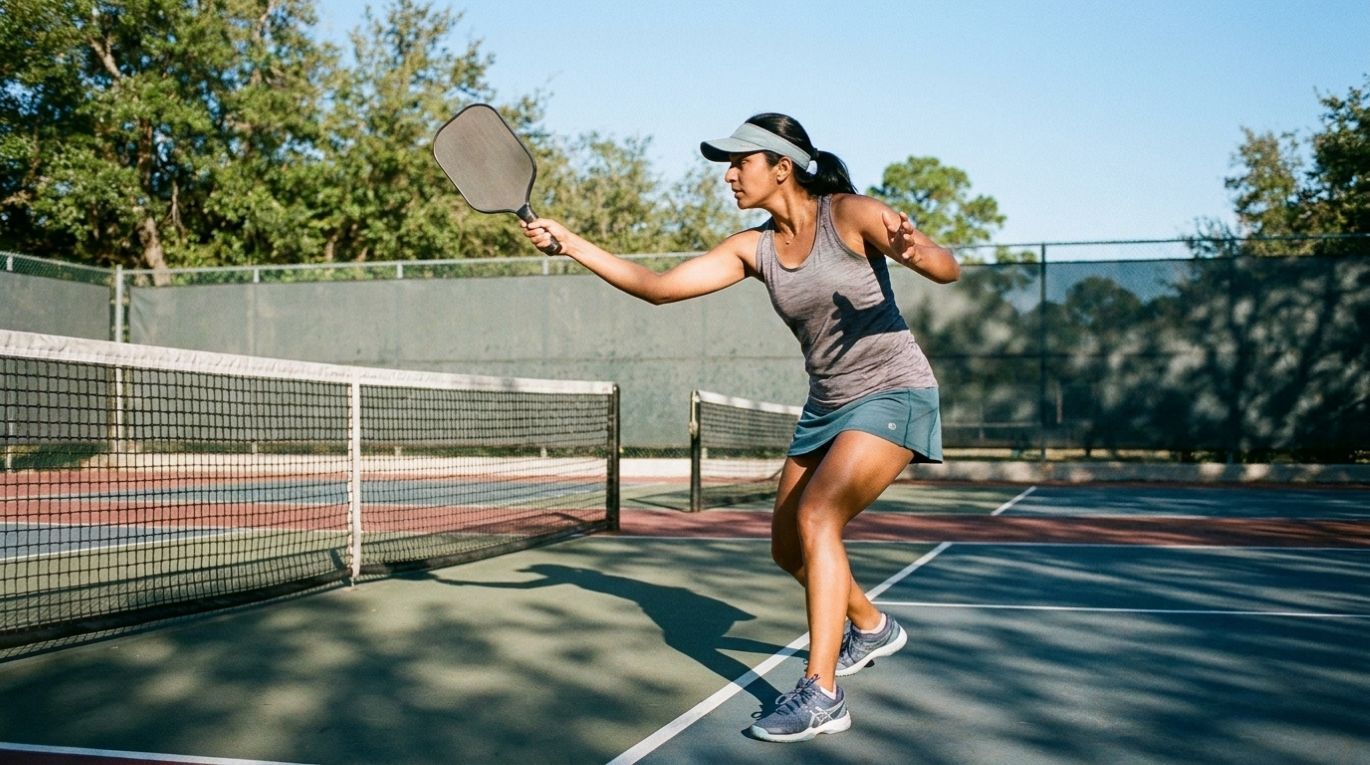
The Erne is an advanced volley executed by stepping outside the court boundary near the sideline and striking the ball in the air. The shot bypasses the kitchen entirely because you are not inside the zone when you make contact.
Your feet land outside the court, not in the kitchen. The result is an aggressive, close-range volley that comes from an unexpected angle and gives your opponent almost no reaction time.
To execute it legally, your feet must be completely outside the court boundaries, not just outside the kitchen, when you make contact. You can get there by jumping over the kitchen corner, running around it along the outside of the sideline, or stepping through the kitchen and re-establishing both feet outside before swinging.
Any of these approaches is legal. The critical requirement is that your feet not be in or touching the kitchen at the moment of contact.
When to Use the Erne
The Erne works when your opponent is hitting predictable cross-court dinks. Wide cross-court dinks are the trigger. As you read the dink coming toward the sideline, you can begin moving laterally and set up the shot.
The narrower and more predictable the cross-court angle, the more confidently you can commit to the Erne position. If your opponent reads your movement and adjusts down the line, the Erne leaves you out of position and your partner exposed. Use it selectively.
The Around-the-Post Shot
The around-the-post, or ATP, is a shot hit outside the net post so the ball travels around it rather than over it. Like the Erne, it is legal because the player hits the ball outside the court boundaries.
The ball does not cross the net, it goes around it. The kitchen is irrelevant to this shot because contact happens well outside the sideline.
ATP opportunities arise when a ball is hit wide and bounces outside the sideline. You follow it, let it bounce, and strike it back around the post at a sharp angle. It is a reactionary, not a planned shot.
You cannot set up an ATP the way you set up an Erne. It requires reading a very specific ball trajectory and having the footwork to get there.
Mastering Kitchen Positioning for These Shots
Both the Erne and ATP are higher-percentage shots at the 4.0 level and above. Before investing time in either, make sure your fundamentals at the kitchen line are solid.
Consistent dinking, clean volley mechanics, and proper foot positioning under pressure are what create the opportunities these shots exploit. A shot guide covering the full spectrum of pickleball shots and when each one fits into rally construction is the right companion piece for building toward these advanced techniques.
Frequently Asked Questions
When can you enter the kitchen in pickleball?
Any time. You can enter the kitchen before, during, or between rallies without a fault. The restriction is on volleying, not on presence. You cannot volley the ball while your feet are in or touching the kitchen.
You can return any ball that has bounced from inside the kitchen.
Can you stand in the kitchen in pickleball?
Yes. Standing in the kitchen is completely legal. The kitchen rule only activates when you attempt to volley while inside the zone. Many players unnecessarily avoid the kitchen entirely and miss short balls as a result.
Step in when the ball requires it, return it, and then exit the zone before the next shot arrives in the air.
What is the momentum rule in pickleball?
The momentum rule states that if your forward movement after a volley carries you into the kitchen or onto the kitchen line, it is a fault, even if the ball is already dead. You can volley cleanly from behind the line and then take one step forward as part of your follow-through.
If that step lands in the kitchen, the rally is yours to lose. The rule is called regardless of what happened to the ball.
Does the kitchen line count as the kitchen?
Yes. The kitchen line is part of the non-volley zone. Touching it with any part of your foot while volleying is a fault, the same as stepping fully into the kitchen. You need both feet completely behind the line to legally volley. Standing with a toe on the line is not behind the line.
Can you swing your paddle over the kitchen?
Yes. The non-volley zone applies to the court surface only, not the airspace above it. Your paddle can cross the plane above the kitchen during a volley as long as your feet are outside the zone.
This is the legal basis for shots like the Erne, where the paddle makes contact with the ball over or near the kitchen corner while the player's feet are outside the court boundary.
What is the Erne in pickleball?
The Erne is an advanced volley where you position yourself outside the court boundary near the sideline to strike the ball before it bounces. Because your feet land outside the court, you are not in the kitchen when you make contact.
The shot produces an aggressive, close-range volley from an unexpected angle. It requires clean footwork to execute legally and is most effective against predictable cross-court dinks.
What happens if your partner gets pushed into the kitchen?
If your momentum after a volley causes you to push your partner into the kitchen or onto the kitchen line, it is a fault against your team. The momentum rule explicitly covers partner contact.
Both players need to be aware of their spacing during aggressive volleys to prevent this from happening, particularly when one player stretches wide for a ball near the sideline.
Conclusion
You can enter the kitchen any time in pickleball. The rule restricts volleying, not presence. Step in when a short ball requires it, return it cleanly, and exit before the next exchange develops in the air.
Know that the kitchen line is part of the zone, that your entire person and clothing count, that your partner counts, and that momentum after your volley is still subject to the fault rule.
The momentum clause is where most disputes happen and where deliberate deceleration practice pays off most clearly. The advanced shots, the Erne and ATP, reward players who understand the rule's boundaries well enough to use them tactically.
A nationwide study on pickleball injury patterns and player habits found that players who underestimate the rules complexity of pickleball commit more position-based errors, including kitchen faults, than those who invest in deliberate rule study.
Knowing the rule completely changes how you move near the net. To put that into practice with structured coaching and local play, Bounce connects you to courts, coaches, and organized sessions in your city.