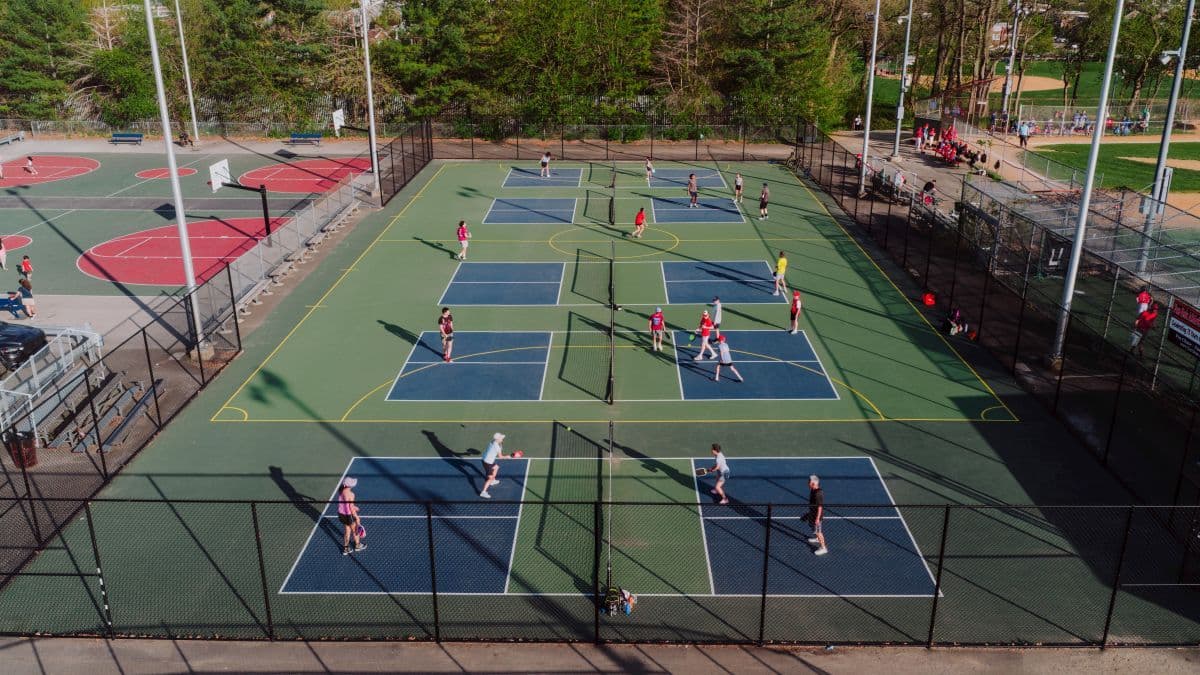
Organizing a round robin pickleball tournament is one of the most practical decisions a club or event coordinator can make. This format gives every player consistent court time, encourages social mixing, and keeps competition fair from the first round to the last.
Most players who show up to a round robin stay until the end. That is not always true with single-elimination formats, where half the field exits early. Knowing how to run a pickleball tournament successfully comes down to three things: format, scheduling, and day-of management. Get those right and everything else falls into place.
This guide walks you through every step, from choosing the right pickleball round robin format to posting final scores.
What Is a Round Robin in Pickleball?
A round robin is a tournament structure where every player or team competes against all other participants in their group. No one gets eliminated after a single loss. Everyone plays the same number of games, and the player with the best record at the end wins.
This format works across all skill levels and group sizes. It rewards consistent performance rather than one lucky bracket run, which makes results feel more earned. For club events, social mixers, and league nights, it is the most widely used structure in recreational pickleball.
Research published in Frontiers in Psychology found that pickleball participation is linked to improved life satisfaction, reduced depression, and stronger social integration, particularly among adults over 50.
The round robin format amplifies those benefits because it actively requires players to rotate and connect with new opponents each round.
What Pickleball Round Robin Format Should You Use?
Choosing the right pickleball round robin format depends on your group size, available courts, and how much social mixing you want to build into the event. Here are the four formats used most often.
Traditional Partner Round Robin
In this format, players are paired into fixed doubles teams for the entire event. Each team plays every other team in their pool. This is the cleanest structure for competitive events where standings matter. It works well when participants have pre-registered as pairs.
Rotating Partner Format (Popcorn)
Partners rotate every game so players team up with different people throughout the event. This is the most popular format for social and recreational play. Because you are constantly switching sides, individual performance matters more than any single partnership.
It reduces the impact of skill gaps between pairs and keeps the energy high throughout the session.
Up and Down the River
After each round, winning pairs move up to a higher-numbered court and losing pairs move down. Players split from their partner before advancing. The goal is to reach and hold the top court by the end of the session.
This format works well when time is limited and you want a clear champion without running a full bracket.
Gauntlet Format
One team stays on a court and challenges the incoming team. Winners stay and play again. Losers rotate out and wait for the next opening. This works well for large groups with limited courts but produces more downtime per player compared to a full rotating format.
If you are running a structured event for the first time, the rotating partner format offers the best balance of organization and player satisfaction. For larger groups, Up and Down the River manages court flow more efficiently once you exceed 16 players.
How to Build Your Round Robin Schedule
A clean pickleball round robin schedule is the backbone of a smooth event. Before you can build one, you need three numbers: total players, available courts, and total time.
Calculate Your Rounds and Game Time
A standard game in recreational play runs 10 to 12 minutes when capped with a time limit, or 15 to 20 minutes when played to 11 points with no clock. Use the cap for larger groups to keep things moving.
Here is a baseline calculation for planning purposes:
- 8 players, 2 courts: 7 rounds, approximately 90 minutes
- 12 players, 3 courts: 5 to 6 rounds, approximately 90 to 120 minutes
- 16 players, 4 courts: 5 rounds, approximately 90 minutes with 12-minute caps
- 24 players, 4 courts: consider splitting into two pools of 12
Use a Free Scheduling Tool
Building a schedule by hand works for groups under 10 but becomes error-prone quickly. A bracket generator removes that problem. Enter your player count and court availability, and it produces a complete rotation with court assignments. Most tools let you export a printable PDF or CSV to share with players before the event.
These tools also handle odd player numbers, late additions, and tiebreaker tracking automatically. Using one saves time and reduces the chance of scheduling conflicts or repeat matchups in the same round.
Rotation Chart Example (8 Players, 2 Courts)
Below is a sample rotation showing how an 8-player round robin runs across 2 courts. Players are numbered 1 through 8.
| Round | Court 1 Team A | Court 1 Team B | Court 2 Team A | Court 2 Team B |
| 1 | 1 & 2 | 3 & 4 | 5 & 6 | 7 & 8 |
| 2 | 1 & 3 | 5 & 7 | 2 & 4 | 6 & 8 |
| 3 | 1 & 4 | 6 & 7 | 2 & 3 | 5 & 8 |
| 4 | 1 & 5 | 2 & 6 | 3 & 7 | 4 & 8 |
| 5 | 1 & 6 | 4 & 7 | 2 & 5 | 3 & 8 |
| 6 | 1 & 7 | 3 & 5 | 2 & 8 | 4 & 6 |
| 7 | 1 & 8 | 2 & 7 | 3 & 6 | 4 & 5 |
In this pickleball round robin rotation, every player partners with and competes against every other player exactly once across seven rounds.
Pickleball Round Robin Scoring: Which System Works Best?
There are two primary approaches to pickleball round robin scoring, and choosing the right one affects how competitive the event feels and how straightforward it is to manage on the day.
Total Points Accumulated
Every point scored in every game counts toward a player's total. If a match ends 11 to 7, the winner banks 11 points and the loser banks 7. At the end of the event, the player with the highest cumulative total wins.
This system rewards consistent offensive play and makes every point in every game meaningful, even when one side is clearly ahead. It also provides a natural tiebreaker because point totals rarely end up identical.
Win-Loss Record
Players earn 2 points for a win, 1 point for a loss, and 0 for a forfeit. Final standings are based on total match points earned. This system is simpler to track on paper and easier to explain to players new to the format.
The drawback is that close matches and blowouts count the same. Two players who both go 5-2 on the day may have had very different levels of performance, and a win-loss record will not show that.
Game Format and Scoring Options
According to USA Pickleball's sanctioned tournament guidelines, the recommended scoring option for round robin brackets is best two of three games to 11 points, win by two.
For time-constrained recreational events, one game to 11 with rally scoring is a practical alternative that keeps rounds under 12 minutes.
Understanding the difference between traditional side-out and rally scoring matters when you set your format. The breakdown of pickleball scoring systems explains how each approach changes the pace and rhythm of games, which is a useful context when communicating the format to players before the event.
If you are running a rated event and want results to feed into the DUPR system, use official game formats and follow DUPR's score reporting process.
VAIR, is another rating verification platform worth knowing if your club wants an alternative or supplemental tool for tracking player performance.
How to Group Players by Skill Level
Skill-balanced pools produce better games and keep players engaged throughout. Mismatched levels create lopsided matches that frustrate both sides, regardless of how well the rest of the event is run.
The most reliable approach is to use existing ratings or self-assessments. Ask players to submit their skill level during registration using the USA Pickleball self-assessment scale (2.0 through 5.0+). Players with DUPR ratings can use those directly, since DUPR reflects verified match results rather than self-reported estimates.
A deeper look at how pickleball ratings work and what they measure is worth sharing with players who are unfamiliar with the rating scale before registration opens.
Once you have skill data, create separate pools or divisions by level. A common structure for a club event runs three groups: beginner (2.0 to 2.5), intermediate (3.0 to 3.5), and advanced (4.0+). If numbers are uneven, it is better to add a player to the next level up than to leave a pool short.
A national survey published in PubMed Central found that older adults who played pickleball reported significantly less perceived loneliness and social isolation compared to non-players. Well-matched, rotating round robins are a direct mechanism for that social benefit because players meet more people in a single session than they would in standard open play.
For clubs that want to simplify organizing skill-based events and building consistent programming, Bounce connects players and organizers in one place, making it easier to run recurring formats that match players to the right competitive level in their city.
Pre-Event Setup and Registration
A well-run event starts before players arrive. These steps reduce confusion and delays on the day.
Confirm Your Player Count Early
Round robins require an exact or near-exact player count to generate a clean schedule. Late cancellations break rotation balance and force last-minute adjustments. Build a waitlist of two to four players so you can fill gaps if someone drops out.Send a reminder the night before.
Confirm start time, parking, court location, and what players need to bring. A significant share of no-shows happen simply because a player forgot.
Prepare the Schedule in Advance
Generate your full rotation before the event. Print enough copies for each court plus a few extras. Post a large, visible copy at a central location so players can check their next assignment between rounds without asking the organizer.
Pre-assign court numbers to each round. Players should never have to ask where they are going next. Clarity in the schedule removes a major source of delays.
Set Up Score Sheets at Each Court
Place a score sheet and pen at each court before play begins. Designate one player per match to record the final score and submit it at the end of each round. Do not rely on verbal reporting or memory.
Day-of Management: Running the Event Smoothly
Start on Time
A late start creates a cascading delay through every round. If you said 10:00 AM, begin the player meeting at 10:00 AM. This sets the expectation for punctuality that carries through the entire event.
Run a Brief Player Meeting Before Round One
Cover the following in under five minutes:
- The format you are using and how partners rotate
- The scoring system and how ties will be resolved
- Where the schedule is posted and how to submit scores
- Round time limits and when the next round begins
- Any safety or facility rules specific to the venue
Keep it brief. Players are there to play, not attend a meeting.
Track Scores Between Rounds
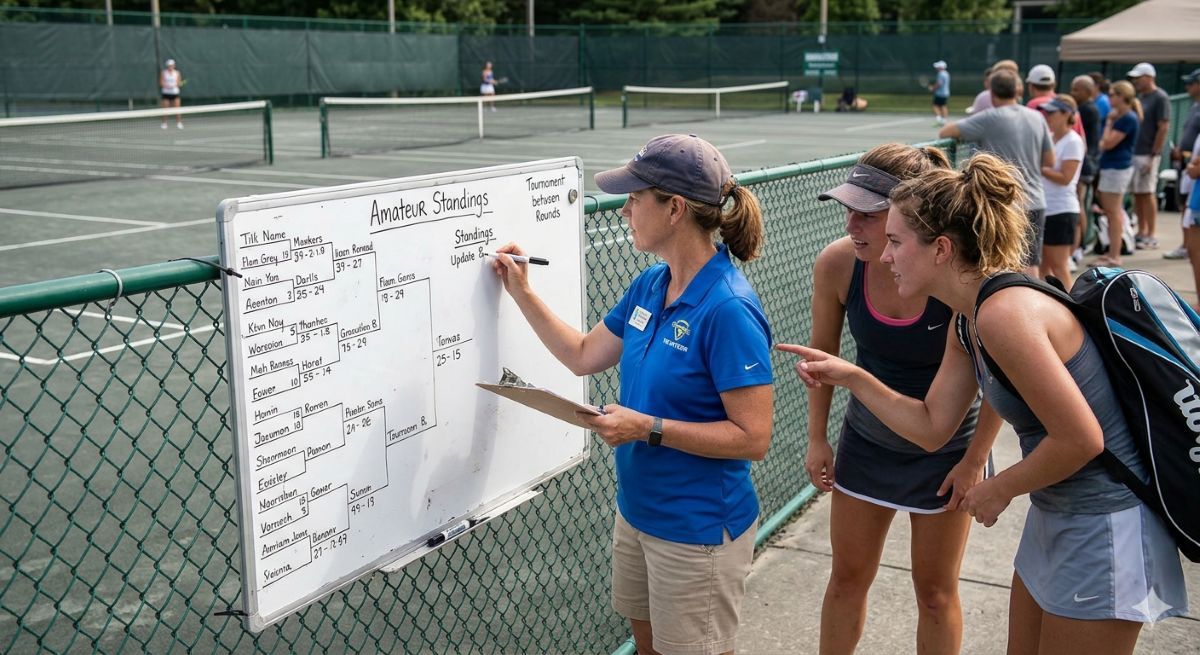
Collect score sheets at the end of each round, update standings, and post results before the next round starts. Players engage more consistently when they can see where they stand.
It also motivates competitive effort in later rounds rather than players disengaging once they believe the outcome is settled.
Handle Tiebreakers Clearly
Define your tiebreaker rules before the event and communicate them at the player meeting. Common options are head-to-head result, point differential, and a tiebreaker game if still tied.
Ambiguity at the end of an event is avoidable when the rules are set in advance.
Plan for Player Absences
If a player leaves mid-event, their remaining matches should be recorded as forfeit wins for their opponents. Adjust the rotation where possible and bring in a waitlist player if one is available. Document your policy in advance so there are no disputes.
Tips for Making the Event More Social
The round robin format is inherently social, but small details amplify that quality.
- Play background music at a volume that adds energy without drowning out conversation
- Provide water and light snacks at a central station between rounds
- Take photos during the event and share them with participants afterward
- Announce final results with a brief recognition moment, not just a posted score
- Ask for one line of feedback at the end to improve the next event
For clubs building recurring programming around events like this, Bounce allows organizers to list and manage regular sessions, reach new players in their city, and handle registrations without needing separate software for every event.
Clubs can also surface their events to players who are actively searching for play opportunities nearby.
Preparing Players Who Are New to Tournament Play
Not every participant in your round robin will have competed in a structured format before. It helps to set expectations before the event rather than managing confusion on the day.
Share the rules and rotation structure with registrants in advance. A short one-page overview sent 24 to 48 hours before the event reduces the number of questions at the player meeting.
For players who are new to tournament settings entirely, pointing them toward a guide to preparing for a first pickleball tournament gives them context on what to expect physically and mentally before they arrive.
Beginners often worry about holding up experienced players. Remind them that the rotating format is designed to balance skill exposure, and that every player was new to structured play at some point.
Common Mistakes to Avoid
- Starting without a confirmed player list. Unconfirmed players cause rotation gaps. Lock your list 24 hours before the event.
- Using no time limits with large groups. Without caps, a single slow game holds up every court. Set a 10 to 12-minute limit and enforce it.
- Mixing skill levels without structure. A 2.5 playing against a 4.5 gets nothing from the experience. Create pools or communicate clearly that the event is open-level.
- Posting standings only at the end. Updating between rounds keeps competitive engagement alive through the final round.
- Skipping the tiebreaker plan. Deciding how to break ties after they happen creates conflict. Set the rules before anyone arrives.
Conclusion
A well-organized round robin pickleball tournament does not require expensive software or event management experience. It requires a confirmed player list, a clean schedule, a clear scoring system, and someone who starts on time.
The format does most of the work for you. Every player gets court time, matches stay competitive, and the social structure builds itself through rotation. Your job is to remove friction, not add complexity.
Start with your player count, choose the right format, generate your schedule with a free tool, and communicate the rules before round one. Do those four things and the event runs itself.
For clubs that want to build consistent programming around leagues, clinics, and regular play, Bounce provides the tools to reach players in your city and run recurring formats without rebuilding the process each time.
FAQs
How many players do you need for a round robin pickleball event?
A round robin works best with 8 to 24 players. Fewer than 8 limits variety in matchups. More than 24 benefits from splitting into two pools rather than running one large group.
How long does a round robin pickleball tournament take?
A typical 8-player event with 4 to 5 rounds takes about 90 minutes. Larger events with 16 to 24 players and 5 to 6 rounds run 2 to 2.5 hours with 10 to 12-minute time-capped games.
What is the best scoring system for a recreational round robin?
Total points accumulated rewards every moment of play and produces cleaner tiebreaking. Win-loss is easier to explain and track on paper. For first-time organizers, win-loss is simpler. For repeat events, point totals produce more meaningful final standings.
Can you run a round robin with an odd number of players?
Yes. Bracket generators handle byes automatically. The player assigned a bye in a given round either sits out or is awarded average points for that round, depending on your system.
What format works best for a large pickleball round robin?
For 20 or more players, Up and Down the River or Gauntlet manages court flow more efficiently than a full rotation. Pool-based play, where you split players into groups of 8 to 10, also keeps games competitive and scheduling manageable.
Do round robins count toward DUPR ratings?
Yes, if the event is set up and submitted through the DUPR platform using their approved event tools. Round robins are one of the most common formats for generating rated match data in club settings. VAIR at vairified.com is another option for clubs looking to track player performance through a separate verification system.