If you have ever walked up to a public pickleball court and felt unsure about what to do next, you are not alone. Open play runs on an unwritten set of rules and customs that nobody hands you a manual for.
Show up without knowing how it works and you might wait around for a game that never comes, or accidentally jump ahead of someone who has been in line far longer than you.
Also called drop-in pickleball, this format requires no registration, no assigned partner, and no set match schedule. Players arrive, find a spot in the rotation, and play with whoever is next in line.
It is fast, social, and accessible, which is a large part of why pickleball has grown the way it has.
This guide covers what open play is, how it is structured at most facilities, how the paddle stacking and rotation systems work, what the on-court rules look like in practice, and the etiquette that keeps everything running smoothly.
What Is Open Play in Pickleball?
Open play is a drop-in format where any player can show up during a designated session and join games without a pre-arranged team or opponent. There is no bracket, no fixed partner, and usually no formal registration beyond checking in at the facility.
Players rotate on and off the courts based on a shared system that determines who plays next, how long each game runs, and how players cycle back into the queue.
Most parks, recreation centers, and pickleball clubs offer scheduled open play sessions on specific days and times. Some facilities organize sessions by skill level, separating beginners from intermediate and advanced players so that games are more evenly matched.
Others run mixed sessions where players self-select their courts based on ability.
Open play is the most accessible entry point into recreational pickleball, especially for players joining for the first time. It is less structured than a league and less intense than a tournament, making it a natural bridge between casual first exposure and building the foundational skills needed to play consistently in more organized formats.
Pickleball Paddle Stacking: How the Queue System Works
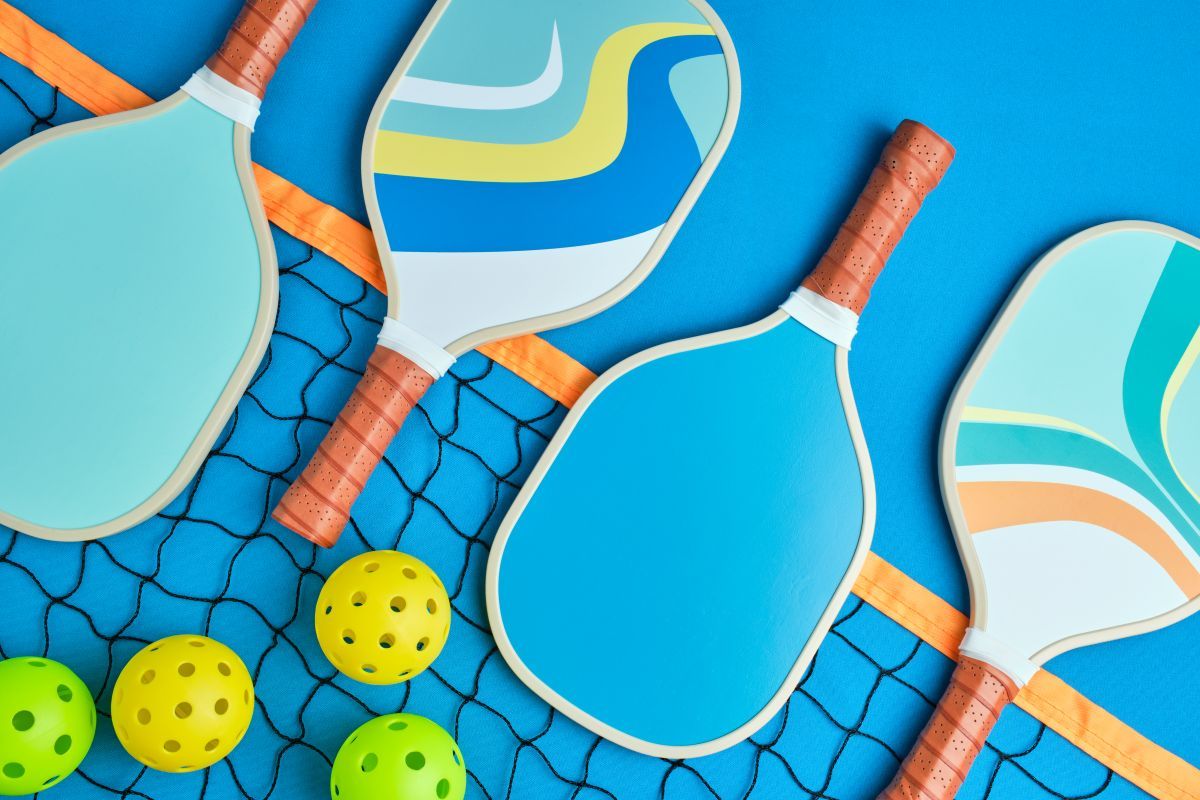
The single most important thing to understand before your first open play session is paddle stacking. It is the system that determines who plays next, and not knowing how it works is the most common reason new players wait far longer than they should.
It can also cause you to accidentally skip ahead of someone who has already earned their spot in line.
What paddle stacking is
Paddle stacking is a physical queuing system used to manage court rotation at open play sessions. When you arrive, you place your paddle in a designated holder, rack, or slot, and your position in that queue represents your place in line for the next available court. The first four paddles in line form the next group to play when a court opens up.
How it typically works in practice
Most facilities use one of two main approaches.
Winners stay, losers rotate: The winning team remains on the court and takes on the next two challengers from the front of the paddle queue. The losing team exits and places their paddles at the back of the line.
This approach rewards winning but keeps games moving because only two new players enter each time.
All players rotate off: All four players leave the court after each game, and the next four paddles in the queue form a new group regardless of the result.
This is more common at recreation centers and public parks because it gives everyone equal court time and prevents any single group from holding a court for extended periods.
Some facilities use a winners rack and losers rack system, where two racks alternate priority using a rotation marker. Whichever rack the marker sits on represents the group up next. This creates a balanced rotation that gives both the winning and losing team fair access to courts over a session.
Playing as a group
If you arrive with a partner or a full group and want to play together, most facilities allow you to place your paddles next to each other in the rack to signal that you are a unit. At facilities that use a four-player rotation, a group of four can place their paddles consecutively to play together.
The key is to follow the specific protocol of the facility, because rules on grouping vary and jumping the queue as a pre-formed group is one of the most common sources of friction at open play sessions.
Facility-specific variations
Paddle stacking protocol is not universal, and different facilities run their court rotation in different ways. The open play rules at Coppell, Texas public courts are a clear example of how a dual-rack system with rotation markers can be organized at a well-run facility. Taking two minutes to read the posted rules at any new venue is always worth it.
How Open Play Sessions Are Typically Organized
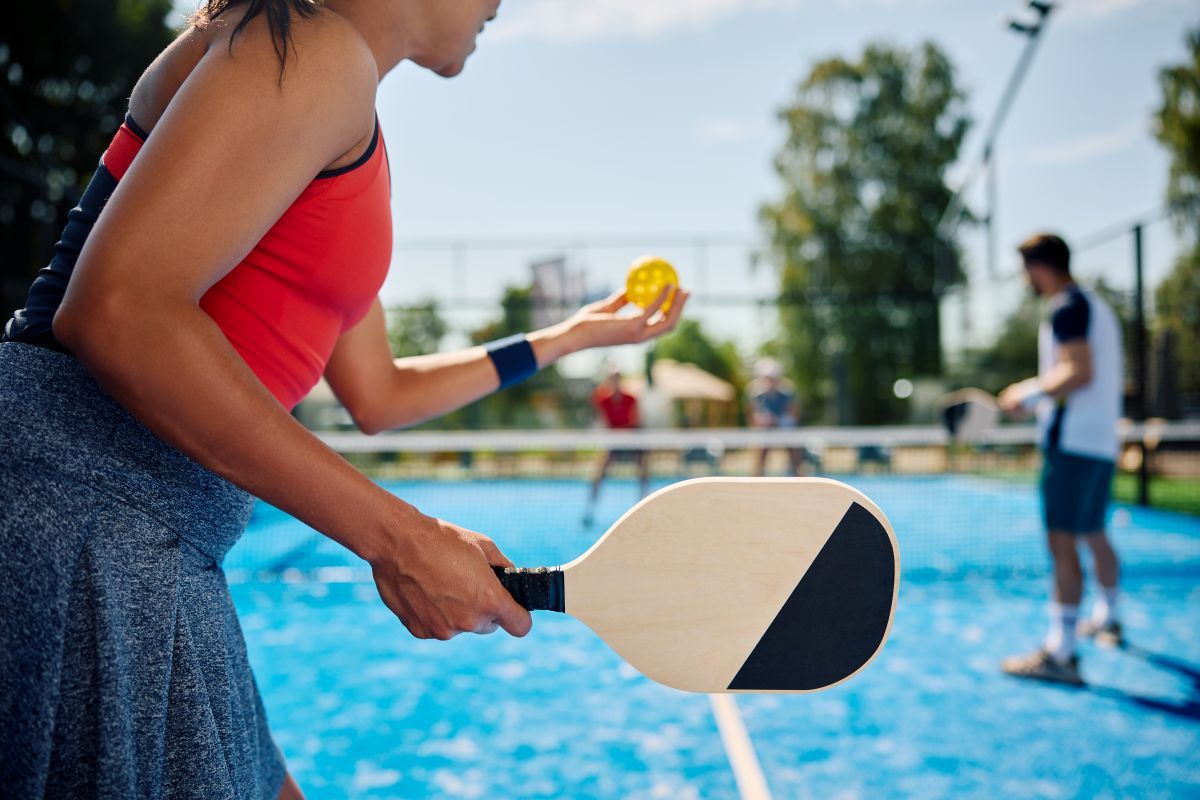
Beyond the paddle system, open play sessions have a broader organizational structure that affects how you fit in and which courts are appropriate for your level. Understanding this before you arrive makes the experience far less confusing.
Skill level divisions
Many facilities separate open play into beginner, intermediate, and advanced courts or time blocks.
These divisions are usually based on self-reported skill ratings, with the most common frameworks being the DUPR scale, VAIR (an AI-powered rating system that assesses skill through adaptive performance modeling), or the USA Pickleball skill levels ranging from 2.0 to 5.0+. Some facilities use simpler three-tier labels.
If you are new and attending for the first time, start on the beginner court regardless of your athletic background. Skill levels in pickleball are game-specific, and experience in other racket sports does not translate directly into pickleball proficiency.
It also helps to understand how pickleball scoring and game flow works before your first session so you can participate without slowing down the game or causing confusion.
Session time limits and player caps
Most open play sessions run for a fixed block of time, typically two to three hours. Some facilities cap the number of players per session to manage court availability and wait times, and registration may be required in advance. Within a session, individual games generally run to 11 points, win by 2.
Some facilities use rally scoring to keep games shorter and allow more players to cycle through during a busy session. If you are not familiar with either scoring format, clarify with the organizer or another player before play begins so you know what to expect when the score is called.
Who runs open play
At recreation centers and public parks, open play is typically self-organized by the players, with staff available nearby for questions or disputes. Some private clubs assign a designated staff member or session coordinator to manage the rotation and answer rules questions.
If you are unsure about anything, finding that person is always the quickest route to clarity.
Finding drop-in sessions in your area is one of the most common early challenges for new players. Bounce connects players with courts, organized open play sessions, and local clubs in their city, making it easier to find the right session at the right skill level without searching across multiple platforms.
On-Court Rules in Open Play
Open play follows the same official pickleball rules that apply in any competitive setting. The game format does not change because the context is recreational, and players who arrive unfamiliar with the rules are expected to learn quickly and play fairly.
Coming prepared avoids slowing down the game for everyone else.
Scoring and game length
Standard open play games are played to 11 points, win by 2. This is the near-universal default at public and club sessions, though some facilities use 15-point games when session time allows.
During peak demand periods, rally scoring is sometimes used to shorten games and keep court rotation moving.
Line calls
In open play, players call their own lines. The player on the same side as the line in question is responsible for making the call, and if the call is genuinely unclear, the convention is to call it in. The benefit of the doubt always goes to the opponent.
The double-bounce rule
One of the rules that trips up new players most often is the double-bounce rule. It requires the return of serve to bounce before it can be played, and the serving team's next shot to also bounce before volleying. After those two bounces, either team may volley freely.
Attempting to volley the return of serve is a fault and one of the most common mistakes at open play sessions.
Kitchen rules
The non-volley zone, commonly called the kitchen, extends 7 feet from the net on both sides. Players may not volley the ball while standing inside this zone, including on the lines.
Kitchen violations are among the most frequently disputed calls in recreational play, so understanding this rule clearly before your first session reduces friction significantly.
Stray balls and safety
If a ball from another court rolls onto your court during a rally, the rally stops and the point is replayed. When a ball from your court heads toward a neighboring court, call out loudly so the players there know to stop play.
This is standard safety protocol at any multi-court facility.
Pickleball Open Play Etiquette: What Every Player Should Know
Most of what makes open play work is unwritten convention rather than formal rule. Following it determines how welcome you feel and how smoothly the session runs for everyone.
The players who thrive at open play understand both the written and unwritten expectations from the start.
Respect the rotation
The paddle queue is the mechanism that makes open play fair for everyone present. Skipping the queue, holding a court beyond your game, or refusing to rotate off after a loss disrupts the experience for every other player in the session.
If there is a problem with how the rotation is being managed, bring it to the session coordinator rather than the other players.
Match your court level
Playing on a court above your skill level slows the game down, frustrates more experienced players, and often results in an unpleasant experience for the newer player as well.
Self-selecting the right skill level court is an act of respect toward every other player in the session. The right court also gives you the most useful playing experience for where you actually are in your development.
Do not offer unsolicited coaching
Open play is not a clinic, and players are there to play rather than receive instruction from strangers.
Offering coaching tips to another player without being asked is widely regarded as one of the more irritating behaviors in recreational pickleball, particularly when directed toward newer players who may experience it as criticism.
USA Pickleball's own sportsmanship guide is explicit on this point, noting that coaching and advice should only be provided when requested. It is a standard that experienced players follow and one that protects the social atmosphere of every session.
Keep the energy positive
Open play is a recreational format, and winning and losing both happen constantly because of the rotation. Getting frustrated over losses, arguing over calls, or venting at a partner damages the environment for every player around you.
Acknowledge mistakes quickly, celebrate good shots on both sides, and move on.
Call your score before serving
Every serve in pickleball should be preceded by the server announcing the score. In doubles, that is three numbers: the serving team's score, the receiving team's score, and the server number. Calling the score consistently prevents a surprising number of disputes, particularly around which side a player should be serving from.
Take care of shared equipment
Paddle racks, nets, and court equipment at public facilities are shared resources. Handle them carefully, report damage to facility staff, and avoid leaning heavily on racks or dragging nets.
If you use a shared ball, make sure it stays with its owner when the game ends.
Limit warm-up time
Other players are waiting behind you in the queue, so warm-up time before a game should be brief. A minute or two of light hitting is appropriate, not a full practice session.
If you need more preparation, arrive early before the session fills up, when courts may be available for casual hitting before the formal rotation begins.
Open Play vs League vs Tournament: How They Compare
Understanding how open play fits into the broader picture of how pickleball is organized helps you choose the right format for where you are in your development. Each format serves a different purpose and attracts a different kind of commitment.
| Category | Open Play | League | Tournament |
| Registration | Drop-in, minimal | Pre-registered by team | Pre-registered individually |
| Partner | Assigned by rotation | Fixed partner | Fixed partner or singles |
| Skill matching | Self-selected by court | Divided by division | Bracket by rating |
| Structure | Informal, self-managed | Scheduled matches | Formal bracket play |
| Scoring format | To 11, sometimes rally scoring | To 11 or 15, traditional | To 11 or 15, traditional |
| Best for | Beginners and all levels | Intermediate and competitive | Competitive and rated players |
| Cost | Usually free or low drop-in fee | Season fee | Entry fee per event |
For players who have found their footing at open play and want to take the next step into structured competition or coaching, Bounce offers access to leagues, certified coaches, and organized events in one place, so the transition from casual drop-in play to something more consistent is straightforward.
Common Confusions at Open Play (and How to Handle Them)
Even players who understand the basics run into situations at open play that are not immediately obvious. Here are the most common ones and the clearest way to handle each.
What if the rotation system is unclear?
Ask before joining the queue rather than guessing and accidentally violating the rotation. Every open play session has either a staff member, a session coordinator, or a group of regulars who know exactly how that facility runs things.
Most experienced players are happy to explain and appreciate a newcomer who takes the time to ask.
What if there is a rules dispute during a game?
The standard resolution in recreational play is a replay of the point. Open play is not a sanctioned event, and arguing a call to the point of confrontation undermines the purpose of the session.
The point is not worth the friction, and the mature move is to offer it to the opponent and keep playing.
What if your skill level is between categories?
Play down rather than up when you are uncertain. Starting on a slightly lower-level court allows you to build confidence, observe how the rotation works, and ease into the social dynamics of that facility.
Moving up once you are established is far less disruptive than arriving at the advanced court and slowing down every game you play in.
What if someone is playing well above their designated level?
This happens often, particularly as pickleball attracts more players from tennis and other racket sports who underestimate how skill-specific the game is. The appropriate response is patience, not confrontation.
If the situation is consistent and disruptive, raise it with the session coordinator rather than addressing the player directly. Most facilities have a process for managing skill level issues and the open play guidelines used in Sandy Springs, Georgia are a useful example of how well-run public programs handle this kind of situation without creating tension on the court.
Conclusion
Open play is one of the most welcoming formats in any sport. It requires no registration, no fixed team, and no prior experience to walk in and join, but that accessibility depends on everyone following a shared set of conventions that are far easier to navigate when you understand them before you show up.
Knowing how the paddle queue works, which court to join, when to rotate, how to call lines, and how to conduct yourself between rallies turns a potentially confusing first visit into a straightforward and enjoyable one.
The players who get the most out of open play come prepared, stay patient, and treat every game as part of a shared experience rather than a private competition.
If you are looking for open play sessions near you, want to find a coach to sharpen your game before stepping into a session, or are ready to take the next step into league play, Bounce is the place to start. Find courts, connect with coaches, and get on the court.
FAQs
Do I need to register for open play pickleball?
It depends on the facility. Many public courts run open play on a true drop-in basis with no registration required, while others with player caps require advance registration to secure a spot. Check the facility's website or call ahead before your first visit.
What is paddle stacking in pickleball?
Paddle stacking is the queuing system used at open play sessions to manage court rotation. Players place their paddles in a designated rack or slot when they arrive, and their position in the queue determines when they get on court next. The first players in line get the next available court when a game ends.
Can I bring my own group to open play?
Yes, but most facilities require you to follow the standard rotation rather than monopolizing a court. If you want to play exclusively with your group, you will typically need to wait for four consecutive spots in the queue or book a private court time instead.
What skill level should I join as a beginner?
When in doubt, start at a level below where you think you belong. Open play is a social environment, and misjudging your level upward is far more disruptive than starting conservatively and moving up once you have a better read on the court.
Are the same rules used in open play as in tournaments?
The core pickleball rules are the same across both formats. Serve mechanics, kitchen rules, scoring, and fault definitions all apply the same way. The main difference is that open play has no referee, so players call their own lines and resolve disputes informally.
How long does each open play game last?
Most open play games run to 11 points, win by 2, and typically last anywhere from 10 to 20 minutes depending on the pace of play and skill levels involved. Facilities running rally scoring tend to have shorter, more predictable game lengths.
What happens if I have to leave mid-session?
Simply remove your paddle from the queue and let any nearby players know you are stepping out. If you are mid-game when something comes up, finish the current rally if possible, then quietly communicate to your group. Most players understand and the rotation adjusts naturally.