Pickleball paddles do not last forever, and the gap between a paddle performing at its best and one that has quietly stopped performing can be hard to notice until it starts affecting your game.
Most recreational players underestimate how much a worn paddle costs them in touch, power, and spin, because the decline usually happens gradually rather than all at once.
How long do pickleball paddles last? The honest answer depends on several factors: how often you play, how aggressively you play, the materials in your paddle, and how well you care for it between sessions.
A casual weekend player and a daily competitive player will see very different timelines from the same paddle.
This guide covers realistic lifespan estimates by player type, the signs that tell you a paddle is past its prime, how to test for dead spots, what delamination means and why it matters, and what you can do to extend your paddle's useful life.
How Long Do Pickleball Paddles Last? Realistic Estimates by Player Type
There is no single answer because paddle lifespan is shaped by usage frequency, play style, and material quality working together. The ranges below reflect what most players actually experience rather than manufacturer claims.
| Player Type | Frequency | Estimated Lifespan | Key Factor |
| Casual recreational | 1 to 2x per week | 3 to 5 years | Low wear rate |
| Active recreational | 3 to 5x per week | 1 to 3 years | Moderate wear rate |
| Competitive amateur | Daily play | 6 to 18 months | High impact and spin demand |
| Professional | Multiple sessions daily | 1 to 3 months | Peak performance threshold |
Professional players replace paddles far more frequently than recreational players not just because they wear them out faster, but because their livelihood depends on peak paddle performance at all times.
A paddle that a recreational player would consider perfectly functional may already be below the performance threshold a competitive player needs.
Material also plays a role in longevity. Research on composite materials in sports equipment confirms that carbon fiber and polymer composites offer strong durability but are susceptible to internal degradation over time from repeated high-impact use.
Graphite and carbon fiber paddle faces tend to hold up well on the surface but can suffer internal core damage, while fiberglass composite paddles are generally more forgiving under heavy use. Wood paddles are the most structurally durable but sacrifice performance well before they show visible wear.
Understanding the full range of paddle materials, weights, and grip sizes that affect performance at different skill levels is a useful starting point when you are evaluating a replacement.
Signs of a Worn Out Pickleball Paddle
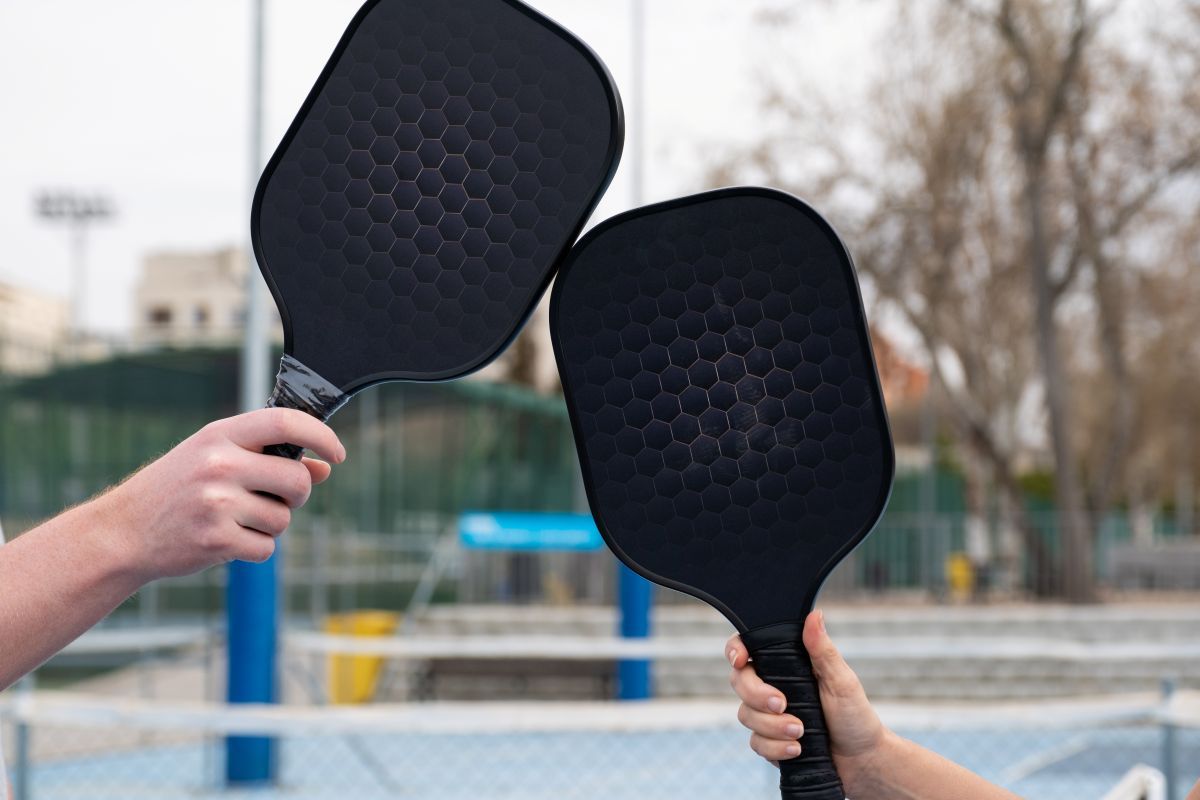
The signs of a worn out pickleball paddle are not always obvious to the eye, especially in the early stages of decline. Some show up in how the paddle feels and sounds rather than how it looks.
Knowing what to look and listen for helps you catch the problem before it starts costing you points.
Loss of surface texture
The face of a pickleball paddle is textured to generate spin. Over time, that texture wears smooth through contact with the ball, the court surface, and general friction. When you run a finger across a new paddle face, it feels noticeably rough.
When that roughness is gone, spin generation drops significantly, even if the paddle still looks intact from a distance.
Reduced power and inconsistent response
A paddle that once produced a sharp, responsive pop off the face and now feels flat or muted is showing clear signs of internal core deterioration. If you are hitting the ball in the same spot with the same swing and getting inconsistent results from shot to shot, the core is no longer responding uniformly.
This inconsistency is one of the most game-affecting symptoms of a worn paddle.
Dead spots
A dead spot is a localized area of the paddle face where the core has compressed or broken down, producing a dull, flat response instead of the lively rebound you expect.
The most reliable way to identify one is the tap test: gently knock your knuckle across different areas of the paddle face and listen for tonal inconsistency.
A healthy paddle produces a consistent sound across the face. A dull or noticeably different sound in one area indicates a dead spot. You can also bounce a ball lightly off different parts of the face and watch for uneven rebound height.
Visible cracks, dents, or edge damage
Physical damage to the paddle face, edge guard, or handle is a clear indicator that the paddle's structural integrity has been compromised.
Cracks in the face material, separation of the edge guard from the body, or a handle that flexes where it should be rigid all point to a paddle that needs replacing. Even small cracks can spread under play pressure and cause rapid, unpredictable deterioration.
Surface delamination
A delaminated paddle is one where the face material has separated, either partially or fully, from the internal core layer beneath it. This is a distinct failure mode from a dead spot.
Where a dead spot involves core compression within an intact structure, delamination involves physical separation of the paddle's layers.
A delaminated paddle often produces a noticeably hollow sound when tapped and can create an unintended trampoline effect at the contact point. In competition settings, this may violate USA Pickleball equipment standards.
If you hear a hollow sound that was not there before, check the edges of the face for any signs of lifting or bubbling.
Worn or slipping grip
The grip wears out independently of the paddle face and core. A grip that has become slick, compressed, or frayed affects your ability to control the paddle during play and increases the risk of the paddle shifting in your hand at contact.
Grip replacement is one of the simplest and least expensive maintenance tasks available to any player.
When Should You Replace Your Pickleball Paddle?
The right time to replace is when your paddle is no longer delivering the results you need, whether that is because of visible damage, detected dead spots, surface texture loss, or a general decline in feel that you cannot attribute to your own play.
A useful framework is to assess your paddle across three dimensions: feel, sound, and appearance. If all three still check out, the paddle has life left. If one or more shows clear decline, it is worth considering a replacement.
Players who are improving their game should also consider the relationship between equipment and skill development.
Playing with a worn paddle can reinforce incorrect technique adjustments made to compensate for a paddle that no longer behaves as expected, which creates habits that are hard to undo when a new paddle is eventually purchased.
If you are not sure whether your game has been affected more by your paddle condition or your technique, working with a certified coach is the most efficient way to find out.
Bounce connects players with verified coaches in their city who can assess your game in context and give you an honest read on whether a paddle change or a skill adjustment is the more pressing need.
Dead Spot vs Delamination: Understanding the Difference
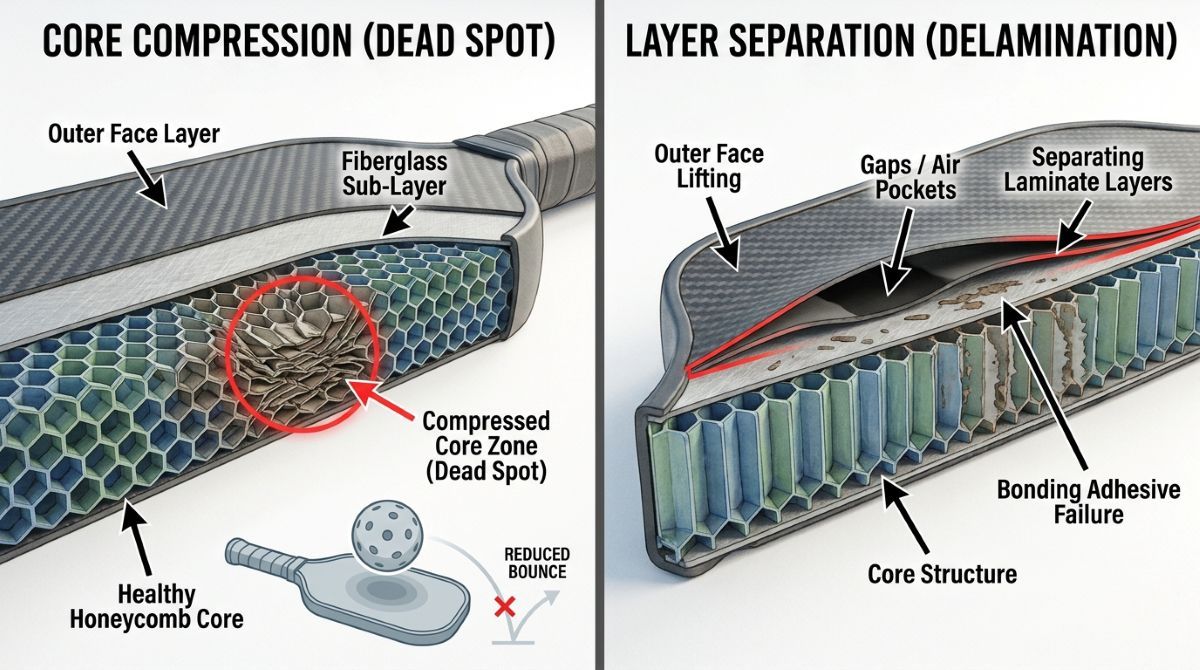
These two failure modes are frequently confused because they can produce similar symptoms, but they have different causes, different implications, and in some cases different consequences for competitive play.
| Feature | Dead Spot | Delamination |
| Cause | Core compression from repeated impact | Face material separating from the core |
| Sound | Dull or flat in one localized area | Hollow, drum-like across a section |
| Feel | Reduced rebound, inconsistent response | Trampoline-like effect, unpredictable power |
| Visible signs | Usually none from outside | Lifting or bubbling at edges or face |
| Competition impact | Performance decline only | May violate USA Pickleball equipment standards |
| Detection method | Tap test or bounce test | Tap test plus visual inspection |
| Resolution | Replace the paddle | Replace the paddle immediately |
The practical takeaway is that delamination is the more urgent problem of the two. A dead spot degrades your game but keeps the paddle technically intact. Delamination can create equipment that behaves unpredictably and, in a tournament setting, may result in a paddle being flagged as non-compliant.
USA Pickleball's equipment standards portal explains the trampoline effect threshold that delaminated paddles can violate, and why paddles exceeding that standard are decertified for sanctioned play.
Understanding this helps you recognize why a delaminated paddle is not just a performance problem but a potential rules issue.
Pickleball Paddle Care and Maintenance: How to Make It Last
Proper care does not require significant time or expense, but it has a meaningful impact on how long a paddle performs at a high level. Most paddle damage that shortens lifespan unnecessarily comes from avoidable habits rather than normal play wear.
Clean the face after every session
Ball contact leaves behind rubber residue, dirt, and oils that gradually fill in the surface texture of the paddle face and reduce spin generation. A quick wipe with a slightly damp, lint-free cloth after each session removes this buildup before it accumulates.
For raw carbon fiber paddles, a dedicated carbon fiber eraser or cleaning block restores texture more effectively than a cloth alone.
Avoid household cleaning products, abrasive pads, and anything containing alcohol or solvent, as these can degrade the face material over time. The core principle of gentle removal with a damp cloth applies broadly across most paddle types.
Store the paddle away from temperature extremes
Heat is one of the most damaging environmental factors for a pickleball paddle. Leaving a paddle in a hot car, a direct-sun bag, or an unventilated space can warp composite materials, loosen adhesive bonds between layers, and accelerate delamination.
Studies on composite materials in sport confirm that heat and environmental exposure are among the primary causes of structural degradation in equipment built the same way your paddle is.
Cold is less immediately damaging but can make paddle materials brittle and reduce their ability to flex properly during play. Store your paddle in a controlled indoor environment or a padded bag that provides insulation against temperature swings.
Handle the paddle deliberately
Paddles are designed to strike the ball, not the court surface, a net post, or another paddle in frustration. Impact against hard surfaces causes edge damage, face cracking, and core compression that would not occur through normal play.
Paddle slams are one of the fastest ways to shorten a paddle's life, and they also pose a risk of injury to yourself and other players nearby. Handle the paddle with the same deliberateness you apply to your shots, especially when you are moving quickly and reaching for balls near the boundaries of the court.
Replace the grip on schedule
The grip is the most frequently overlooked maintenance item and also the easiest to address. A worn grip that has become slick or compressed costs you control and increases hand fatigue, both of which affect how you use the paddle and can lead to compensatory technique changes.
Overgrip tape is inexpensive and takes a few minutes to apply. Most regular players should replace or add overgrip every few weeks, with a full base grip replacement needed every few months depending on usage.
Inspect the edge guard regularly
The edge guard protects the perimeter of the paddle core from impact damage. When it begins to separate, chip, or lift away from the body, dirt and moisture can enter the gap and accelerate internal deterioration.
Checking the edge guard after sessions where the paddle has contacted the court or fence, and pressing any lifting sections back down while they are still adhesive, can extend the paddle's structural life noticeably.
Practical Habits That Extend Paddle Life
Beyond the core maintenance tasks, a few additional habits make a meaningful difference in how long a paddle stays at performance level.
- Use a paddle cover or case: Paddles stored loose in a bag are subject to repeated impact from other gear. A dedicated cover or padded case eliminates this.
- Avoid resting the paddle face-down: Courts accumulate grit and abrasive particles that scratch the face when a paddle rests face-down between points or games.
- Rotate paddles if you play daily: Players who play frequently can extend each individual paddle's lifespan by alternating between two paddles, reducing cumulative impact hours on any single one.
- Keep it away from moisture: Even a brief soaking can introduce moisture into edge gaps and begin compromising the adhesive layers that hold the paddle structure together.
- Do the tap test monthly: Building a quick knuckle-tap check into your regular routine catches dead spots and delamination early, before they affect enough of the paddle to seriously impact your game.
When Maintenance Is No Longer Enough
There are points in a paddle's life where no amount of cleaning, grip replacement, or careful storage makes a meaningful difference. Once the core has compressed beyond a certain threshold, the surface texture is gone, or delamination has begun, the paddle needs to be replaced.
Continuing to play with a deteriorating paddle is not just a performance issue. Your body and technique adjust to a paddle that no longer behaves correctly, building habits that work against you when you eventually switch to a fresh one.
The criteria for deciding whether a paddle has reached the end of its useful life come down to a performance assessment rather than a fixed time threshold. If the paddle consistently underdelivers on touch, spin, or power despite being used correctly and maintained reasonably well, that is the signal.
For players who are still developing their game, a fresh paddle that performs predictably is also important for skill acquisition. Learning on an inconsistent paddle makes it harder to build reliable muscle memory and shot feel.
The gear decisions that matter most at the beginner and intermediate stages include prioritizing a paddle that responds consistently, which is something a worn paddle simply cannot deliver.
If you are ready to replace your paddle and want guidance on finding the right match for your skill level and play style, Bounce connects you with certified coaches who can help you evaluate options and make a replacement decision that actually improves your game.
Conclusion
Most recreational pickleball paddles last between one and three years under regular use, though that range stretches significantly based on how often and how aggressively you play.
The more important question is not how many years have passed but whether your paddle is still performing the way it should.
Checking regularly for dead spots, watching for surface texture loss, monitoring for signs of delamination, and keeping up with basic cleaning and storage habits gives you the information you need to make a timely replacement decision rather than playing with a paddle that is quietly undermining your game.
When it is time to replace, take the opportunity to make a more informed choice. Bounce connects players with certified coaches who can help you match your next paddle to where your game actually is, so the upgrade works in your favor from the first session.
FAQs
How long do pickleball paddles last on average?
Most recreational players get one to three years of solid performance from a paddle with regular use. Casual players who play once or twice a week may see five or more years, while daily competitive players often replace paddles every six to twelve months.
How do I know if my pickleball paddle has a dead spot?
Perform the tap test: use your knuckle to gently tap across different areas of the paddle face and listen for tonal inconsistency. A dull or noticeably different sound in one area compared to the rest of the face indicates a dead spot.
You can also bounce a ball lightly off different areas and watch for inconsistent rebound height.
What is a delaminated pickleball paddle?
Delamination occurs when the paddle's face material physically separates from the internal core layer beneath it. It produces a hollow sound when tapped and can create an unintended trampoline effect on contact.
A delaminated paddle may violate USA Pickleball equipment standards in tournament play and should be replaced immediately.
What is the difference between a dead spot and delamination?
A dead spot involves core compression within an otherwise intact paddle structure, reducing rebound in a localized area. Delamination involves the face layer physically lifting away from the core, producing a hollow sound and unpredictable power.
Both require paddle replacement, but delamination is the more urgent of the two.
When should I replace my pickleball paddle?
Replace your paddle when you notice consistent decline in feel, power, or spin that you cannot attribute to your own technique, when a tap test reveals dead spots or hollow sounds suggesting delamination, or when there is visible physical damage such as cracking, edge separation, or significant surface wear.
Does storing my paddle in a hot car damage it?
Yes. High heat accelerates the breakdown of adhesive bonds between paddle layers, warps composite materials, and can trigger delamination. Store your paddle in a temperature-controlled environment and avoid leaving it in a car during warm weather.
How often should I replace the grip on my pickleball paddle?
Most regular players should refresh their overgrip tape every few weeks and do a full base grip replacement every few months, depending on how frequently they play and how much they sweat during sessions.
A grip that feels slick or no longer absorbs moisture effectively needs replacing regardless of the time elapsed.
Can I fix a dead spot or delamination myself?
No. Neither dead spots nor delamination can be reliably repaired at home. Dead spots result from internal core breakdown that cannot be reversed, and delamination involves structural layer separation that requires manufacturer-level intervention.
Attempting to glue a delaminated face back down may temporarily mask the problem but does not restore safe or compliant paddle performance.