

Yes, you can play pickleball on grass, and plenty of people do. It is not the same experience as playing on a hard court, and it is not a format that competitive players train on.
But for a casual afternoon in the backyard, a family gathering, or a group of friends who do not have access to a nearby court, grass is a workable surface that keeps the game accessible without requiring any permanent construction.
The appeal is straightforward. A backyard grass court requires no special permits, no concrete, and no significant investment beyond a portable net and some boundary markers. The barrier to entry is about as low as it gets in any organized sport.
The tradeoffs are real though, and understanding them before you set up helps you manage expectations and get the most out of the experience. This guide covers what grass does to the game, the honest pros and cons, how to set up a functional court, what gear actually helps, and the adjustments that make grass play more enjoyable.
Pickleball on Grass: Pros and Cons
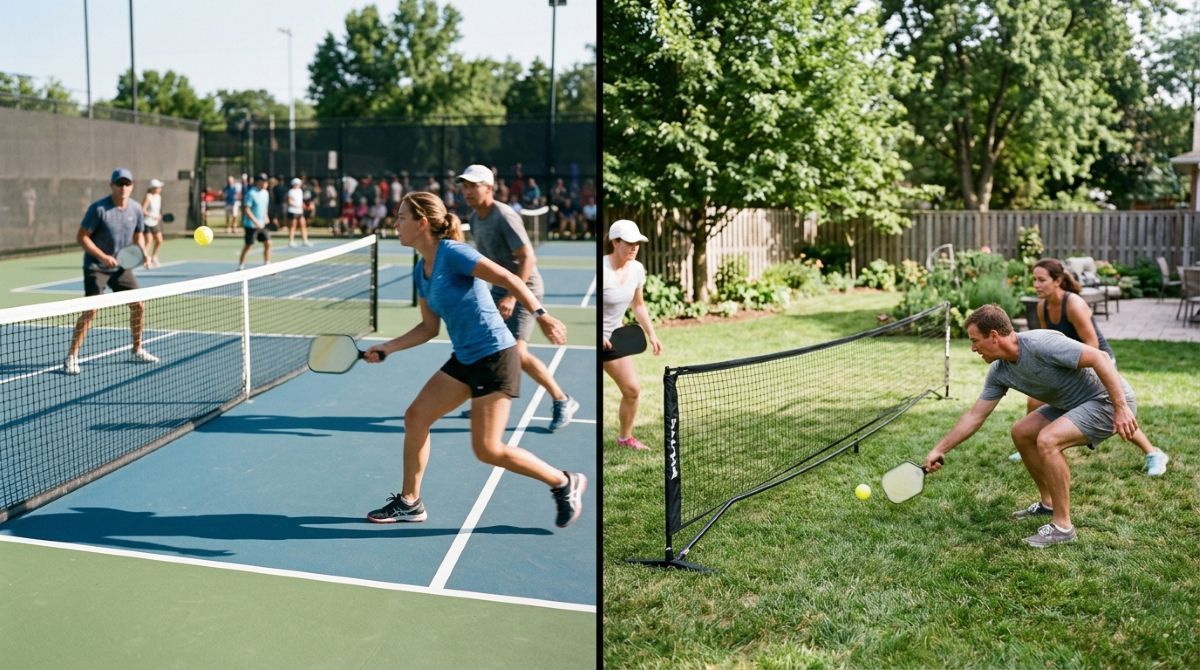
The pros and cons of playing pickleball on grass are straightforward once you understand what the surface actually does to the ball and to your movement.
Grass is softer, slower, and less predictable than any hard court surface, and the entire experience of the game shifts around those three realities.
Pros of playing pickleball on grass
- Accessibility: Grass is available in most backyards, parks, and open spaces. No booking, no court fees, no travel required.
- Joint comfort: The softer surface reduces impact on knees, ankles, and hips during lateral movement. Players with joint sensitivity often find grass easier on the body over extended play.
- Low setup cost: A portable net and some boundary markers are all you need to start. No permanent installation, no surface preparation beyond mowing.
- Casual social appeal: Grass play has a relaxed, informal energy that suits social and family settings. The lower intensity makes it less intimidating for complete beginners.
- Flexible space use: A grass court can be sized down slightly to fit the available lawn without significantly disrupting casual gameplay.
Cons of playing pickleball on grass
- Unpredictable bounce: This is the central problem with grass as a playing surface. The bounce is lower, slower, and inconsistent compared to hard courts.
Uneven ground, tufts of longer grass, and soft patches all alter ball trajectory in ways that are impossible to predict reliably.
- Standard balls perform poorly: Regulation outdoor pickleballs are engineered for hard surface bounce. On grass, they either sit up too slowly or barely bounce at all, depending on the turf density and moisture level.
- Footing and safety concerns: Grass becomes slippery when wet or damp. Lateral movements on slick grass carry a meaningful risk of slipping or ankle rolling, especially during faster exchanges near the kitchen line.
- Line marking challenges: Boundary lines on grass are harder to see and maintain than on painted hard courts. Disputes about in or out calls increase significantly when the lines are chalk or garden markers.
- Not for competitive development: The irregular bounce and slower pace of grass play do not build the instincts, footwork, or shot feel that transfer to hard court competition.
USA Pickleball's official guidance on court construction makes clear that hard surfaces such as concrete or asphalt are the recommended playing surface for pickleball, specifically noting that grass will not allow the ball to bounce in the way the sport requires.
That standard is worth knowing, even if it does not disqualify a casual grass game from happening.
Why Grass Ball Bounce Is the Core Challenge
The bounce problem on grass is worth understanding in detail because it is not just an inconvenience. It fundamentally changes how the game plays, which shots are viable, and how you need to move.
Pickleballs are hollow plastic with perforations designed for hard surface play. When struck, they rely on the ground to return predictable energy back upward. On a hard court, that rebound is consistent and controllable. On grass, the turf fibers absorb energy and the soft substrate underneath reduces the force returned to the ball.
This is supported by research on grass court surface mechanics, which confirms that grass surfaces exhibit greater deformation on ball impact, absorbing more energy and returning significantly less rebound than hard courts.
The result for pickleball is a ball that bounces lower, slower, and often at a different angle than expected.
Grass density and height amplify these effects. A freshly mowed, firm lawn performs noticeably better than a thick, spongy lawn or one with uneven patches.
Even on well-maintained grass, the bounce variation between a bare patch and a dense tuft is enough to turn a well-placed shot into an unplayable one.
How to Set Up a Pickleball Court on Grass
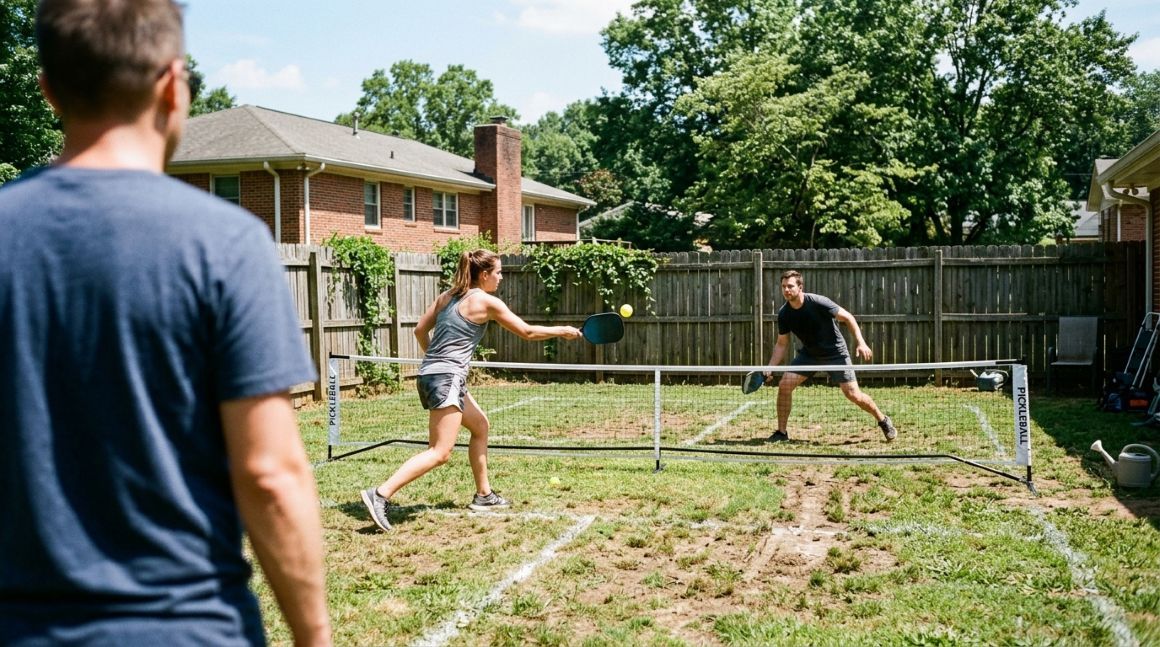
Setting up your court properly makes the difference between a frustrating experience and a genuinely enjoyable one. Most setup problems come from uneven ground, poorly marked lines, or a net that is not at the right height.
Step 1: Choose and prepare the ground
Select the flattest available area of lawn. Slope is the single biggest impediment to fair play on grass, because it adds directional drift to every bounce that no amount of skill can compensate for.
Mow the selected area as short as your mower allows, ideally to about one inch.
Walk the area before marking lines and remove any rocks, sticks, or debris. Check for significant soft spots or low points where water pools, as these areas become especially unpredictable when the ball lands nearby.
Step 2: Mark the court dimensions
A standard pickleball court is 20 feet wide and 44 feet long, with a total recommended playing area including run-off at 30 feet wide by 64 feet long. You can find the full breakdown of official court dimensions and layout including how to measure and position each line accurately.
For grass, use brightly colored marking paint, garden chalk, or sports field chalk spray for the boundary lines. White chalk is hard to see against grass. Bright orange or yellow stands out far better and remains visible through a full session.
Mark the baseline, both sidelines, the centerline, and the non-volley zone line 7 feet from the net on each side.
If space is limited, a functional casual court can work in a space as small as 18 by 36 feet. Keep the proportions consistent and make sure the kitchen zone is still clearly marked, as the non-volley zone rule still applies during grass play.
Step 3: Set up the net
Use a portable pickleball net with adjustable height. The net must be 36 inches at the sidelines and 34 inches at the center. Check the height with a measuring tape before play begins rather than estimating by eye.
Anchor the net posts firmly into the ground. On soft grass, net posts can shift during play, especially on lighter portable systems. Driving the stakes deeper or adding weight to the base reduces this problem.
Step 4: Check safety conditions
Do not play on wet grass. The risk of slipping during lateral movement is high enough to cause real injury. Wait until the surface has dried fully after rain or morning dew before setting up.
Also check that the run-off space beyond the baselines is clear, as players chasing balls will be moving backward at pace.
Best Ball for Pickleball on Grass
Choosing the right ball is one of the most practical improvements you can make to the grass playing experience. Standard outdoor pickleballs are designed for hard surface bounce, and they perform noticeably worse on grass than purpose-suited alternatives.
Why standard pickleballs struggle on grass
According to the USA Pickleball equipment standards, standard outdoor pickleballs weigh between 0.78 and 0.935 ounces and are constructed from hard plastic designed to rebound off concrete or asphalt.
On grass, the soft surface absorbs too much of the ball's energy on impact, producing a weak, low bounce that barely rises above ankle height on dense turf.
Better options for grass play
- Heavier outdoor pickleballs: Heavier outdoor balls in the upper end of the regulation weight range penetrate the turf surface slightly better than lighter balls, producing a marginally more reliable bounce.
- Foam pickleballs: Foam balls are specifically designed for soft surface play and are widely used for introductory and youth pickleball. They do not bounce like a regulation ball, but they are far more playable on grass than hard plastic balls and reduce the frustration of near-zero bounces on dense turf.
- Rubber-coated balls: Rubber-coated options compress slightly on impact with grass and return more energy than a rigid plastic ball, producing a more consistent and useful bounce for casual play.
For a purely casual grass session, matching ball choice to what you are trying to accomplish matters more than sticking with regulation equipment. Regulation balls are appropriate if you want to practice with real equipment on an imperfect surface.
Foam or rubber alternatives are better if the priority is an enjoyable, accessible game for mixed-ability players.
Tips for Playing Pickleball on Grass
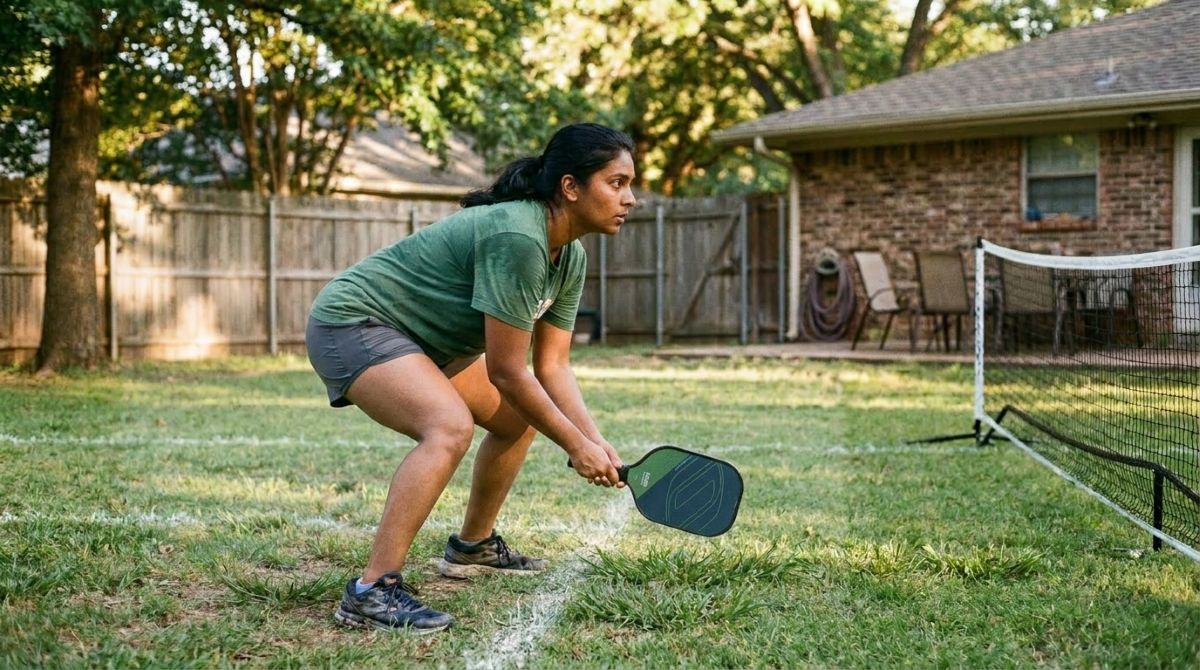
Adjust your ready position lower
Because the bounce is lower and slower than on a hard court, your standard ready position needs to drop. Keep your knees more bent, your weight further forward, and your paddle lower than you normally would.
This adjustment alone makes a significant difference in how often you can reach and cleanly contact a grass bounce.
Shorten your swing
Long backswings are built for predictable, waist-height hard court bounces. On grass, the ball often does not rise that high, and a full swing on a low ball produces a ground shot more often than a clean return.
Use shorter, more compact strokes and prioritize contact over pace. Soft, controlled placement beats power on grass.
Play a slower, more patient game
Grass naturally slows the game down. Resist the instinct to force pace, and instead treat grass play as an exercise in patience and placement. Dink-style exchanges are actually well suited to grass, because the lower bounce makes softer shots more manageable than drives that land and die unpredictably.
Wear shoes with appropriate grip
Court shoes with lateral support are still the right choice on grass, but traction matters more than on a hard surface. Shoes with deeper grooves or herringbone-pattern outsoles grip grass better than flat-soled court shoes.
Avoid standard running shoes, which lack the lateral ankle support needed for pickleball movement, and avoid cleated soccer or football shoes, which can dig into the turf and create uneven footing.
The guidance on what footwear works best for pickleball movement applies on grass as well, with additional emphasis on traction over everything else.
Set realistic expectations before you play
Grass play is casual play by nature. Set that expectation with everyone before the game starts to prevent frustration when a rally ends because a ball sat up dead after hitting a soft patch.
The surface guarantees some unpredictability, and the sessions that work best are the ones where everyone accepts that going in.
If grass play has introduced you or your group to pickleball and you want to take the next step onto a proper court, Bounce makes it easy to find nearby courts, open play sessions, and beginner-friendly lessons in your city.
Getting on a hard court for the first time after practicing on grass is a significantly easier transition when you have already built the basics of rally play and game flow.
Grass vs Other Pickleball Court Surfaces: How They Compare
Understanding where grass sits relative to other surfaces puts the experience in useful context for anyone evaluating their options.
| Feature | Grass | Concrete | Asphalt | Artificial Turf |
| Ball bounce | Low and unpredictable | Consistent and high | Consistent | Lower than hard courts |
| Joint impact | Low | High | Moderate to high | Low to moderate |
| Traction | Variable, poor when wet | Good | Good | Moderate |
| Setup cost | Very low | High (permanent) | High (permanent) | Moderate to high |
| Suitable for competition | No | Yes | Yes | Limited |
| Best use case | Casual backyard play | Competitive and recreational | Competitive and recreational | Practice and casual club use |
| Maintenance | Mowing and marking | Resurfacing periodically | Resurfacing periodically | Cleaning and inspection |
For players who want to develop real court skills alongside their casual grass sessions, Bounce connects players with certified coaches who run structured lessons on proper court surfaces. A few sessions with a coach accelerates the transition from backyard play to confident, consistent hard court performance.
When Grass Makes Sense and When It Does Not
Grass is the right surface for a specific set of circumstances. Knowing when it fits and when it does not helps you use it well without expecting more than it can deliver.
When grass is a good choice
- You want a casual, low-stakes session with friends or family who are new to the sport.
- No hard courts are accessible and you want to practice rally mechanics and game flow in a realistic context.
- You are introducing pickleball to beginners, children, or older players who benefit from a softer surface and slower pace.
- The goal is fun rather than competitive development, and everyone is aligned on that expectation before the game starts.
When grass is not the right choice
- You are preparing for tournament or league play. Grass mechanics do not transfer to hard court performance and can reinforce counterproductive habits.
- The lawn is wet, long, or significantly uneven. These conditions make play genuinely unsafe and produce an experience that is frustrating rather than enjoyable.
- You are trying to build reliable shot mechanics. The inconsistent bounce makes it impossible to develop the muscle memory that carries over to competitive play.
- Anyone in the group has serious knee, ankle, or balance concerns. Soft, uneven ground amplifies those risks even during casual play.
Conclusion
The answer to whether you can play pickleball on grass is yes, with a clear understanding of what you are signing up for. Grass is accessible, gentle on the body, and perfect for casual backyard sessions where the point is to enjoy the game rather than sharpen your hard court skills.
The tradeoffs are real: unpredictable bounce, limited ball performance, and footing that demands extra caution on anything but a dry, mowed surface.
Set up the court carefully, choose the right ball for the surface, keep your shots compact and patient, and match the expectations of everyone playing to the informal nature of a grass game.
Done right, a backyard grass session is a genuinely enjoyable way to spend time on the court.
When you are ready to move from the backyard to a real court and build the skills that transfer to competitive play, Bounce connects you with courts, coaches, and open play sessions in your city. Find your next game and take your pickleball further than the lawn.
FAQs
Can you play pickleball on grass?
Yes. Pickleball can be played on grass for casual and recreational purposes. The surface changes the game significantly, particularly the ball bounce, but it is a workable option for informal play when hard courts are not available.
Why does the ball not bounce well on grass?
Pickleball balls are designed for hard surface rebound. Grass absorbs impact energy through the turf fibers and soft substrate beneath, returning far less energy to the ball than concrete or asphalt does. The result is a lower, slower, and less predictable bounce.
What is the best ball for pickleball on grass?
Foam pickleballs or rubber-coated balls perform better on grass than standard hard plastic outdoor balls. They compress slightly on impact with the turf and produce a more usable bounce. For players who want to stick with regulation equipment, heavier outdoor balls in the upper weight range are the best available option.
Is a backyard pickleball grass court safe to play on?
On dry, mowed, flat grass it is reasonably safe for casual play. Wet grass is a significant slip hazard and should be avoided. Uneven terrain with soft patches or obstacles also increases injury risk during the lateral movements pickleball requires.
What are the court dimensions for a grass pickleball court?
The regulation pickleball court dimensions of 20 feet wide by 44 feet long apply on grass the same as any other surface. For casual backyard play, the court can be scaled down slightly if space requires it, but the kitchen zone should always be maintained at 7 feet from the net on both sides.
Does USA Pickleball recommend playing on grass?
No. USA Pickleball's official guidance identifies hard surfaces such as concrete and asphalt as the appropriate surfaces for pickleball, and notes that grass does not allow the ball to bounce in the way the sport requires. Grass play is a casual alternative, not a sanctioned or recommended format.
How do I mark lines on a grass pickleball court?
Use brightly colored sports field chalk spray, garden chalk, or marking paint in a high-visibility color such as orange or yellow. White chalk is difficult to see against grass. Lines should be refreshed if they fade during extended play or after morning dew.
Can I use pickleball on grass to improve my game?
Grass play is useful for building familiarity with game flow, scoring, and kitchen rules. It is not useful for developing shot mechanics or footwork patterns that transfer reliably to hard court play. Use it to enjoy the game, not to train for competition.


