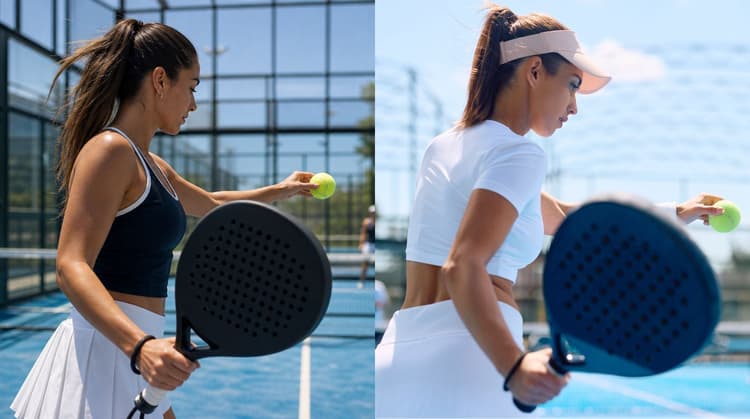
Mastering your pickleball grip is one of the fastest ways to improve control, consistency, and overall performance. Grip determines paddle angle, ball trajectory, spin generation, and even how quickly you can react at the net.
Players often focus on strategy or footwork first, but grip is the mechanical foundation behind every successful shot.
A technically sound grip allows you to execute dinks with softness, drives with authority, and volleys with stability. It reduces mishits, prevents unnecessary tension in the wrist and forearm, and supports long-term development.
Players who refine their grip mechanics early tend to progress faster because their strokes become repeatable and efficient.
What Is a Pickleball Grip?
A pickleball grip refers to how your hand is positioned on the paddle handle. That positioning directly determines the paddle face angle at contact, which controls whether the ball travels flat, with topspin, or with underspin. Grip alignment also influences wrist mobility and reaction time during fast exchanges.
The paddle handle is shaped with bevels, similar to a tennis racquet. Proper hand placement typically aligns the heel pad of the palm along one of these bevels, creating consistent orientation. If the hand rotates too far clockwise or counterclockwise, the paddle face may open or close unintentionally.
Grip fundamentals include:
- Heel pad placement on a consistent bevel
- Index finger comfortably extended along the paddle face edge
- Neutral wrist alignment at setup
- Full contact between palm and handle for stability
Establishing consistent alignment ensures your strokes remain repeatable under pressure.
Grip Pressure: The Foundation of Control
Grip pressure determines how the paddle interacts with the ball. Tension affects touch, power, and reaction speed. A helpful framework uses a 1–10 scale:
- 1–3: Very light grip (used for dinks and resets)
- 4–6: Moderate pressure (baseline drives, serves)
- 7–8: Firm but controlled (volleys in fast exchanges)
- 9–10: Excessively tight and typically counterproductive
When grip pressure is too tight, several problems occur. The wrist stiffens, touch disappears, and mishits increase. Excess tension also slows hand speed during net battles.
A relaxed but controlled grip provides:
- Better feel on soft shots
- Improved spin production
- Reduced forearm fatigue
- Faster paddle repositioning
Elite players constantly adjust grip pressure within rallies. Soft hands at the kitchen line and firmer contact on overheads create adaptability without full grip changes.
Finger Placement and Hand Positioning
Finger placement contributes to both control and comfort. The index finger should rest naturally along the paddle face edge, creating directional control. It acts almost like a guide for aiming.
The remaining fingers wrap around the handle firmly but without squeezing. The thumb rests comfortably on the opposite side of the grip, supporting stability.
Proper hand positioning supports:
- Quick reaction during volleys
- Stable paddle face through contact
- Efficient energy transfer on drives
- Reduced wrist strain
Players should avoid choking up too high on the handle, which reduces leverage, or holding the paddle too low, which can limit fine control at the net.
The 3 Main Types of Pickleball Grip Explained
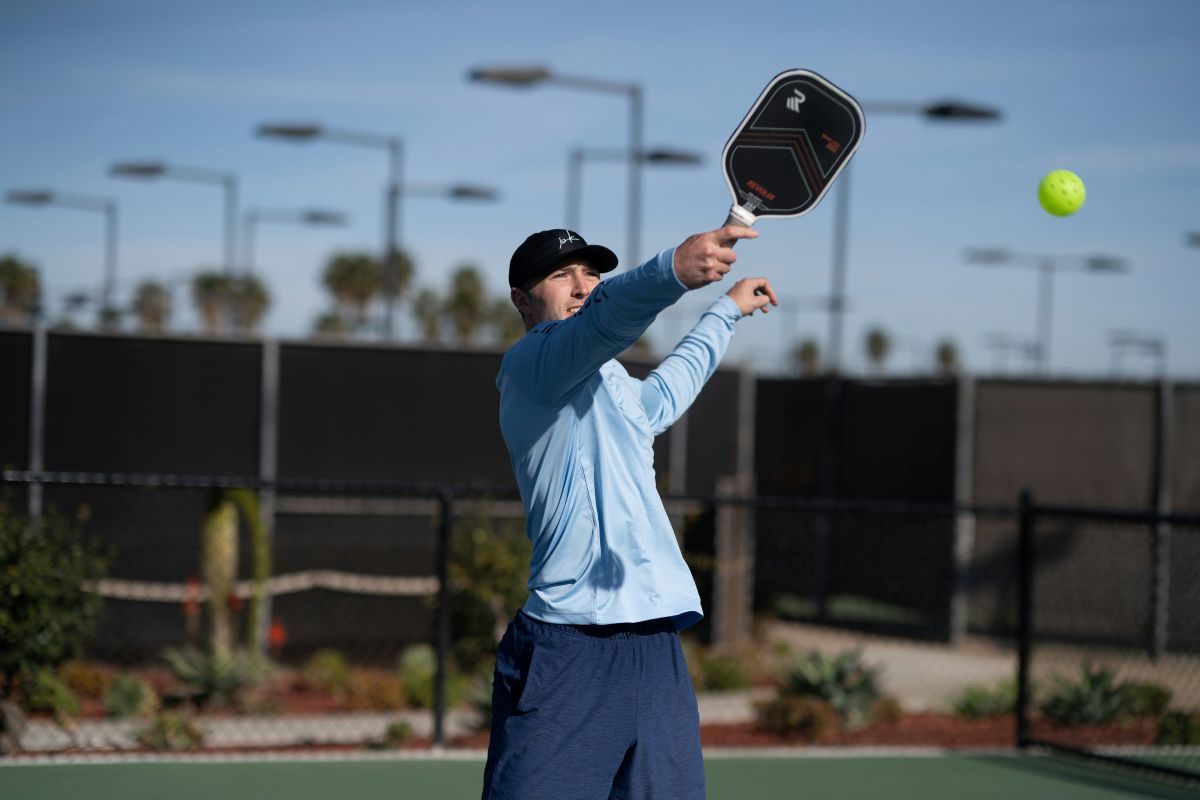
1. Continental Grip (The Most Versatile Pickleball Grip)
The Continental grip is widely regarded as the most adaptable grip in pickleball. It allows smooth transitions between forehands and backhands without rotating the hand on the handle. For many players, it becomes the foundation grip for nearly every shot.
This grip positions the heel pad on a bevel that keeps the paddle face relatively neutral. That neutrality supports:
- Stable volleys
- Consistent dinks
- Reliable serves
- Efficient overheads
Because pickleball emphasizes quick exchanges at the non-volley zone, minimizing grip changes is essential. The Continental grip supports that simplicity. It enables players to react quickly without sacrificing paddle alignment.
Many certified instructors recommend this grip as the starting point for beginners and the primary grip for intermediates.
2. Eastern Grip
The Eastern grip rotates the hand slightly, closing the paddle face more on forehand shots. This adjustment supports topspin production and can enhance baseline drives.
Benefits include:
- Increased topspin on forehands
- Stronger power generation on drives
- Aggressive baseline control
However, the trade-off is reduced versatility at the net. Because the paddle face angle shifts, transitioning quickly to backhand volleys can feel less natural.
Intermediate players sometimes experiment with Eastern variations to add spin to their offensive game. Competitive players may use subtle shifts while maintaining overall paddle stability.
3. Western Grip (Advanced Variation)
The Western grip further rotates the hand, significantly closing the paddle face. This grip is far more common in tennis than pickleball due to the lower bounce and faster hand exchanges in pickleball.
Advantages include:
- Maximum topspin potential
- Heavy, dipping baseline drives
Limitations include:
- Reduced comfort during volleys
- Slower transition at the kitchen line
- Increased strain on the wrist
Because pickleball prioritizes quick net play, Western grips are less common. Advanced players may use hybrid variations situationally but rarely rely on it as a primary grip.
Pickleball Grip by Skill Level
Beginner Players
For beginners, simplicity is critical. A consistent Continental grip paired with moderate grip pressure creates stability. Developing muscle memory early prevents bad habits that become difficult to correct later.
Beginners should focus on:
- Consistent hand placement before every serve
- Relaxed grip during dinks
- Stable paddle face alignment
Structured lessons accelerate this process. Through Bounce, players can connect with certified pickleball coaches in their city who provide grip correction and foundational skill instruction.
Repetition in clinics and beginner leagues reinforces grip consistency under real-game pressure.
Intermediate Players
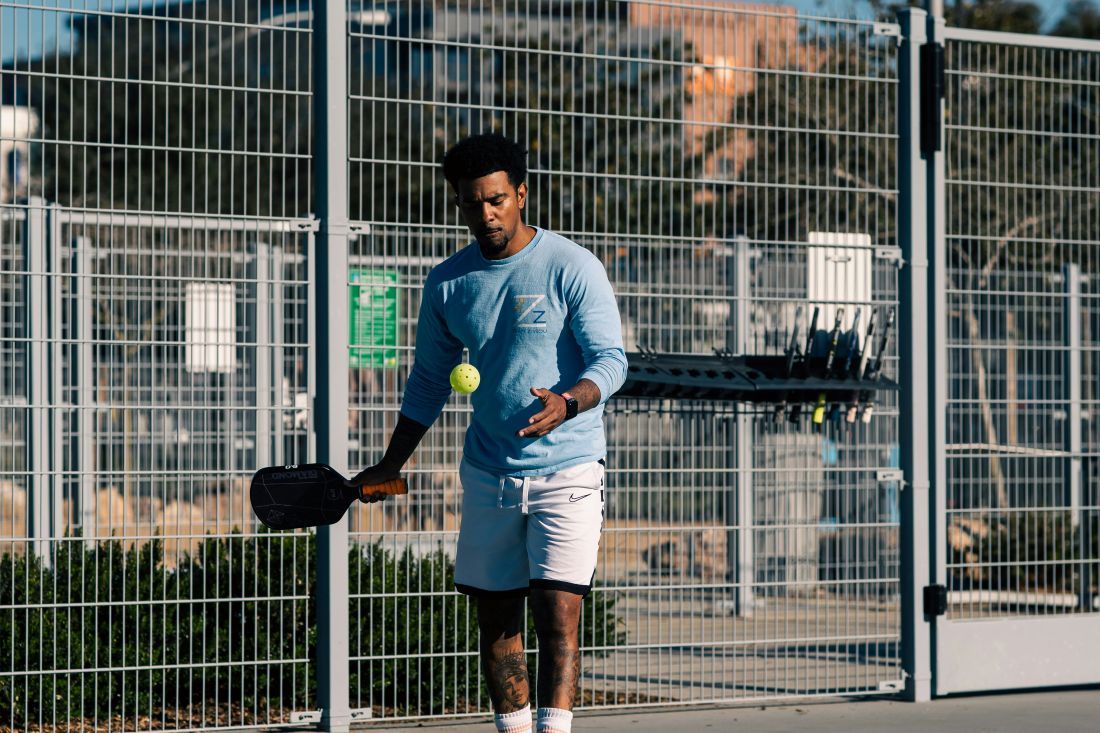
Intermediate players benefit from refining grip pressure during competitive play. Small adjustments during rallies improve adaptability.
At this stage, players often:
- Increase spin production on drives
- Fine-tune grip firmness during volleys
- Maintain relaxed touch for resets
Participation in structured leagues strengthens these habits. Organized formats found through Bounce allow players to compete consistently while refining grip mechanics in dynamic environments.
Exposure to varied opponents highlights when grip adjustments improve shot quality.
Advanced & Competitive Players
Advanced players focus on micro-adjustments rather than major grip changes. Hand speed, paddle control, and reaction time become central.
Advanced refinements include:
- Subtle grip pressure shifts during firefights
- Maintaining neutral paddle face through rapid exchanges
- Preserving touch while adding controlled aggression
Competitive environments demand repeatable mechanics. Players who compete regularly through city leagues and organized play formats build the consistency required at higher levels.
Pickleball Grip for Different Shots
Serves
On serves, grip pressure should sit at a moderate level. A stable but relaxed wrist promotes consistency and spin.
Key considerations:
- Neutral paddle face alignment
- Controlled acceleration
- Balanced grip firmness
Excess tension often leads to flat, inconsistent serves.
Third Shot Drives
Third shot drives benefit from slightly firmer grip pressure to generate topspin and depth. Paddle acceleration must remain smooth.
Effective technique includes:
- Slightly closed paddle face
- Full follow-through
- Balanced wrist position
Grip consistency ensures depth without sacrificing control.
Dinks
Dinks require soft hands. Grip pressure should drop significantly, allowing the paddle to absorb the ball’s energy.
Critical elements include:
- Relaxed forearm
- Minimal backswing
- Stable paddle face
Too much tension results in pop-ups and attackable balls.
Volleys
Volleys demand quick reactions and compact movements. Grip pressure should increase slightly to stabilize the paddle face without locking the wrist.
Players should:
- Keep elbows in front
- Maintain ready position
- Adjust firmness during rapid exchanges
Stable grip alignment ensures controlled redirection.
Overheads
Overheads require firmer grip pressure for power and stability. The wrist must remain aligned to transfer energy efficiently.
Effective overhead grip technique includes:
- Balanced stance
- Firm but controlled squeeze at contact
- Full extension through the ball
Grip alignment supports directional accuracy and pace.
Choosing the Right Pickleball Grip Size and Overgrip
How to Measure Grip Size
Proper grip size prevents injury and enhances comfort. A grip that is too small forces excessive squeezing. A grip that is too large limits wrist mobility.
General guidelines include:
- Measure from palm crease to tip of ring finger
- Ensure a finger-width gap between palm and fingertips when gripping
- Test comfort during extended play
Comfort and control should guide final selection.
Replacement Grips vs. Overgrips
Replacement grips form the base cushioning layer. Overgrips wrap over that layer to add tackiness and moisture control.
Benefits of overgrips include:
- Enhanced traction
- Sweat absorption
- Custom thickness adjustment
Regular replacement maintains consistent feel and reduces slipping during play.
Grip Size and Injury Prevention
Improper grip size increases strain on the wrist, elbow, and forearm. Long-term discomfort can affect performance and limit playing frequency.
Correct sizing supports:
- Efficient energy transfer
- Reduced fatigue
- Better shock absorption
Players participating in regular leagues or multiple weekly sessions benefit significantly from optimized grip comfort.
Improving Your Pickleball Grip Through Structured Play and Community
Technical improvement accelerates in structured environments. Practicing alone helps, but competitive play reveals inconsistencies.
Structured opportunities provide:
- Real-time pressure
- Feedback from skilled opponents
- Repetition across varied scenarios
Bounce operates as a city-based ecosystem connecting players with coaches, clinics, leagues, and organized formats. Players searching for instruction or competitive play can discover options by sport and location, creating consistent opportunities for refinement.
Clubs and coaches use Bounce to list programs, clinics, and events, making it easier for players to find development pathways that reinforce grip fundamentals.
Final Thoughts
A technically sound pickleball grip forms the foundation of every shot. From soft dinks to powerful overheads, grip alignment and pressure dictate ball behavior and shot consistency.
Small refinements produce measurable performance gains. Grip consistency enhances control, increases spin capability, and reduces unnecessary errors. Players who commit to mastering their grip mechanics often experience rapid improvements across all aspects of their game.
Consistent play, structured environments, and qualified instruction reinforce proper technique. Bounce connects players, coaches, clubs, and organized programming within city ecosystems, supporting long-term development and skill progression.
Improving your pickleball grip is not a minor adjustment. It is a core investment in performance. Commit to refining it, reinforce it through consistent play, and build a technical foundation that supports every level of advancement.