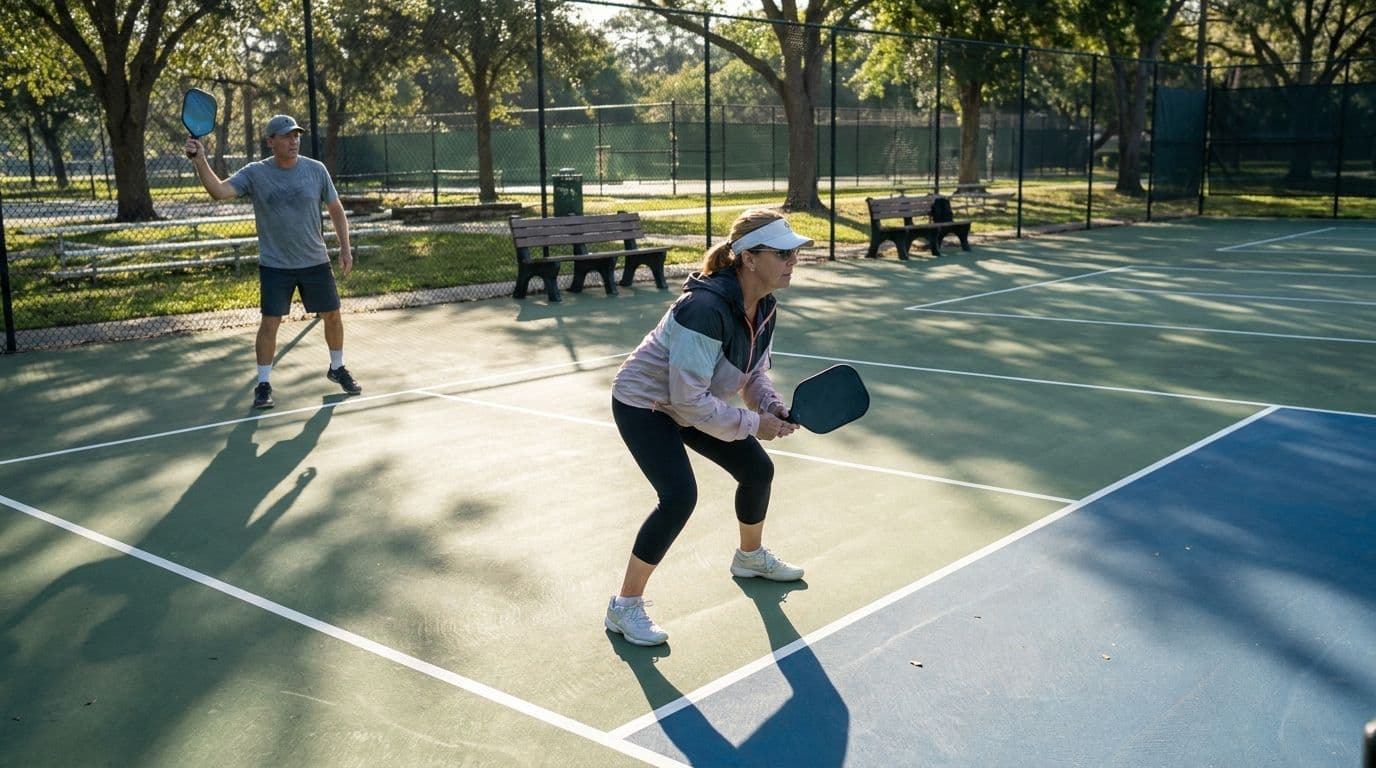
Regular singles covers the full 20-foot width of the court. Two players, one court, 880 square feet of ground per person to cover. For most recreational players, that turns singles into a conditioning test before it turns into a useful game.
Skinny singles cuts the court in half and changes what the game rewards. The width drops to 10 feet, the shot selection shifts toward dinks, drops, resets, and net play, and the physical demand becomes something most players can sustain for a real session.
Quick answer: Skinny singles pickleball is played on one lengthwise half of the standard court, usually 44 x 10 feet, with 2 players. Scoring follows standard side-out pickleball scoring: games usually go to 11, win by 2, and only the server can score. In the official USA Pickleball version, called mini-singles, the server and receiver positions are based on each player's score.
Skinny singles is the common recreational name many players use for half-court singles. USA Pickleball’s official version is called mini-singles, a half-court variation of standard singles. Casual skinny singles can stay simple, but official mini-singles has specific court-position rules and requires the centerline to extend through each non-volley zone.
What skinny singles is
Skinny singles narrows the normal singles problem into one 10-foot lane. In USA Pickleball’s official mini-singles format, players use only half of the court per point, with the active side determined by each player’s score. From there, the game feels tighter right away. There is less scrambling, less open-court chasing, and more pressure on clean placement.
Players may end up rallying crosscourt or straight ahead, depending on the score and the active court positions. Either way, 2 players get a real game that forces cleaner serves, returns, drops, dinks, and kitchen movement.
That is why skinny singles works as both a match format and a practice tool. You can keep score, play hard, and still get the kind of repeated shot patterns that make your doubles game better.
Skinny singles court setup
A standard pickleball court is 44 feet long and 20 feet wide. Skinny singles uses the full length but only half the width, usually 44 x 10 feet, split along the centerline that already runs the length of the court.
For casual skinny singles, either half of the court works and you usually do not need extra lines. The full court layout is easier to understand once you know the standard pickleball court dimensions.
Official mini-singles is more specific. USA Pickleball lists mini-singles as an approved format, and official play may require a temporary centerline through the non-volley zone so the active half of the kitchen is clear. If you are just practicing with one other player, agree on the active half before the first serve and keep it consistent.
| Dimension | Standard court | Skinny singles |
| Length | 44 feet | 44 feet |
| Width | 20 feet | 10 feet |
| Kitchen depth | 7 feet | 7 feet |
| Players | 2 or 4 | 2 |
Skinny singles rules
Every standard pickleball rule still matters. The format changes the active court area, not the core rules of the game.
Serving
The server serves diagonally from behind the baseline. The ball must clear the non-volley zone and land in the correct crosscourt service box. USA Pickleball's official rulebook is the best source for standard serving and scoring language.
Two-bounce rule
The serve must bounce before the receiver returns it. The return must also bounce before the server can hit the third shot. After those 2 bounces, either player may volley as long as they are outside the non-volley zone. The double bounce rule explains why this rule shapes early-point positioning.
Non-volley zone
Neither player can volley the ball while standing in or touching the kitchen line. Foot faults apply the same way they do in standard play. USA Pickleball's rules summary confirms the non-volley zone extends 7 feet from the net on each side.
Out of bounds
Any ball that lands on the non-active half of the court is out. The centerline is a live boundary. A ball landing on the centerline itself is in.
Side switching
In casual crosscourt skinny singles, the simplest method is to let the server's score determine the serving side: even score serves from the right, odd score serves from the left. The receiver mirrors the server diagonally across the court.
Official mini-singles adds more structure. Each player's position is based on their own score, so the active court can change at each end depending on the server's score and the receiver's score. For casual games, agree before play whether you are using the simple recreational version or official mini-singles positioning.
Scoring
Use standard side-out scoring unless your group agrees otherwise. Games usually go to 11, win by 2. Only the serving player can score. If the receiver wins the rally, they take the serve without scoring a point.
Scoring walkthrough
This is where most players get confused, so start with the casual crosscourt version.
Alex and Jordan are playing. Alex serves first.
Point 1: Alex's score is 0
Alex has 0, an even score, so he serves from the right side of his half. Jordan positions diagonally across from him. Alex serves crosscourt and wins the rally.
Point 2: Alex's score is 1
Alex now has 1 point, an odd score, so he serves from the left side of his half. Jordan mirrors him diagonally across the court. Alex serves crosscourt again. Jordan wins the rally.
Sideout: Jordan serves
Jordan wins the serve. Her score is 0, so she serves from the right side of her half. Alex positions diagonally across from her.
The pattern: in recreational skinny singles, the server's score determines the serving side. The receiver mirrors the server diagonally. The receiver does not choose a side independently.
| Server's score | Server's side | Receiver's side |
| 0 | Right | Crosscourt right |
| 1 | Left | Crosscourt left |
| 2 | Right | Crosscourt right |
| 3 | Left | Crosscourt left |
| 0 after sideout | Right | Crosscourt right |
The 2 skinny singles variations
There are 2 common ways to play skinny singles. They feel different, and they train different skills.
Crosscourt variation
Players rally diagonally, using the same angle as a standard service exchange. This is the default version and the one most players learn first. The court opens at an angle, dink exchanges happen diagonally, and the geometry closely mirrors how doubles rallies develop after the return.
Best for: dink consistency, third-shot drops, service-return positioning, and non-volley zone transitions. If you play doubles regularly, this version transfers cleanly to your doubles game.
Straight-ahead variation
Players line up directly across from each other and play straight down the line. The ball travels perpendicular to the net, the court corridor is narrower, and there is less angle to work with on either side.
Best for: resets, line defense, tight-corridor control, and neutralizing pressure when your opponent has position. The margins are smaller, and precision matters more.
Start with crosscourt if you are new to the format. Add straight-ahead sessions when you want to train reset consistency and line defense.
Skinny singles strategy
The half-court geometry changes what works. Strategy that makes sense on a 20-foot-wide court can get sloppy inside a 10-foot corridor.
Get to the kitchen
The net player controls more points because angles, put-aways, and reaction time favor the player at the non-volley line. Getting to the kitchen is the first objective on most points.
Serve to the weak side
In a 10-foot corridor, a serve placed at the body or toward the backhand lands in a tighter window. There is less room to step around a weak-side serve and attack it. Find the backhand and keep going there until your opponent proves they can handle it.
Prioritize the third-shot drop
Hard drives are riskier in skinny singles. The narrow court limits angles, so a drive that misses by 6 inches is just out. A good drop lands softly in the kitchen, neutralizes your opponent's position, and lets you move forward without feeding them a put-away ball.
Win dink rallies
Rallies can last longer in skinny singles than in regular singles because there is less open court to attack. The player who keeps the ball low, waits for a better ball, and avoids loose errors usually wins more points than the player trying to end every rally early.
Be patient
At the recreational level, skinny singles rewards fewer loose errors. The narrow court punishes rushed attacks quickly. If you are forcing winners from bad positions, you are giving points away.
A coach can also turn skinny singles into a targeted session instead of a loose practice game. Through Bounce, players can find pickleball coaches who build drills around third-shot drops, kitchen movement, and doubles patterns.
Skinny singles vs. regular singles
These games share the same net height, but they reward different things.
| Category | Skinny singles | Regular singles |
| Court width | 10 feet | 20 feet |
| Movement demand | Moderate | High |
| Shot selection | Dinks, drops, resets | Power, angles, athletic retrieval |
| Physical demand | Moderate | High |
| Best for | Drilling, casual 2-player games, doubles prep | Competitive singles play |
Regular singles rewards speed, endurance, and the ability to chase down balls in the corners of a 20-foot-wide court. That physical demand makes it less accessible for many recreational players.
Skinny singles rewards shot precision and patience. The format is more accessible, more transferable to doubles, and more useful for players who want to train the skills they actually use in regular games.
How skinny singles builds your doubles game
Skinny singles is one of the most direct ways to train doubles skills with only 2 players.
The half-court geometry forces the same decisions you face in doubles: third-shot drops from the baseline, dink exchanges at the kitchen, non-volley zone transitions under pressure, and resets when your opponent has the angle. A basket drill gives you repetitions. Skinny singles adds score pressure.
That pressure is why the drill works. You can hit cooperative dinks for an hour and still avoid the exact ball that bothers you. In skinny singles, every loose contact costs you the rally, the serve, or the point.
Practical structure
Use skinny singles in short, focused blocks.
- Play 20 to 30 minutes per practice session. Beyond that, fatigue starts reducing rep quality.
- Add one constraint at a time. Drop every third shot, require yourself to reach the kitchen before attacking, or play 5 points where drives are not allowed.
- Switch between crosscourt and straight-ahead play when you want different pressure. Crosscourt trains doubles patterns. Straight-ahead trains line defense and resets.
For beginner-specific practice structures, the pickleball drills for beginners guide pairs well with skinny singles sessions.
Players who learn better in organized formats can use Bounce to find clinics, round robins, and structured play in their city, then use skinny singles as a focused practice tool between sessions.
Conclusion
Skinny singles gives 2 players a complete game on one court. It keeps the movement manageable and puts the pressure on the skills that decide most doubles points: kitchen play, drops, resets, dink consistency, and patience.
Use the casual version when you want a simple practice game. Use official mini-singles rules when you are preparing for a sanctioned format or want the most accurate version of the game.
If you play doubles regularly, skinny singles belongs in your practice routine. It is efficient, competitive, and hard to fake. Your bad habits show up fast.
For players building their doubles game through structured coaching and organized play, Bounce connects you with certified coaches, clinics, and competitive formats in your city.
Frequently asked questions
What is skinny singles pickleball?
Skinny singles is a 2-player format played on one lengthwise half of the standard pickleball court. Most recreational players use the term for casual half-court singles. USA Pickleball calls the official version mini-singles.
Is skinny singles the same as mini-singles pickleball?
They are closely related. Skinny singles is the common recreational name. Mini-singles is the official USA Pickleball format with defined court-position rules and, in some settings, temporary line requirements.
How does scoring work in skinny singles?
Skinny singles usually uses standard side-out scoring. Games go to 11 points, win by 2. Only the serving player can score. If the receiver wins the rally, they earn the serve without adding a point.
Which side of the court do you serve from in skinny singles?
In the simple recreational version, even scores serve from the right and odd scores serve from the left. The receiver mirrors the server diagonally. In official mini-singles, each player's court position is based on their own score. The approved tournament formats page is the best place to confirm how USA Pickleball currently treats mini-singles.
What is the difference between skinny singles and regular singles pickleball?
Regular singles uses the full 20-foot-wide court. Skinny singles uses a 10-foot-wide half. That smaller court reduces running and shifts the game toward precision, soft shots, kitchen movement, and patient point construction.
Is skinny singles good for doubles players?
Yes. Skinny singles trains many of the same decisions doubles players face: third-shot drops, dink exchanges, kitchen transitions, and resets under pressure. It is one of the most efficient 2-player practice formats in pickleball.
Can beginners play skinny singles pickleball?
Yes. Beginners often benefit from skinny singles because it reduces the running load and lets them focus on serve, return, kitchen approach, and shot control. Start with crosscourt skinny singles before adding straight-ahead variations.