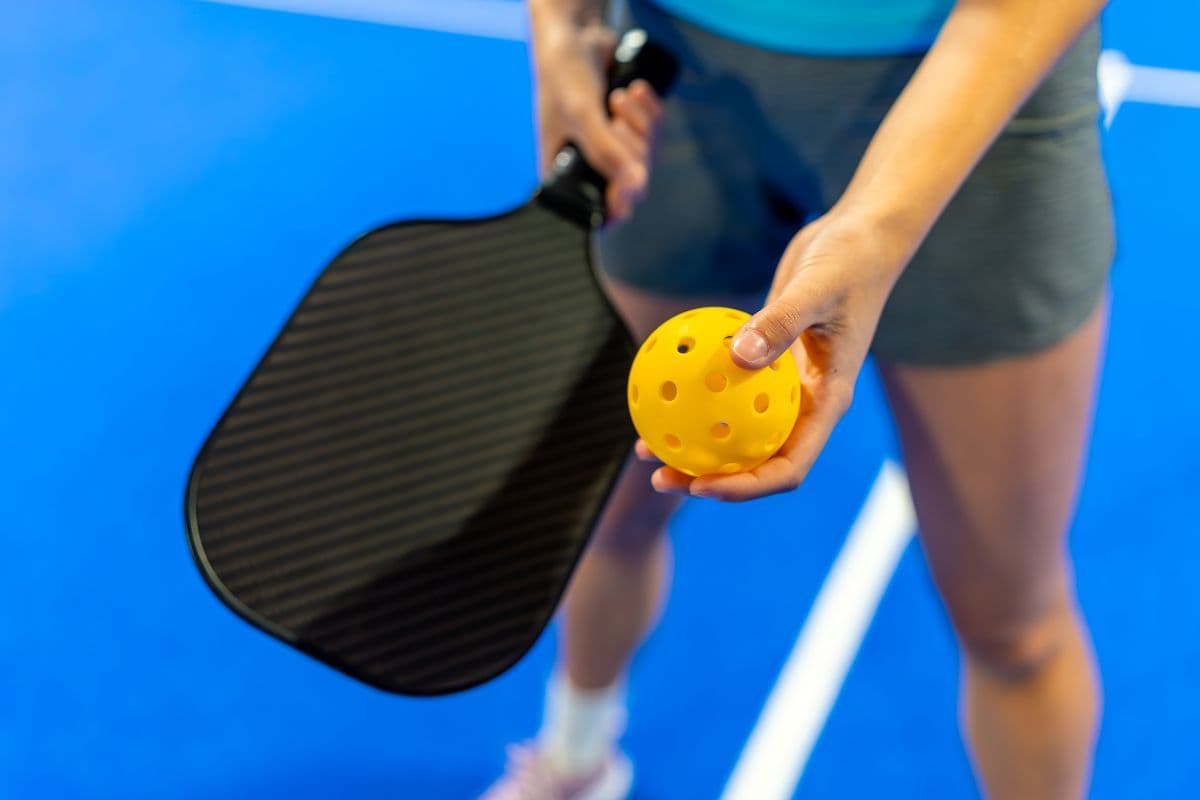
Knowing what pickleball paddles are made of is not just trivia. The materials that go into your paddle determine how the ball feels at contact, how much spin you can generate, how your arm holds up over a long session, and how much you need to spend to get real performance benefits.
Every paddle is built from two primary components: a face layer and a core. The face is the surface that contacts the ball. The core sits underneath and determines how energy is transferred through the paddle.
Both layers have multiple material options, each with distinct performance characteristics.
This guide breaks down every major face and core material, compares the two most important head-to-head matchups in each category, and gives you a clear answer on which material combination fits where you are in your game right now.
Pickleball Paddle Face Materials
The face is the layer you see when you look at a paddle. It is the material your ball actually contacts on every shot, and it has the greatest influence on feel, spin, and power transfer.
Wood
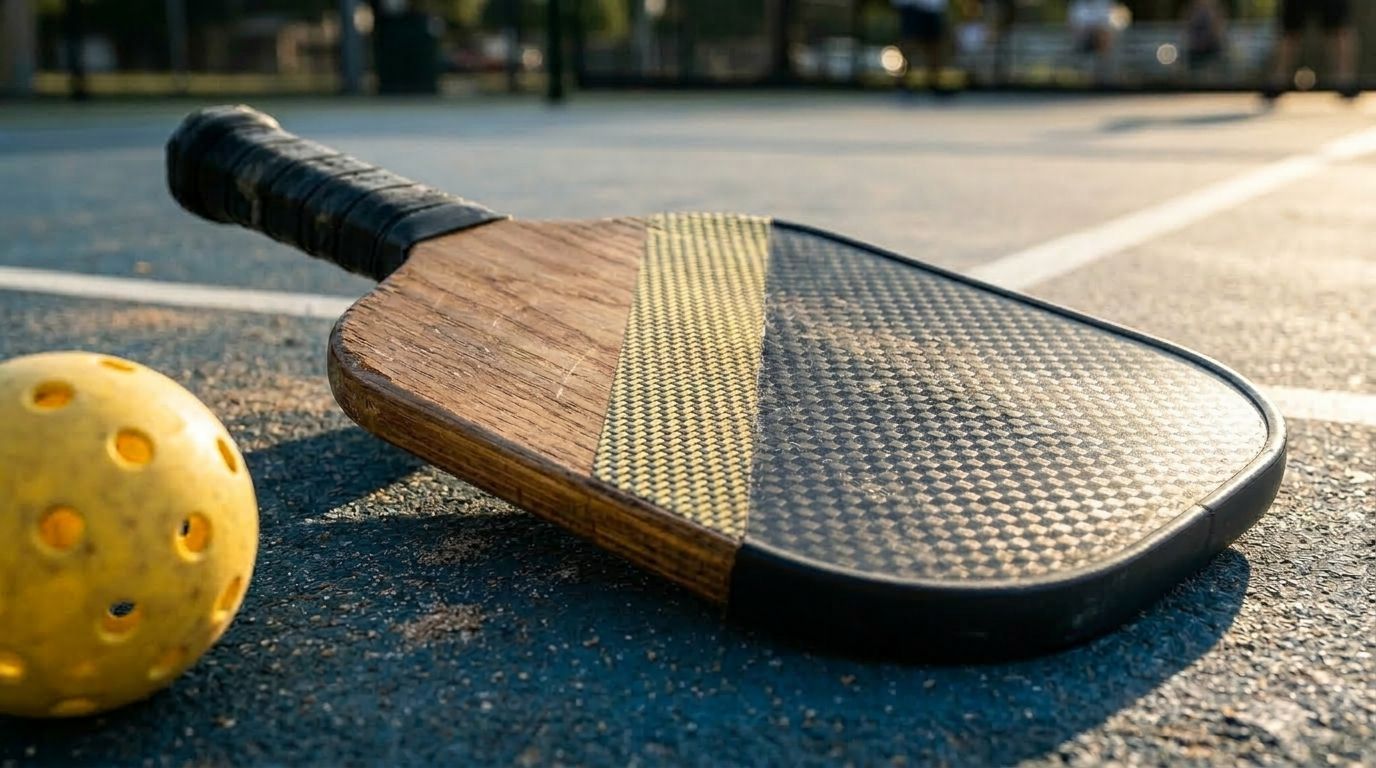
Wood is the original paddle face material. It is dense, inexpensive, and produces a heavy paddle that generates minimal spin. Wood paddles are still sold, primarily as recreational options for backyard use and beginners who are not ready to commit any budget.
The performance ceiling is low. A wood paddle's weight slows your swing speed and the smooth face cannot grip the ball to generate useful spin. If you play regularly, even once a week, you will outgrow a wood paddle almost immediately.
Fiberglass
Fiberglass, also called composite, became the dominant entry and mid-range face material as the sport grew. It is a woven glass fiber sheet bonded to the core with resin.
The material flexes slightly at contact, which creates a trampoline effect that adds pop to your shots and produces a larger effective sweet spot.
That flex is both the strength and the limitation of fiberglass. For beginners and recreational players, the forgiveness on off-center hits is genuinely useful. For advanced players, the same flex that helps beginners reduces the precision and spin potential you need at higher levels.
A review of composite materials in racket sports equipment confirms that fiberglass composites offer strong impact absorption properties but lower stiffness compared to carbon-based alternatives, a trade-off that defines how the material plays at contact.
Graphite
Graphite paddles use a thin graphite sheet bonded over the core. Graphite is stiffer than fiberglass, which means less energy is lost at contact and more is transferred to the ball. The result is better feedback on every shot and a crisper, more connected feel.
Graphite sits in the middle of the performance spectrum. It outperforms fiberglass on feel and responsiveness, and costs less than raw carbon fiber. For players in the 2.5 to 3.5 range who are building fundamentals, a graphite paddle in the $80 to $130 range covers the performance demands of that development stage well.
Carbon Fiber
Carbon fiber is the premium face material. It is stiffer, lighter per unit of strength, and more durable than graphite or fiberglass. The surface of a raw carbon fiber face has a natural texture that grips the ball at contact, generating significantly more spin than either of the alternatives below it.
Research on carbon and glass fiber-reinforced polymer manufacturing and properties establishes that carbon fiber's combination of high tensile strength, excellent stiffness, and fatigue resistance makes it the preferred material in performance sports equipment where precision and durability under repeated loading are priorities.
Those same properties explain why carbon fiber has become the standard at the advanced and competitive level in pickleball.
Pickleball Paddle Face Materials: Quick Comparison
| Material | Price Range | Key Strength | Limitation | Best For |
| Wood | $10-$30 | Low cost | Heavy, no spin, poor feel | Backyard/casual only |
| Fiberglass | $40-$100 | Forgiving sweet spot | Flex limits precision | Beginners, recreational |
| Graphite | $80-$150 | Crisp feel, good feedback | Less spin than carbon | Intermediate players |
| Carbon Fiber | $120-$250+ | Spin, precision, durability | Higher cost | Advanced, competitive |
Carbon Fiber vs Fiberglass Pickleball Paddle
This is the comparison most players land on when deciding whether to step up from an entry-level paddle. Here is what actually separates the two.
Fiberglass flexes at contact. That flex increases the dwell time of the ball on the paddle face, which helps less consistent players hit shots that still travel with acceptable pace. It also creates a softer, more muted sound and feel at contact.
Carbon fiber does not flex the same way. The face is rigid. Energy is returned directly to the ball without being absorbed by the material. That produces sharper, louder contact, better spin potential from the textured surface, and more precision on placement shots.
You can feel exactly where the ball made contact, which speeds up your ability to make swing adjustments.
The gap matters more as your consistency improves. Below 3.0, your contact point varies enough that fiberglass forgiveness helps more than carbon precision. Above 3.0, a carbon fiber face gives you tools that you can actually use.
| Factor | Carbon Fiber | Fiberglass |
| Surface texture | Rough, grips ball at contact | Smooth, less grip |
| Spin generation | High | Low to moderate |
| Feel at contact | Crisp, sharp | Soft, muted |
| Sweet spot | Smaller, precise | Larger, forgiving |
| Best player level | 3.0 and above | Beginners, casual players |
| Price range | $120-$250+ | $40-$100 |
Choosing between face materials is easier when you understand where your game actually sits. The complete guide to choosing a pickleball paddle walks through face material, core type, weight, and grip size in one place so you can make one informed decision instead of four separate ones.
Pickleball Paddle Core Materials
The core is the internal structure of the paddle. You cannot see it, but it does more to shape your overall playing experience than almost any external feature.
Core material determines power, control, sound, and how the paddle performs at different swing speeds.
Polymer Core
Polymer honeycomb is the most widely used core material in pickleball today. It is a polypropylene honeycomb structure with cells ranging from 5 to 16 millimeters in diameter.
The polymer material is soft relative to Nomex or aluminum, which produces a quieter, more controlled response at contact.
The softness of a polymer core absorbs some of the energy at contact, which translates to better touch on dinks and resets near the kitchen. It is also more forgiving on your arm over long sessions.
The trade-off is that polymer cores produce less pop than Nomex at equivalent swing speeds, which matters more for players who generate power from their swing mechanics.
Polymer cores also come in different thicknesses. A thicker core, typically 16 millimeters, produces a softer, more controlled response. A thinner core at 11 to 13 millimeters is stiffer and generates more power.
This is one of the more underappreciated variables in paddle selection because two paddles with the same face material can play very differently based on core thickness alone.
Nomex Core
Nomex is an aramid fiber paper originally developed for aerospace applications. It is formed into a honeycomb structure and coated with phenolic resin, producing a core that is significantly harder and stiffer than polymer.
Research on polymer composites and their performance properties in sports equipment identifies that aramid-based composites offer superior stiffness and resilience under repeated impact loading compared to polypropylene alternatives, which is why Nomex was the performance core standard before polymer technology improved.
A Nomex core generates considerably more pop at contact. The harder structure returns energy to the ball more aggressively, which is why older competitive paddles built on Nomex cores were favored by power-oriented players.
The downside is the sound: Nomex paddles are noticeably louder than polymer ones, which has caused restrictions at some noise-sensitive facilities and residential courts.
Aluminum Core
Aluminum honeycomb cores were common in earlier paddle generations. Aluminum is lightweight and produces consistent, even response across the paddle face.
It is now largely replaced by polymer and Nomex in serious play because it offers less control refinement and generates a harder, less comfortable feel at contact during extended sessions.
You will still find aluminum cores in budget paddles. For recreational play with no ambitions toward improvement, an aluminum core is acceptable.
For any player developing skills, the performance difference between aluminum and a quality polymer core is significant enough to justify upgrading.
Pickleball Paddle Core Materials: Quick Comparison
| Core Material | Feel | Power | Control | Sound Level | Best For |
| Polymer (thin) | Medium | Medium-High | Medium | Quiet | Power-leaning players |
| Polymer (thick) | Soft | Medium | High | Quiet | Control, soft game focus |
| Nomex | Hard | High | Lower | Loud | Power players, older designs |
| Aluminum | Medium | Medium | Medium | Moderate | Budget recreational play |
Polymer Core vs Nomex Pickleball Paddle
Most paddles you consider today will use a polymer core. Nomex cores still exist, particularly in older or more specialized paddle designs, and the difference matters if you are shopping across a wide price range.
A polymer core gives you touch. The softer structure at contact allows you to feel the ball more clearly, execute softer dinks with better control, and reset aggressive shots without overhitting.
If your game is built around kitchen play and soft exchanges, a thick polymer core is almost always the right choice.
A Nomex core gives you pop. If you drive the ball from the baseline and want maximum energy return on every swing, the harder Nomex structure delivers that. The trade-off is less feel and significantly more sound, which is a practical issue at many facilities.
For most players at the recreational and intermediate level, a polymer core in the 13 to 16 millimeter range is the better starting point. It gives you the control to develop your soft game while still producing adequate power on drives.
| Factor | Polymer Core | Nomex Core |
| Primary feel | Soft, controlled | Hard, explosive |
| Power output | Medium | High |
| Touch and control | High | Lower |
| Sound at contact | Quiet | Loud |
| Noise restrictions | Compatible | May not comply |
| Arm comfort | More forgiving | More impact transmission |
| Best playing style | Kitchen-focused, all-court | Power baseline play |
If you are not sure which core thickness and face combination fits your current game, working with a coach who can watch how you hit and where your game is strongest makes the decision clearer.
Bounce connects you to certified pickleball coaches in your city so you can get specific, personalized guidance rather than guessing from spec sheets.
Handle and Edge Guard Construction
Face and core materials get most of the attention, but the handle and edge guard also affect how a paddle performs and holds up over time.
Handle Construction
Most paddle handles are built from a composite or polymer base wrapped in a cushioned grip tape. The handle length varies between four and six inches. Longer handles suit players who use two-handed backhands or who are transitioning from tennis. Shorter handles place the hand closer to the face for more control and maneuverability.
Grip circumference is measured in the same range as tennis rackets, from 4 to 4.5 inches. Grip size is a personal preference issue, but a grip that is too thick limits wrist movement and can contribute to forearm fatigue.
A grip that is too thin reduces control and requires compensatory tightening that stresses the forearm extensors.
Edge Guard
The edge guard protects the perimeter of the paddle face from court contact during low shots and ground scrapes. Budget paddles use basic plastic guards that can crack and separate over time.
Premium paddles use more durable composite edge guards with tighter bonding to the face material.
Edgeless paddle designs eliminate the guard entirely, extending the face material to the full perimeter of the paddle. This increases the usable hitting surface and removes the dead zone that traditional edge guards create around the perimeter.
Edgeless paddles require more precise manufacturing and typically sit at the higher end of the price range.
Best Material for Pickleball Paddle: A Skill-Level Guide
The best paddle material is the one that matches where your game actually is, not where you want it to be. Here is a clear breakdown by skill level.
Beginner (2.0 to 2.5)
At this stage, your priority is consistency and confidence. A fiberglass face paired with a polymer core gives you a forgiving sweet spot and enough touch to start developing dink mechanics.
You do not need carbon fiber spin yet because your contact is not consistent enough to use it deliberately.
Spend between $40 and $80. There is no performance reason to invest more at this level. What improves your game is court time and instruction, not paddle technology.
Intermediate (2.5 to 3.5)
Your contact is more consistent and you are starting to develop intentional shot placement. A graphite face with a thick polymer core is the right step up.
It gives you better feel and feedback than fiberglass without the price jump of a full carbon fiber setup.
Spend between $80 and $150. This range covers graphite and entry-level carbon fiber paddles with quality polymer cores. The complete pickleball equipment guide covers what to look for in this price range so you are not paying for marketing instead of materials.
Advanced (3.5 and above)
At this level, your technique is consistent enough to feel and use the performance difference that premium materials provide. A raw carbon fiber face with a thermoformed construction and a precision-tuned polymer core is the standard at competitive and serious club play.
Spend between $150 and $250 or above. Carbon fiber spin generation, better energy transfer, and thermoformed durability all contribute meaningfully to your game when your mechanics are refined enough to notice them.
Below 3.5, the difference is mostly theoretical.
Material Recommendations by Skill Level
| Skill Level | Face Material | Core Material | Price Range | Why It Works |
| Beginner 2.0-2.5 | Fiberglass | Polymer (thick) | $40-$80 | Forgiving, easy to rally with |
| Intermediate 2.5-3.5 | Graphite or entry carbon | Polymer (medium) | $80-$150 | Better feel, developing precision |
| Advanced 3.5+ | Raw carbon fiber | Polymer (tuned thickness) | $150-$250+ | Spin, precision, full performance |
Conclusion
Pickleball paddles are made of a face material and a core, and both choices matter more than most players realize when they are shopping.
Your face material determines feel, spin, and precision. Your core material determines power, touch, and sound.
Getting both right for your current skill level means you are not paying for performance you cannot use yet, and you are not limiting yourself with materials that cap your development too early.
Start where your game is, not where you want it to be. Upgrade when your technique is consistent enough to feel the difference.
To find coaches who can help you develop that technique and get more out of your paddle, Bounce connects you to certified pickleball coaches and local play opportunities in your city.
Frequently Asked Questions
What are pickleball paddles made of?
Pickleball paddles are made of a face layer and a core. Face materials include wood, fiberglass, graphite, and carbon fiber, in order from lowest to highest performance.
Core materials include polymer honeycomb, Nomex, and aluminum, with polymer being the current standard across most price ranges.
What is the best face material for a pickleball paddle?
Carbon fiber is the best face material for performance. It is the stiffest, most durable, and generates the most spin.
For beginners and recreational players, fiberglass is the more practical choice because its forgiveness suits inconsistent contact better than carbon fiber precision does.
What is the difference between a polymer and a Nomex core?
Polymer cores are softer, quieter, and better for touch and control. Nomex cores are harder, louder, and generate more power.
Most modern paddles use polymer cores because the control benefits suit the kitchen-focused nature of advanced pickleball better than raw power does.
Is carbon fiber better than fiberglass for pickleball?
For players above 3.0 with consistent contact mechanics, yes. Carbon fiber generates more spin and provides better feel and precision.
For beginners, fiberglass is the better choice because the larger sweet spot and forgiving flex suit inconsistent contact better than carbon fiber's precision.
Does paddle core thickness matter?
It matters significantly. Thicker polymer cores, typically 16 millimeters, produce softer, more controlled responses suited to kitchen play. Thinner cores at 11 to 13 millimeters are stiffer and generate more power.
Two paddles with identical face materials can play very differently based on core thickness alone.
Why are carbon fiber paddles more expensive?
Carbon fiber costs more to produce than fiberglass or graphite, and the manufacturing precision required to apply it consistently across a paddle face adds cost.
Thermoformed carbon fiber paddles also require specialized equipment that adds further production expense. The price difference reflects real material and manufacturing costs, not just branding.