Aluminum pickleball paddles get a bad reputation they don't fully deserve. They have real limitations for developing players, and real strengths for everyone else.
They're cheap, durable, and do exactly what they promise. The problem is the gap between what they promise and what most players actually need, and most people figure that out after they've already bought one.
Want a quick answer? Aluminum paddles cost $30-60, weigh 8.0-9.5 oz, and hold up for years of casual play. They generate solid power but limit control, particularly at the kitchen line. They're a reasonable starting point for beginners on a tight budget, but they don't grow with your game. Once you're playing regularly and developing touch shots, polymer or graphite will serve you better.
This guide covers what aluminum paddles actually are, who they make sense for, where they fall short, and how to know when it's time to move on.
What "aluminum" actually means in a pickleball paddle
The aluminum in an aluminum paddle isn't the face. It's the core.
Most aluminum pickleball paddles use an aerospace-grade aluminum honeycomb core: a grid of hexagonal aluminum cells sandwiched between two face layers, usually fiberglass. That structure gives the paddle its defining characteristics. The aluminum cells are rigid, which transfers energy efficiently on contact and produces a loud, stiff hit. There's less flex in the core than polymer, so the ball comes off faster with less dwell time.
Dwell time matters more than most players realize. More dwell time on the paddle face means more opportunity to shape a shot, to add spin, redirect angle, or drop the ball softly into the kitchen. Aluminum's rigidity reduces that window.
The core is also heavier than polypropylene, which is why aluminum paddles land in the 8.0-9.5 oz range while polymer paddles typically run 7.0-8.5 oz.
How aluminum compares to polymer and graphite
The dominant paddle materials each make a different set of tradeoffs. Here's how they stack up:
| Feature | Aluminum | Polymer | Graphite/Carbon |
| Price | $30-60 | $50-120 | $80-250+ |
| Weight | 8.0-9.5 oz | 7.0-8.5 oz | 6.5-8.0 oz |
| Core | Aluminum honeycomb | Polypropylene honeycomb | Varies |
| Power | High | Medium | Medium-High |
| Control | Low-Medium | High | High |
| Noise | Loud | Quiet | Medium |
| Durability | Very high | High | High |
| Best for | Beginners, casual play | All levels | Intermediate-Advanced |
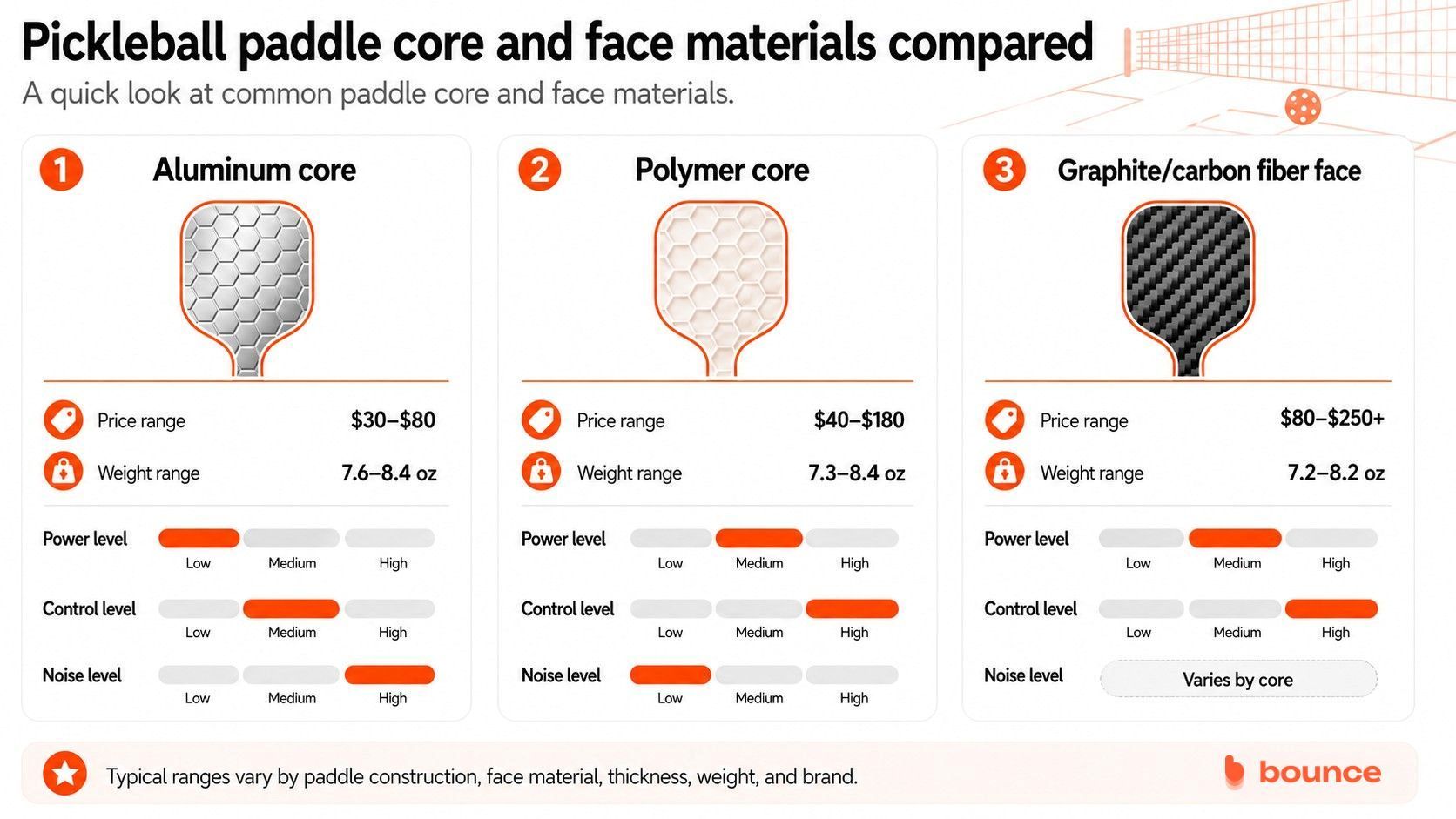
Polymer is the material that took over the recreational market for a reason. It's quieter, offers more control, and the polypropylene core is softer at contact, which is exactly what kitchen play demands. Graphite and carbon fiber go further: lighter, more spin-capable, and better suited to players who've developed enough touch to use that performance.
When you're choosing a pickleball paddle, the core material is the decision that shapes everything else. Face material, weight, and grip size matter, but the core determines the fundamental feel of the paddle.
Who aluminum paddles are actually for
4 types of players are well-served by aluminum:
Beginners on a strict budget. If you're spending under $50 and genuinely aren't sure whether you'll stick with the sport, an aluminum paddle is a reasonable call. The full breakdown of what you need to play pickleball shows how to get started for under $155 total, and an aluminum paddle fits that budget comfortably.
Casual players who are rarely on the court. If you're playing once a month, the performance ceiling on an aluminum paddle probably won't limit you. You're not developing kitchen mechanics yet, so the control deficit doesn't cost you much.
Players who received one as a gift. Use it. There's no reason to replace a functional paddle you already own until the game starts demanding more from you.
Kids just getting started. A durable, low-cost paddle that handles rough treatment without delaminating is a practical first choice. Once they're playing regularly, move them to something with more control.
Who should skip aluminum
If any of these apply, skip the aluminum paddle, even if it's cheap.
You're actively developing your game. The kitchen line is where pickleball points are won and lost. Dinks, drops, and resets all require soft hands and a paddle that responds to subtle input. Aluminum's rigid core works against that. The paddle doesn't misbehave. It just gives you less room to work with.
You're playing at community courts or indoor facilities. Aluminum paddles are significantly louder than polymer, running 10-15 dB louder on a typical hit. Research from the Acoustical Society of America documents how pickleball's sharp high-frequency impact noise is perceived more acutely than its raw decibel level suggests. Many parks, recreation centers, and HOA courts have noise ordinances specifically targeting pickleball. If you're finding pickleball courts near you, check the facility rules before showing up with an aluminum paddle.
You're planning to compete. Tournament legality is covered below. But beyond legality, competitive play at 3.0+ rewards control and shot variety. Aluminum's limitations become real liabilities.
Are aluminum pickleball paddles USA Pickleball tournament legal?
This one trips people up. The answer is: some are, some aren't, and it depends on the specific paddle model, not the material.
USA Pickleball evaluates paddles based on surface texture, deflection, and other performance specs. Aluminum paddles can appear on the approved list, but you have to verify your specific paddle's model number against the current approved paddle list. The material doesn't grant automatic approval.
If you're playing in a sanctioned event, check the list before you show up. If you're playing recreationally, it's irrelevant.
The noise difference: what it actually means on the court
Aluminum makes a distinct sound at contact: a sharper "ping" compared to the softer thud of polymer. That's the sound of a rigid core with less vibration dampening.
This matters for 2 reasons beyond the noise ordinance issue above.
First, other players will notice. On a crowded court with multiple games running, a loud paddle is a social friction point. Second, the noise is also feedback. A polymer paddle's quieter contact gives you better tactile information about where on the face you struck the ball. Aluminum's sharp response can actually mask off-center hits that you'd otherwise feel more clearly. Research published in Sports Engineering has documented how core stiffness affects vibration dampening and player feedback in racket-family sports, and the same physics apply to pickleball paddles.
When to upgrade from an aluminum paddle
The signal isn't a rating number. It's a pattern of errors you recognize.
If you're consistently popping the ball up at the kitchen, struggling to keep drops low, or losing control on reset shots despite working on your mechanics, the paddle is probably contributing. Aluminum paddles don't give you enough dwell time to execute the soft game at 3.0+.
The upgrade path is straightforward: move to a polymer core paddle with a fiberglass or graphite face in the $60-120 range. You don't need to spend $200 on your second paddle. The jump from aluminum to mid-range polymer is a bigger improvement than the jump from mid-range polymer to elite carbon fiber.
If you want a specific read on what your game actually needs, whether the paddle is the limiting factor or the technique, a certified pickleball coach can tell you in one session. Bounce connects players with certified instructors who can assess your mechanics and give equipment guidance based on what they actually see on court, not generic recommendations.
Conclusion
Aluminum paddles are functional. They're built to last and they cost less than almost anything else on the market. For a complete beginner or an occasional player, that's enough.
The honest issue is that pickleball rewards touch and control more than raw power, and aluminum's construction limits both. Most players find that out around the time they start caring about their kitchen game.
When you're ready to move on, the jump to polymer is worth it. And when you want to understand your game well enough to make that call confidently, organized coaching and consistent play are where that development happens. Bounce connects players with certified instructors and structured play formats in their city, across pickleball, tennis, and padel.
Frequently asked questions
Are aluminum pickleball paddles good?
For beginners and casual players, yes. Aluminum paddles are durable, affordable ($30-60), and generate solid power. The tradeoff is control, particularly soft shots at the kitchen line, and noise. As a starting paddle for someone new to the sport, aluminum is a reasonable choice. As a paddle for someone actively developing their game, it starts to work against you.
Is an aluminum pickleball paddle USA Pickleball tournament legal?
Some are, some aren't. USA Pickleball approves paddles based on specific model performance specs, not the core material. Check the approved paddle list for your specific paddle model before a sanctioned event. If you're playing recreationally, legality doesn't apply.
What is the difference between aluminum and polymer pickleball paddles?
The core material. Aluminum honeycomb is rigid and produces a loud, powerful hit with less dwell time at contact. Polypropylene (polymer) honeycomb is softer, quieter, and gives players more control, particularly on dinks and reset shots. Polymer paddles cost more ($50-120 vs. $30-60) but perform better at every skill level above beginner.
Are aluminum pickleball paddles too loud for community courts?
Potentially yes. Aluminum paddles produce a sharp "ping" that runs 10-15 dB louder than polymer on a typical hit. Many parks departments, HOAs, and recreation centers have noise ordinances that affect pickleball facilities. If your local court has noise restrictions, check the posted rules before playing with an aluminum paddle.
When should I upgrade from an aluminum paddle?
When you notice the kitchen game is consistently breaking down despite working on your mechanics. Aluminum's rigid core limits dwell time, which makes soft shots and resets harder to execute reliably. The upgrade path is a mid-range polymer paddle ($60-120), and the control improvement is immediate and significant.
How much does a good aluminum pickleball paddle cost?
Most aluminum paddles fall between $30 and $60. Spending more than $60 on an aluminum paddle is hard to justify: at that price point, polymer paddles start becoming available and offer better performance. If your budget allows $60-80, go straight to polymer.