What do you need to play pickleball?
You can start playing pickleball for about $95 to $155 if you buy smart.
You can also spend $400 before your first game and still own the wrong gear. That happens more often than beginners want to admit.
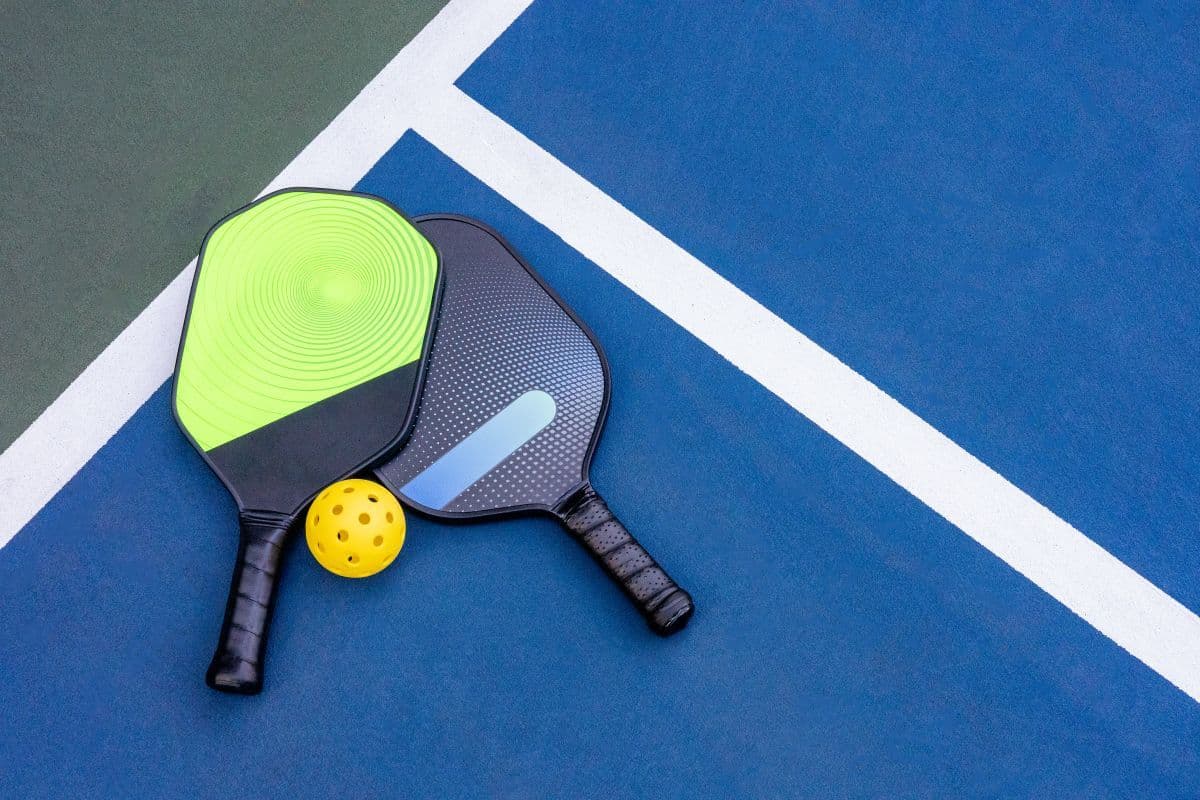
The starter list is short: court access, a beginner-friendly paddle, pickleball balls, and court shoes. Everything else can wait.
A nice bag, premium paddle, ball hopper, and matching outfit are fine once you know you like the sport. Buying all of it early turns a cheap test into an expensive guess.
Want a quick answer? To play pickleball, you need a court, a paddle, pickleball balls, and court shoes. A realistic beginner setup costs $95 to $155, with shoes taking priority because bad footwear can end your first month fast.
Before you buy gear: where will you actually play?
Most beginners ask which paddle to buy before they know where they are going to play.
Court access decides the ball type, shoe needs, cost, schedule, and whether you need your own gear on day 1. Start with where you will play, then buy around that reality.
Use Google Maps, your local parks department, club websites, and the USA Pickleball places to play directory. Look for open play times, beginner sessions, court fees, and whether loaner gear is available.
| Court type | Typical cost | What to expect |
| Free public courts | $0 | Crowds, mixed levels, informal rotation, low pressure |
| Public pay-per-play courts | $5 to $15 per session or hour | Scheduled access, better predictability, basic amenities |
| Private clubs | $30 to $100+ per month for basic access, more at premium clubs | Lessons, leagues, socials, cleaner scheduling |
| Schools, universities, resorts, recreation centers | Varies by facility | Good access if they allow community play |
If you want one place to connect the next steps, Bounce connects players with courts, coaches, lessons, leagues, and organized play in their city. Use it after you know the sport fits your schedule, or use it early if court discovery is the thing slowing you down.
If you have no court access nearby, hold off on the full gear purchase. Find the court first. Then buy based on how and where you will play.
The beginner gear checklist: budget-tier breakdown
The cheapest way to start pickleball is to borrow or rent gear for your first few sessions.
Once you know you want to keep playing, buy a starter setup. You need gear that is safe, durable enough, and forgiving while your timing is still rough.
Tier 1: starter setup, about $95 to $155
| Item | Starter budget | What to buy |
| Paddle | $40 to $60 | Composite or fiberglass paddle, standard shape, midweight |
| Balls | $15 to $25 | 4-pack of outdoor balls for outdoor hard courts, or indoor balls if your court requires them |
| Court shoes | $40 to $70 | Court shoes with lateral support and court traction |
| Bag | $0 | Use a backpack or small duffel |
| Total | $95 to $155 | Enough to play safely and comfortably |
For the paddle, start with a composite or fiberglass face. These are usually more forgiving on off-center hits than premium carbon paddles. A midweight paddle around 7.5 to 8.5 oz works for many adults, and the broader beginner range of 8 to 10 oz helps you avoid ultra-light paddles that punish mishits.
The deeper paddle choice comes down to weight, core, face material, grip size, and shape. The paddle selection process should come before buying based on a pro setup.
For balls, buy the type that matches your court. The USA Pickleball approved equipment database separates approved paddles and balls, which is useful if you want gear that can be used in sanctioned play.
For shoes, do not wear running shoes if you can avoid it. Running shoes are built for forward motion. Pickleball asks you to stop, shuffle, cut, and recover sideways. ASICS lists pickleball shoes built for court movement, including entry-level models in the $60 to $100 range.
Tier 2: committed setup, about $320 to $420
| Item | Intermediate budget | What changes |
| Paddle | $120 to $180 | Better control, feel, and consistency |
| Balls | $20 to $30 | Try different indoor and outdoor models |
| Shoes | $80 to $120 | Better cushioning and court durability |
| Accessories | $20 to $30 | Towel, overgrip, cover |
| Bag | $40 to $60 | Dedicated paddle bag |
| Total | $320 to $420 | Better fit for frequent play |
This is where upgrades start to make sense. If you are playing 2 or more times per week, your shoes and paddle will start telling you what they lack.
You may want more spin, more control, more power, or a grip that feels better in sweaty hands. Those are real preferences. Beginners usually do not know them yet.
Tier 3: advanced setup, $500+
This tier is for players committed to rated play, tournaments, and specific performance needs.
A premium paddle alone can cost $200+. Add backup paddles, tournament balls, frequent shoe replacement, grips, lessons, club costs, and travel, and the budget climbs quickly.
Start lower. Premium gear rewards clean contact and clear preferences. Beginners are still building both.
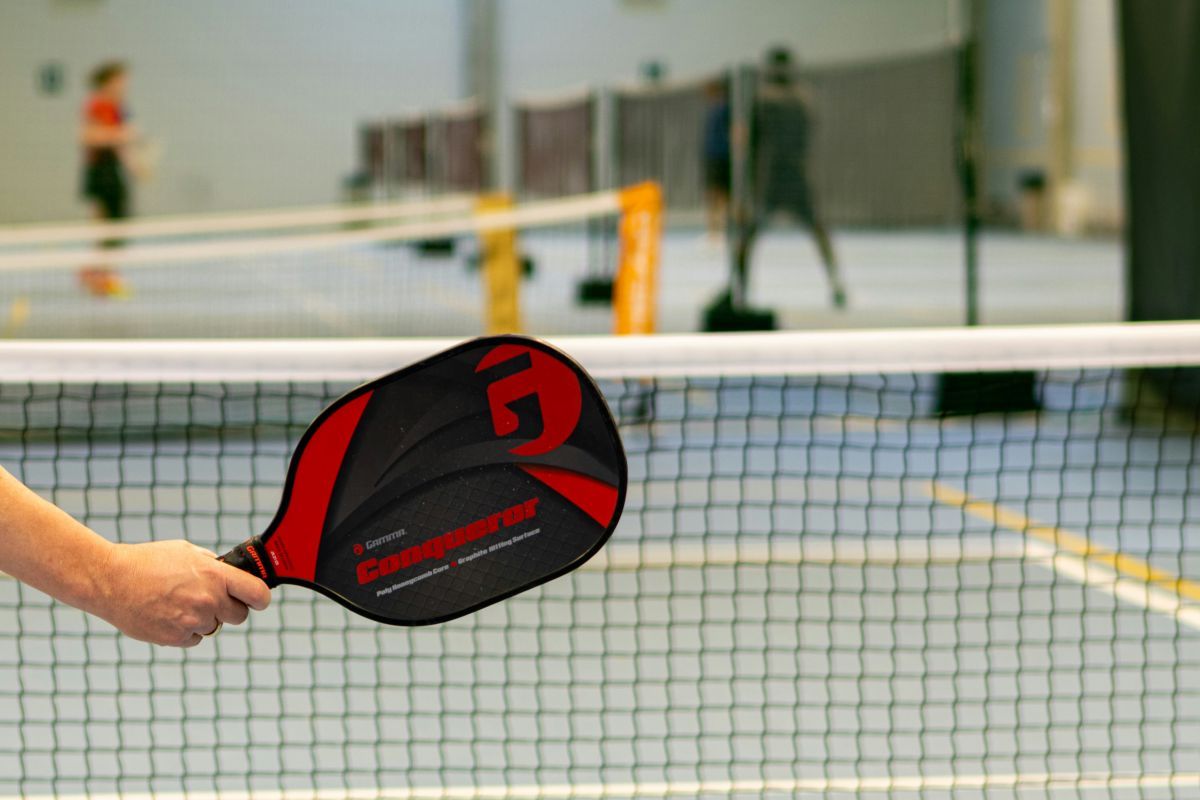
The essential gear explained: paddle
Your paddle matters less than beginners think during the first month.
A paddle has 4 parts you should understand:
- Face: the hitting surface. Material affects spin, power, sound, and feel.
- Core: the inside of the paddle. Most modern paddles use polymer honeycomb.
- Edge guard: the rim that protects the paddle from court contact.
- Handle and grip: the part that decides comfort, wrist position, and control.
For beginners, the best paddle is usually boring in the best way: midweight, standard shape, comfortable grip, and forgiving face. If you plan to play organized events later, check the USA Pickleball approved paddle list before buying so you know the paddle is legal for sanctioned play.
Paddle materials
Fiberglass is common in beginner paddles. It tends to feel lively, costs less, and gives new players enough power without needing perfect technique.
Composite sits in the middle. Many beginner and intermediate paddles use composite builds because they balance cost, durability, and feel.
Graphite usually costs more and gives better control. It is a better upgrade once you have cleaner contact and a steadier swing path.
Carbon fiber is popular for players who care about spin, control, and touch. Many beginners find it less forgiving until contact improves, which is why carbon fiber is usually a later purchase.
The approval label matters more than the material label if you ever play tournaments. USA Pickleball’s equipment database exists because approved paddles and balls must pass equipment testing before sanctioned use.
Paddle weight
Weight matters more than the logo.
A paddle under 7.3 oz feels quick, but it can make off-center contact feel worse. A paddle in the 7.5 to 8.5 oz range works for many beginners because it balances hand speed and stability. Heavier paddles can add power, but they also add fatigue.
Start in the middle. If your elbow or shoulder gets sore, go lighter. If every block gets pushed around by pace, you may need a little more mass.
Grip size
Most adult grips land around 4.25 to 4.5 inches.
Too large, and your hand gets tired. Too small, and you may squeeze too hard or flick the wrist too much. Neither helps.
Hold the paddle before buying whenever possible. If you order online, use a retailer with easy returns.
The simple rule: buy a paddle you can control for 10 games, not one that feels exciting for 10 swings.
The essential gear explained: balls
Pickleball balls look similar until you use the wrong one.
Outdoor balls are harder and heavier. They handle wind better and are built for hard courts. Indoor balls are lighter and softer, with a slower feel on gym floors or indoor surfaces.
Buy based on the court you will actually use. The USA Pickleball approved ball list labels balls by type, including indoor and outdoor, which makes it the cleanest source to check before you buy.
For beginners, a standard $15 to $25 4-pack is enough. You do not need premium balls for casual learning. The performance difference is too small to matter while you are still figuring out spacing, swing length, and footwork.
The common mistake is simple: indoor balls on outdoor courts, or outdoor balls indoors. Both feel wrong. Both make the game harder than it needs to be.
The essential gear explained: shoes
Shoes are the least exciting purchase and the easiest one to regret skipping.
Pickleball is full of lateral movement. You shuffle, split-step, recover, stop, and change direction in short bursts. Running shoes are built for forward motion, which makes them a poor fit for repeated side-to-side cuts.
Court shoes give you 3 things:
- Lateral support
- Court-specific traction
- A stable base for quick stops
| Shoe example | Typical price range | Why it works |
| ASICS GEL-DEDICATE 8 Pickleball | $60 to $90 | Entry-level court support and pickleball-specific positioning |
| New Balance 696v6 | $70 to $90 | Stable tennis court shoe, widely available |
| adidas GameCourt styles | $50 to $80 | Budget court traction and side-to-side support |
Do not get cute with this.
Casual sneakers are unsafe. Running shoes are a compromise. Worn-out tennis shoes with flat soles are another problem.
Good shoes cost $60 to $100. One ankle sprain can cost more than your entire starter setup. Cleveland Clinic also points to shoe height, ankle protection, and grip as part of staying safer on court.
Replace shoes when the sole is flat, the outsole separates, the upper tears, or your feet start hurting after normal sessions. If you play 3 or more times per week, expect replacement every 6 to 12 months.
Beginner gear mistakes that waste money
Most beginner gear mistakes come from buying for the player you want to become instead of the player you are today.
Mistake 1: buying the lightest paddle
Light paddles feel fast in the store. Then the ball hits off-center and the paddle twists. Beginners need stability more than speed. Start with a midweight paddle and adjust after 6 months of regular play.
Mistake 2: buying premium balls
A beginner can learn the serve, return, dink, and third shot with standard approved balls. Buy balls that match the court. Save the extra money for court fees or a clinic.
Mistake 3: buying an oversized paddle
A bigger paddle face sounds helpful. It can also reduce control and make technique sloppy. Standard paddle shapes are standard for a reason.
Mistake 4: skipping shoes to save $60
This is the bad one.
Shoes protect your feet, ankles, knees, and hips. The first time you slide sideways in running shoes, you will understand why court shoes exist.
Mistake 5: buying a full kit before testing the sport
Borrow gear for 2 to 3 weeks if you can. Plenty of clubs, recreation centers, and local players have loaner paddles. Use them. The best first purchase is the one you make after a few games.
Mistake 6: buying what the pros use
Professional players use gear that matches elite timing, strength, and shot selection. You need gear that helps you learn clean contact. That is a different job.
If your first few sessions feel chaotic, fix positioning, swing size, and shot selection before blaming the paddle. The beginner foundation will do more for most new players than another gear purchase.
Accessories that actually matter
Accessories are where beginners overspend fast. Start with the small stuff that solves real problems.
Towel or sweat rag, $5 to $15
A towel keeps your hands dry and helps clean the paddle face. Ball residue and court dust can fill the surface texture that helps create spin, so paddle cleaning is a real habit once you upgrade. The simple paddle care routine is enough for most players.
Overgrip, $3 to $8
Buy overgrip once your handle feels slippery or too thin. Most beginners can wait a few months.
Paddle cover, $10 to $30
A cover makes sense once your paddle costs $80+. For a $40 starter paddle, use your bag and avoid tossing it loose in the trunk.
Ball hopper, $20 to $40
Skip it unless you drill often. A hopper is useful for practice, not casual open play.
Water bottle, $10 to $25
This is basically mandatory. Nothing pickleball-specific is required.
String dampener, $3 to $5
Skip it. Most beginners will not notice enough difference to care.
Try before you buy: testing gear without committing
Treat your first paddle as a test purchase.
Borrow one at open play. Most players are happy to let a beginner try a paddle for a game, especially if you ask politely and return it quickly.
Try to notice 4 things:
- Does the paddle feel too heavy after 1 game?
- Does the grip feel too big or too small?
- Do off-center hits feel harsh?
- Can you control short shots without popping the ball up?
Some clubs and pro shops rent paddles for $5 to $10 per day. That is money well spent if it keeps you from buying the wrong $120 paddle.
Sporting goods stores can also help. You may not be able to hit with every paddle, but you can compare weight, grip shape, handle length, and balance.
For shoes, test fit matters even more. Try them in-store if possible. If you order online, use a return-friendly retailer and wear them indoors first to check fit.
Hold the paddle before buying. Test the shoes before committing.
Used vs. new: when secondhand gear makes sense
Used gear can save money, but inspect it like a player, not a bargain hunter.
Safe to buy used
Used paddles are fine if the face is intact, the edge guard is secure, and the paddle does not sound hollow or broken.
Used bags and covers are usually fine. Used balls are fine for casual play if they are round, uncracked, and still bounce normally.
Used shoes are riskier. Fit and support matter too much. Buy used shoes only if the soles have minimal wear and the upper still holds the foot securely.
Red flags
Do not buy a paddle with:
- Delamination
- Deep gouges
- A cracked edge guard
- A loose handle
- Dead spots across the face
Do not buy shoes with:
- Flattened soles
- Torn uppers
- Water damage
- Smooth outsole tread
- One side crushed down more than the other
For your first paddle, new is usually better because you get returns and warranty support. After that, used can make sense because you know your preferred weight, shape, and grip.
A used $120 paddle for $50 to $70 can be a smart second purchase. A used shoe with dead support is just a medical bill with laces.
The hidden costs: what gear does not cover
Court access and lessons usually become the bigger pickleball costs.
A beginner can spend $95 to $155 on gear and then spend far more over the year on places to play, coaching, and replacement shoes.
| Cost | Typical range |
| Public court drop-in | $5 to $15 per session |
| Basic public or facility pass | $30 to $100 per month |
| Private club membership | $100 to $300 per month |
| Group clinic | $20 to $50 per session |
| Private lesson | $50 to $150 per hour |
| Shoe replacement | $50 to $120 every 6 to 12 months |
| Ball replacement | $15 to $25 per pack |
| Local tournament | $30 to $80 per event |
For beginners who want structured help, 2 to 4 lessons can save months of bad habits. If you are trying to turn scattered open play into better reps, Bounce connects players with coaches, clinics, leagues, and organized games in their city.
That is usually a better investment than a premium paddle in month 1.
| Player type | Play frequency | Realistic annual cost |
| Casual | 1 to 2 times per week | $100 to $300 |
| Regular | 3 to 4 times per week | $500 to $1,500 |
| Competitive | 5+ times per week | $2,000+ |
The jump comes from court fees, lessons, shoe replacement, and tournaments. Gear gets you started. Access keeps you playing.
Seasonal and climate considerations
Your gear wears differently depending on where you play.
Hot climates are harder on shoes, grips, and balls. Outdoor courts bake materials, sweat breaks down grips faster, and hydration becomes part of your setup.
Cold climates create a different problem. Outdoor play may shut down for months, which pushes players indoors. That means indoor balls, different court surfaces, and more attention to shoe grip.
Humid climates chew through grips. If your hand slips in the first 20 minutes, buy overgrips sooner rather than later.
Outdoor players should expect more ball wear and shoe wear. Indoor players should pay closer attention to ball type and outsole grip.
If you travel for pickleball, keep the setup simple: paddle, shoes, balls, towel, water bottle. Buy extra balls locally if needed.
Beginner-to-intermediate progression: when to upgrade
Use your beginner setup for about 6 months unless something hurts.
That gives you enough time to learn your style. You will know whether you like power, control, touch shots, drives, dinks, singles, doubles, open play, or leagues.
Upgrade your paddle when:
- You play 2 or more times per week
- You have 50+ hours on court
- You know what feels wrong about your current paddle
- You are entering leagues, ladders, rated play, or tournaments
- You need a specific change, like more control or spin
Upgrade your shoes when:
- The soles are compressed
- The outsole is smooth
- Your feet or ankles hurt
- You play 4 or more times per week
- The upper no longer holds your foot securely
Do something useful with old gear. Keep it as a loaner, sell it locally, or donate it to a school, recreation center, or beginner program.
| Timeline | Gear move |
| Month 0 | Starter setup, $95 to $155 |
| Month 3 | Add towel, overgrip, cover if needed |
| Month 6 | Consider intermediate paddle, $120 to $180 |
| Month 12 | Replace shoes, $80 to $120 |
| Month 18+ | Buy based on clear preferences |
Building your local pickleball community
Gear gets you through the gate. Regular play makes you better.
Beginners need people to play with, players close enough in level, and coaches who can fix problems before they become habits. Random open play can help, but structure speeds things up.
- Find a court.
- Borrow or rent gear.
- Buy the starter setup.
- Find regular partners.
- Take a few lessons.
- Join organized play when you are ready.
If ratings come into the picture later, systems like DUPR and VAIR can help track player level. Day 1 is for games, feedback, and consistent reps.
Beginner gear checklist
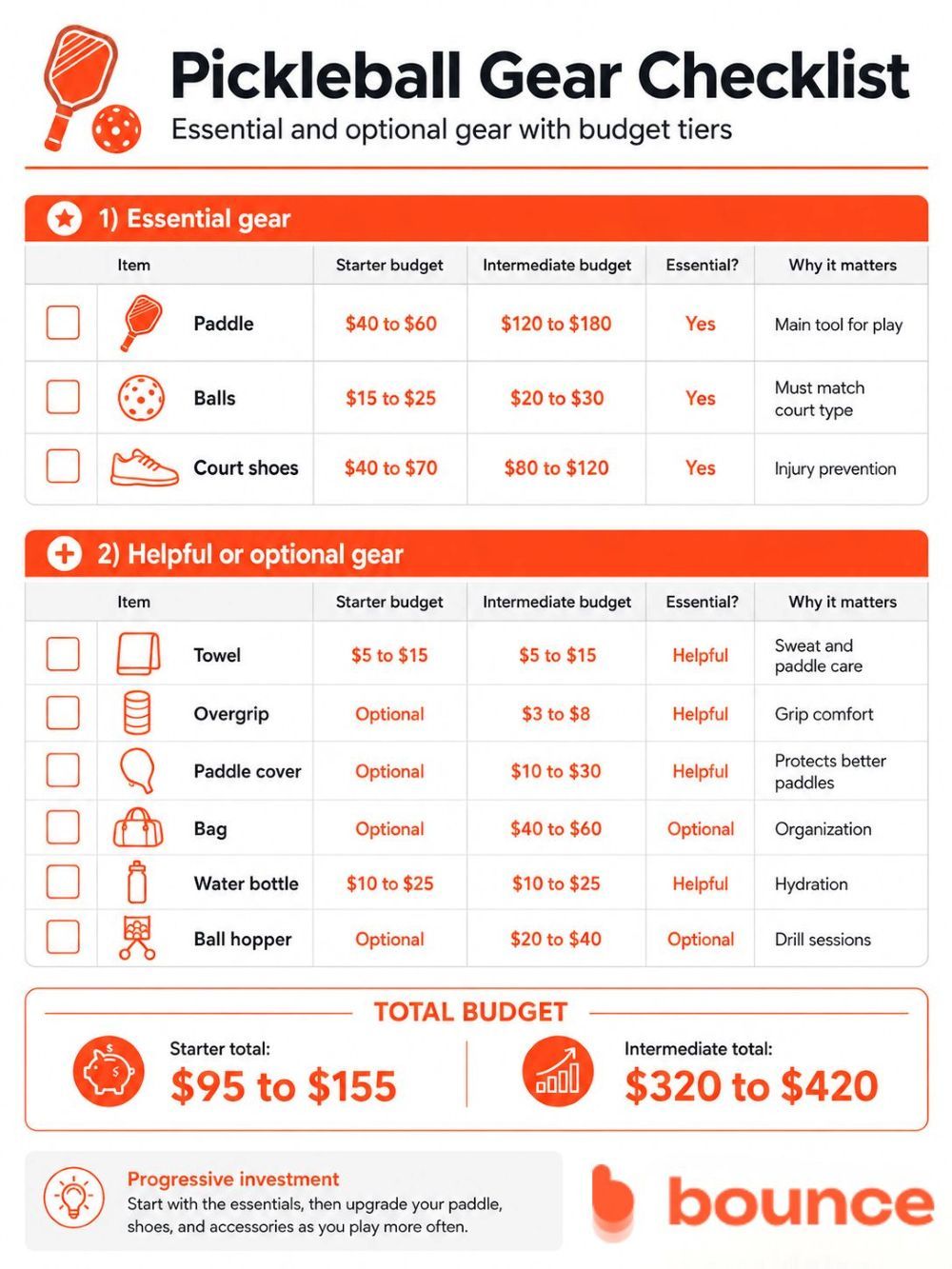
Beginner priorities:
- Court access
- Court shoes
- Beginner-friendly paddle
- Correct ball type
- Basic sweat and hydration gear
Start small. Upgrade when the sport earns more of your budget.
Conclusion
What do you need to play pickleball? Less than you think.
You need a court, a paddle, balls, and shoes that keep you safe during lateral movement. That starter setup can cost $95 to $155 if you buy carefully.
The bigger investment comes later: court access, lessons, regular partners, leagues, and replacement gear. That is where players either stay casual or start improving.
The smart path is simple. Find a court first. Borrow or rent gear for a few sessions. Buy beginner gear once you know you want to keep playing. Take a few lessons before bad habits settle in. Upgrade after your game tells you what you actually need.
When you are ready to move from occasional games to better games, Bounce can help you find courts, coaches, lessons, leagues, and organized play in your city.
FAQs
Can I play with borrowed gear as a beginner?
Yes. Borrowing gear is one of the smartest ways to start. Use a loaner paddle for a few games, learn what feels comfortable, then buy once you know you want to keep playing.
Do I need to buy everything at once?
Buy gradually. You need court access, shoes, a paddle, and balls. Accessories can wait until you know your habits.
What is the difference between pickleball shoes and court shoes?
Pickleball shoes are court shoes built around lateral movement, grip, and quick stops. Tennis shoes can work if they have strong side support. Running shoes are the weak choice because they are built for forward motion.
Is a $200 paddle worth it as a beginner?
For most beginners, skip it. A $40 to $60 paddle can work for your first 6 months. Spend the saved money on court time, lessons, or shoes.
Should I buy used or new?
Buy your first paddle new if possible because returns matter. Used paddles are fine later if you know what to inspect. Shoes are better new unless the used pair has very little wear.
What is the cheapest way to start pickleball?
Borrow a paddle, play at a free public court, and buy only court shoes if you need to spend money early. Once you commit, buy a starter setup for about $95 to $155.
When should I upgrade my paddle?
Upgrade after 6 to 12 months of regular play, or when you can clearly explain what your current paddle lacks. "I want a better paddle" is vague. "I need more control on resets and dinks" is useful.
Do I need separate gear for indoor and outdoor play?
Usually, only the balls change. The same paddle works indoors and outdoors. Shoes depend on the surface, but one good pair of court shoes can handle most beginner play.
What is a realistic annual budget if I play 2 to 3 times per week?
Plan for $500 to $800 if you pay for courts, replace shoes once, buy balls, and take a few lessons. Public court players may spend less. Club players may spend more.
Should I join a club as a beginner?
Start with public courts if you can. They are cheap and low pressure. Join a club once you know you like the sport and want better scheduling, coaching, leagues, and regular partners.