
The best padel booking software depends on the job your club needs done first: running reservations, controlling member relationships, reaching marketplace players, or increasing participation in clinics, leagues, and open play. A 4-court padel club with clean operations and empty off-peak slots has a demand problem.
A packed club with messy billing has an operations problem.
Buying one platform to cover every job usually wastes money. The costs show up as commission, staff time, double entry, and empty court-hours.
Want a quick answer? Playtomic fits clubs that need marketplace discovery in cities where its player network already has density. PlayByPoint and CourtReserve fit US clubs that need reservation, membership, payment, and reporting depth. OpenCourt and SliceWin fit clubs that want branded control. Bounce adds demand generation for clubs keeping their current reservation system.
For US padel clubs running 2 to 8 courts, the main decision is whether the business needs stronger operations, more player discovery, or a separate demand channel.
Why category matters before features
A useful software decision starts with the job the club needs done right now.
Padel demand is real, but it is uneven by city. The latest padel popularity statistics and growth trends show rapid global expansion, while booking density still depends on the number of active players and courts in each local market.
The International Padel Federation is the sport’s global governing body, and recent reporting has tracked sharp growth in Europe and North America. The Guardian reported that 860,000 Britons played padel at least once in 2025 and that UK courts reached 1,553 across 559 venues. AS, citing the 2026 Global Padel Report from Playtomic and Strategy& by PwC, reported that Spain reached 17,400 courts, with well-run clubs hitting 70% occupancy and 55% gross margins.
Those numbers make software decisions feel urgent. The risk is buying a tool for the wrong layer of the club.
The market breaks into four categories:
- Marketplace platforms connect a club to a player network, then handle discovery and booking. Playtomic is the clearest global example.
- White-label club management systems give clubs branded booking, memberships, payments, and scheduling. PlayByPoint, OpenCourt, CourtReserve, and SliceWin sit here.
- Demand generation platforms list a club’s programming where players are already searching. Bounce sits above existing reservation tools.
- Generic scheduling tools handle basic court calendars for small operators with a simple member-only strategy.
Clear padel levels also make clinics, leagues, and open play easier to market because players can see whether a session fits before they book.
Many growing US clubs with 4 or more courts eventually benefit from combining operations software with a demand-generation channel.
The Playtomic question
Playtomic sits apart because its player network is part of the product.
CincoDías reported in March 2025 that Playtomic had 6,000 clubs, 1.5 million monthly active users, operations in 63 countries, and more than €240 million in 2024 gross bookings after a €65 million funding round that named US expansion as a priority.
That scale matters when local players already use the app to find matches. A new club in a dense Playtomic city can get discovery from day 1. A club in a thinner US market should check how many nearby clubs already use the app before budgeting for marketplace demand.
Price matters too. Playtomic’s public materials leave the exact club commission rate to the sales agreement, so operators should ask for the rate, payout timing, refund policy, and subscription tier during sales.
The commission question is simple: how many bookings came from Playtomic that your club would have missed?
How each padel booking software platform fits a club operation
Bounce
Bounce is a demand-generation platform for racket sports clubs. Rather than replacing reservation or club management software, it helps clubs fill clinics, leagues, socials, camps, and open play by promoting their programming to players searching for racket sports in their city through the Bounce marketplace.
Clubs keep their existing operational systems, including CourtReserve, PlayByPoint, ClubCloud, AllBooked, and PodPlay, while using Bounce to increase visibility, registrations, and player acquisition through its marketplace. Clubs can also promote programming with featured placements, communicate directly with players, and measure performance through built-in analytics.
Best for: Clubs with existing reservation software that want to increase participation and fill unused court time.
Revenue model: Free listing, with paid Growth and Scale plans. No booking commission.
US availability: Yes, in supported city markets.
Playtomic
Playtomic is the global racket-sports marketplace best known for padel court discovery and match organization. Clubs list courts in the app, and players use the same profile across clubs where Playtomic has density.
Best for: Clubs in cities where players already search through Playtomic.
Revenue model: Commission plus subscription tier. Confirm the exact rate in the club agreement.
US availability: Yes. City density matters.
PlayByPoint
PlayByPoint is a US-built club management system for racket-sports facilities. It covers court reservations, member accounts, branded apps, payments, and program scheduling.
Best for: US padel clubs that want one operating system for reservations and members.
Revenue model: Subscription.
US availability: Yes.
OpenCourt
OpenCourt is a white-label club platform for operators who want the member relationship inside their own brand. Its strongest fit is a community-first club with leagues, private groups, recurring sessions, and local programming.
Best for: Clubs building a branded member experience and local community identity.
Revenue model: Subscription. Verify current booking-fee terms directly.
US availability: Yes.
CourtReserve
CourtReserve is a US-native club management platform covering reservations, memberships, leagues, staff roles, reporting, and events. It fits facilities that run padel beside tennis or pickleball and need one administrative system.
Best for: Multi-sport facilities or established clubs with layered membership programs.
Revenue model: Subscription.
US availability: Yes.
SliceWin
SliceWin is club software built around revenue retention for court owners. It supports padel and pickleball, uses QR onboarding for local discovery, and keeps the club in charge of player relationships.
Best for: Clubs that want full booking revenue retention and a local-first acquisition path.
Revenue model: Subscription with 0% booking commission.
US availability: Yes.
Padel booking software comparison by category and fit
| Platform | Category | Revenue model | Best fit |
| Bounce | Demand generation | Free / Subscription | Increase registrations for clinics, leagues, socials, and open play while keeping existing reservation software |
| Playtomic | Marketplace | Commission plus subscription tier | Discovery where Playtomic already has local player density |
| PlayByPoint | Club management | Subscription | US reservation and member operations |
| OpenCourt | White-label club management | Subscription, verify booking-fee terms | Branded community control and member ownership |
| CourtReserve | Club management | Subscription | Multi-sport clubs and complex membership programs |
| SliceWin | White-label club management | Subscription with 0% booking commission | Revenue retention and local QR onboarding |
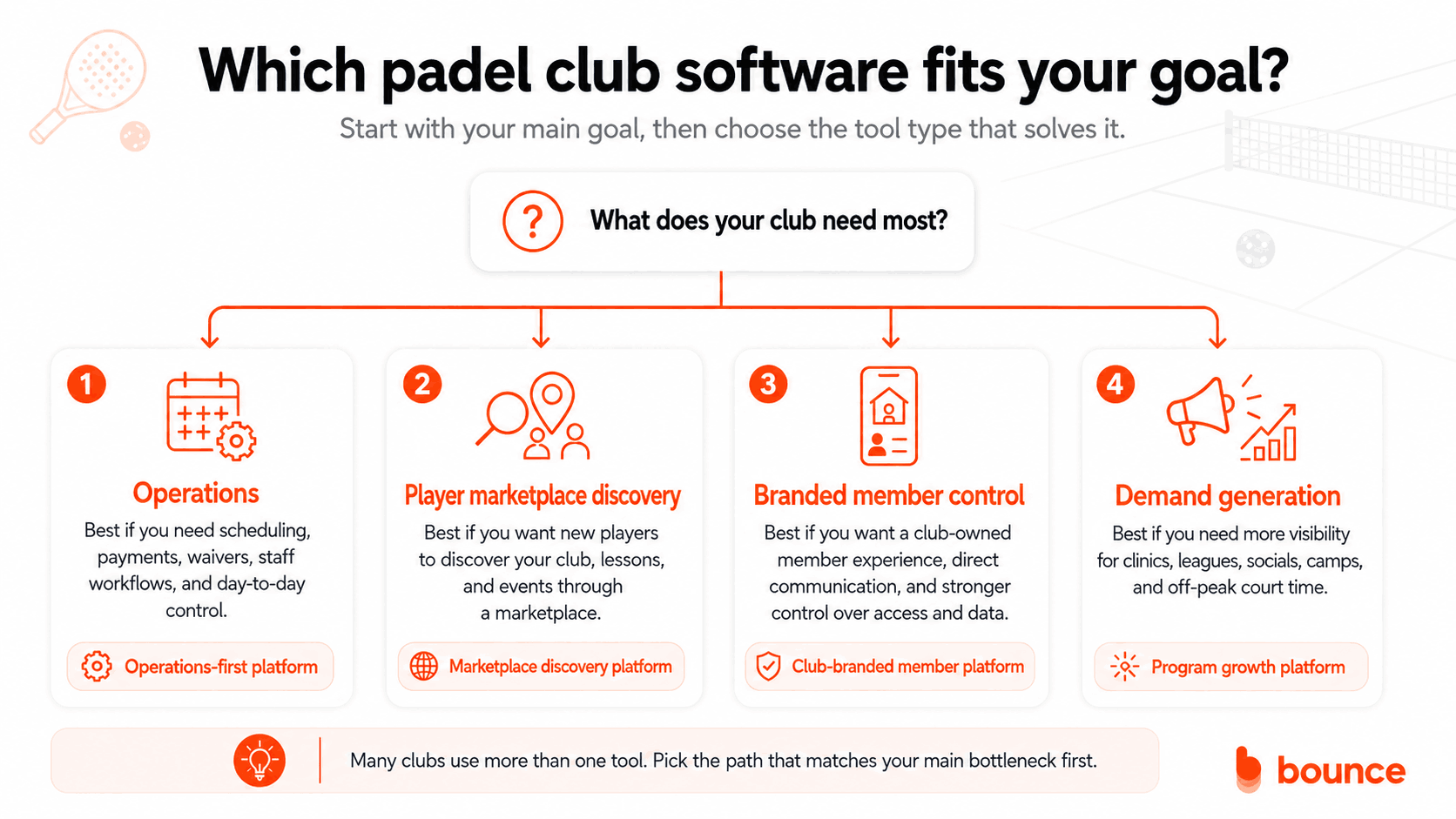
Start with the constraint that costs you money this month.
If empty public slots are the problem, choose a marketplace or demand layer first.
If messy member billing is the problem, choose club management first.
If brand-owned community is the problem, choose white-label management first.
If operations and discovery are both under pressure, run a club system with a demand layer.
A single platform can still be the right answer for a small club. A growing 4 to 8-court facility usually needs cleaner separation: one system that runs the club, and one channel that brings in players.
The common mistake: fixing administration and leaving demand thin
A club running CourtReserve with 200 active members and 4 courts has a working operating system. Payments process. Members book. Staff can see the calendar.
But if those 4 courts sit at 60% utilization, the remaining 40% is real inventory. At $30 per court-hour, 2 empty court-hours a day costs $60. Across 30 days, that is $1,800 in missed gross booking revenue.
The clubs that grow past that plateau add a player acquisition channel to their existing setup. Bounce features help clubs promote open play, socials, leagues, and clinics to players searching within supported markets.
Padel social formats convert well because new players can join a session before committing to membership. If they enjoy the session, they start asking about court positioning and shot selection, equipment choices, and recurring play. That is where casual discovery turns into a player pipeline.
Pick the problem before the platform

The software decision gets clearer when you separate the jobs. Playtomic is the marketplace bet. PlayByPoint, CourtReserve, OpenCourt, and SliceWin are operations bets. SetTime and Koalendar are starter scheduling bets. Bounce is the demand bet.
Most growing US clubs will end up with a stack: one tool for operations and one channel for demand.
Choose the job that fixes the revenue leak first. Then pick the platform that does that job cleanly.
For clubs building demand through structured coaching and organized play, Bounce connects your programming with players searching in your city.
FAQs
1. What is padel booking software?
Padel booking software is a system that allows players to reserve courts online while helping clubs manage availability, payments, customers and daily operations. More advanced platforms also support memberships, open matches, coaching, tournaments, access control and booking analytics.
2. What features should padel booking software include?
The most important features are real-time availability, online payments, split payments, cancellation management, memberships, recurring reservations and occupancy reporting. Clubs may also need open matches, coaching schedules, tournaments, access control and hardware integrations.
3. How can booking software help fill empty padel courts?
Booking software can publish open matches, notify players about newly available courts, promote off-peak time slots and offer variable prices. Some systems automatically create open matches from unused availability, reducing the amount of manual promotion required from club staff.
4. Can padel booking software find players for an incomplete match?
Yes. Platforms with open-match functionality allow players to reserve individual positions rather than the whole court. The Reddit discussions show that users also want filters based on location, availability, level, experience and playing style.
5. Can padel booking software send cancellation alerts?
Some systems offer waitlists or availability notifications, although the exact workflow varies. Cancellation monitoring addresses a major Reddit pain point because popular courts may be booked several weeks in advance.
6. Can padel booking software control doors and court lights?
Some platforms integrate with access-control and lighting hardware. Current Playtomic documentation says compatible integrations can generate a unique code for each reservation and automate when court lights turn on and off.
7. Is Playtomic the only padel booking software?
No. Playtomic is one prominent booking and club-management platform, but clubs can also evaluate marketplace systems, independent club software and white-label platforms. The best choice depends on local player adoption, required features, integrations, pricing and the amount of control the club wants over its customer data.
8. What is the difference between a private booking and an open match?
A private booking is normally used when the organizer already knows who will play and reserves the court for the group. An open match allows individual players to find the game, reserve a position and pay their portion.
9. Is padel booking software suitable for an unmanned club?
It can be, provided it supports automated access, temporary PIN codes, online payments, lighting controls and remote management. Clubs should also check how the platform handles failed access, refunds, support requests, connectivity problems and emergency overrides.