Padel and squash both use walls, but the similarity fades once the first point starts.
Padel is usually played as doubles on opposite sides of a net. Squash is usually singles, with both players moving through the same enclosed court. Padel gives beginners more time around the ball. Squash demands earlier preparation and faster recovery.
Want a quick answer? Choose padel if you want social doubles and a gentler first session. Choose squash if you want a fast singles game with higher cardio and lower-body demand.
What is the difference between padel and squash?
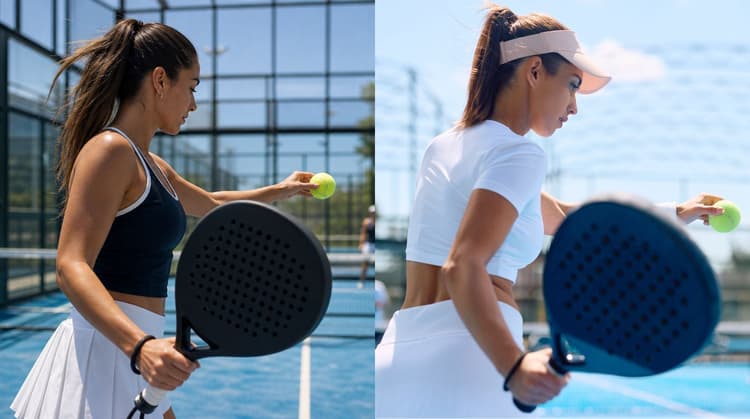
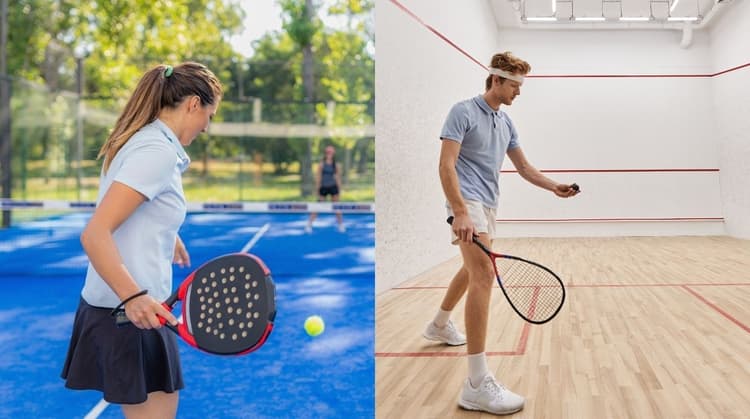
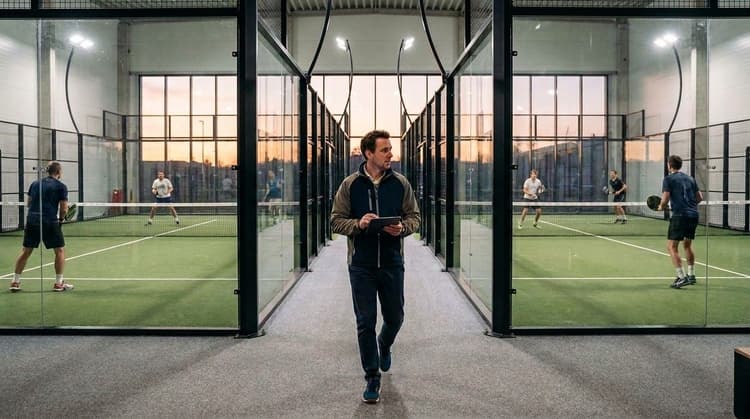
Padel is a doubles racket sport played on a 20m by 10m enclosed court. A net divides the teams, while glass walls and metal fencing keep the ball in play after the bounce.
Squash is usually played as singles on a 9.75m by 6.4m four-wall court. Both players share the same floor space and take turns sending the ball to the front wall.
That shared space changes the movement.
Padel partners defend one side of the net together. In squash, you must recover after every shot while giving your opponent a clear path to the ball and enough space to swing.
Padel gives beginners more time around the ball. Squash rewards early preparation and fast movement away from your own shot.
Court size and wall rules change the game
The official padel court dimensions are 20m long and 10m wide, measured inside the enclosure. The net divides the court into two equal halves.
A standard singles squash court is 9.75m long and 6.4m wide. World Squash publishes the technical specifications used for approved courts.
The walls work differently in each sport.
In padel, a return must bounce in the opponent’s court before touching their wall or fence. A player may also send the ball off their own wall before it crosses the net. These rules turn the glass into a defensive tool rather than a target for every shot.
In squash, a return can hit a side wall or back wall before reaching the front wall. The ball must reach the front wall above the tin and below the out-line before it bounces on the floor.
Padel walls often give the defender another chance to set up. Squash walls create sharper angles and reduce the time available for recovery.
Padel rackets, squash rackets, and ball feel
What is the difference between padel and squash?
Padel is a doubles racket sport played on a 20m by 10m enclosed court. A net divides the teams, while glass walls and metal fencing keep the ball in play after the bounce.
Squash is usually played as singles on a 9.75m by 6.4m four-wall court. Both players share the same floor space and take turns sending the ball to the front wall.
That shared space changes the movement.
Padel partners defend one side of the net together. In squash, you must recover after every shot while giving your opponent a clear path to the ball and enough space to swing.
Padel gives beginners more time around the ball. Squash rewards early preparation and fast movement away from your own shot.
Court size and wall rules change the game
The official padel court dimensions are 20m long and 10m wide, measured inside the enclosure. The net divides the court into two equal halves.
A standard singles squash court is 9.75m long and 6.4m wide. World Squash publishes the technical specifications used for approved courts.
The walls work differently in each sport.
In padel, a return must bounce in the opponent’s court before touching their wall or fence. A player may also send the ball off their own wall before it crosses the net. These rules turn the glass into a defensive tool rather than a target for every shot.
In squash, a return can hit a side wall or back wall before reaching the front wall. The ball must reach the front wall above the tin and below the out-line before it bounces on the floor.
Padel walls often give the defender another chance to set up. Squash walls create sharper angles and reduce the time available for recovery.
Padel rackets, squash rackets, and ball feel
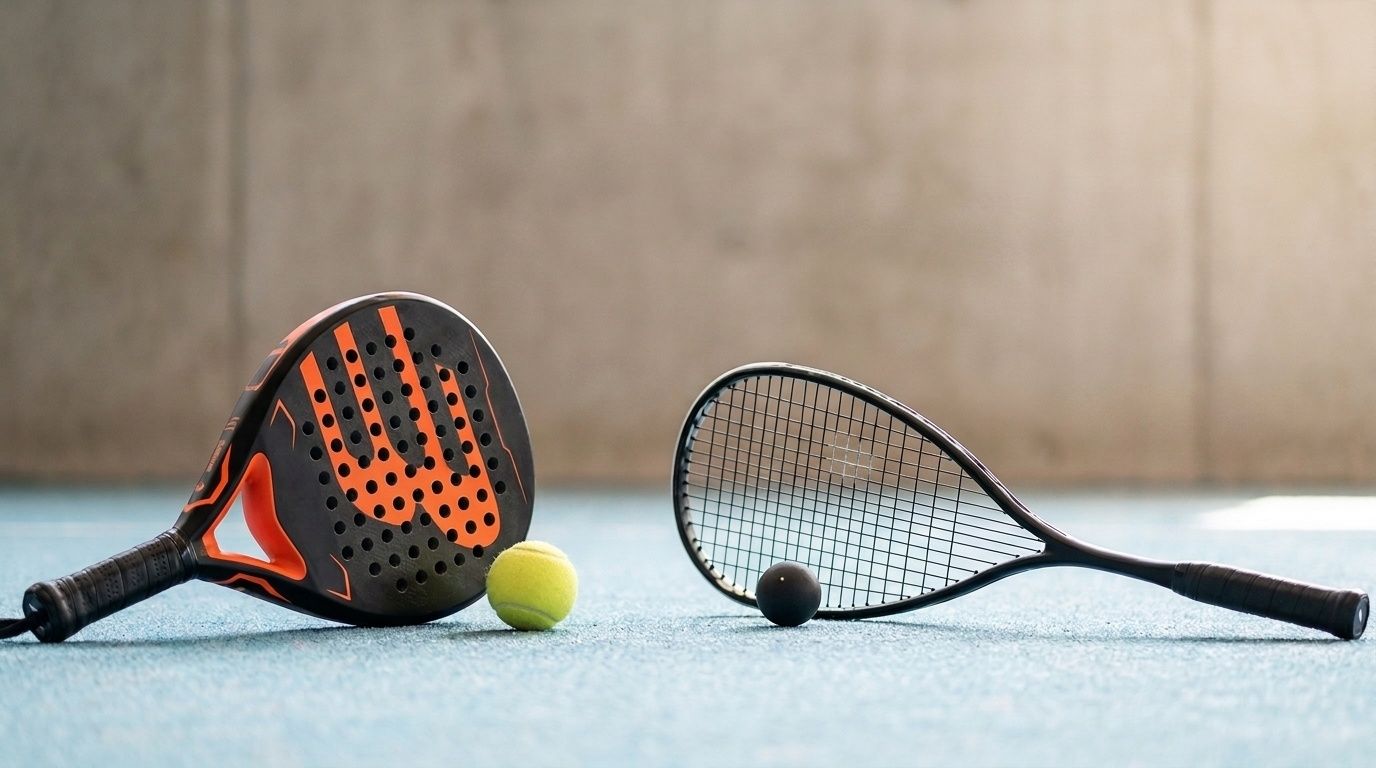
Padel uses a solid, stringless racket with holes through the face. The racket usually has a foam core and a fiberglass or carbon-fiber surface.
Under the International Padel Federation rules, a racket can measure up to 45.5cm long, 26cm wide, and 38mm thick. It must also have a non-elastic safety cord attached to the handle, and the player must wear that cord around the wrist.
A basic padel equipment setup includes a racket, padel balls, court shoes, and an overgrip once you own your racket.
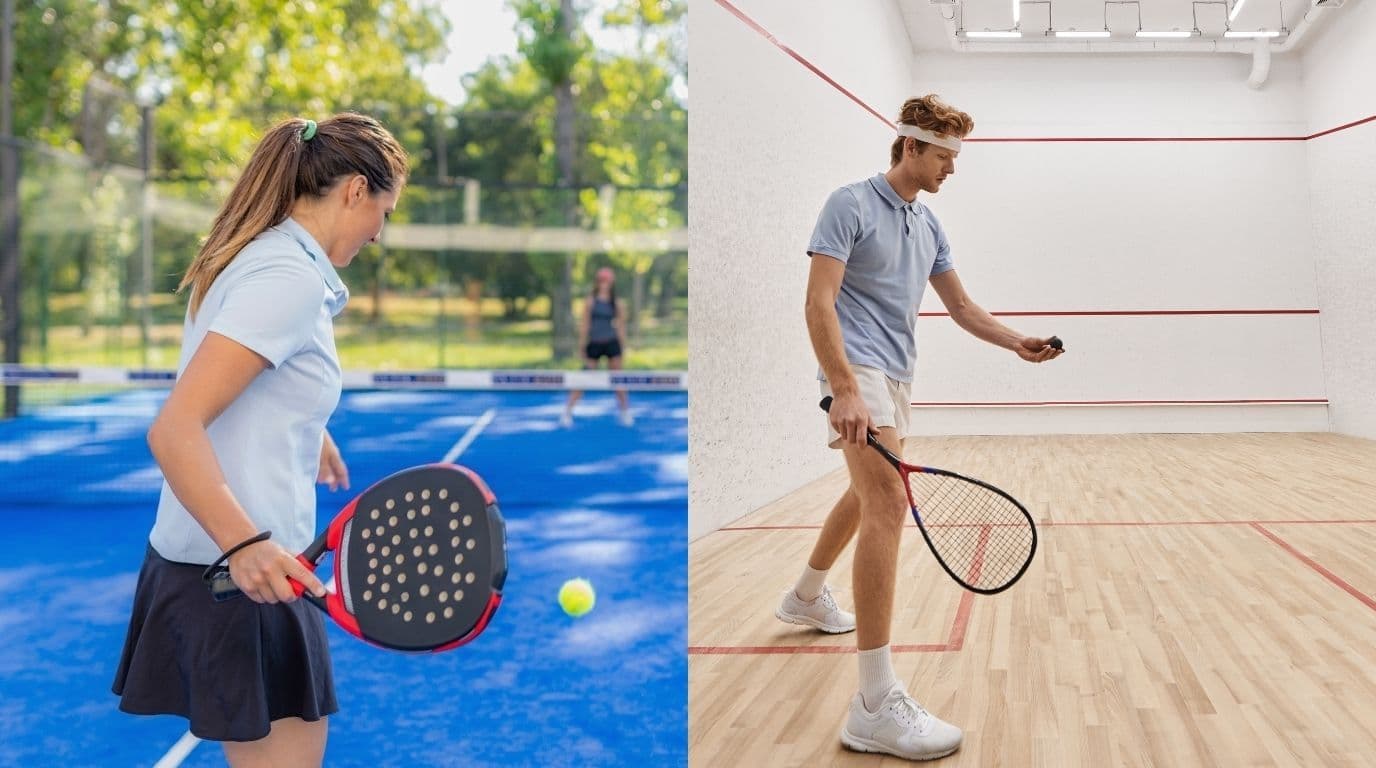
Squash uses a longer, strung racket. The longer handle gives players reach when retrieving balls from the back corners, while the strings create a different contact feel from a solid padel face.
The balls also behave differently.
A padel ball is close to a tennis ball in size but runs at lower pressure. It gives players a larger contact window and a more familiar bounce than a competition squash ball.
A squash ball is much smaller. Competition balls bounce low and need to warm up through repeated hitting. Beginner balls are larger or bouncier, which makes them easier to use before a player can generate enough pace.
Tennis players will recognize padel’s net and ball size. Pickleball players will recognize the solid racket face. Squash contact usually takes longer to judge because the ball stays lower and loses more speed after the bounce.
Rules and scoring
Padel uses tennis-style scoring: 15, 30, 40, and game. Standard sets are played to 6 games, with a 2-game margin required. A tie-break is normally played at 6-6.
The current FIP rules recognize advantage scoring, Star Point, and Golden Point formats. The format used can depend on the competition.
Padel serves follow a bounce. The server must:
- Stand in the correct service area.
- Bounce the ball inside the serving box.
- Strike it at or below waist height.
- Keep at least one foot on the ground.
- Send the ball diagonally into the opposite service box.
- Avoid touching the service line or imaginary center-line extension.
A server gets a second attempt after a first-service fault. The full padel serve rules also cover lets, fence contact, receiving order, and the updated bounce wording introduced in 2026.
Squash uses point-a-rally scoring. The player who wins the rally earns a point and serves next. Games are played to 11, and a player must lead by 2 if the score reaches 10-10. Matches are normally best of 5 games, although best-of-3 formats may be used.
For a legal squash serve, one foot must remain inside the service box without touching its boundary. The ball must hit the front wall between the service line and out-line, then land in the opposite back quarter unless the receiver volleys it.
Padel creates time; squash applies pressure
Basic padel strategy starts with controlling the net as a pair.
The serving team usually moves forward after the serve. From there, both players try to hold their position, cover the middle together, and wait for a ball they can attack cleanly.
When pushed to the back of the court, padel players can let the ball pass, read the rebound from the glass, and return it after the wall. A good lob can then push the other team away from the net.
Squash strategy starts with length and court position.
Players hit deep toward the back corners, recover toward the T, and try to make the opponent cover more ground. A loose shot near the middle gives the other player a chance to volley early or attack the front corners.
The wall skills may look related from outside the court. The timing is different.
Padel often rewards waiting for the rebound. Squash rewards taking the ball early and clearing space before the opponent arrives.
Which sport is easier to learn?
Padel is easier for most beginners.
Four parts of the game lower the entry point:
- The serve follows a bounce and is struck at or below waist height.
- Each team stays on its own side of the net.
- Partners divide the defensive workload.
- The larger ball creates a more comfortable contact window.
New players will still struggle with court position and glass rebounds. The basic rally usually develops sooner because the ball stays playable for longer and each person covers less court.
Squash has a steeper first month.
The ball stays low, both players share the same space, and poor recovery can block the opponent’s path. Beginners must learn to strike the ball and clear away from it in the same movement.
Early squash sessions often involve learning how to warm the ball, judge the back-corner bounce, return to the T, and avoid crowding the next shot.
For players starting with padel, Bounce lessons let you search for coaches by location, sport, skill level, and schedule. Early coaching can clean up partner spacing, glass reads, and footwork before those mistakes become habits.
Which sport is the harder workout?
Squash usually feels more intense.
One player handles every retrieval, and points involve repeated lunges, short bursts, and changes of direction. The rallies may be short, but the recovery demands arrive quickly.
Padel still provides a solid workout. Players move laterally, accelerate toward short balls, retreat for lobs, and stay engaged through longer rallies.
Doubles spreads the court between two people, so padel usually involves less constant sprinting and lunging than squash. The stop-start movement can still challenge the calves, ankles, and hips, especially during long matches.
Squash fits players who want higher cardio and lower-body demand in a compact session. Padel fits players who want repeatable doubles exercise with a stronger social element.
Injury patterns and body load
The two sports place stress on different parts of the body.
A systematic review of padel injuries found that the elbow was the most frequently reported injury site, followed by the knee, shoulder, and lower back. Tendon and muscle injuries were the most common types reported, although the researchers described the available evidence as limited.
Squash research points more heavily toward lower-limb soft-tissue injuries. Repeated lunging, braking, and direction changes place regular demand on the legs, while the shared court adds a risk of contact with the ball, racket, or another player.
World Squash recommends approved protective eyewear for every player during matches and warm-ups. Eye protection is mandatory in World Squash-sanctioned junior and doubles events.
Existing pain should guide the decision.
Players with elbow or shoulder trouble may need to manage racket weight and repetitive volleying in padel. Players who struggle with deep lunges or repeated hard stops may find squash more demanding.
Neither sport is universally safer. Your movement history, playing frequency, footwear, and technique all affect the load.
Padel vs squash comparison
| Category | Padel | Squash |
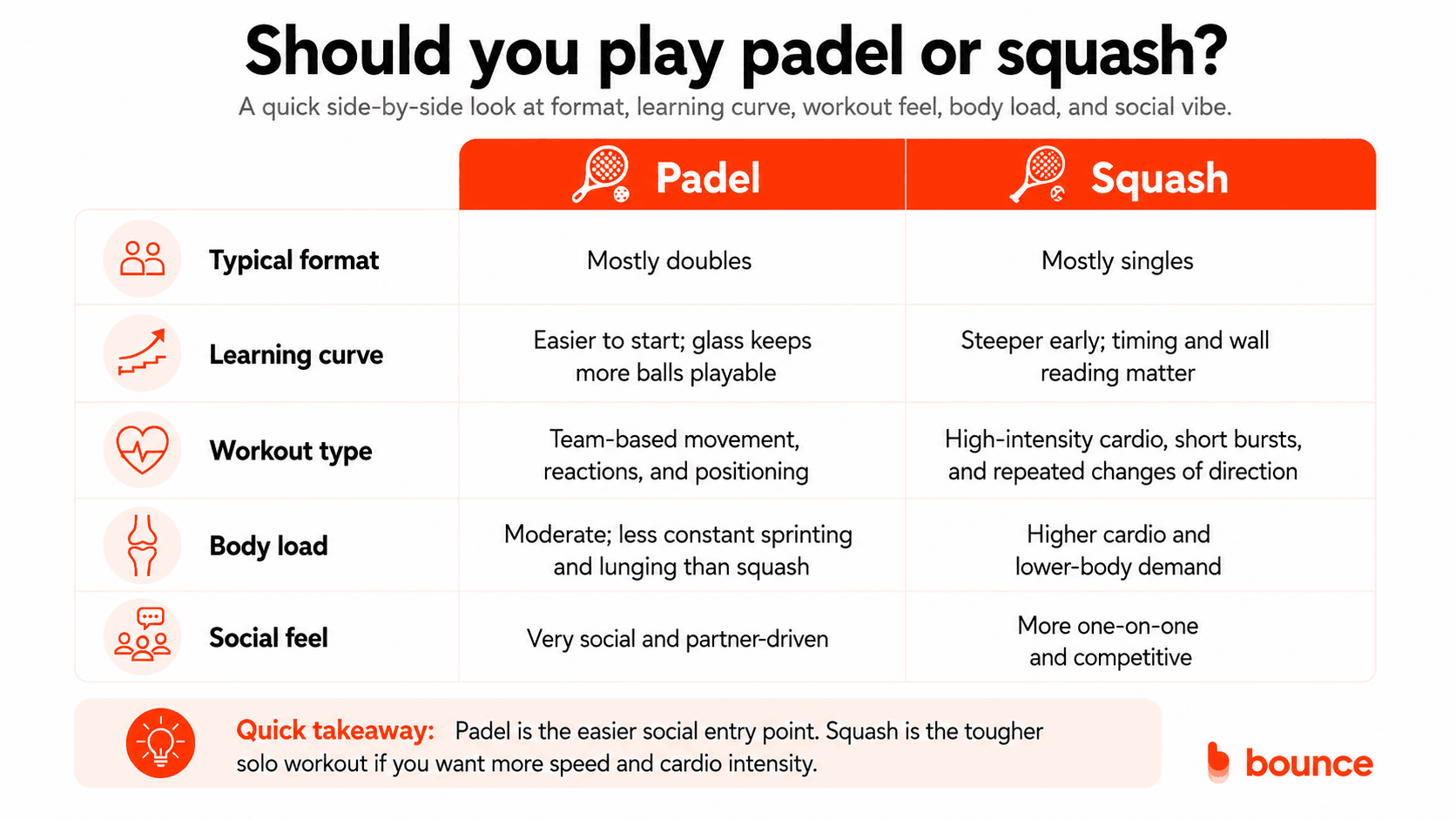
| Typical format | Doubles | Singles |
| Court | 20m × 10m enclosed court | 9.75m × 6.4m four-wall court |
| Net | Yes | No |
| Player space | Teams stay on opposite sides | Both players share the court |
| Wall use | The opponent’s wall comes into play after the bounce. Players may also use their own wall before returning the ball. | Side and back walls may be used before the ball reaches the front wall. |
| Racket | Solid, perforated, and stringless | Longer and strung |
| Ball | Larger and pressure-controlled | Smaller, with different bounce speeds available |
| Scoring | Tennis-style games and sets | Point-a-rally games to 11 |
| Serve | After a bounce, at or below waist height, and served diagonally | Served from a service box toward the front wall |
| Learning curve | Usually easier to begin rallying | More demanding early movement and ball control |
| Workout feel | Moderate, with less constant sprinting and lunging than squash | Higher cardio and lower-body demand |
| Best fit | Social doubles and longer rallies | High-intensity singles and tight-court movement |
Which sport should you choose?
Choose padel if you want social doubles, a faster learning curve, and more time to read the ball.
It suits casual players, tennis players looking for a new doubles format, and anyone who prefers shared court coverage. The glass takes time to understand, but it also keeps defensive balls playable.
Choose squash if you want singles, fast pressure, and a harder conditioning test.
It suits players who enjoy tight angles, individual problem-solving, and a game that demands immediate recovery after every shot.
Playing both is possible. The wall-reading skills transfer, but the movement habits need adjustment. Padel encourages pair positioning and controlled patience. Squash asks you to recover toward the T and clear your opponent’s path.
For players choosing padel, Bounce leagues provide structured matches against players near your level. Regular match play teaches positioning, scoring, and full-set decision-making faster than isolated hitting.
Conclusion
Padel and squash share enclosed courts and playable walls. The games demand different instincts.
Padel gives you a partner, a larger court, an underhand serve, and more time around the ball. Squash gives you singles pressure, tight angles, faster recovery demands, and a heavier conditioning test.
Start with the sport that fits the weekly habit you can maintain. A technically perfect choice means little if the court, schedule, or playing format keeps you from showing up.
For players building their padel game through coaching and organized play, Bounce connects you with coaches, leagues, open play, and clubs in supported cities.
FAQs
1. Is padel harder than squash?
Padel is generally easier for beginners to start playing, while squash is usually more physically intense. Padel still becomes highly technical at advanced levels, especially when players must master positioning, glass rebounds, lobs, volleys and overhead shots.
2. Which is a better workout, padel or squash?
Squash normally provides the more intense cardiovascular workout because singles players repeatedly accelerate, lunge and recover in a confined court. Padel can still provide substantial exercise, but recreational matches often contain more pauses and shared court coverage.
3. Do squash players make good padel players?
Squash players often adapt well because they understand angles, wall play, racket preparation and defensive movement. They may initially struggle with excessive wrist use, hitting too hard, padel volleys, lobs and the stronger rebound from glass.
4. What is the main difference between padel and squash?
Padel is normally played as doubles on a net-divided court enclosed by walls and glass. Singles squash is played by two opponents sharing one court and striking the ball onto the front wall.
5. Is padel easier to learn than squash?
Most beginners can sustain enjoyable padel rallies sooner because the serve is underarm, partners share the court and the ball is relatively lively. Squash demands more initial movement, ball control and understanding of shared-court positioning.
6. Why do squash players hit the ball too hard in padel?
Squash players are accustomed to walls absorbing more of the ball’s pace. In padel, a hard shot may rebound strongly from the back glass and give the opponents an easier return. Control, placement and patience are often more effective than maximum power.
7. Is squash losing popularity?
Squash participation and court availability vary by country. Although some Reddit users report local decline, squash is scheduled to make its Olympic debut at Los Angeles 2028, and its professional tour has recently reported increased investment and record player compensation.
8. Is padel losing popularity?
Current global data indicates continued growth rather than decline. The International Padel Federation reported more than 35 million players in 2025, along with annual growth in clubs, courts and registered federation members.
9. Is padel more social than squash?
Padel is normally played by four people, which naturally creates more conversation and group interaction. Squash requires only two players and is often more individually competitive, although the social experience ultimately depends on the club and participants.
10. Which sport should a beginner choose: padel or squash?
Choose padel when the priority is social play, beginner-friendly rallies and playing with friends. Choose squash when the priority is an intense workout, individual competition and a sport that requires only one opponent. Trying both is the best way to determine which format is more enjoyable.