A standard padel court is 20 meters long and 10 meters wide. That sounds like a builder detail until you start playing off the glass.
The court size explains why the lob matters, why the underarm serve works, and why positioning beats raw speed so often in padel.
Want a quick answer? A padel court measures 20 x 10 meters, or 65.6 x 32.8 feet. The net is 88 cm high at the center and 92 cm at the posts. The service lines sit 6.95 meters from the net on both sides, according to the International Padel Federation Rules of Padel.
This guide covers the official court size, net height, service boxes, wall heights, indoor clearance, lighting notes, and how a padel court compares to a tennis court.
Official padel court dimensions
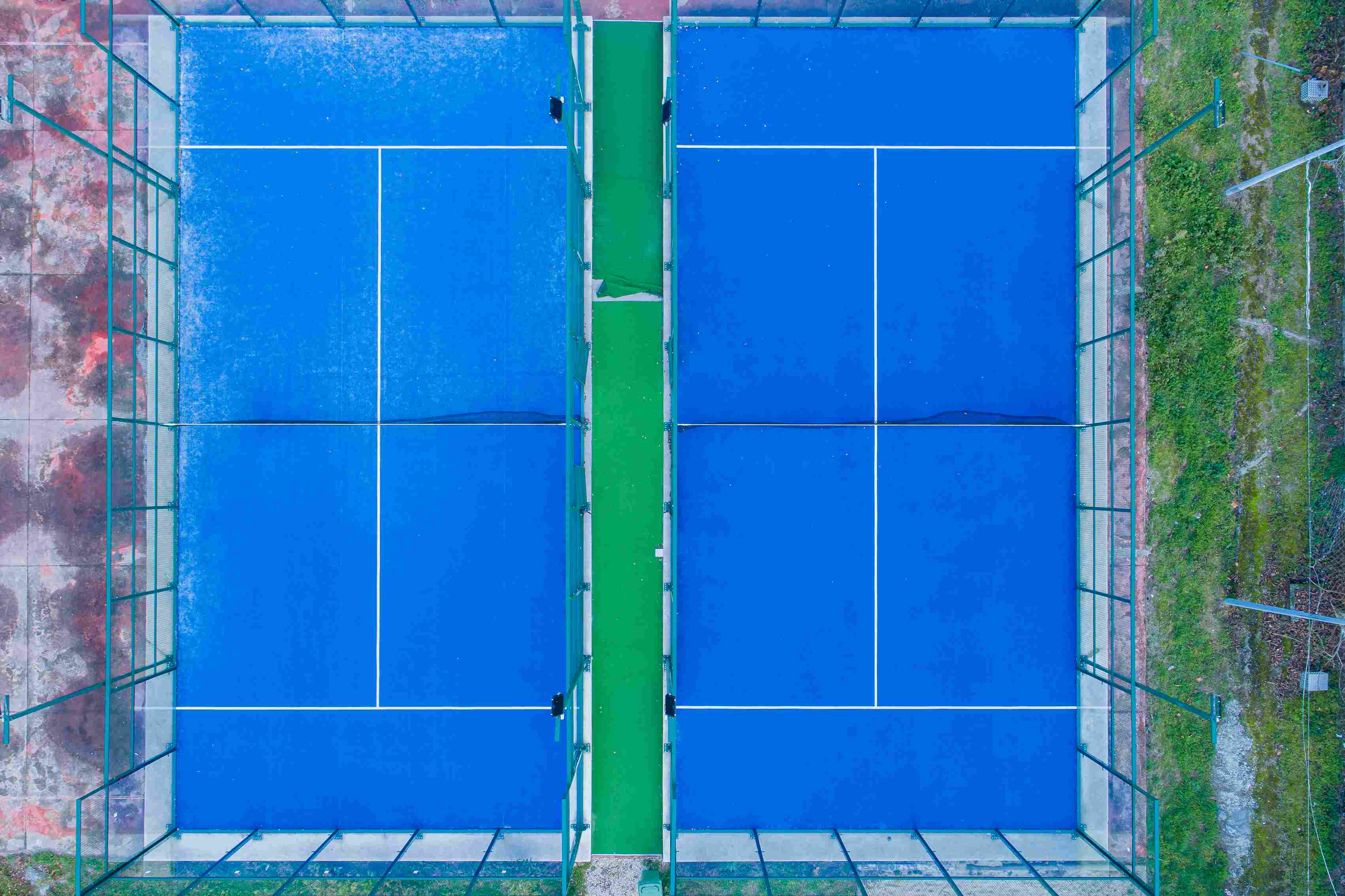
The official padel court is a rectangle with interior measurements of 10 meters wide by 20 meters long. FIP allows a 0.5% tolerance, but competitive courts are built to the 20 x 10 meter standard.
| Measurement | Official size | Feet and inches |
| Court length | 20 m | 65 ft 7 in |
| Court width | 10 m | 32 ft 10 in |
| Total playing area | 200 square meters | 2,153 sq ft |
| Net height at center | 0.88 m | 2 ft 10.6 in |
| Net height at posts | 0.92 m | 3 ft 0.2 in |
| Service line from net | 6.95 m | 22 ft 9.6 in |
| Line width | 5 cm | 2 in |
| Dimensional tolerance | 0.5% | 0.5% |
The numbers matter because they show the real shape of the game. Each half is only 10 x 10 meters, so you do not have much room to hide. The walls keep the ball alive, which means your court position gets tested over and over.
How a padel court is divided
The net splits the court into two equal 10 x 10 meter halves. Each half has a service area near the net and a back area near the glass.
Service boxes
The service line runs parallel to the net, 6.95 meters behind it. A center service line divides the service area into 2 boxes on each side.
Each service box measures 6.95 meters deep by 5 meters wide. There are 4 service boxes total.
The center service line extends at least 20 cm past the service line toward the back wall. That short extension helps define the service box boundary.
In padel, a serve must bounce inside the diagonal receiving service box. The lines count as good. A serve becomes a fault if it lands outside the box, hits the server or partner, or bounces in the box and then touches the metal fence before the second bounce.
The back area
The space between the service line and the back wall is 3.05 meters deep. This is where new players get exposed fast.
A ball that bounces, hits the back glass, and comes back into the court can still be played. So you need to learn when to step forward, when to let the ball pass, and when to use the wall.
Lines and markings
All court lines are 5 cm wide. FIP says line colors should contrast with the court surface, usually white or black.
For players, the practical rule is simple: if the ball touches a line, it is in.
Padel net height and net specifications
The padel net runs across the full 10 meter width of the court. It is lower in the middle and slightly higher at the posts.
| Net specifications | Official measurement |
| Net length | 10 m |
| Height at center | 88 cm |
| Height at posts | 92 cm |
| Net height tolerance | 0.5 cm |
| Top band | 5.0 to 6.3 cm white strip |
| Maximum post height | 1.05 m |
That 4 cm rise from center to posts creates the slight arc you see across the net. It also changes shot selection. The safest ball through the middle has more margin than a low ball near the side glass.
Padel wall height and enclosure rules
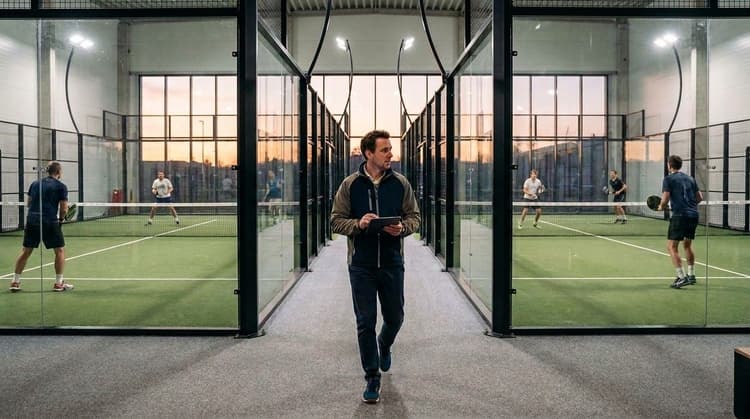
The walls are part of the court. They are where padel stops feeling like small tennis and starts feeling like its own sport.
FIP requires the court to be fully enclosed. The end walls are 10 meters wide and 4 meters high: the lower 3 meters are wall, and the upper 1 meter is metal fence.
The wall can be clear glass, brick, or another hard material that creates a regular bounce. Modern padel courts usually use tempered glass because players and spectators can see the ball cleanly.
End walls
End walls sit behind each baseline. They are 4 meters high in total.
| End wall section | Height | Common material |
| Lower wall | 3 m | Tempered glass |
| Upper fence | 1 m | Metal mesh |
| Total height | 4 m | Glass plus mesh |
Glass courts must meet FIP court homologation requirements. Many builders also reference EN 12150-1, the European standard for thermally toughened soda lime silicate safety glass.
Side walls
FIP allows 2 main side-enclosure variants.
| Side enclosure | What it means |
| Variant 1 | Stepped wall sections at both ends: first 3 m high x 2 m long, then 2 m high x 2 m long, with metal fencing completing the enclosure. |
| Variant 2 | A clear glass wall area at each end: 3 m high x 4 m long, with metal mesh completing the enclosure up to 4 m at the extreme ends. |
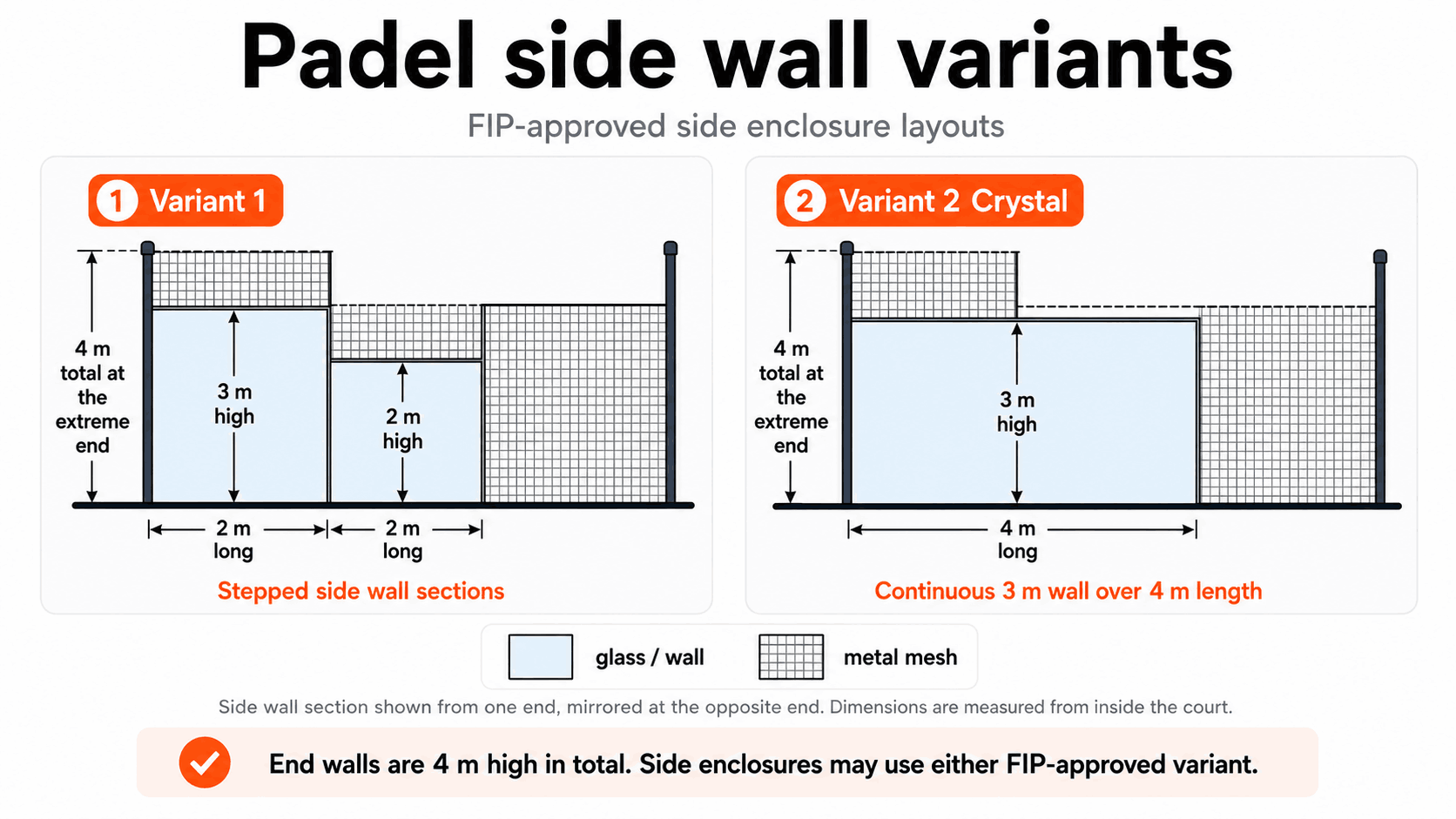
The short version: the back corners carry the main rebound play, so they need wall material that gives a clean bounce. The center side sections rely more on metal mesh because fewer standard rallies use those zones.
Singles padel court dimensions
Doubles is the standard version of padel. Singles padel exists, but dedicated singles courts are rare.
| Format | Length | Width | Playing area |
| Doubles padel | 20 m | 10 m | 200 square meters |
| Singles padel | 20 m | 6 m | 120 square meters |
A singles court keeps the same length and narrows the width to 6 meters. A standard doubles court can be adapted for singles practice, but the side walls stay at the wider doubles position, so the angles do not play the same.
Padel court vs tennis court dimensions
If you come from tennis, the padel court will feel tighter right away. The playable area is about 23% smaller than a doubles tennis court.
| Measurement | Padel court | Tennis court, doubles |
| Length | 20 m | 23.77 m |
| Width | 10 m | 10.97 m |
| Total playing area | 200 square meters | 260.8 square meters |
| Net height at center | 88 cm | 91.4 cm |
| Walls | Yes | No |
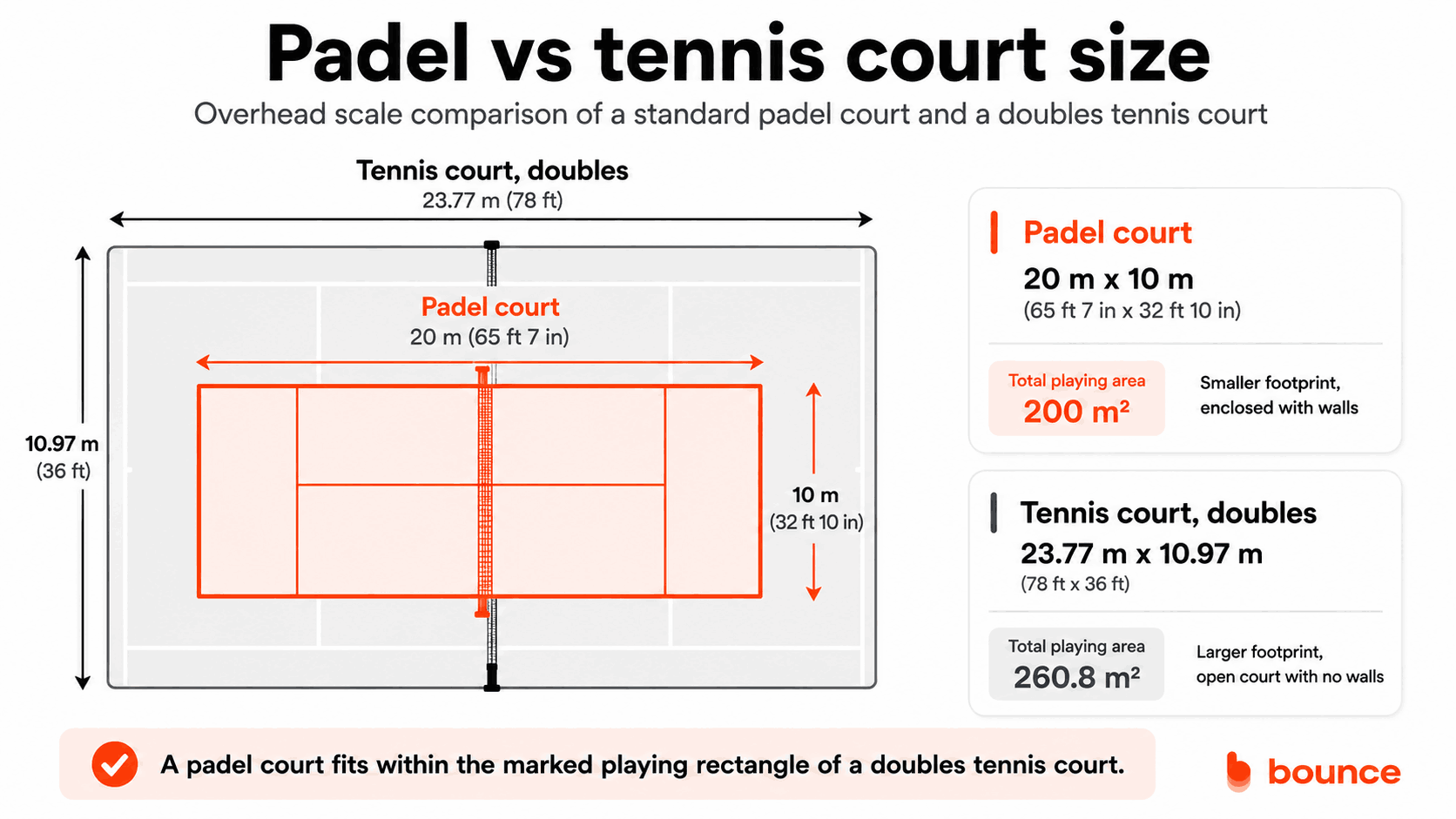
The smaller footprint changes the pace. You cover less raw distance, but you make more decisions after the ball hits glass. That is why long rallies are common and why a player with good timing can beat a player with more power.
If you’re comparing racket sports, the biggest differences show up in court size, equipment, rules, and how rallies actually play out. The padel vs pickleball guide goes deeper on that comparison.
If you are deciding where to play next, Bounce helps players find racket sports programming by city, including padel sessions where available.
Total court footprint and indoor clearance
The official 20 x 10 meter rectangle is the interior playing area. A real facility needs more space for structure, access, safety, and movement around the court.
| Requirement | Recommended planning number |
| Interior playing area | 20 x 10 m |
| Practical minimum footprint | 21 x 11 m |
| Better planning footprint | 22 x 12 m |
| FIP minimum free height | 6 m |
| FIP suggested free height for new facilities | 8 m |
| Out-of-court play safety area | At least 3 m wide by 4 m long on each side |
The LTA padel court guidance is useful for facility planning because it gets into build details like sub-base gradients, drainage, and construction standards.
Indoor height matters because lobs are a major part of padel. Six meters is the minimum free height. Eight meters is the better target for new courts.
For players, the same geometry shows up in match play. If you are still learning how to use the back glass and side glass, the padel tips guide covers the positioning habits that matter first.
For organized play, Bounce gives players a way to move from casual court time into structured matches and local racket sports communities through leagues and socials.
Lighting standards for padel courts
FIP says artificial light must be uniform and placed so it does not create vision problems for players, umpires, or spectators.
For television and filming, FIP calls for at least 1,000 lux of vertical illumination. Light projectors must sit at least 6 meters from the ground. For new facilities, FIP suggests 8 meters when lights are installed inside the court projection.
That sounds like facility language, but players feel it fast. Bad lighting makes overheads harder, hides ball spin, and turns glass rebounds into guesswork.
Why padel court dimensions shape the way you play
The 20 x 10 meter court gives players enough room to defend, but not enough room to drift. You are always close to a wall, a partner, or the net.
The 6.95 meter service depth helps explain the underarm serve. The court gives the server enough room to place the ball diagonally, then move forward without turning the point into a tennis-style serve contest.
The walls change the shot menu. A hard shot that would end a tennis point may come back off the glass in padel. A patient lob can buy time, move opponents away from the net, and reset the point.
Equipment follows the court. Padel rackets are solid, perforated, and shorter-handled because the game is built around compact swings, wall rebounds, and fast reactions.
The padel equipment guide breaks down what that means for rackets, balls, shoes, and beginner gear.
The bottom line
A padel court is 20 meters long, 10 meters wide, and fully enclosed. The net is 88 cm high at the center. The service lines sit 6.95 meters from the net. The end walls are 4 meters high, with 3 meters of wall and 1 meter of metal fence.
Those dimensions are the reason padel rewards positioning so much. The court is small enough to keep 4 players involved, tall enough to make lobs matter, and enclosed enough to make the wall part of every rally.
For players building their game through structured coaching and organized play, Bounce connects you with coaches, court opportunities, leagues, socials, and racket sports programming in your city.
Frequently asked questions
What are the official padel court dimensions?
A standard padel court is 20 meters long and 10 meters wide. In feet, that is 65 ft 7 in by 32 ft 10 in. These are the official FIP dimensions for doubles padel.
What are padel court dimensions in meters?
Padel court dimensions in meters are 20 m long by 10 m wide. The total playing area is 200 square meters.
What are padel court dimensions in feet?
Padel court dimensions in feet are about 65 ft 7 in long by 32 ft 10 in wide. Many simplified guides round this to 66 x 33 feet, but the official metric size is 20 x 10 meters.
How high is the net on a padel court?
The padel net is 88 cm high at the center and 92 cm high at the posts. It spans the full 10 meter width of the court.
How big is a padel service box?
Each padel service box is 6.95 meters deep and 5 meters wide. There are 4 service boxes total, 2 on each side of the net.
How high are padel court walls?
The end walls are 4 meters high. The lower 3 meters are wall, usually glass, and the upper 1 meter is metal fence. Side wall height depends on the FIP-approved enclosure variant used.
How much space do you need for a padel court?
The interior court is 20 x 10 meters. For planning, allow at least 21 x 11 meters, and preferably 22 x 12 meters, so the structure and surrounding space fit properly.
What is the minimum ceiling height for an indoor padel court?
FIP requires a minimum free height of 6 meters across the court. For new facilities, FIP suggests 8 meters of free height with no obstructions.
Can a padel court fit inside a tennis court?
Yes. A padel court is smaller than a doubles tennis court. A padel court is 200 square meters, while a doubles tennis court is about 260.8 square meters.
Is singles padel the same court size as doubles padel?
No. A singles padel court is 20 meters long and 6 meters wide. The standard doubles court is 20 meters long and 10 meters wide.