You are at game point in Game 2. Someone says, “Switch sides.”
Your partner walks to the other end. You follow. Someone else says, “Wait, do we switch now or after?”
That small pause tells you why this rule causes so many arguments. The basic version is easy. The match-format version is where players get sloppy.
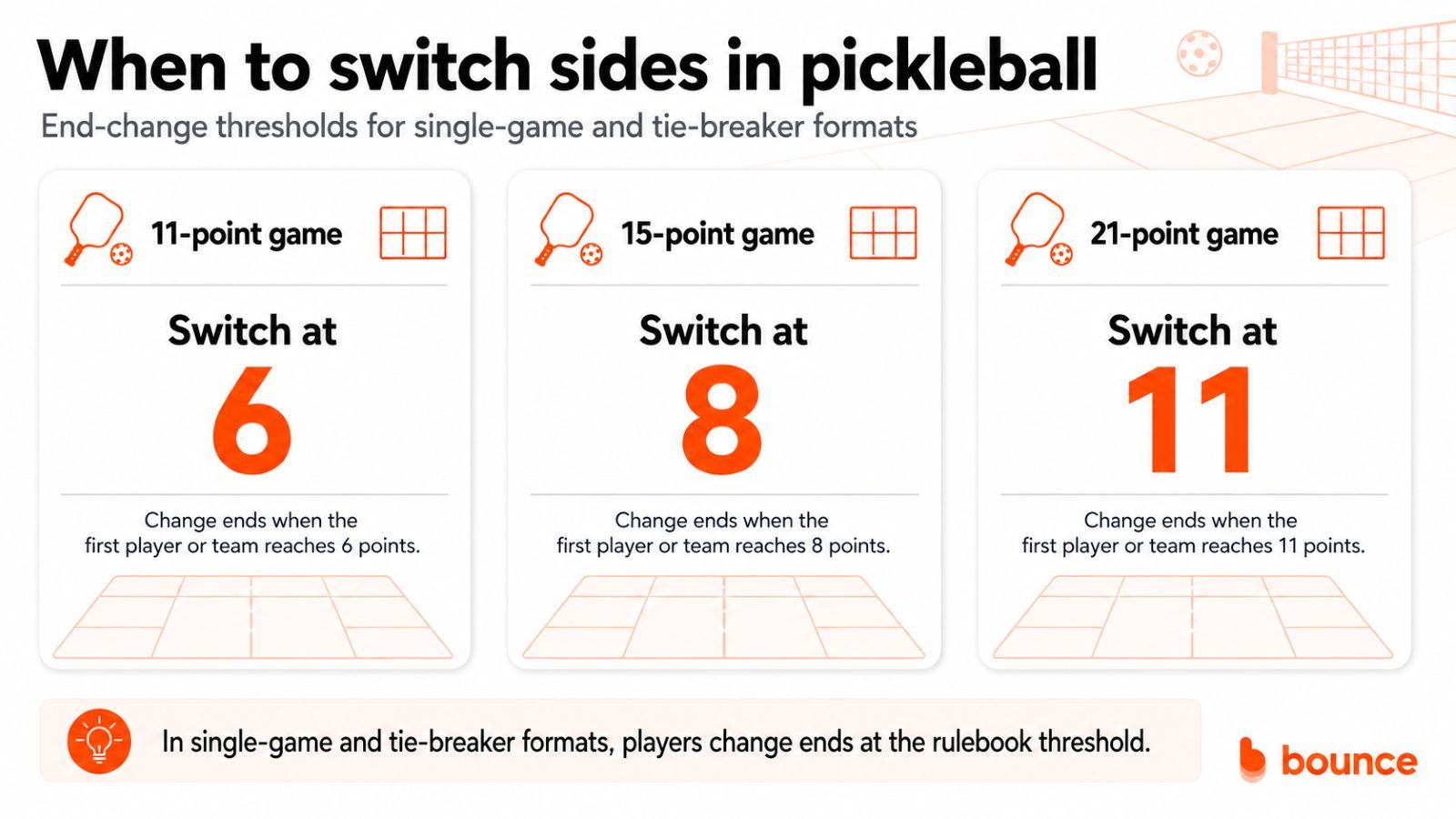
Want a quick answer? In pickleball, you switch ends after every game in a match. In an 11-point deciding game or tie-breaker, players switch when the first player or team reaches 6. In tournament formats, 15-point games switch at 8 and 21-point games switch at 11.
This breakdown covers end changes between games, mid-game switching, singles positioning, doubles service order, and what to do when your group forgets to switch on time.
Between games: switch ends after every game
Teams switch ends after each completed game.
You finish Game 1, then both teams walk to the opposite end before Game 2 starts. If the match goes to Game 3, you switch again before that game starts.
The official USA Pickleball rulebook page explains that the rulebook governs how the game is played and is updated at the beginning of each year. In the 2026 Official Rulebook, players are given up to 2 minutes between games to change ends.
That means the next game starts from the other end of the court. It also means the initial service setup resets for that game.
For a deeper pickleball rules base, start with the core pieces: scoring, faults, kitchen rules, and the serve sequence. Those four areas explain most of the confusion that happens during real games.
The third game: switch when one side reaches 6
In a best-of-three match, the third game is the deciding game. If that deciding game is played to 11, teams switch ends when the first player or team reaches 6 points.
Do not wait for both teams to reach 6. The trigger is the first side to get there.
Example: your team leads 6-3 in Game 3. The rally ends, the score becomes 6-3, and both teams switch ends. Play resumes from the new end.
The server does not change just because you switched ends. After the end-change timeout, play continues with the same server.
That detail matters. A side switch changes where you stand on the court. It does not erase the service sequence.
Tournament games: 11, 15, and 21-point thresholds
Tournament formats can use single-game matches or tie-breaker games to 11, 15, or 21. The end-change threshold depends on the game length.
According to the 2026 USA Pickleball Official Rulebook:
| Format | When players switch ends | What happens after the switch |
| 11-point single game or tie-breaker | First player or team reaches 6 | Same server continues |
| 15-point single game or tie-breaker | First player or team reaches 8 | Same server continues |
| 21-point single game or tie-breaker | First player or team reaches 11 | Same server continues |
| Between games in a match | After each completed game | Initial service changes for the next game |
A common mistake is mixing up service-court movement with end changes. Odd and even scores decide which service court a player uses. End changes are about walking to the opposite end of the net.
Players preparing for structured competition should know this before match day. Bounce leagues and tournament-style formats are useful for that exact reason: you learn the rules under real scoring pressure, with less guessing between points.
If you are playing outside a USA Pickleball event, check the posted rule set before the match. The Global Pickleball Federation rulebook page is another reference point for international play, but the event director’s posted rules control the event.
What happens if you forget to switch?
If players miss the required end change, the fix is simple. Switch ends when the mistake is noticed.
The score stays the same. Nobody gets a fault. The same server continues.
This is one of the most useful parts of the rule because it prevents a small mistake from turning into a bigger argument. Correct the court position, confirm the score, and keep playing.
In rec play, this usually sounds like:
“Score is 7-4-1. We should have switched at 6. Same server. Let’s switch now.”
That is enough.
Why pickleball players switch sides
Side-switching exists because court conditions are rarely equal.
Outdoor courts can have one end facing sun glare. Wind can carry lobs long from one baseline and hold drives up from the other. Even the background behind the court can make the ball harder to read from one direction.
Switching ends spreads those conditions across the match.
Indoor play usually reduces the effect. Lights, walls, ceiling height, and background contrast still vary, but sun and wind are mostly gone. The rule still applies.
If you are choosing where to play, Bounce courts can help you find nearby pickleball and tennis courts. For outdoor courts, check sun direction, shade, wind exposure, and fence background before you assume both ends play the same.
Singles side switching is different from service-court positioning
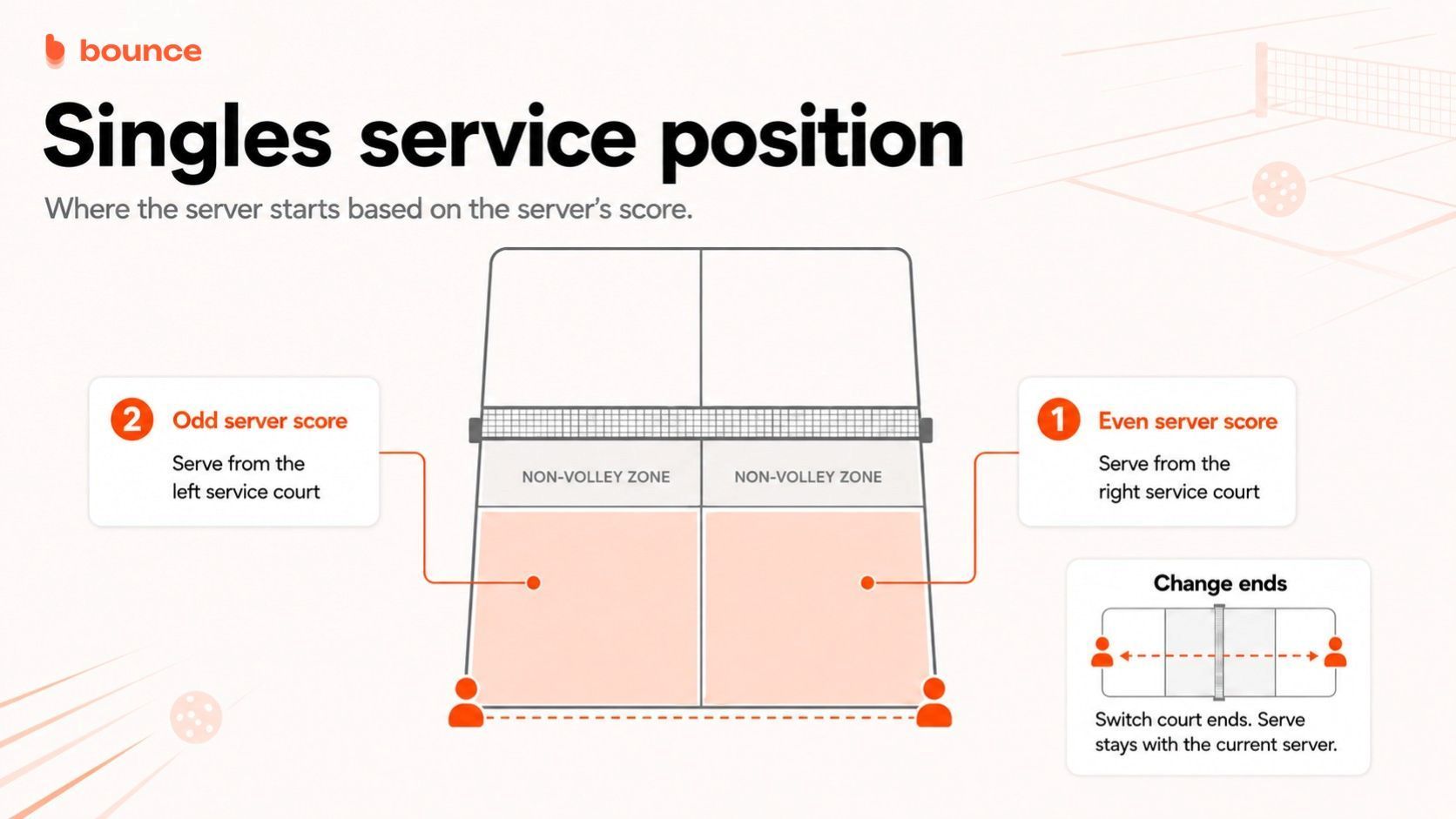
Singles pickleball creates another layer of confusion because players move left and right during the game.
End switching means walking to the opposite end of the net.
Service-court positioning means choosing the right or left service court before the serve.
In singles, the server uses the right service court when their score is even. The server uses the left service court when their score is odd. That movement happens throughout the game and follows the server’s score.
End changes follow the match format. After each game, players switch ends. In an 11-point deciding game or tie-breaker, they switch when the first player reaches 6.
So if the score is 6-2 in a third game, the players switch ends. Then the server still serves from the correct service court based on the score.
Doubles: who serves after players switch ends?
In doubles, the same server continues after a mid-game end change.
If your team reaches 6 in Game 3 and the score is 6-4-1, you switch ends and continue at 6-4-1. The first server remains the first server. The second server remains the second server.
Between games, the setup changes. Teams change ends and initial service for the next game. Teams can also change the starting server between games in tournament play, but they should notify the referee or opponent before the next game starts.
This is where players get tangled. They switch ends, then someone accidentally resets the server number. That creates a scoring mess.
If serving rules are still shaky, work through pickleball serving rules before your next league match. The side switch is easier once the service sequence is automatic.
Do you switch sides after every point?
You switch service courts after scoring points on serve. You switch ends only at the required end-change moments.
That distinction matters.
In doubles, if the serving team wins a rally and scores, the server moves from right to left or left to right for the next serve. That is service-court movement.
End switching is bigger. Both teams walk to the opposite end of the court after each game, or at the mid-game threshold in deciding games and certain tournament formats.
For doubles positioning, the Bounce breakdown of pickleball doubles rules explains how the server’s score connects to who should stand on which side.
Quick rec-play checklist
When your group reaches a side-switch moment, keep it boring.
- Say the score out loud before anyone walks.
- Keep the ball with the current server after a mid-game switch.
- Walk to the opposite end of the court.
- Resume from the correct service court based on the score.
That takes 10 seconds and saves 2 minutes of arguing.

Conclusion
The core rule is easy: switch ends after each game.
In an 11-point deciding game or tie-breaker, switch when the first player or team reaches 6. In tournament games to 15, switch at 8. In games to 21, switch at 11.
The same server continues after a mid-game end change. If you forget to switch on time, switch when you notice it, keep the score, and keep the same server.
For players building their game through structured coaching and organized play, Bounce connects you with certified coaches, courts, leagues, and competitive formats in your city.
FAQ
When do you switch sides in pickleball?
You switch ends after every game in a match. In an 11-point deciding game or tie-breaker, players also switch when the first player or team reaches 6.
In tournament formats, games to 15 switch at 8. Games to 21 switch at 11.
Do you switch sides in pickleball between every game?
Yes. After each completed game, both teams switch ends.
In a best-of-three match, that means players switch before Game 2 and again before Game 3.
When do you switch sides in the third game of pickleball?
In a third game played to 11, players switch ends when the first player or team reaches 6. Play then continues from the new ends.
The same server continues after the switch.
When do you switch sides in pickleball tournament play?
In USA Pickleball tournament play, end changes depend on the game format. An 11-point single game or tie-breaker switches at 6, a 15-point game switches at 8, and a 21-point game switches at 11.
After the end-change timeout, play continues with the same server.
What happens if you forget to switch sides in pickleball?
Switch ends as soon as the mistake is noticed. The score stays the same.
It is not a fault. Service continues with the same server.
Do you switch sides after every point in pickleball?
You switch service courts after scoring points on serve. You switch ends only after each game or at the required end-change threshold.
Singles has a separate rule: the server uses the right service court on even scores and the left service court on odd scores.
Why do pickleball players switch sides?
Players switch ends to make court conditions fairer across the match. Outdoor courts can have sun, wind, glare, or background differences that favor one end.
The rule spreads those conditions across both players or teams instead of giving one side the same court advantage for too long.