Most intermediate pickleball drills fail because players use them like warm-ups.
They dink for a few minutes. They hit a few drops. Then they play games and call it practice. Six months later, the same mistakes are still there: high dinks, rushed thirds, dead-zone panic, and attacks from balls that were never attackable.
The stall between 3.0 and 4.0 usually comes from specific technical leaks. Specific drills fix them.
Want a quick answer? The best intermediate pickleball drills for 3.0-4.0 players are cross-court dinks, triangle dinking, third shot drops, transition resets, fifth shot sequences, reflex volleys, attack reads, deep serve and return work, lob retrieval, and skinny singles. Each drill below has a measurable target, so you know whether the skill is actually getting better.
This is for players who already know the rules, can sustain rallies, and want practice that transfers into games. The goal is simple: build shots you can trust under pressure.
What intermediate means in pickleball
Intermediate is a wide range.
- A 3.0 player can rally, dink, serve consistently, and understand basic court position. The game still breaks down when the ball gets low, wide, fast, or awkward.
- A 3.5 player has more control but gets predictable. The dinks go to the same place. The third shot is streaky. The player wins points with athleticism and then gives them back with rushed choices.
- A 4.0 player has a more complete system. The drops are more repeatable, resets hold up under pace, and attacks come from better balls. The gap from 3.5 to 4.0 is usually decision-making plus execution, not one magic shot.
USA Pickleball's skill level guide gives a useful baseline for what players at each level should be able to do. Pickleball ratings, DUPR, and VAIR at vairified.com can also help you track progress against real match behavior.
Use the rating as a mirror, not a personality trait. If you miss 6 out of 10 third shot drops, you know what to drill.
Players who want coached feedback through the 3.5 plateau can find private lessons through Bounce. A good coach can spot the thing you usually cannot feel: late contact, paddle face drift, lazy split steps, or a reset that starts too high.
The drill overview
Start with the full map.
| Drill | Solo or partner | Primary skill | Best for level |
| Cross-court dink rally | Partner | Dink consistency | 3.0-3.5 |
| Triangle dinking | Partner | Placement and angles | 3.5 |
| Third shot drop from baseline | Partner | Drop accuracy | 3.0-4.0 |
| Three and go | Partner | Transition resets | 3.5-4.0 |
| Fifth shot sequence | Partner | Drive plus drop pattern | 4.0 |
| Reflex volley battle | Partner | Hand speed | 3.5-4.0 |
| Initiator attack game | Partner | Attack decisions | 4.0 |
| Serve and return deep zones | Partner | First-ball pressure | 3.0-3.5 |
| Lob retrieval and overhead response | Partner | Overhead defense | 3.5-4.0 |
| Skinny singles | Partner | Full-game transfer | 3.5-4.0 |
All 10 are designed for live-ball practice. Wall work can help with contact feel, but intermediate players need moving balls, bad feeds, pressure, and recovery decisions.
That is where these drills earn their place.
Kitchen control drills
The kitchen exposes fake consistency.
A straight-ahead dink rally can make a player feel better than they are. Add a cross-court angle, a low contact point, or a ball near the sideline, and the pop-ups start.
Good kitchen control means you can place the ball low without giving away the next attack.
Drill 1: Cross-court dink rally
Setup: Both players start at the kitchen line, positioned diagonally from each other. Use even side to even side first, then odd side to odd side.
Execution: Rally cross-court dinks with no attacks. Every ball should clear the low part of the net and land inside the kitchen. Stay balanced after contact. Recover to ready position after every shot.
Measurable target: Complete 30 consecutive cross-court dinks without a fault. After that, add a target: 7 of 10 balls must land within 12 inches of the sideline.
What it fixes: Intermediate players leave too many dinks in the center of the kitchen. That gives opponents easy speed-up balls. This drill teaches safe pressure through angle and depth.
Level note: Best for 3.0-3.5. At 4.0, add height control: every dink must cross below your opponent's attack window.
Drill 2: Triangle dinking
Setup: Place 4 small targets on your opponent's side: left kitchen corner, middle kitchen, right kitchen corner, and deep kitchen near the non-volley zone line.
Execution: Dink to one target at a time in a set pattern. Go left, middle, right, deep. After 4 rounds, your partner calls the next target before your contact.
Measurable target: Hit 28 of 40 targets without a fault. Track each target separately. A miss pattern tells you more than a total score.
What it fixes: Intermediate dink rallies get predictable. This drill forces direction change, touch control, and quick paddle-face adjustment.
Level note: Best for 3.5. A 3.0 player can simplify it by using 2 targets: cross-court corner and middle kitchen.
Transition and reset drills
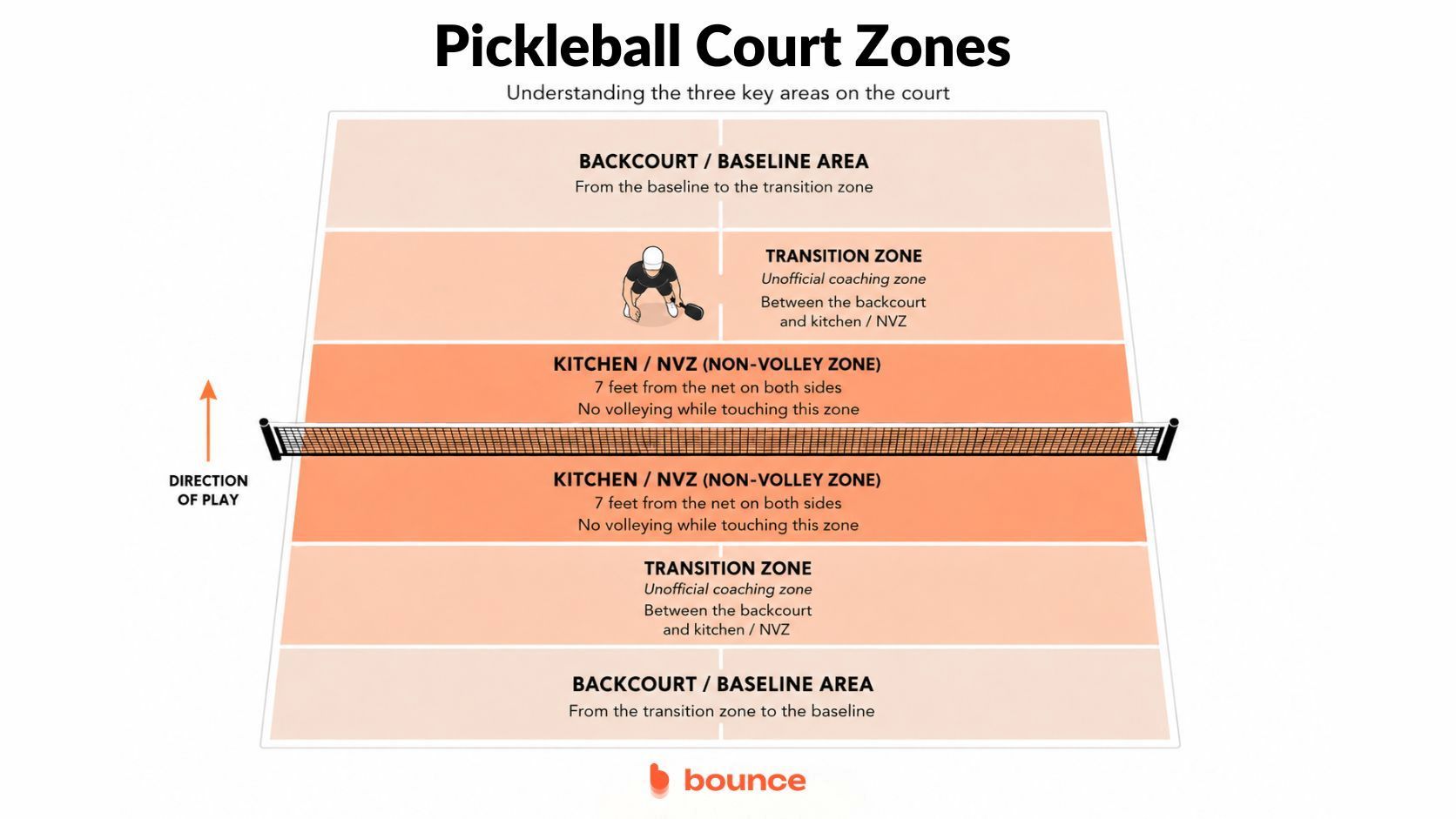
The transition zone decides more intermediate points than players admit.
This is the space between the baseline and the kitchen. Players rush through it, get caught with the ball at their feet, then blame the third shot. The real problem is movement after the third.
A reset is a soft, controlled shot that neutralizes pressure and lets you keep moving forward. These drills build that habit.
Drill 3: Third shot drop from baseline
Setup: One player starts at the baseline. The feeder stands near the kitchen line and sends firm balls back deep.
Execution: The baseline player hits a soft drop into the kitchen. Use a compact lift, quiet wrist, and contact in front of the body. Reset after every ball instead of rushing forward automatically.
Measurable target: Land 14 of 20 drops inside the kitchen. At least 10 of those should cross the net below the feeder's easy attack height.
What it fixes: The third shot drop is where many 3.0 and 3.5 players lose control of the point. They swing too hard, float the ball, or miss short because they try to guide it.
Level note: Useful for every intermediate level. At 4.0, add lateral movement before contact so the drop has to happen from a less perfect position.
Drill 4: Three and go
Setup: One player starts in the transition zone. The feeder stands at the kitchen line and sends low balls below waist height.
Execution: The transition player must hit 3 clean resets before moving to the kitchen. After the third reset lands safely, the player advances and the point becomes live.
Measurable target: Reach the kitchen in 6 of 10 attempts with the ball still neutral. Neutral means your opponent cannot attack down at your feet.
What it fixes: Players want to win the transition zone with one perfect shot. Better players win it with a series of boring resets. This drill teaches patience and forward movement at the same time.
Level note: Best for 3.5-4.0. At 3.5, the feed should be controlled. At 4.0, the feeder can add pace and sharper angles.
Drill 5: Fifth shot sequence
Setup: Start with a serve and return. The server begins at the baseline. The receiver returns deep.
Execution: The serving side drives the third shot deep, then drops the fifth shot into the kitchen and moves forward. Play out the point after the fifth.
Measurable target: Complete the full pattern 6 of 12 times. The third shot drive must land in, the fifth shot drop must land in the kitchen, and the serving side must reach the kitchen without giving up an attackable ball.
What it fixes: Intermediate players treat shots as separate events. This drill teaches sequence thinking. Drive to earn a weaker ball. Drop to move forward. Then play the point.
Level note: Best for 4.0. A 3.5 player should start with drive plus reset from the transition zone before adding the full sequence.
Volley and net-play drills
Net play rewards compact swings.
Intermediate players lose these exchanges by doing too much. A backswing at the kitchen gives the opponent time and opens your paddle face to mistakes.
Drill 6: Reflex volley battle
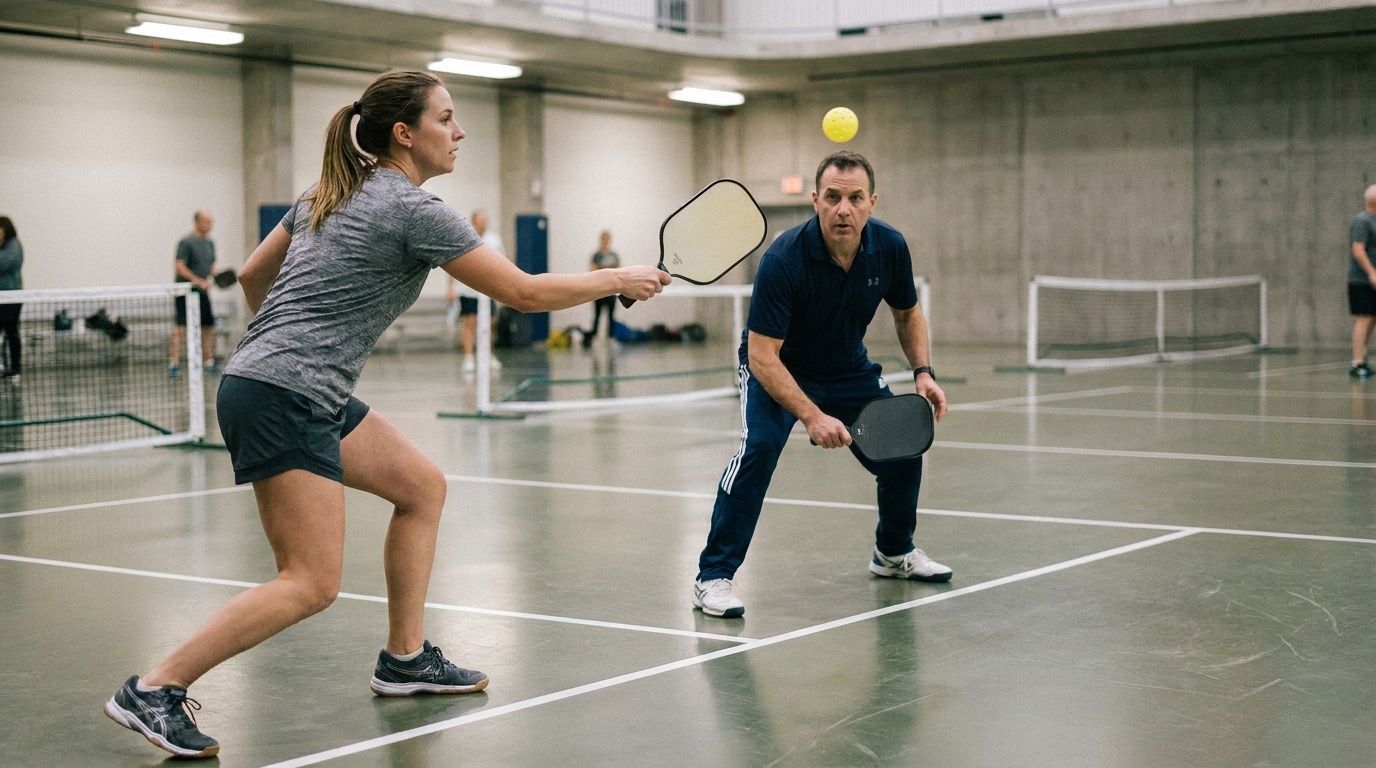
Setup: Both players stand at the kitchen line, about 2 feet behind the non-volley zone line. Keep the rally controlled.
Execution: Volley back and forth without letting the ball bounce. Keep the paddle in front of your chest. No backswing. Use short blocks and small counters.
Measurable target: Complete 40 consecutive volleys without a fault. Then add direction: every fourth volley must go to the opponent's hip.
What it fixes: Big swings at the kitchen. The drill forces shorter strokes, cleaner contact, and faster recovery.
Level note: Best for 3.5-4.0. At 4.0, increase pace and reduce the recovery time between contacts.
Drill 7: Initiator attack game
Setup: Both players start in a cross-court dink rally. One player is the initiator. The other player is the defender.
Execution: The initiator may attack any ball they think is attackable. The defender can only counter or reset. Play to 7 points with rally scoring, then switch roles.
Measurable target: The initiator should win at least 4 of 7 points. The defender should win at least 3 of 7 in the next round. If one side dominates every time, the feeds or attack rules are too easy.
What it fixes: Shot selection under pressure. Intermediate players attack from knee height, speed up balls from too low, or sit passive on attackable balls. This game makes the read obvious.
Level note: Best for 4.0. At 3.5, limit the initiator to clear pop-ups for the first round, then loosen the rule.
Game-situation drills
Isolated drills build the piece. Game-situation drills test whether the piece survives contact with a real point.
You need both.
Drill 8: Serve and return deep zones
Setup: Mark 4 deep zones: center T serve, backhand corner serve, deep middle return, and deep backhand return.
Execution: Serve 10 balls to each target. Your partner returns every ball deep. Play out every fifth point so the serve work connects to the third shot.
Measurable target: Hit 16 of 20 serves into the back third of the service box. Hit 12 of 20 returns within 4 feet of the baseline.
What it fixes: Intermediate players underpractice the first 2 balls. A deep serve buys time. A deep return keeps the serving team back. Those 2 balls shape the point before the kitchen even matters.
USA Pickleball's rules summary is worth checking if your serve mechanics are unclear. For technique, Bounce's work on pickleball serve mechanics gives a cleaner breakdown of stance, contact, and variation.
Level note: Best for 3.0-3.5. At 4.0, add serve shape: one flat, one with spin, one to the body, one wide.
Drill 9: Lob retrieval and overhead response
Setup: Start with both players at the kitchen line in a dink rally. Either player can lob without warning.
Execution: The lobbed player must turn and run, let the ball bounce when needed, and return the ball deep. The lobbing player moves forward and prepares to finish. Play the point out.
Measurable target: Retrieve 7 of 10 lobs into playable depth. Playable depth means the return lands past the midcourt and does not feed an easy overhead.
What it fixes: Panic footwork. Many intermediate players backpedal, lose the ball overhead, or swing while falling away. This drill makes lob defense routine.
Level note: Best for 3.5-4.0. At 4.0, the lobber should mix middle, sideline, and backhand-shoulder targets.
Drill 10: Skinny singles
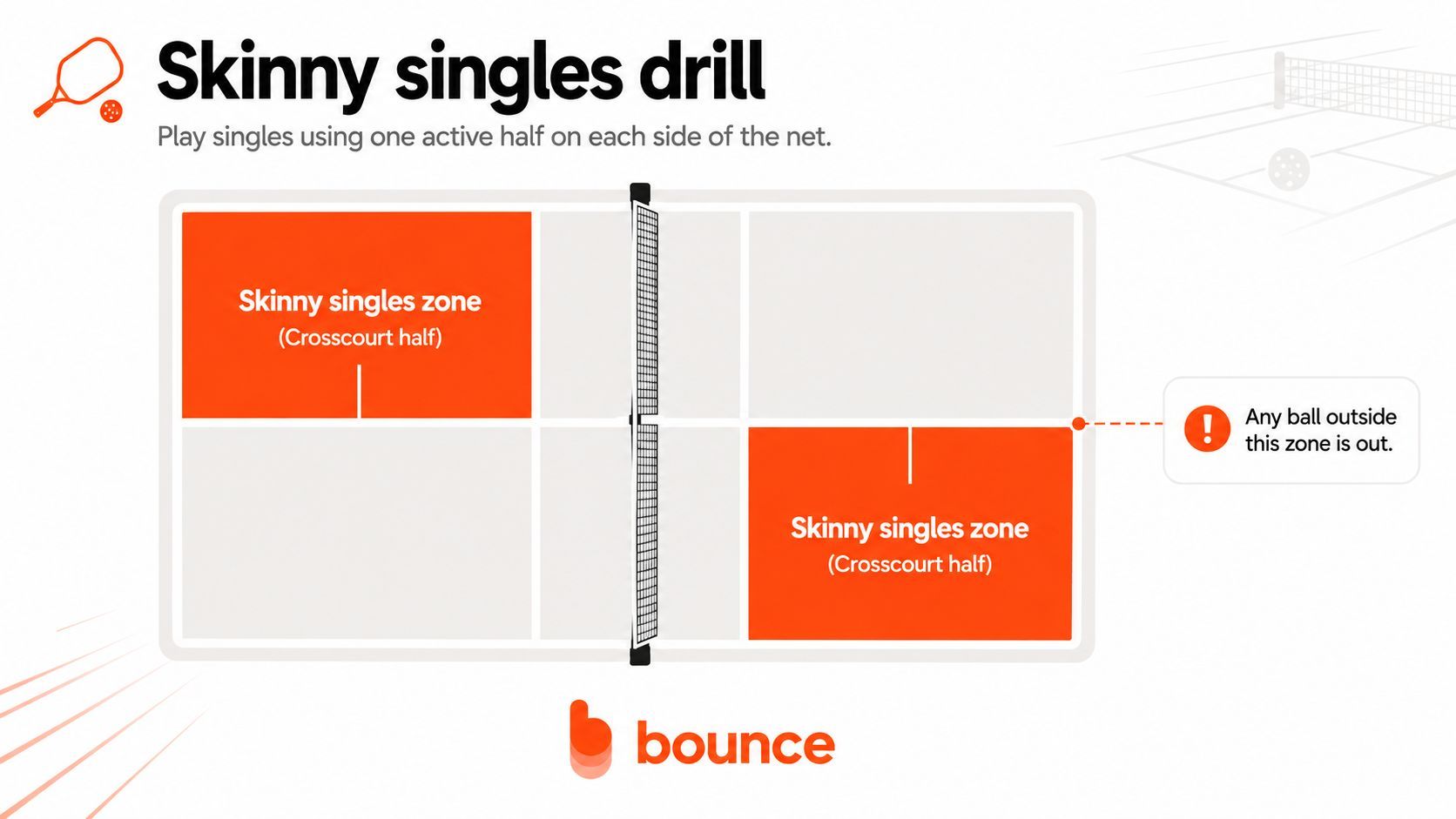
Setup: Two players play singles using one diagonal half of the court. Start right-side cross-court, then switch to left-side cross-court for the next game.
Execution: Use normal scoring and normal kitchen rules. Any ball outside the chosen half is out. Play to 11.
Measurable target: Keep at least 70% of rallies alive past the third shot. Win 1 of 3 games against a similar-level player.
What it fixes: Everything hides in doubles for a while. Skinny singles strips that away. You have to serve, return, drop, dink, reset, defend, and make decisions without a partner covering half the mistakes.
Level note: Best for 3.5-4.0. A 3.0 player can play cooperative skinny singles first: each rally must reach 6 shots before either player can attack.
A 60-minute intermediate drilling session
Do fewer things with more attention.
Six focused blocks beat 10 rushed drills. This order starts with touch, moves through transition pressure, then ends with competitive transfer.
| Time | Drill | Focus |
| 0-10 min | Cross-court dink rally | Warm-up and low-ball control |
| 10-20 min | Third shot drop from baseline | Baseline-to-kitchen feel |
| 20-30 min | Three and go | Transition resets |
| 30-40 min | Reflex volley battle | Compact hands |
| 40-50 min | Initiator attack game | Attack and reset reads |
| 50-60 min | Skinny singles | Full-game transfer |
Track the numbers. Do not just say it felt better.
If your target is 14 of 20 drops and you hit 8, the next session has a job. If you hit 16, add movement, pace, or a smaller landing zone.
How often to drill vs. play
Two dedicated drilling sessions per week is the floor for real improvement.
They do not need to be long. A focused 35-minute session with targets beats 2 hours of casual hitting where nobody tracks anything.
A useful split for most intermediate players is 40% drilling and 60% play. At 3.0, lean slightly more toward drilling because the core strokes still need reps. At 3.5-4.0, live games carry more weight because decision-making becomes the limiter.
Research on deliberate practice describes skill growth as effortful work aimed at specific performance gaps. Motor-learning research on contextual interference also supports the value of mixing practice conditions when the goal is retention and transfer.
So block the skill first. Then vary it.
Hit 20 third shot drops from one spot. Then hit drops while moving. Then add a returner. Then play skinny singles and see whether the shot holds up.
Drills need game pressure after them. Finding open play through Bounce gives you different styles, speeds, and matchups. That is where you find out whether the practice ball became a match ball.
How to choose the right drill for your level
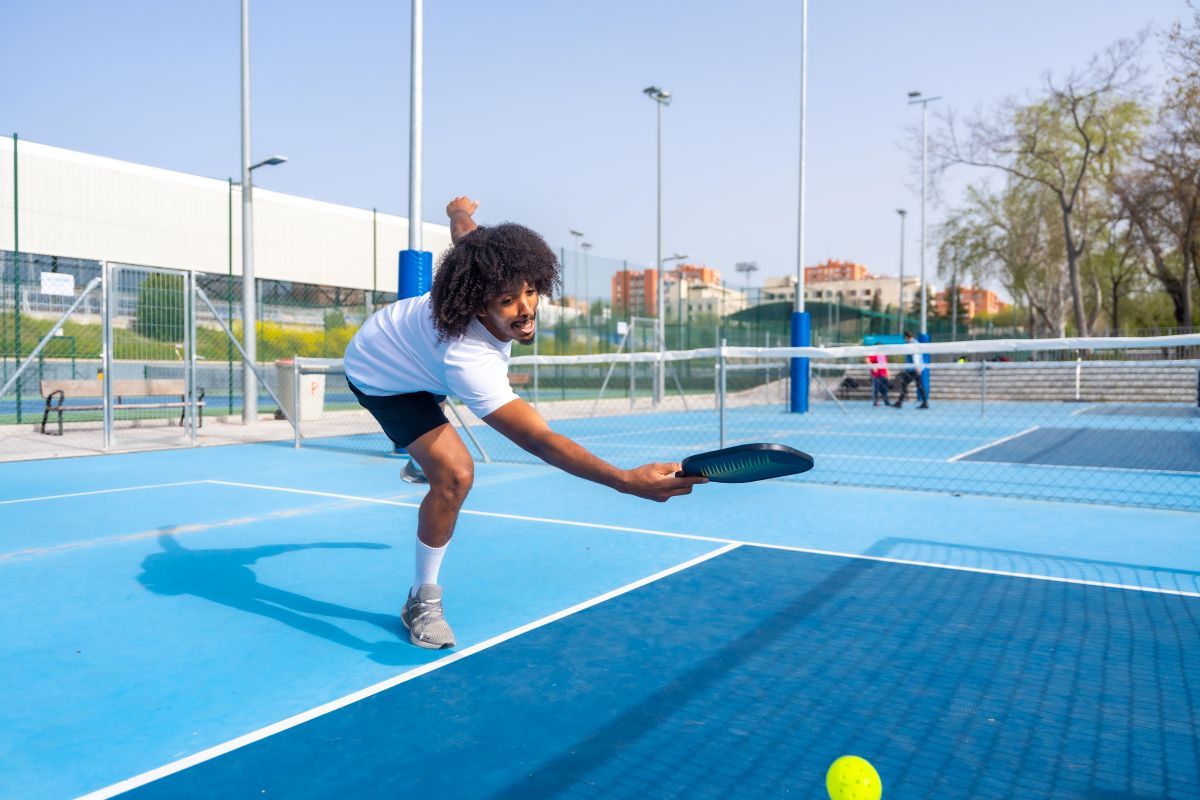
At 3.0, spend most of your time on cross-court dinks, third shot drops, deep serves, and deep returns. Your job is to reduce easy errors.
At 3.5, spend more time on triangle dinking, three and go, reflex volleys, and lob retrieval. Your job is to stay neutral when the point gets uncomfortable.
At 4.0, spend more time on fifth shot sequences, initiator attack games, and skinny singles. Your job is to link shots together and make better reads under pressure.
Do not rotate drills just because you are bored. Stay with one weakness for 4 weeks. Then retest.
Conclusion
Intermediate pickleball drills should give you a number.
How many drops landed in the kitchen. How many resets got you to the line. How many volleys stayed compact. How many skinny singles rallies survived the third shot.
That is how you move through the 3.0-4.0 band. You stop guessing, drill the leak, test it in games, and raise the target when the old one gets easy.
For players building their game through structured coaching and organized play, Bounce connects you with certified coaches, courts, lessons, leagues, and open play in your city.
FAQ
What drills should intermediate pickleball players focus on?
Intermediate players should focus on drills that improve kitchen control, third shot accuracy, transition resets, volley compactness, serve depth, and game transfer. Start with cross-court dinks, third shot drops, three and go, reflex volleys, and skinny singles.
How often should intermediate pickleball players drill?
Two dedicated drilling sessions per week is a strong baseline. Each session can be 35-60 minutes if the targets are clear. Pair those sessions with regular games so you can test whether the skill holds under pressure.
Can I do intermediate pickleball drills alone?
Some contact work can be done alone, including shadow swings, target serves, and wall volleys. Most intermediate drills need a partner because the real problem is reading live balls, moving after contact, and making decisions against pressure.
What is the best drill for a 3.5 pickleball player?
Three and go is the best single drill for many 3.5 players. It trains the transition zone, where this level loses a lot of points. The drill forces you to reset before advancing instead of sprinting into a ball at your feet.
How long does it take to improve from 3.0 to 4.0 in pickleball?
A realistic window is 12-18 months for players who drill twice per week, play regularly, and get occasional coaching feedback. The timeline changes with age, athletic background, practice quality, and match volume.
What is skinny singles in pickleball?
Skinny singles is a practice format where 2 players compete using only one half of the court, usually cross-court. It helps intermediate players because it tests serve, return, third shot, dink, reset, and attack decisions in a tight competitive space.