
If you played tennis before you picked up a padel racket, the first minute feels easy. Fifteen, thirty, forty, game. Six games wins a set. Two sets wins a match.
Then deuce hits. Someone says Golden Point. Someone else says Star Point. Your partner asks who serves next. The match pauses while 4 players try to rebuild the rulebook from memory.
That pause is avoidable.
Want a quick answer? Padel scoring uses 15, 30, 40, game. Sets go to 6 games with a 2-game lead, with a tiebreak at 6-6. At 40-40, the match format decides whether you use Advantage, Star Point, or Golden Point. In doubles, the same player serves the entire game, and all 4 players follow a fixed service order for the set.
This guide covers the full scoring flow: points, games, sets, deuce formats, tiebreaks, super tiebreaks, side changes, and serve rotation. If your club or tournament uses a house format, use that format. For a casual match, agree on the deuce rule before the first serve.
Padel points: love, 15, 30, 40, game
Padel uses the same point names as tennis: love, 15, 30, 40, game. The FIP Rules of Padel are the source of truth for official play, and the LTA Padel rules explain the same basic scoring sequence for new players.
A team wins a game by winning 4 points with a 2-point lead, unless the chosen deuce format changes how 40-40 is played.
A point is lost when the opposing team creates one of these errors:
- The ball bounces twice before you return it.
- You hit the ball into the net.
- You hit the ball out, including a ball that hits glass or cage before bouncing in the court.
- You commit a double fault on serve.
The serving team calls the score before each point, starting with its own score. If your team has 30 and the opponents have 15, you call "30-15."
Deuce formats: Advantage, Star Point, and Golden Point
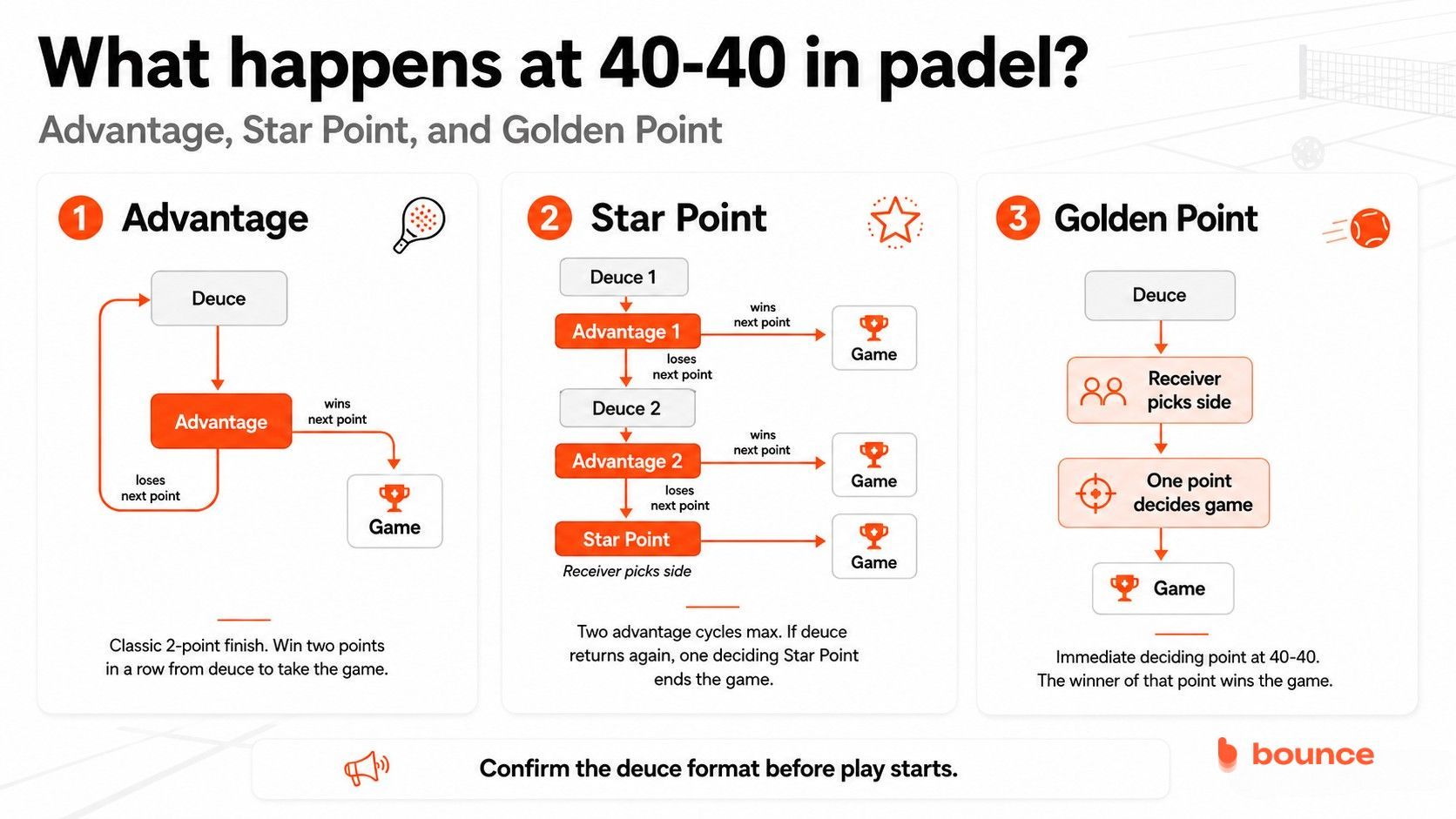
Deuce is the scoring moment that causes most of the arguments. The 2026 FIP rulebook recognizes 3 formats for a game that reaches 40-40: Advantage, Star Point, and Golden Point.
Advantage
Advantage is the classic system. At 40-40, one team wins the next point and gets advantage. If that same team wins the following point, it wins the game. If it loses the following point, the score returns to deuce.
This format can create long games. It is still an approved FIP option, and some tournaments use it because it keeps the traditional 2-point finish inside each game.
Star Point
Star Point is the current 2026 pro-tour scoring signal. FIP and Premier Padel announced that Star Point would be used on Premier Padel from the Riyadh Season P1, and on the CUPRA FIP Tour from the 2026 season. The USPA 2026 competition structure guide also says Star Point is used in USPA-sanctioned tournaments and matches.
The flow is simple once you see it once:
- At the first 40-40, one point is played to create Advantage 1.
- If the team with Advantage 1 wins the next point, it wins the game. If it loses, the score returns to Deuce 2.
- A second advantage cycle is played the same way.
- If the score returns to deuce again, one Star Point decides the game. The receiving team chooses the service side, and the winner of that point wins the game.
The receiving pair cannot switch positions to receive the Star Point. In mixed matches, the receiver on the deciding point must be the same gender as the server.
The FIP Star Point explanation frames the system as a way to cap long deuce games while keeping 2 advantage chances before the deciding point.
Golden Point
Golden Point is the immediate deciding point at 40-40. The receiving team chooses the left or right side, and the regular receiver on that side returns the serve. Whoever wins that point wins the game.
Many club, social, and timed league formats use Golden Point because it keeps matches on schedule. Ask before play starts. The wrong time to discover the deuce rule is after the score reaches 40-40.
Games and sets: how you win a set
The first team to win 6 games wins the set, with a minimum 2-game margin.
- 6-0, 6-1, 6-2, 6-3, and 6-4 end the set.
- At 5-5, play continues to 7-5 if one team wins 2 straight games.
- At 6-6, the set goes to a tiebreak.
The 5-5 score trips up new players. A 6-5 lead is only a lead. The set ends at 7-5 or goes to a tiebreak at 6-6.
Tiebreak rules: first to 7, win by 2
A tiebreak decides the set when the games reach 6-6. The tiebreak uses regular numbers: 1, 2, 3, and so on. The first team to 7 points wins, provided it leads by 2 points. If the tiebreak reaches 6-6, play continues until one team leads by 2.
Serving follows a fixed pattern. The player whose turn it is in the service rotation serves the first point from the right side. The opposing team serves the next 2 points. After that, each server serves 2 points in order until the tiebreak ends.
Teams change ends every 6 points in the tiebreak. FIP allows 20 seconds for that tiebreak side change. The next set starts with service by the pair that did not begin serving the tiebreak.
Super tiebreaks: first to 10 in club and league formats
A standard padel match is best of 3 sets. In many recreational and league formats, a split-set match uses a super tiebreak instead of a full third set.
The super tiebreak works like a regular tiebreak, but it goes to 10 points with a 2-point margin. The FIP rulebook lists the 10-point super tiebreak as an alternative score method for deciding the match when the sets are tied 1-1.
This format fits court bookings. It also makes late-match points feel sharper. At 9-9, one point can swing the whole match, and the service order decides who has the ball in hand.
For players who rush when the score gets tight, Bounce open play is useful because you get scored games with different partners and opponents. That is where the rulebook becomes a habit.
Serve rotation: the rule beginners get wrong
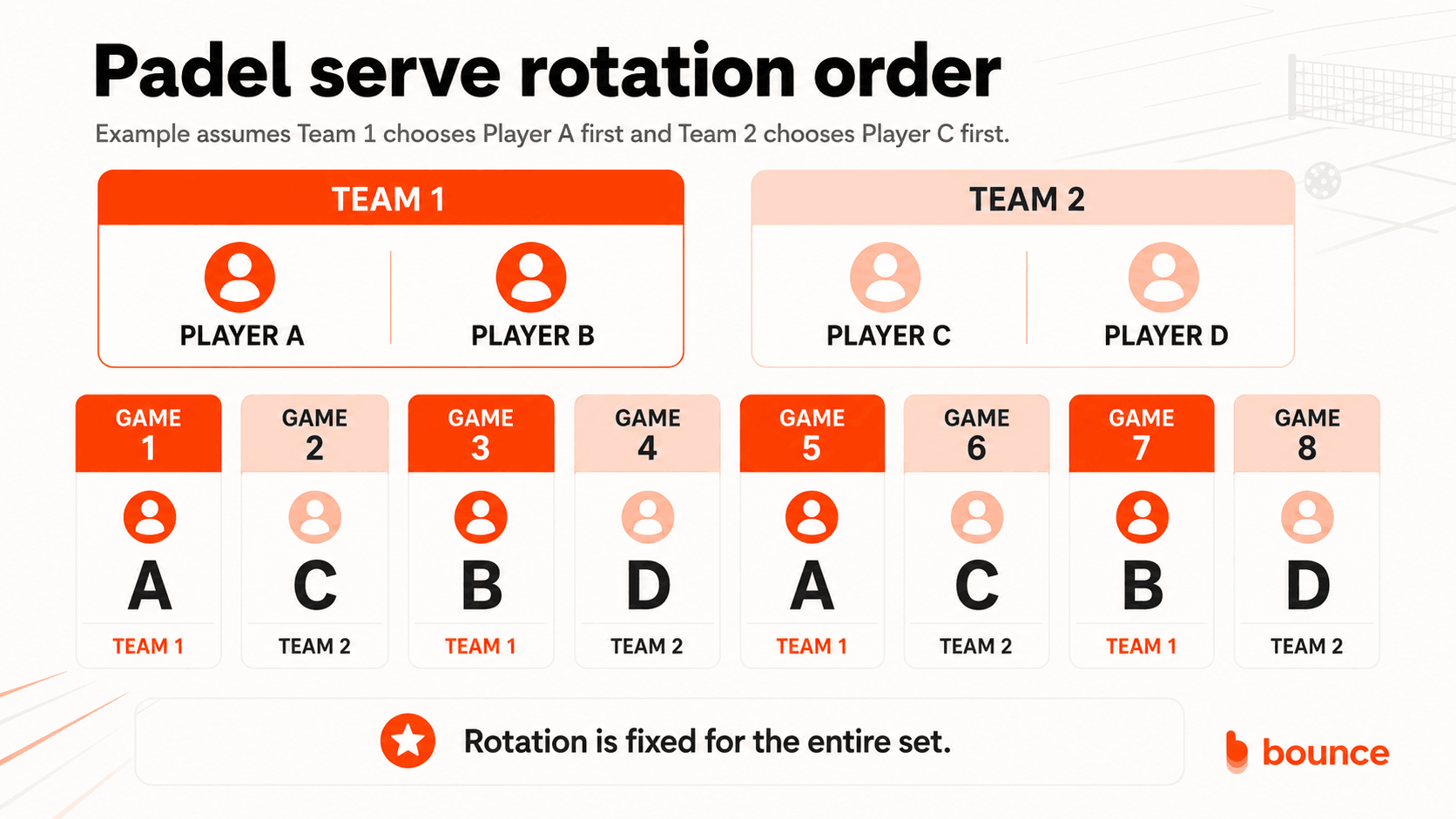
In padel doubles, the serving order is fixed for the full set. Before the set starts, each pair chooses which player serves first. Once the order is set, it stays set until the next set.
Here is the basic pattern with Team 1 as Players A and B, and Team 2 as Players C and D:
- Game 1: Player A serves every point.
- Game 2: Player C serves every point.
- Game 3: Player B serves every point.
- Game 4: Player D serves every point.
- Game 5: back to Player A.
Within each service game, the same player serves every point. The serve alternates between the right and left service boxes, but the server does not change.
That is the mistake. A player sees the serve move to the other service box and assumes the partner should serve. The box changes. The server stays.
The FIP rulebook also covers mistakes. If a player serves out of turn and the error is discovered, the correct server takes over as soon as the mistake is found. Points played before discovery remain valid.
Receiving order is fixed too. Each pair decides who receives first in the set, then receivers alternate during each return game. Once that order is chosen, it stays in place during the set and tiebreak.
Players coming from padel vs pickleball usually adjust faster when they separate scoring rules from movement rules. The serve order is procedural. Court position is tactical. Keep those in different buckets.

Side changes and time between points
Teams change sides after every odd-numbered game in a set: after game 1, game 3, game 5, and so on. They do this to balance court conditions such as sun, wind, lighting, and glass glare.
FIP allows up to 90 seconds for normal side changes. After the first game of a set and during a tiebreak, players change without a full rest period. In a tiebreak, teams change ends every 6 points, with 20 seconds for the change.
If teams forget to change ends, correct it as soon as the mistake is discovered. Points already played still count.
Padel scoring vs tennis scoring: where players get caught
Padel and tennis share the point names, basic game count, and most set logic. The match feels familiar until deuce formats, service order, and third-set rules start affecting decisions.
| Scoring moment | What confuses players | Padel rule to use |
| 40-40 | Players assume every match uses advantage. | Confirm Advantage, Star Point, or Golden Point before play starts. |
| Serve box switch | Players think the server changes when the ball moves sides. | The same player serves the whole game. Only the service box changes. |
| Deciding point | Receivers forget they choose the side. | On Golden Point or Star Point, the receiving pair chooses left or right. |
| Third set | Players expect every match to play a full third set. | Many club and league formats use a 10-point super tiebreak. |
Once scoring stops stealing attention, the next layer is match rhythm. Bounce has separate padel tips for the habits that matter after the rally starts. If you are still sorting out the basics off court, the padel equipment breakdown covers rackets, balls, shoes, and the gear that actually matters.
How to call the score in a casual match
In friendly and club play, the serving team calls the score before each point. Call your team score first, then the opponents score.
- Your team has 30, they have 15: "30-15."
- Both teams have 40: "Deuce" or "40-all."
- Your team has advantage: "Advantage us" or "ad in."
- Their team has advantage: "Advantage them" or "ad out."
- Golden Point at 40-40: "Golden Point, receivers choose."
- Star Point after the second advantage cycle: "Star Point."
In a tiebreak, call the serving team score first. If your team is serving and leading 4-3, call "4-3." If your team is serving and trailing 4-3, call "3-4."
For new players, Bounce lessons with padel-specific coaches can cover scoring habits alongside serve mechanics, return positioning, and match routines. Getting this right early saves you from a year of quiet confusion.
Padel scoring summary table
| Situation | Rule |
| Points sequence | Love, 15, 30, 40, game |
| Game requirement | Win 4 points with a 2-point lead, unless the deuce format creates a deciding point |
| Advantage | At deuce, win 2 points in a row to win the game |
| Star Point | After 2 advantage cycles, one deciding point wins the game |
| Golden Point | At 40-40, one deciding point wins the game |
| Receiving choice | On Golden Point or Star Point, the receiving pair chooses the side |
| Games to win a set | 6 games with a 2-game margin |
| Score tied 5-5 | Play to 7-5 or continue to 6-6 |
| Score tied 6-6 | Tiebreak to 7, win by 2 |
| Third set in many club formats | Super tiebreak to 10, win by 2 |
| Serve rotation | Fixed for the full set, all 4 players rotate by game |
| Wrong server | Correct immediately when discovered; previous points stand |
| Side changes in a set | After every odd-numbered game |
| Side changes in a tiebreak | Every 6 points |
The score becomes part of the match
The score should disappear into the rhythm of the match. You call it, choose the right deuce format, serve in order, and keep playing.
Once that happens, scoring becomes tactical. Who receives on a deciding point matters. Who serves at 9-9 in a super tiebreak matters. Side conditions matter when the sun is low or one glass end plays faster than the other.
For players building these habits through structured coaching and organized play, Bounce connects you with padel coaches, lessons, open play, and competitive formats in your city.
FAQ
How does padel scoring work?
Padel scoring uses love, 15, 30, 40, and game. Sets go to 6 games with a 2-game lead, and a tiebreak is played at 6-6. Matches are usually best of 3 sets, with many club formats using a 10-point super tiebreak instead of a full third set.
What is Golden Point in padel?
Golden Point is a single deciding point played at 40-40. The receiving team chooses which side receives, and the regular receiver on that side must take the return. Whoever wins that point wins the game.
What is Star Point in padel?
Star Point is a 2026 FIP-recognized deuce format. The game gets 2 advantage cycles first. If the score returns to deuce again, one deciding Star Point is played, with the receiving team choosing the side.
How does serve rotation work in padel?
Each team chooses its first server before the set starts. The serving order then rotates through all 4 players by game and stays fixed for the full set. Within one service game, the same player serves every point while switching between the right and left service boxes.
What is a super tiebreak in padel?
A super tiebreak is a 10-point tiebreak used to decide the match when the sets are tied 1-1. It must be won by 2 points. Many club and league formats use it because it fits booking windows better than a full third set.
Is padel scoring the same as tennis?
Padel uses the same 15, 30, 40, game point sequence and the same basic 6-game set structure. The main differences are the deuce formats, the fixed doubles serve order, and the frequent use of a 10-point super tiebreak in club play.