Padel shots are the building blocks of every point: serve, forehand, backhand, volley, lob, smash, bandeja, víbora, gancho, chiquita, wall return, and bajada de pared. The fastest way to improve is to learn what each shot does, then build them in the right order.
Most new players chase the flashy shots first. The lob wins more points early. The wall return saves more rallies. The bandeja keeps you at the net when a smash would hand the point back.
Want a quick answer? Padel has 12 main shots. Beginners should learn the serve, lob, forehand, backhand, volley, and wall return before spending much time on the víbora or bajada. The best padel shot depends on court position: use lobs to regain space, volleys to pressure, bandejas to hold the net, and wall returns to stay alive long enough to attack.
Players in their first 30 sessions should focus on what each shot does, where to use it, and which technical cue matters most. That foundation makes the advanced shots easier to learn when your movement and court awareness catch up.
What are the main padel shots?
Padel has 12 main shots, split by what they do in the rally.
| Shot | Spanish name | Main job | Learn early? |
| Serve | Saque | Start the point and support the move toward the net | Yes |
| Forehand | Derecha | Control back-court balls on your dominant side | Yes |
| Backhand | Revés | Control back-court balls on your non-dominant side | Yes |
| Volley | Volea | Apply pressure and keep net position | Yes |
| Lob | Globo | Push opponents away from the net and create space to advance | Yes |
| Back-wall return | Salida de pared | Defend after the ball rebounds from the back glass | Yes |
| Chiquita | Chiquita | Play a soft, low ball toward the net players’ feet | Soon |
| Bandeja | Bandeja | Control a lob and recover your net position | Soon |
| Gancho | Gancho | Control a lob arriving over your non-dominant shoulder | Later |
| Víbora | Víbora | Attack with a sidespin overhead that rebounds low from the wall | Later |
| Smash | Remate | Attack a short lob with power and try to finish the point | Soon |
| Bajada de pared | Bajada de pared | Attack a high ball after it rebounds from the back glass | Later |
Padel adds wall play and splits the overhead category into several different decisions. Players who understand the difference between padel and pickleball tend to read that tactical shift faster because the glass gives defenders extra time.
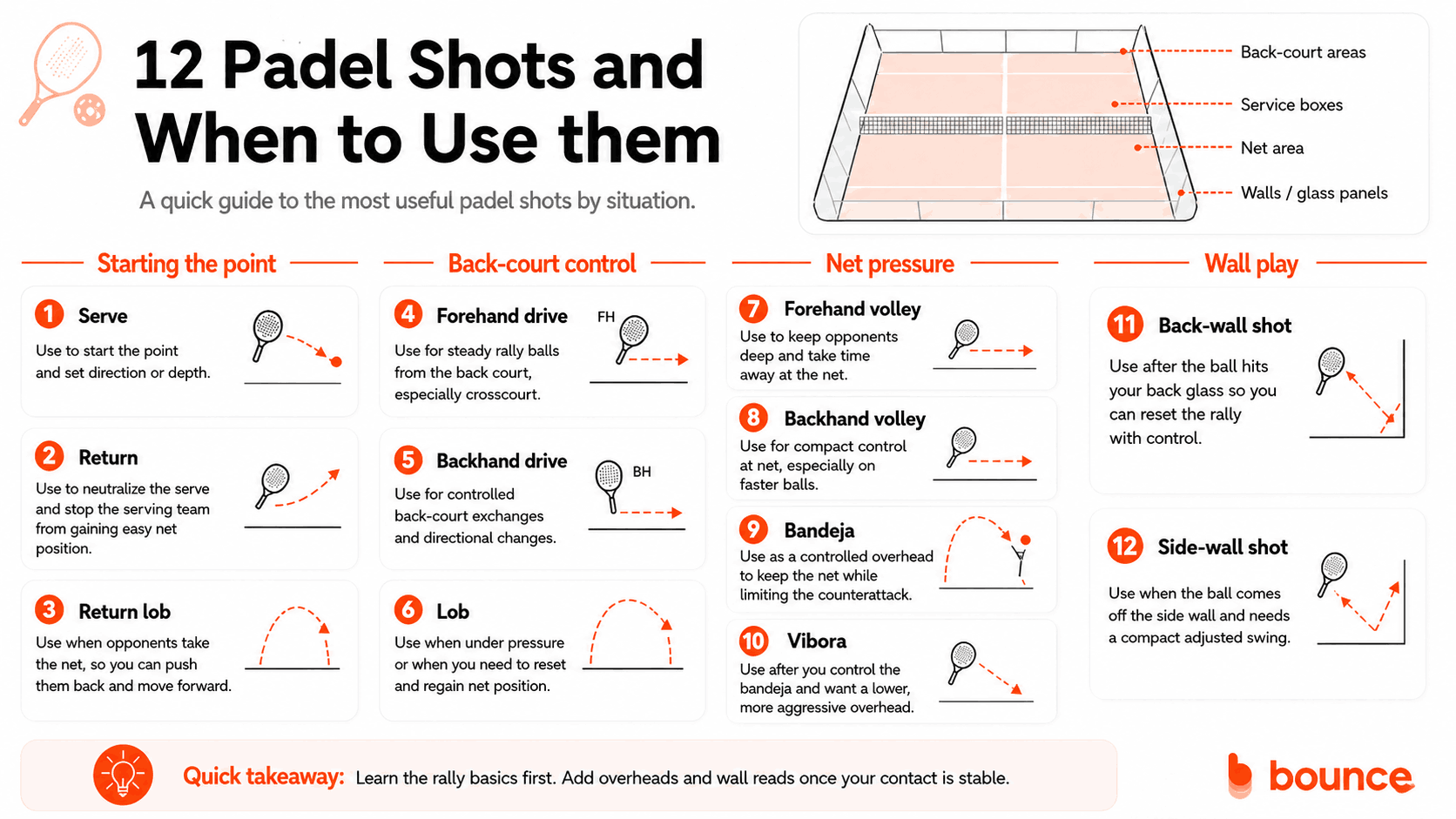
The serve starts the point, then gets you moving forward
The padel serve is underhand. Under International Padel Federation rules, the server gets 2 attempts, the ball must bounce in the server’s box, contact must happen at or below waist height, and at least 1 foot must stay on the ground.
The server's job is placement. Aim close to the side glass or deep enough that the receiver hits up. Then move forward with your partner.
A hard serve that lands comfortably in the receiver’s strike zone creates a cleaner return. That is the beginner trap. You feel like you hit a better serve because the ball moved faster, then the receiver uses the back glass and sends it back with interest.
Use this serve pattern first:
- Bounce the ball inside your own service box.
- Keep the racket face stable and contact below waist height.
- Aim deep to the receiver’s backhand side.
- Follow the serve toward the net.
If you double-fault more than once per game, strip the serve back. Get 8 of 10 in before you add angle or speed.
Forehand and backhand are control shots first
The forehand and backhand in padel need shorter swings than most tennis players want to use. Contact happens in front of the body, with the racket set before the bounce.
The forehand, or drive, is your basic back-court shot on the dominant side. Hit it flat when you have time and slice it when you want the ball to stay low after the bounce.
The backhand, or revés, needs the same compact setup. A two-handed backhand gives newer players more stability when the ball comes off the glass or stays low near the side wall.
The full tennis takeback is the crossover mistake. The padel court gives you less space, and the glass creates awkward rebounds. A long swing makes you late by half a beat.
Players also overestimate how much padel equipment changes these shots. A better racket helps once your contact is clean. A giant backswing inside a glass box still breaks down.
The volley is where points start to tilt
The volley is a short punch before the ball bounces. Keep the racket high and step into contact. Finish with the racket face stable.
Net position matters because the team closer to the net controls angles. From the back court, you defend and reset. From the net, you make opponents hit low, lift the ball, or lob under pressure.
Aim volleys at 4 targets:
- Opponent’s feet
- Middle seam between both players
- Side glass
- Open space after you move a player wide
Beginners swing too much on volleys. The ball already has speed. Your job is to redirect it with a firm face and a small step.
Racket height tells on you. If your racket drops below the ball, your volley pops up. If your weight sits back, the ball floats.
A coach can fix both quickly because the error is visible from the side. Bounce lessons let players search by city and skill level when they want that feedback before the habit hardens.
The lob is the shot that resets the court
The lob, or globo, is the most useful padel shot for early improvement. It moves net players backward and gives you time to recover. It also forces overhead decisions.
A peer-reviewed study of professional padel match play analyzed more than 35,000 shots and found that lobs appeared in more than 76% of points, usually 2 to 3 times per point. At the 2025 Alpine Paris Major, Padel Intelligence data reported that women used lobs on 30.8% of shots, more than any other shot type in that event sample.
Defensive lob
Use a defensive lob when you are trapped deep or stretched wide. The goal is height and time. Make the opponents move back, then recover your own position.
A defensive lob can be ugly and still useful. Depth matters more than shape.
Offensive lob
Use an offensive lob when you are balanced and can aim deep near the back glass. The goal is to push opponents off the net while giving yourself a chance to move forward.
Most beginner lobs fail for the same reason: low arc, short landing spot. A simple target works: aim for the last 3 feet of court before the back glass.
Smash, bandeja, víbora, and gancho are different overhead choices
This table compares 4 common padel overheads. Your choice depends on the height and depth of the lob, your contact position, and whether you’re trying to finish the point or protect the net.
| Overhead shot | Use it when | Main risk |
| Smash | The lob is short, you’re balanced, and you have a realistic chance to finish the point | A flat or weak smash can rebound from the back wall and give opponents another ball |
| Bandeja | The lob is deep and your priority is controlling the ball while recovering net position | Floating it short gives opponents time to attack or lob again |
| Víbora | The lob is attackable and you can strike with sidespin toward the corner or side wall | Forcing the shot from a poor position raises the error rate and can pull you out of position |
| Gancho | The lob travels over your non-racket shoulder and a bandeja contact would feel cramped | Late contact can produce a short ball or send the shot into the net |
The smash
The smash, or remate, is the point-ending overhead. Use it on short lobs when you can make contact high and in front.
A flat remate drives through the court. A spin remate kicks off the back glass or leaves the court when the angle is right.
Most early players smash from bad positions. The result is a hard ball that rebounds off the glass and gives opponents a second life.
The bandeja
The bandeja is the first overhead I would teach most beginners after the basic shots. It is a sliced overhead built for control and net position.
Use the bandeja when a lob is deep enough to make a smash risky but short enough that you can stay in control. Contact is slightly to the side, and the racket cuts under the ball.
The bandeja feels boring until you start winning more points. Then it becomes addicting.
The víbora
The víbora is an attacking overhead with sidespin. The swing is more aggressive than a bandeja, and the ball kicks sideways after the glass.
Use it when you are balanced and have a clear corner target. Aim toward the side glass and back glass junction, especially cross-court.
A víbora with poor footwork turns into a low-margin miss.
The gancho
The gancho is a softer angled overhead, usually hit around shoulder height. It helps when the ball is too low for a smash and too awkward for a clean bandeja.
Use the gancho to pull opponents forward or sideways. Very little pace is enough because the shot changes height and angle.
A peer-reviewed padel biomechanics study found that overhead strokes place the shoulder in high-load positions, including shoulder abduction above 90 degrees and external rotation. Build the bandeja before chasing every smash.
The chiquita breaks net pressure
The chiquita is a soft, controlled shot that drops just over the net. Think of the chiquita as a low-speed problem for the opponent.
Use it when opponents are at the net and you are stuck with a low ball. The goal is to make them volley from below net height.
A good chiquita lands near the feet. A bad chiquita floats to the racket. The mechanic is a gentle push with slight slice and very little hand speed.
Wall returns turn panic into playable balls
Wall play is what makes padel feel strange at first. The ball can pass you and still be playable after it hits the back glass.
The wall return, or salida de pared, is the basic version. Let the ball hit the back glass, then move into the rebound. Play it after it comes forward.
The beginner's mistake is backing all the way into the glass. Then there is no room to swing. Stay 1.5 to 2 meters off the wall when you can. Track the bounce and let the ball come back to you.
Use this sequence:
- Read whether the ball will reach the glass.
- Turn your shoulders early.
- Give yourself space from the back wall.
- Swing after the rebound.
Good wall habits also sit near the top of my list of padel tips for players trying to move from beginner to early intermediate.
The bajada de pared attacks from the back glass
The bajada de pared, usually shortened to bajada, is an attacking shot after the ball rebounds off the back glass. The ball drops from high to low, and you drive through it.
Use it after a deep lob rebounds off the back glass and gives you time to step forward. The shot can be flat or sliced, but the goal is pressure.
The bajada is harder than it looks because timing matters more than strength. Swing too early and the ball jams you. Wait too long and the ball drops below attack height.
A good first cue: move forward as the ball comes off the glass. Hit while your weight travels into court.
Build the bajada after your first few sessions, once you can read the back glass and punish weak lobs.
Which padel shots should beginners learn first?
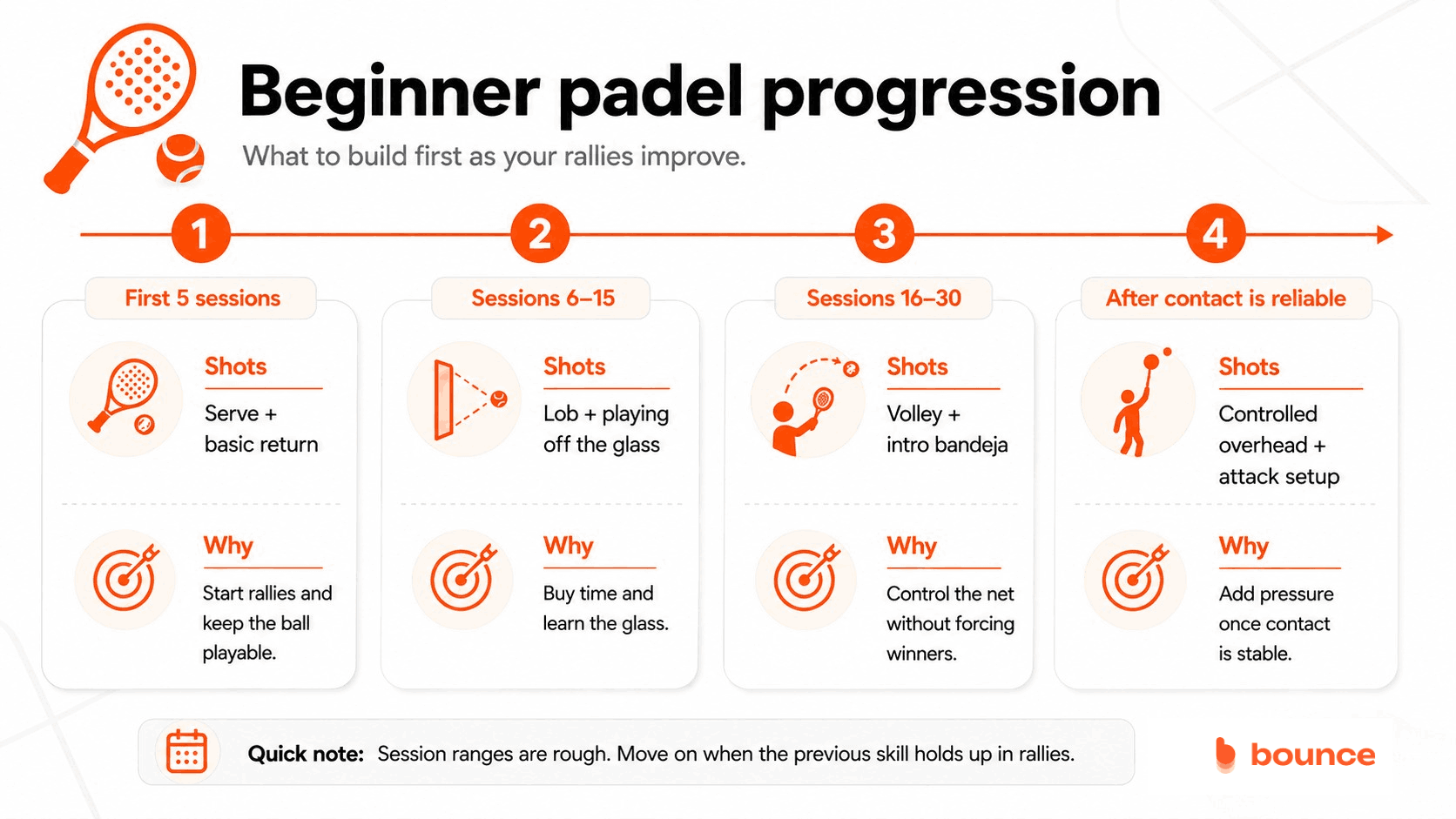
| Typical learning stage | Shot focus | Why this order works |
| First 5 sessions | Serve and return, forehand, backhand, lob, basic volley, basic back-wall return | You can start points, sustain a rally, and experience every main court position |
| Sessions 6–15 | Controlled volleys, wall returns, chiquita, lob under pressure | You learn to defend with the glass and move forward without rushing the point |
| Sessions 16–30 | Bandeja, flat smash, double-wall return | You can handle higher balls, protect net position, and attack a short lob |
| After 30 sessions, or when ready | Víbora, gancho, bajada de pared | These shots require stronger positioning, earlier preparation, and more reliable contact |
This order surprises tennis players because the lob appears so early. In padel, the lob is a core tactic. It decides who controls the net.
The smash comes later because it needs the right ball. A player who hunts smashes too early usually gives away errors and position.
If you want structured reps beyond random open-play survival, Bounce open play helps players find padel sessions where the same shots come up enough times to learn them.
Practice plan for your next 4 sessions
Practice turns a padel shot into something you can trust under pressure. Use these 4 sessions to build control from the back court, move forward, and add your first overhead.
| Session | Focus | Rep goal |
| 1 | Serve, return, and lob | Hit 20 serves from each side, complete 20 controlled returns, then land 15 lobs beyond the service line |
| 2 | Groundstrokes and back-wall returns | Complete 20 controlled forehands and backhands, then return 20 straight back-wall feeds beyond the service line |
| 3 | Volley-lob pattern | The net team completes 4 controlled volleys before the back team uses a balanced lob to move forward |
| 4 | Bandeja introduction | Hit 20 bandejas from each side, recover your net position after every shot, and land at least 14 beyond the service line |
FAQs
What are the different shots in padel?
The main padel shots are the serve, forehand, backhand, volley, lob, smash, bandeja, víbora, gancho, chiquita, wall return, and bajada de pared. Players also use advanced variations such as the rulo, dormilona, contra pared, x3 smash, and x4 smash as their timing and court awareness improve.
How many shots are there in padel?
There’s no official fixed number of padel shots because coaches classify variations differently. A practical beginner framework covers 12 core shots, while advanced play adds specialized smashes, wall exits, drop shots, and overhead variations. Player discussions commonly use a much longer list once those variations are counted separately.
What are the main overhead shots in padel?
The bandeja, víbora, and smash are the overhead shots most players learn first. The bandeja controls a lob and protects your net position, the víbora adds sidespin and pressure, and the smash attacks a short or weak lob. The gancho is another common overhead when the ball arrives above your non-dominant shoulder.
What is the most effective shot in padel?
The lob is the most useful padel shot for many beginner and intermediate players because it can push both opponents away from the net and give your team time to move forward. A good lob must come from a balanced position and clear the opposing players without giving them an easy smash. Experienced players regularly recommend learning the lob before advanced attacking shots.
What is a smash called in padel?
A smash in padel is commonly called a remate. Common versions include the flat smash, kick smash, x3, and x4, with the name describing the spin, direction, or where the ball leaves the court. A bandeja or víbora may look similar during preparation, but each has a different tactical purpose.
Which padel shots should beginners learn first?
Beginners should start with groundstrokes, volleys, lobs, wall returns, serves, and serve returns. Add the bandeja once you can move into position early and contact overhead balls with control. These shots keep rallies alive and teach the court movement covered in our padel tips for developing players.