Most beginners lose padel points before the ball is hit hard enough to look like a winner.
They lose because they stand in the wrong part of the court, then choose shots that make that position worse.
Want a quick answer? Padel strategy starts with net control. Use the lob to move opponents off the net, use the bandeja to hold the net when they lob, and move with your partner in the same horizontal band.
The safest players learn when to defend from the back glass, when to move through the transition zone, and when to close forward.
This guide covers the court positions, shot choices, and doubles habits that turn padel from a reaction game into a point-building game.
Why net control drives padel strategy
Padel rewards the team that can hit down. The FIP rules define a 10m by 20m court with glass and metallic walls in play, so deep balls can rebound and keep rallies alive. That court design makes position beat raw pace.
Professional data points the same way. A study of 2,107 rallies found that six out of ten rallies finished at the net, and points scored at the net accounted for more than 80% of the total.
Winning players scored 34% more points at the net and made 49% fewer unforced errors there than the losing players.
Those numbers show what good players feel immediately: the net gives you downward contact, sharper angles, and the first clean chance to force a weak ball.
Players who compare padel vs pickleball feel the difference quickly. Both reward forward pressure, but padel gives the defensive team extra time through the glass. You have to earn the net, then protect it through smarter overheads and better spacing.
The 3-zone court system: where each shot belongs
Your court position tells you what shot belongs there. Almost every bad tactical decision starts with ignoring that.
The court breaks into 3 functional zones based on your distance from the net.
Defensive zone: back glass to about 2m forward
You are under pressure here. The right play is height and depth: a lob over the opponents, or a controlled ball that buys time to reset. A 2022 professional padel study of 2,759 World Padel Tour golden-point rallies found that points ended more often through errors than winners for both men and women.
That should scare the club player a little. From the back glass, choose safety before pace.
Transition zone: mid-court between service line and back glass
Your options open up here. On waist-height balls, press cross-court or put the ball at the opponent’s feet. On low balls, play deep and stay neutral. The goal is to create a ball you can follow forward.
Net zone: net to about 3m back
This is where points get decided. Volleys should go at feet, into the middle gap, or into an angle that makes the next ball float. High balls give you an overhead choice: bandeja to keep position, smash to finish a clearly attackable ball.
The lob: padel’s best reset and best test
The lob does more tactical work in padel than any other shot.
A good lob moves the net team backward and gives your team time to recover. A study of 1,324 lob-related actions from the 2018 women’s World Padel Tour finals looked at how defensive pairs used balls sent over the attacking pair to recover court position.
That is the lob’s job in one sentence: move the opponent off the net so you can fight for it.
Aim deep to the back corner, especially near the junction of the back glass and side glass. That rebound is awkward because the opponent has to judge height, depth, and wall angle while moving backward.
Contact the ball low with an open racket face. Give it enough height to clear a tall player, then enough depth to keep the overhead from becoming easy. Short lobs feed smashes. Deep lobs create decisions.
Bandeja vs. smash: the overhead choice beginners rush
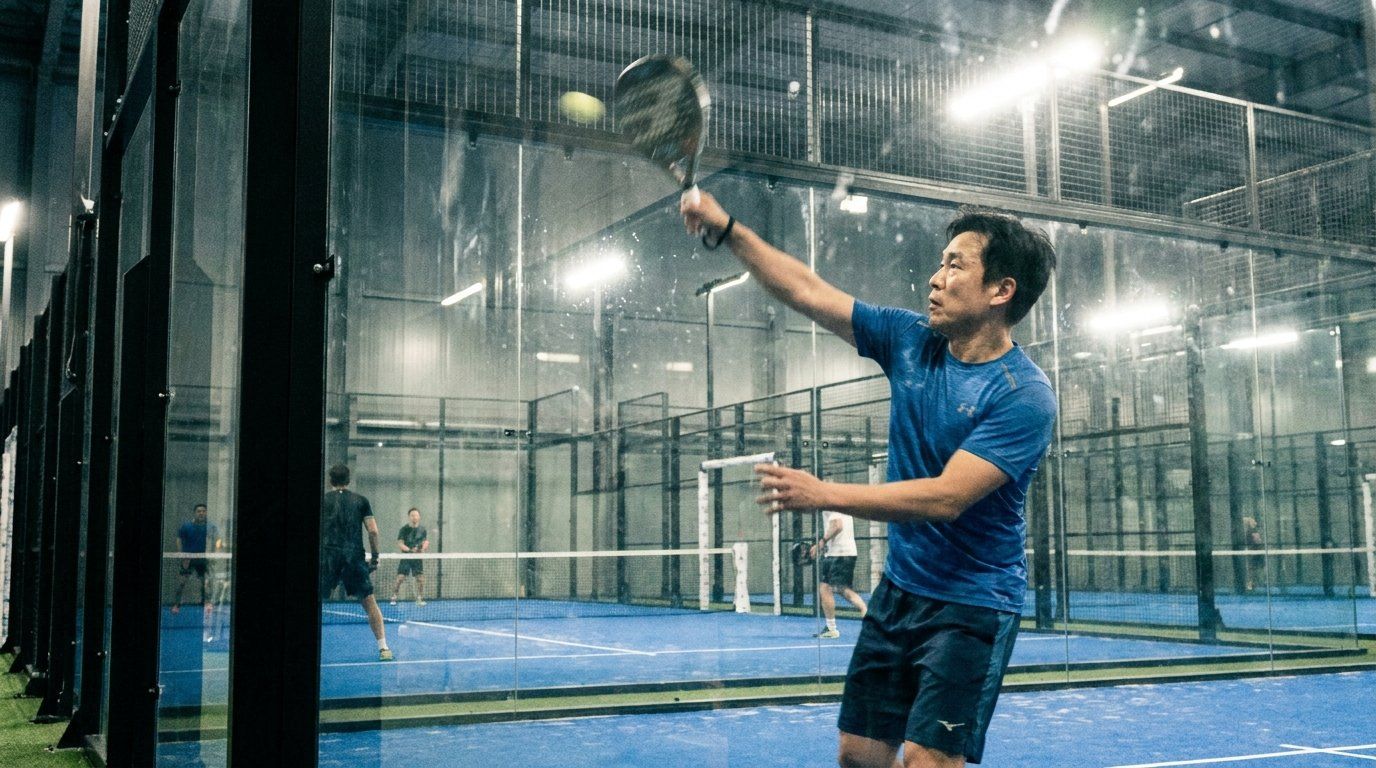
The overhead choice separates beginners from players who can actually hold the net.
The bandeja is the overhead that lets you keep position. LTA Padel describes it as the common overhead and the antidote to the lob. Its job is to retain net position.
Use the smash when the ball is high, slow, and clearly finishable. Use the bandeja when the ball is deep enough to pull you away from the net, or when a full-power smash would leave you out of position.
Most club players smash too many overheads. The better habit is simple: kill the ball when the finish is there, then play the bandeja when position matters more than pace.
The vibora sits one step more aggressive than the bandeja. It uses more side spin and forward intent, usually into the back corner. Learn the bandeja first because it protects your court position. Add the vibora once your overhead contact is stable.
The lob-bandeja-net loop: how padel points repeat
Padel looks chaotic until you see the loop.
The net team pressures. The back team lobs. The net team plays a bandeja to stay forward. The next weak ball gets volleyed at feet or through the middle.
That loop explains why isolated shot practice fails so many players. A lob only matters because it tests the net team’s overhead.
A bandeja only matters because it keeps the attacker close enough to volley the next ball. The shots are connected. Practice them that way.
Two drills that build the loop
1. 10-lob reset drill: One pair starts at the back glass. They must hit a deep lob before advancing. The net pair scores only when they hold the net through the next overhead.
2. Bandeja hold drill: One pair starts at the net. The other pair feeds 10 lobs. The net pair scores 1 point for every bandeja that lands deep and lets both partners recover forward.
Doubles positioning: move with your partner or give away the middle
Competitive padel is built around pairs. Your positioning has to work as a pair too.
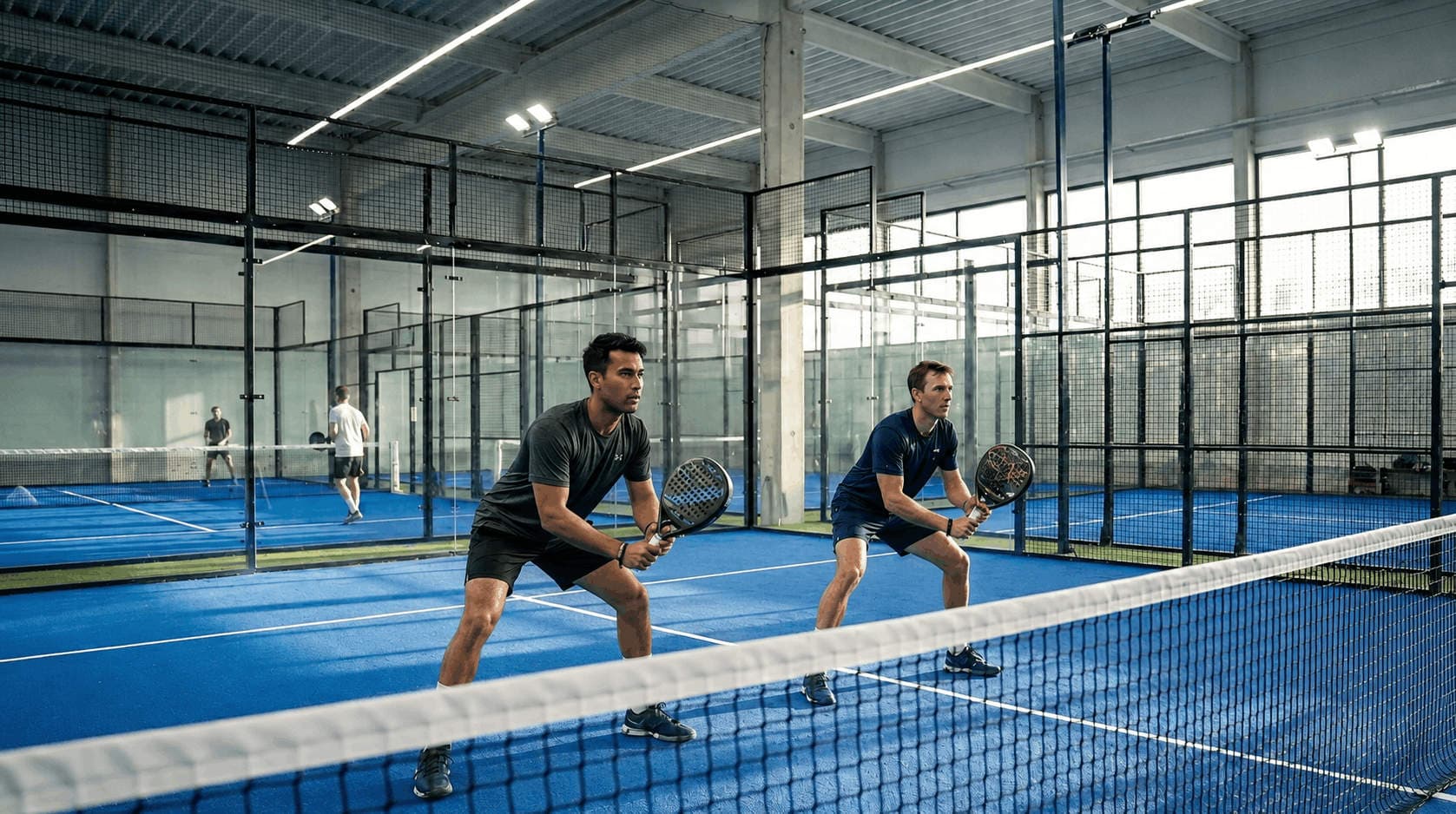
Both players should occupy the same horizontal band of the court. Both at the net, or both near the back glass. A split pair gives opponents an easy target through the middle gap.
When one player moves wide, the partner shifts in the same direction. When one player retreats for a lob, the partner adjusts to cover the next ball. This takes communication, especially on overheads. Call “mine” or “yours” early. Late calls make clean bandejas impossible.
At the net, the middle is usually the smartest target. A ball between the opponents forces a decision and creates more errors than a low-percentage attempt past the outside shoulder.
For players who need live reps with different partners, Bounce open play gives you match-speed games where you can test calls, middle coverage, and net recovery against players who hit different balls than your regular partner.
Shot selection by zone: a reference table
| Court zone | Ball height | Best shot | Intention |
| Defensive zone | Any | Lob or high deep ball | Buy time and reset |
| Transition zone | High, shoulder level or above | Press cross-court or at feet | Build pressure |
| Transition zone | Low, below waist | Controlled deep ball | Stay neutral |
| Net zone | High | Bandeja, vibora, or smash | Hold position or finish |
| Net zone | Mid or low | Volley to feet or middle | Force a weak reply |
| Any zone | Rushed | Lob | Recover position |
Serve and return: your first net-control decision
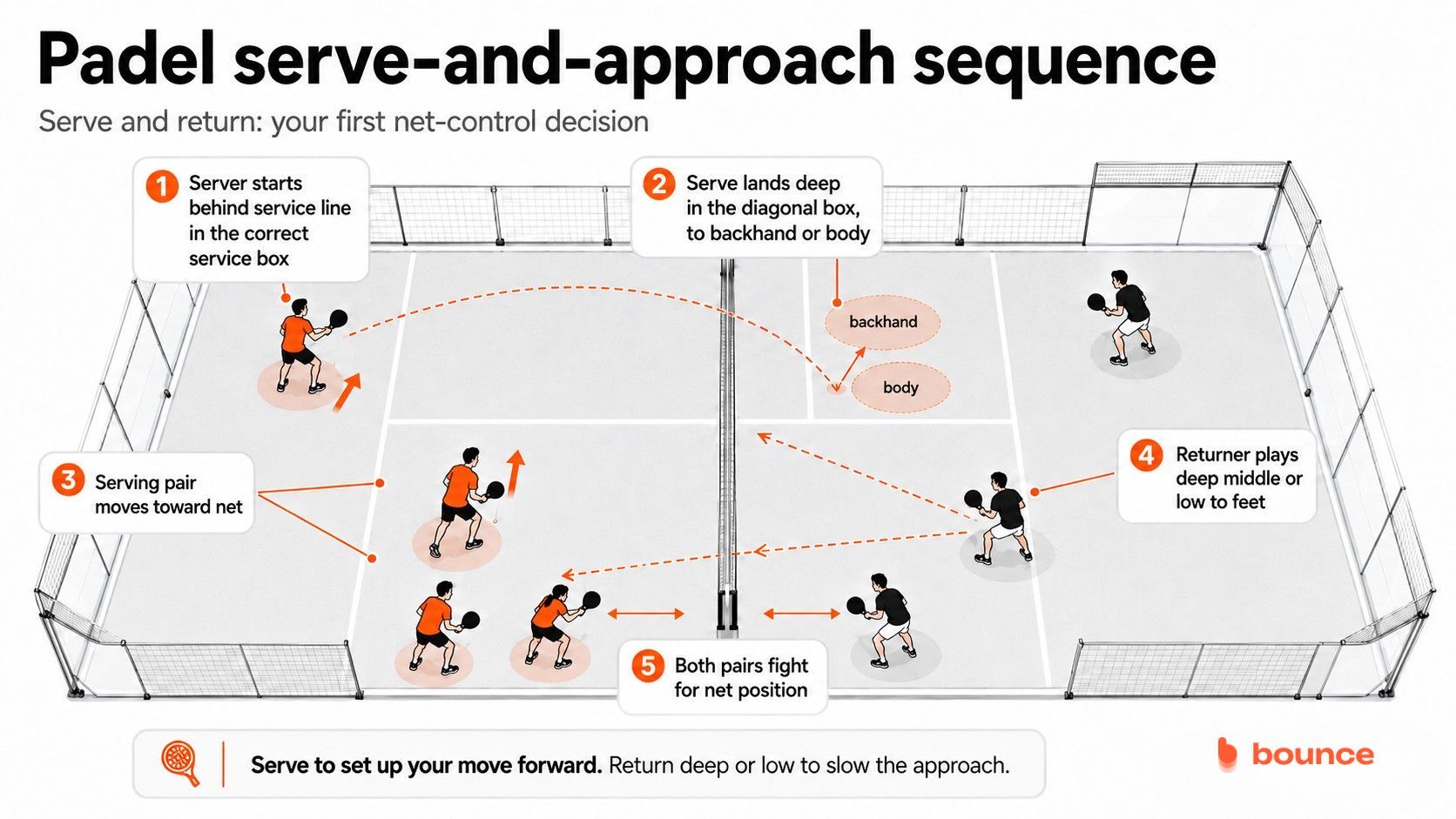
The serve starts your first move forward. Under the official rules, the serve is hit after a bounce and below waist level, so the goal is setup and position. Hit a serve that makes the returner contact low or late, then move behind it.
A PLOS One study of 2,148 points found clear level differences in service movement: high-level players moved faster toward offensive position and spent less time between serve and return impacts than beginners.
That matters because slow movement after the serve gives the returner time to aim at your feet.
On return, your first job is to prevent the serving pair from arriving comfortably at the net. Deep through the middle is usually safer than a sharp angle. A low return at the server’s feet works too, especially when the server is already closing.
Reading the back glass from the defensive zone
Back-glass shots are where rushed players give away points. The ball looks late, so they panic and swing while it is still behind the body.
Let the glass buy you time. When the ball is moving fast and deep, let it rebound, reset your feet, then choose height or depth. Attack only when the ball comes forward enough to contact in front of your body.
Low rebound? Play deep and cross-court. High rebound? Lob. Ball stuck behind your hip? Reset. The back glass gives you extra time, but only if you use it instead of rushing through it.
Once you move past beginner basics, the padel tips that matter most are usually boring in the right way: let the ball come to you, take fewer balls behind your body, and choose height before speed.
The chiquita: a soft shot that breaks net rhythm
The chiquita is a low, soft shot aimed at the feet of the net team. It gives you a second way to contest the net when the lob is too predictable.
The ball should travel just over the net and land near the opponent’s shoelaces. From there, the net player has to volley upward, which creates a short ball or gives you time to move forward.
Hit the chiquita with touch, then still make it reach the feet. The mistake is floating it. A floating chiquita becomes a sitter volley.
Common strategy mistakes beginners make
Trying to win from the defensive zone
The back glass is a recovery area. Use it to survive pressure. From deep in the court, lobs and high deep balls beat low-percentage drives.
Smashing every overhead
A smash that fails to end the point usually gives away the net. Use the bandeja for most deep overheads, then smash the ball you can finish cleanly.
Standing split from your partner
One player forward and one player back leaves the middle open. Move as a pair. If one of you retreats, the other has to adjust.
Ignoring gear control
Padel strategy depends on touch, especially on lobs, chiquitas, and volleys at feet. Players choosing padel equipment should care more about control and comfort than raw power, especially in the first 12 months.
Waiting too long to get feedback
Court geometry is hard to feel from inside the point. Bounce lessons connect players with padel coaches who can see your transition timing, overhead choice, and partner spacing from the side.
Conclusion
Padel strategy gets easier once you judge each ball by court position.
The net gives you geometry. The lob challenges it. The bandeja protects it. The back glass buys time when you are rushed. Build that loop first, then add more pace.
For players building their game through structured coaching and organized play, Bounce connects you with certified coaches and competitive formats in your city.
FAQ
What is the golden rule of padel strategy?
Win the net, then protect it. Padel points favor the team that can hit down, close angles, and force the back-court pair to play upward.
What is the most important padel strategy for beginners?
Beginners should learn court zones first. Defend from the back glass with height and depth, move through the transition zone behind a good ball, and use the net zone to volley at feet or through the middle.
What is the lob used for in padel?
The lob pushes the net team backward and gives your pair time to recover. A deep lob into the back corner forces a hard overhead decision and helps you fight for the net.
What is the difference between a bandeja and a smash in padel?
A smash is an attacking overhead meant to finish the point. A bandeja is a controlled overhead used to keep the ball low, recover forward, and hold net position after the opponent lobs.
How do you control the net in padel doubles?
Move with your partner in the same horizontal band. Target the middle gap, volley at feet, call lobs early, and recover forward after every bandeja.
What is the best padel strategy for tennis players?
Tennis players get better faster when they treat the back glass as extra time. Use the wall to reset, build the point through position, and choose the bandeja over the smash on deep overheads.