Search 'padel vs paddle tennis' and you hit a naming problem before you hit a sports comparison.
Padel is one sport. Pop tennis is another. Platform tennis is a third. People call all of them paddle tennis at some point, which is why this query gets messy fast.
All three use solid paddles. All three borrow from tennis. The court, ball, wall rules, and player experience are different enough that choosing the wrong one can waste your first few sessions.
Want a quick answer? Padel is played on a 20 x 10 meter enclosed glass court, usually in doubles, with live walls. Paddle tennis, now commonly called pop tennis, is played on an open 50 x 20 foot court with no walls. Platform tennis is a separate winter sport on a 44 x 20 foot elevated court with live wire screens.
This guide compares padel vs paddle tennis, padel vs pop tennis, and padel vs platform tennis so you know which sport you are actually looking at.
The naming problem: paddle tennis, pop tennis, and platform tennis
Before comparing padel to anything, the paddle tennis category needs cleaning up. Most articles skip this. That is where the confusion starts.
Paddle tennis was invented in 1898 by Reverend Frank Beal as a smaller tennis-style game. The modern version is commonly called pop tennis, and POP Tennis describes it as tennis on smaller courts with shorter solid paddles and low-compression tennis balls.
Platform tennis came later, in 1928 in Scarsdale, New York. It is played on a raised heated court surrounded by tight wire screens. The screens are live, so the ball can be played after it rebounds off them.
When someone searches 'padel vs paddle tennis,' they usually mean one of two comparisons: padel vs pop tennis, or padel vs platform tennis. This article covers both.
What is padel?
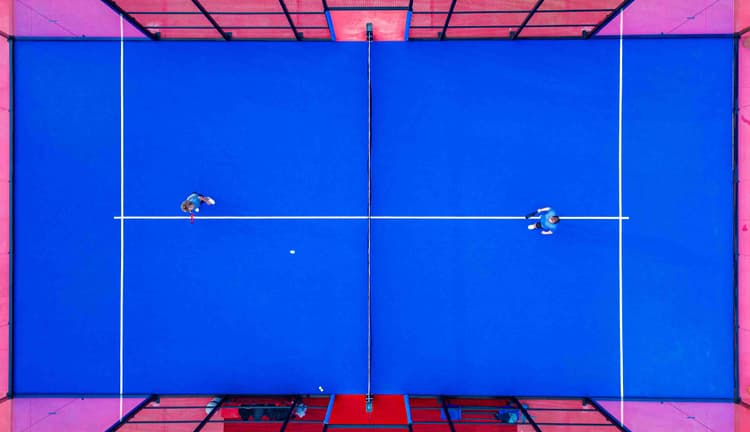
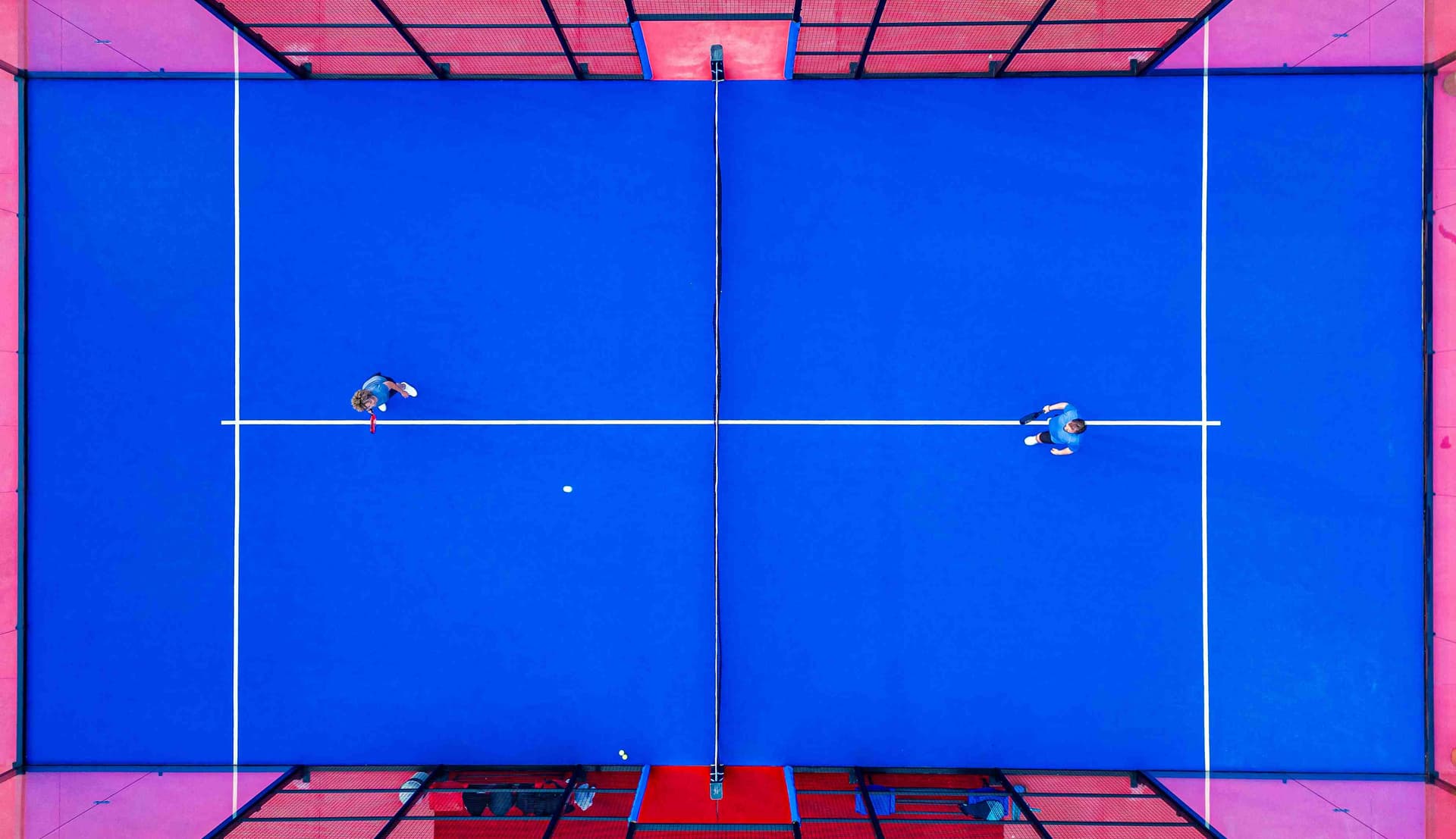
Padel is a doubles racket sport played on a 20 x 10 meter enclosed court with glass and mesh walls. The walls are part of the game, and the International Padel Federation rules define the court, serve, scoring, and equipment standards.
Padel started in Acapulco, Mexico, in 1969. Enrique Corcuera built walls around a small court, and the wall game became the sport’s defining skill. The ball can rebound off the glass after it bounces, which gives padel a different rhythm from tennis or pop tennis.
The serve is underhand. Scoring follows tennis: 15, 30, 40, game, set, match. Most recreational and competitive padel is doubles.
If padel is the part you are trying to understand first, the padel vs pickleball comparison is the better next read because it compares the two fastest-growing crossover sports.
What is paddle tennis, now called pop tennis?
Pop tennis is an open-court tennis-style sport played on a 50 x 20 foot court with a solid paddle and a low-compression tennis ball. POP Tennis USA lists the official court at 50 x 20 feet and racquets at a maximum length of 18.5 inches.
Pop tennis feels closer to tennis than padel. There are no walls. The ball goes out when it clears the court. Groundstrokes, depth, and net coverage carry more of the game than wall reads or glass rebounds.
What is platform tennis?
Platform tennis is a cold-weather doubles sport played on an elevated 44 x 20 foot court with live wire screens. The American Platform Tennis Association describes it as an outdoor racket sport usually played in cool or cold weather.
Platform tennis has a Northeast US identity because the courts are heated from below and built for winter play. The ball is sponge rubber. The screen game matters a lot, especially on lobs and defensive resets.
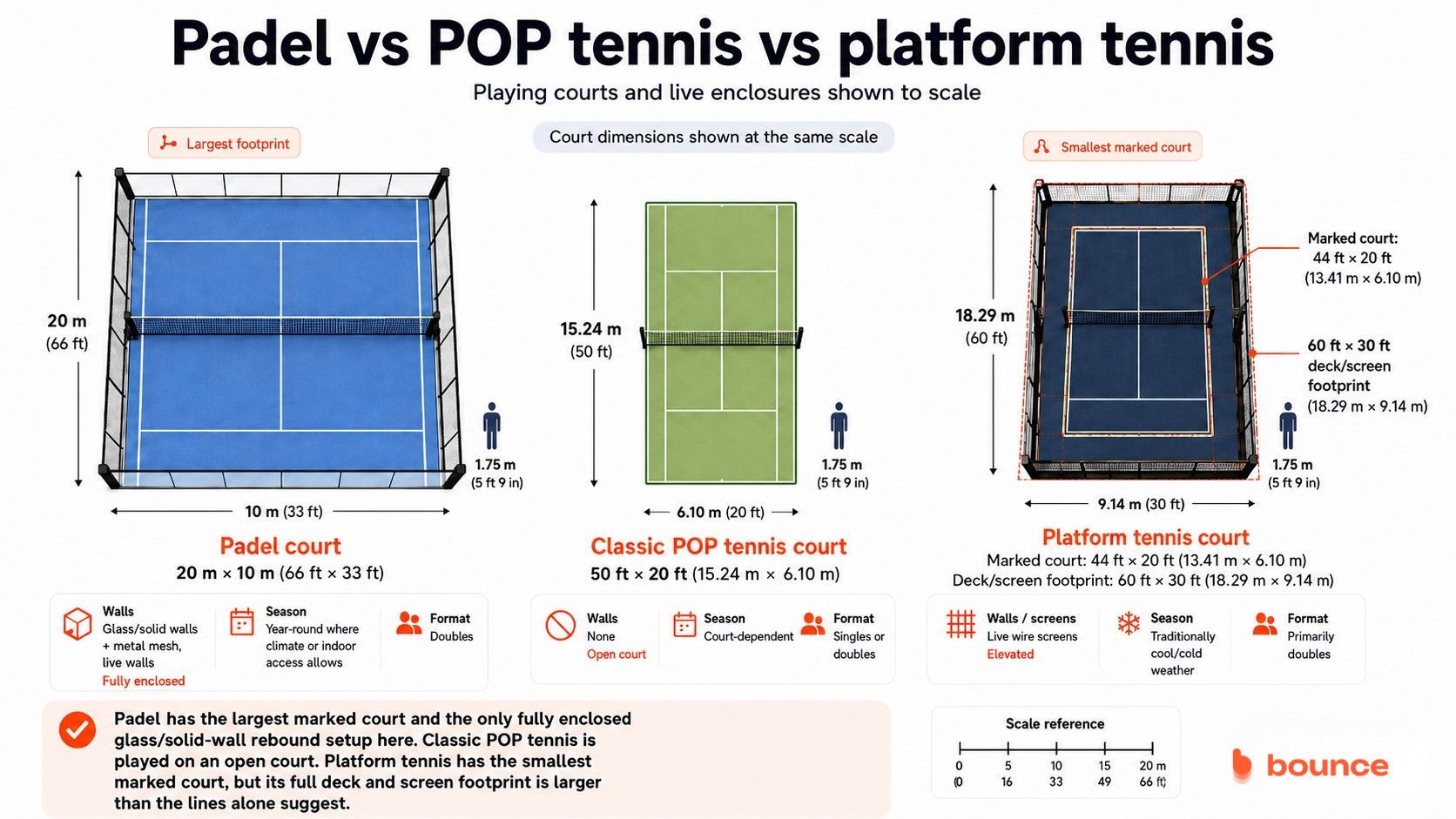
Court comparison: padel vs pop tennis vs platform tennis
| Feature | Padel | Pop tennis | Platform tennis |
| Court size | 20 m x 10 m (66 x 33 ft) | 50 x 20 ft | 44 x 20 ft |
| Walls | Glass and metal mesh, live | None | Wire screens, live |
| Surface | Artificial turf | Hard court, asphalt, or tennis surface | Raised heated aluminum platform |
| Enclosure | Fully enclosed | Open | Elevated, screened enclosure |
| Usual season | Year-round | Year-round | Cool or cold weather |
| Typical format | Doubles | Singles or doubles | Doubles |
Equipment comparison: rackets, balls, and cost
The paddles are not interchangeable in any practical sense. Each sport uses its own paddle shape, ball type, and court behavior.
For a deeper gear pass before you buy, the padel equipment guide covers rackets, balls, shoes, bags, and beginner buying mistakes.
| Equipment | Padel | Pop tennis | Platform tennis |
| Paddle length | Max 45.5 cm | Max 18.5 in | Max 18 in |
| Typical paddle weight | 340 to 380 g | 230 to 270 g | 250 to 310 g |
| Paddle surface | Solid, perforated, often textured | Solid, no strings | Solid, perforated |
| Ball | Lower-pressure padel ball | Low-compression tennis ball | Sponge-rubber ball |
| Entry paddle cost | About $50 to $350+ | About $30 to $120 | About $60 to $200 |
| Shoes | Padel-specific or clay-court shoes | Court shoes or tennis shoes | Court shoes with cold-weather grip |
Rules and scoring: what changes between the sports
Scoring
All three sports use tennis-style scoring: 15, 30, 40, deuce, advantage, game. Sets are typically first to 6 games, with a tiebreak at 6-6.
The serve
Padel uses an underhand serve after a bounce. The ball must be struck at or below waist height and served diagonally. Two serves are allowed.
Pop tennis also uses an underhand serve, but one serve is allowed. A fault loses the point.
Platform tennis allows an overhand or underhand serve, depending on format and rule set, with one serve in doubles.
Wall and screen play
Padel uses glass walls and mesh as live parts of the rally. Good players learn when to let the ball hit the glass and when to cut it off early.
Pop tennis has no wall layer. The open court makes the game cleaner for tennis players because the ball is out when it clears the boundary.
Platform tennis uses wire screens. A lob that lands in and carries into the screen can stay playable, which creates long defensive points.
| Rule | Padel | Pop tennis | Platform tennis |
| Serve type | Underhand after a bounce | Underhand | Overhand or underhand |
| Serves allowed | Two | One | One in doubles |
| Wall or screen play | Glass walls are live | No walls | Wire screens are live |
| Primary format | Doubles | Singles or doubles | Doubles |
| Best transferable skill | Net control and patience | Tennis groundstrokes | Lob defense and screen reads |
Which sport is right for you?
The best choice depends on where you live, who you can play with, and what kind of game you want. Use the table as a fast filter.
| Player type | Best fit | Why |
| Complete beginner | Padel | The walls keep more balls in play, and the underhand serve lowers the first-session barrier. |
| Tennis player who wants familiar movement | Pop tennis | The open court and groundstroke patterns feel closest to tennis. |
| Northeast player looking for winter doubles | Platform tennis | Heated courts and screen play were built for cold-weather club doubles. |
| Social player who wants organized doubles | Padel | The sport is designed around doubles and group formats. |
| Budget-first player | Pop tennis | Public courts and lower-cost paddles can make entry cheaper. |
| Player chasing the fastest-growing option | Padel | US participation and court supply are growing fast, with 1,073,000 players counted in 2025. |
Switching from tennis: what transfers and what has to change
Tennis players are the most common switchers into these sports. The transfer is cleanest in pop tennis and hardest in platform tennis if you have never played screens.
Tennis to padel
Groundstroke timing helps, but padel rewards a compact swing. The biggest adjustment is the wall game. Tennis instincts tell you to back away from the ball near the glass.
Padel asks you to stay calm, let the ball rebound, and hit from a controlled position.
If that wall adjustment is the part that feels weird, these padel tips for newer players give you the positioning habits that matter before shot selection gets complicated.
Tennis to pop tennis
Pop tennis is the easiest transfer. The court is open, the ball is familiar, and the shot shapes carry over. The single-serve rule makes serving more conservative.
Tennis to platform tennis
Platform tennis rewards patience. The screens bring balls back that would be finished points in tennis, so power-first players often get frustrated before they learn the screen patterns.
Court access in the US: where you can actually play
Knowing which sport you prefer only matters if you can find a court.
USA Padel reported 1,073,000 US padel players in 2025 and just over 1,000 courts across 31 states as of April 2026. That makes padel the clearest national growth story in this group.
Pop tennis is strongest in Southern California, Florida, New York, and pockets of the Southwest. Some facilities use dedicated 50-foot courts, while others adapt existing junior tennis lines.
Platform tennis is strongest in the Northeast, especially New York, New Jersey, Connecticut, Pennsylvania, and nearby club markets. Most courts sit at clubs rather than public parks.
Find organized padel near you
Start with court access. If padel is available near you, the rest gets easier: lessons, open play, leagues, and social sessions all depend on having a place you can play consistently. Bounce courts is the cleanest place to begin.
The bottom line
Padel, pop tennis, and platform tennis share paddles and tennis-style scoring. The actual games feel different.
Pick padel if you want a fast-growing doubles sport with walls, coaching, clubs, leagues, and social formats. Pick pop tennis if you want the closest open-court cousin to tennis. Pick platform tennis if you live near clubs with winter courts and want a screen-based doubles game.
Trying any of them for a few sessions costs less than buying your way through the wrong gear. Start with the sport you can play consistently where you live.
If padel feels like the right fit, Bounce helps you find the next step in your city, from courts and coaching to organized play.
Frequently asked questions
Is padel the same as paddle tennis?
Padel and paddle tennis are different sports. Padel is played on an enclosed 20 x 10 meter glass court with live walls. Paddle tennis, now commonly called pop tennis, is played on an open 50 x 20 foot court with no walls.
What is the difference between paddle tennis and pop tennis?
Pop tennis is the modern name for the sport historically called paddle tennis. The sport uses a solid paddle, a low-compression tennis ball, and a smaller open court.
What is the difference between padel and platform tennis?
Padel uses glass walls, artificial turf, and a 20 x 10 meter court. Platform tennis uses wire screens, a raised heated court, and a sponge-rubber ball. Platform tennis is tied strongly to cold-weather doubles in the Northeastern US.
Which is easier to learn: padel or paddle tennis?
Padel is usually easier for complete beginners because the walls keep rallies alive and the serve is simple. Pop tennis can feel easier for tennis players because the open court and groundstrokes transfer more directly.
How many padel courts are there in the US?
USA Padel reported just over 1,000 padel courts across 31 states as of April 2026. It also cited 1,073,000 Americans who played padel in 2025.
Can you use the same paddle for padel and pop tennis?
Use the right paddle for each sport. Padel rackets are heavier and built for a larger enclosed court. Pop tennis paddles are lighter and sized for a smaller open court.