Your knees take more abuse in pickleball than the court makes obvious.
Pickleball knee injuries usually come from the same sequence: hard-court stops, repeated knee bend at the kitchen, lateral shuffles, and late direction changes. The court is short, so the movement looks small. The load still lands in the joint.
A 2025 nationwide study of 1,758 pickleball players published in Sports Medicine - Open found the knee had the highest injury prevalence of any body region, at 29.1%. That tracks with what you see on court. Players can manage elbow soreness for weeks. Knee pain changes how they move on the next point.
Want a quick answer? The most common pickleball knee injuries are patellar tendinitis, meniscus irritation or tears, knee bursitis, and patellofemoral pain syndrome. They are usually caused by repeated split-step landings, dinking stance, lateral shuffles, and hard braking.
Mild cases often improve with load control, an active warm-up, court shoes, and hip and quad strength, while swelling, locking, giving way, or pain that lingers beyond 2 to 3 weeks needs medical assessment.
Why pickleball knee pain shows up quickly
The knee sits between body weight from above and ground force from below. StatPearls describes the knee as one of the body’s most frequently injured joints, with bone, ligament, tendon, cartilage, synovial fluid, and bursa structures all involved in how it moves and swells.
Pickleball asks that joint to absorb four repeat demands in a small space.
Split-step landings happen before almost every opponent contact. A good split-step is small, but it still creates a landing force through the patellofemoral joint, where the kneecap tracks against the femur.
Dinking stance keeps you bent at the non-volley zone line for long exchanges. That position loads the patellar tendon and keeps pressure around the front of the knee.
Lateral shuffle and plant steps stress the meniscus and inside knee because the foot sticks while the body changes direction. The harder the court and the stiffer the leg, the more the knee absorbs.
Backpedaling and hard braking create the ugly injuries. A late retreat from the kitchen can turn into a fall, a twist, or a loaded pivot with the knee in a bad position.
The short court hides the volume. Two hours of play can include hundreds of small knee loads, and the joint does not care that each one looked minor.
Common pickleball knee injuries and what causes them
Patellar tendinitis
Patellar tendinitis is irritation of the patellar tendon, the thick band connecting the kneecap to the shinbone. Mayo Clinic describes the classic pain location as the front of the knee, just below the kneecap.
In pickleball, it usually comes from repeated split-steps, low ready position, and long dinking rallies. The tendon gets loaded every time you bend the knee and push out of that position.
Watch the timing. Pain that warms up after 5 minutes, then returns after play, is a tendon warning. Pain that lingers 24 to 48 hours after a session means the tendon is losing the recovery battle.
Meniscus irritation and tears
The menisci are cartilage pads between the thighbone and shinbone. They absorb shock and help the knee handle rotation. AAOS OrthoInfo lists pain, swelling, catching, locking, and trouble moving the knee through full range as common meniscus tear symptoms.
Pickleball stresses the meniscus during plant-and-push movements. The risky moment is easy to picture: your foot sticks, your body turns, and your knee is bent under load while you reach for a wide ball.
Older players face a different version. The meniscus can already be worn from years of use, then a normal-looking lateral step becomes enough to cause a flare or tear.
Knee bursitis
Bursae are small fluid-filled sacs that reduce friction around a joint. In pickleball, the prepatellar bursa over the kneecap and the pes anserine bursa on the inside of the knee are the usual suspects.
This pain feels more local than tendon pain. You can often point to it with one finger. The area may feel warm, swollen, and tender to pressure, especially after repeated low lunges or awkward reaches near the kitchen.
Patellofemoral pain syndrome
Patellofemoral pain syndrome usually feels like a dull ache around or behind the kneecap. It can flare during stairs, squats, prolonged sitting, or repeated low ready positions.
The root cause is often upstream. Weak hip abductors let the thigh drift inward during shuffles and landings. Once the femur rotates inward, the kneecap tracks poorly, and the front of the knee takes the hit.
Who is most at risk for pickleball knee injuries
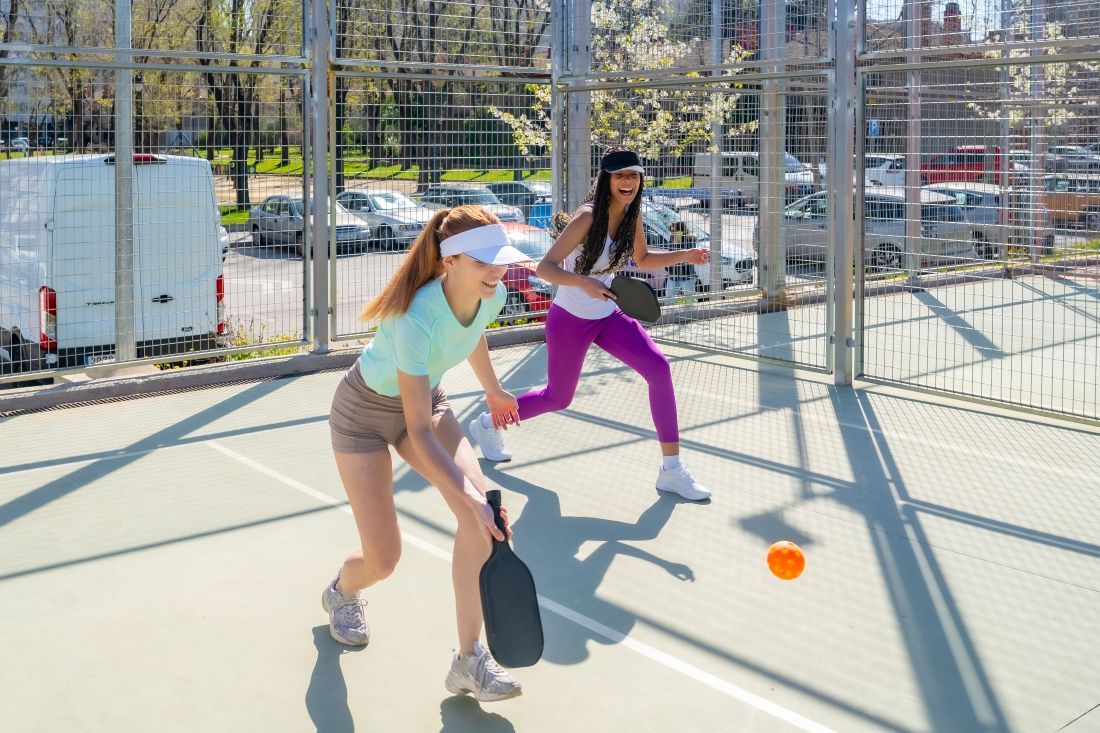
Age matters, but volume and preparation matter more than most players admit. The pickleball injury statistics are clear about older players carrying a large share of the injury burden, especially when falls and soft-tissue injuries are counted together.
New players are also exposed. They can learn the scoring and basic strokes quickly, then jump into 90-minute sessions before their hips, quads, calves, and balance are ready for the workload.
For players over 55, the goal is smart exposure. The sport can be a good fit, and Bounce’s pickleball for seniors coverage explains why the social and fitness benefits are real. The knee still needs strength, footwear, and recovery habits that match the amount of court time.
Two risk factors show up again and again: cold starts and bad shoes.
Cold starts make the first 20 minutes the danger zone. Your legs are asking tendons and cartilage to handle hard stops before the muscles around the joint are fully awake.
Bad shoes usually means running shoes on a hard court. Running shoes are built for forward motion. Pickleball asks for side-to-side control. The footwear difference between pickleball shoes and tennis shoes matters because court shoes support lateral braking and repeated shuffles.
Knee injury prevention for pickleball players
Use an active warm-up before every session
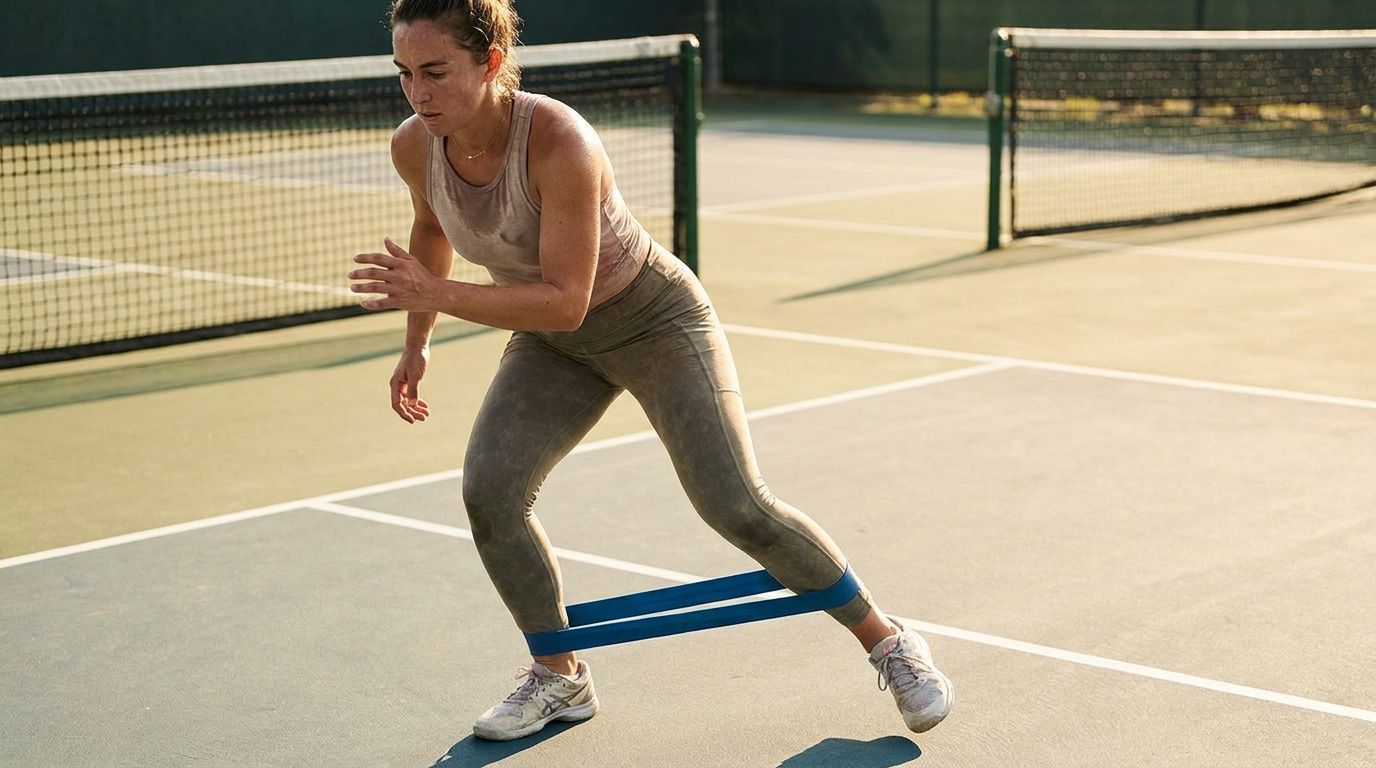
A good warm-up prepares the whole hip-knee chain. Think lateral band walks, leg swings, glute bridges, walking lunges, and slow shadow shuffles before you ever hit a ball.
Give it 8 to 10 minutes. Bounce’s pickleball stretches and warm-up sequence gives players a full pre-play routine that matches the sport’s stops, starts, and lateral movement.
Strengthen the hips and quads off court
The hip controls where the knee goes. The quad controls how well the kneecap tracks and how much force the tendon can tolerate. Weakness in either area shows up fast when you are late to a ball.
A simple weekly base works: slow step-downs, wall sits, lateral band walks, and single-leg glute bridges. For patellar tendinopathy specifically, a clinical review in PubMed Central notes that eccentric exercise is commonly used as a first-line treatment approach.
For players who want coaching around movement quality, Bounce clinics give you a structured way to work on footwork and technique in a group setting instead of guessing alone.
Move low and land quiet
Two habits change knee load immediately.
Stay low during lateral shuffles. An upright shuffle makes the knee absorb force with fewer muscles helping. A lower athletic stance spreads the work across the hips, quads, calves, and feet.
Land quiet on split-steps. Loud landings usually mean stiff landings. Stiff landings send more force straight into the front of the knee.
Use court shoes for regular play
Court shoes keep you closer to the ground and give the foot a wider, more stable base. That matters when you brake at the kitchen line or push laterally for a wide dink.
If you play once a month, shoes may feel like a small detail. If you play twice a week, they become part of your injury-prevention setup.
How to recover from a pickleball knee injury
The first mistake is judging recovery by how the knee feels after it warms up. Tendons and irritated joints can feel better after 10 minutes, then punish you that night or the next morning.
Use the 24-hour rule. If pain is worse the next day, your session was too much. Reduce court time, remove hard lateral cuts for a week, and rebuild from controlled movement before full games.
Recovery timelines by injury type
| Injury | Typical return-to-play range | What has to improve first |
| Patellar tendinitis | 4 to 8 weeks for mild to moderate cases | Pain with stairs, squats, and split-step landings must settle. |
| Minor meniscus irritation | 2 to 4 weeks | Swelling and joint-line pain must calm down before hard lateral cuts. |
| Structural meniscus tear | 6 to 12 weeks or longer depending on severity | Locking, catching, and giving way require clinician guidance. |
| Knee bursitis | 1 to 3 weeks for mild cases | Localized swelling and tenderness must reduce. |
| Patellofemoral pain syndrome | 4 to 8 weeks with strength work | Hip and quad control must improve along with pain. |
Recovery should move in stages. First, calm the irritated tissue. Then restore range of motion. Then rebuild strength. Then add pickleball-specific movement: shadow shuffles, split-steps, kitchen resets, and controlled points.
Players returning from knee pain also need technique feedback. A coach can see whether you are landing stiff, shuffling upright, or reaching late into risky positions. That is where Bounce lessons fit naturally: you can work on movement mechanics while keeping the session controlled.
When to see a clinician
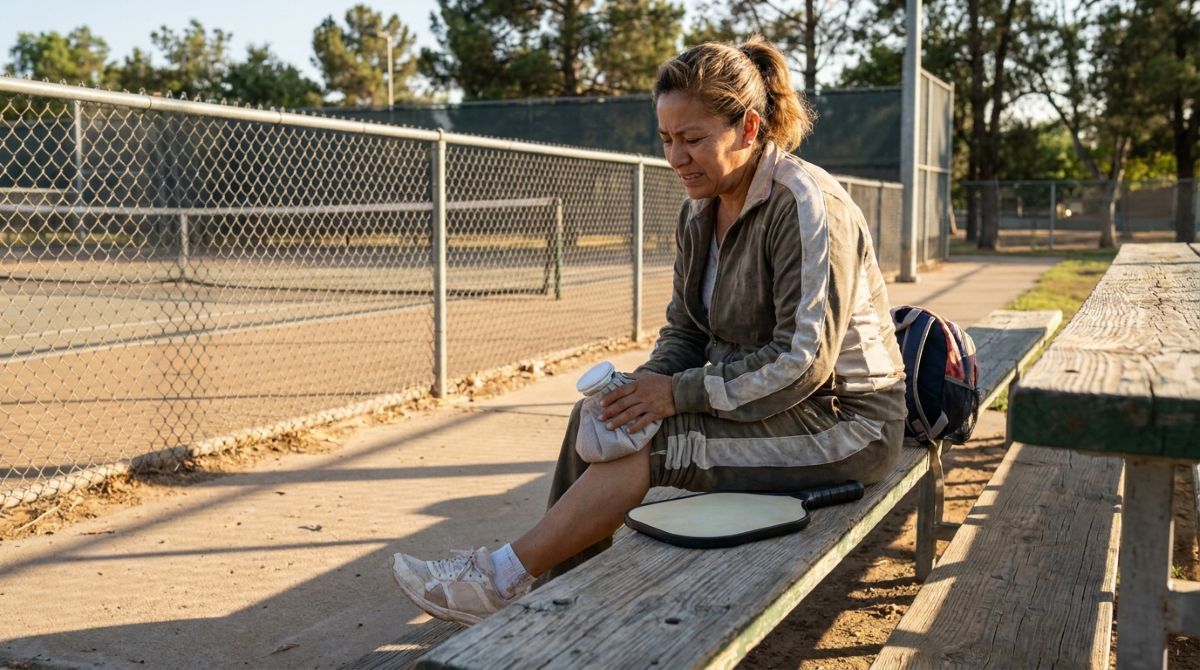
Get evaluated quickly if swelling develops within hours, you cannot fully bear weight, the knee gives way, or the joint locks or catches. Those signs point toward a structural issue that needs a medical exam.
Pain that stays the same after 2 to 3 weeks of smart load reduction also deserves a closer look. Imaging and physical therapy can keep a small problem from becoming a season-long one.
A decision framework: modify or stop
| Symptom pattern | What it usually means | Action |
| Mild ache during warm-up that fades | Tendon stiffness or poor warm-up | Extend warm-up by 5 minutes and monitor. |
| Ache that gets stronger during play | Active tissue stress | Reduce intensity and shorten the session. |
| Pain lasting 24 to 48 hours after play | Overload without enough recovery | Take 5 to 7 days off court and address the cause. |
| Sharp pain during one movement | Possible acute injury | Stop the session and reassess before returning. |
| Swelling the same day | Inflammatory response or joint irritation | Stop, ice, raise, and seek care within 48 hours. |
| Locking, catching, or giving way | Possible structural injury | Stop play and get an orthopedic evaluation. |
Conclusion
Pickleball knee injuries usually follow a pattern. The split-step, the low kitchen stance, the hard lateral shuffle, and the late brake all load the joint in repeatable ways.
That is good news for players who pay attention. You can warm up the right tissue, build the right strength, wear the right shoes, and change the movements that keep irritating the knee.
Recovery works the same way. Treat the pain, then fix the movement problem that created it.
For players building their game through structured coaching and organized play, Bounce connects you with certified coaches and competitive formats in your city.
FAQ
What are the most common pickleball knee injuries?
The most common pickleball knee injuries are patellar tendinitis, meniscus irritation or tears, knee bursitis, and patellofemoral pain syndrome. They usually come from repeated split-step landings, hard lateral shuffles, deep kitchen stance, and late braking on a hard court.
How do I know if my knee pain from pickleball is serious?
Swelling within hours, limping, locking, catching, giving way, or pain that keeps getting worse are warning signs. Mild soreness that settles within 24 hours is usually a load issue. Pain that lingers beyond 2 to 3 weeks deserves a medical evaluation.
Can I keep playing pickleball with knee pain?
You can usually modify play if the pain is mild, stays stable, and settles within 24 hours. Shorten the session, avoid hard lateral cuts, and extend the warm-up. Stop playing if pain gets sharper, swelling appears, or the knee feels unstable.
How long does pickleball patellar tendinitis take to recover?
Mild to moderate patellar tendinitis often takes 4 to 8 weeks with load management and progressive strengthening. Complete rest by itself usually fails because the tendon needs controlled loading to rebuild tolerance. Return when stairs, squats, and split-steps are pain-free or clearly improving.
Do pickleball shoes help prevent knee injuries?
Yes, mainly by improving lateral stability. Court shoes sit lower, support side-to-side braking, and reduce the sloppy foot movement that can push extra load into the knee. Running shoes are built for forward motion, so they are a poor match for regular hard-court pickleball.
What exercises prevent pickleball knee injuries?
Use slow step-downs, wall sits, lateral band walks, single-leg glute bridges, and controlled lateral shuffles. Do strength work 2 to 3 times per week and use an active warm-up before play. The goal is simple: stronger hips, stronger quads, softer landings, and better control when you change direction.