Padel vs racquetball sounds like a natural comparison because both sports put walls into play. Once the first rally starts, the games ask for different instincts.
Padel gives you a net, a partner, glass walls, and tennis scoring. Racquetball gives you a front wall, a live ceiling, a faster ball, and one-on-one pressure in a sealed court.
If you played racquetball in the 1980s or 1990s and keep hearing that padel is the new wall sport, this comparison will save you a bad assumption.
And if you play padel and keep seeing old four-wall courts at gyms, this explains what those rooms were built for.
Want a quick answer? Padel and racquetball both use enclosed courts, but they are different sports. Padel is usually played as doubles on a 20 x 10 meter glass-walled court with an underhand serve and tennis scoring. Racquetball is usually played as singles on a 40 x 20 x 20 foot court with a strung racquet, a live ceiling, and a faster ball.
This comparison covers court size, equipment, rules, scoring, skill transfer, beginner fit, and court access in the US.
Quick comparison
| Feature | Padel | Racquetball |
| Court size | 20 m x 10 m | 40 ft x 20 ft x 20 ft |
| Court type | Glass and mesh court with a net | Four-wall court with front wall target |
| Default format | Doubles | Singles |
| Serve | Underhand bounce serve | Overhand serve into the front wall |
| Scoring | Tennis scoring | Games commonly played to 15 |
| Main skill | Positioning and wall reading | Power, reaction speed, and ceiling control |
Where each sport came from
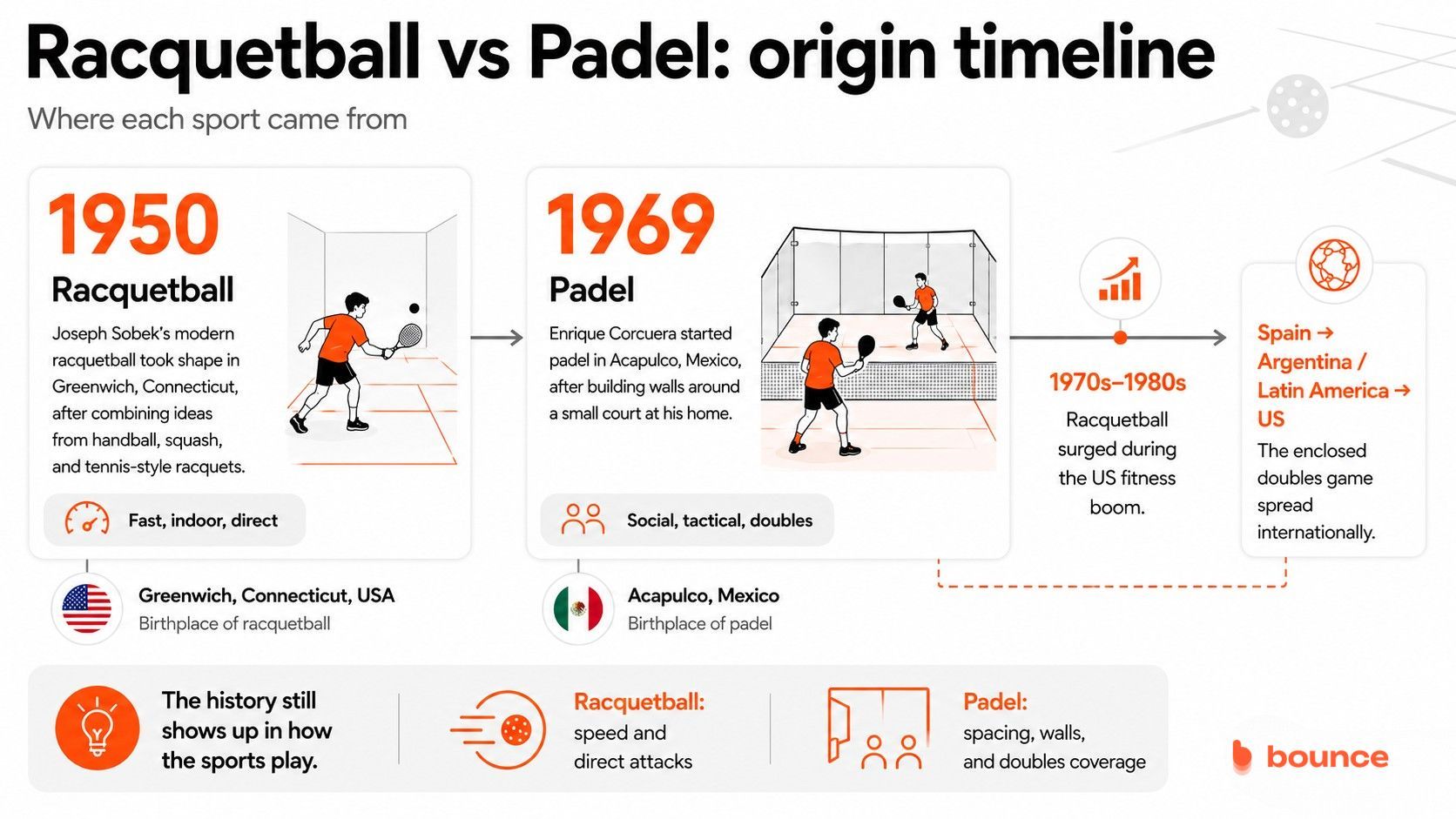
Racquetball grew out of indoor court sports in the US. Joseph Sobek is credited with creating the sport in 1950 in Greenwich, Connecticut, after combining ideas from handball, squash, and tennis-style racquets. The sport surged during the fitness boom of the 1970s and early 1980s.
Padel started in Acapulco, Mexico, in 1969. Enrique Corcuera built walls around a small court at his home, and the enclosed doubles game spread through Spain and Latin America before moving into the US.
The history matters because the games still carry that DNA. Racquetball is fast, indoor, and direct. Padel is social, tactical, and built around doubles court coverage.
Padel origin explains how the sport moved from one private court in Mexico into Spain, Latin America, and then the US.
Court dimensions and design
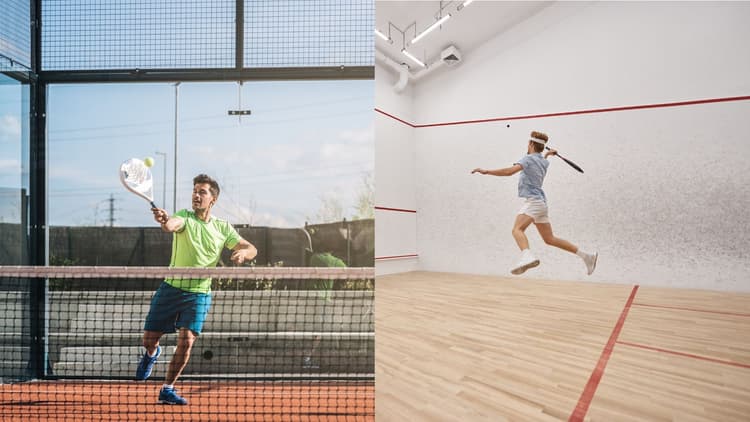
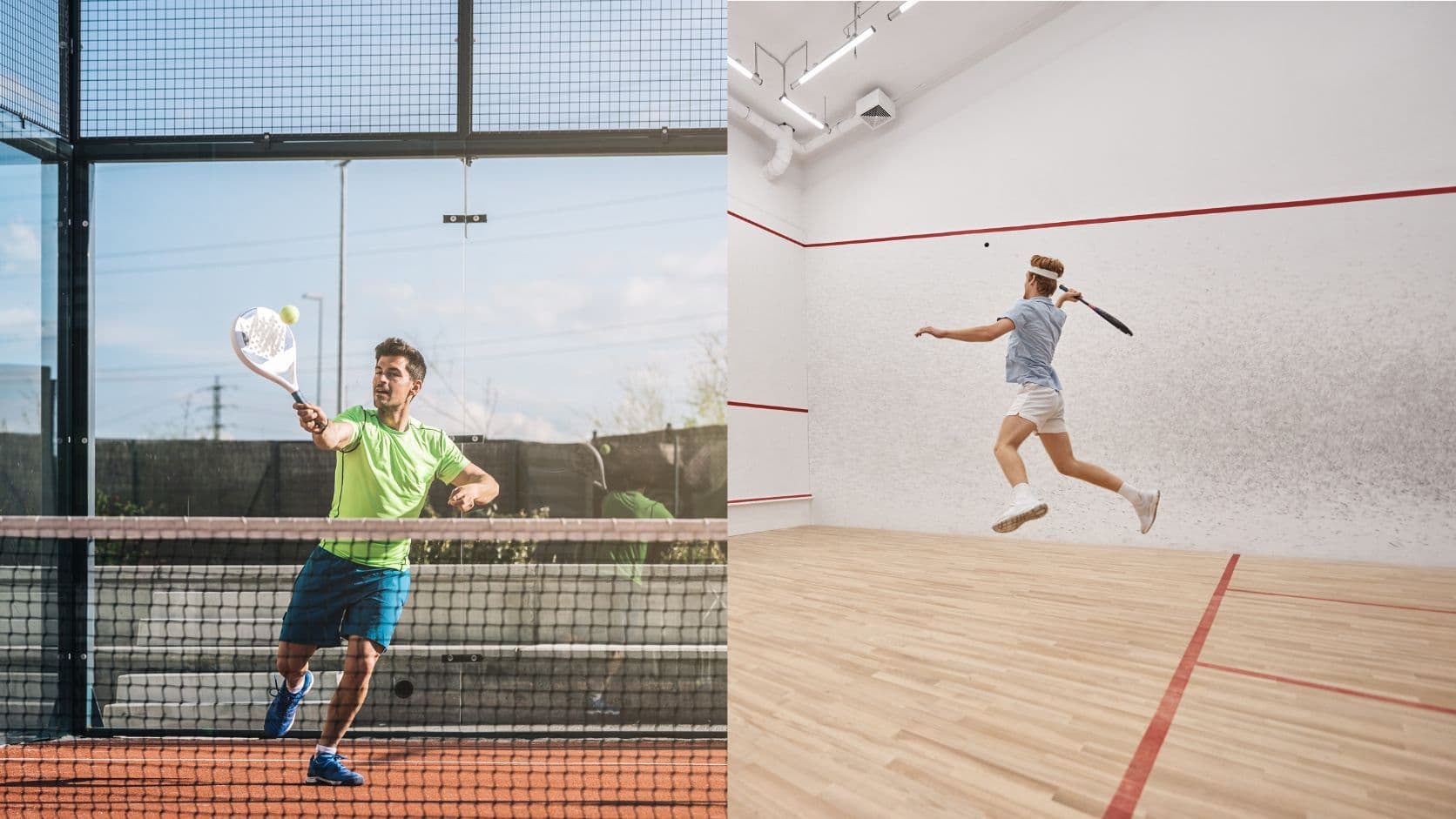
A padel court is 20 meters long and 10 meters wide, divided by a net. The court is enclosed by glass walls and metal mesh fencing. The ball can rebound off the back or side glass after it bounces in the opponent's court, which turns defense into a real part of the game.
A standard four-wall racquetball court is 40 feet long, 20 feet wide, and 20 feet high, according to USA Racquetball court specifications. The front wall is the target. The side walls, back wall, floor, and ceiling can all matter during a rally.
The ceiling changes everything physically. In racquetball, a high defensive shot into the ceiling can buy time and push the ball deep. In padel, the game has no live ceiling, so the defensive work comes from glass rebounds, lobs, and court position.
| Court feature | Padel | Racquetball |
| Length | 20 meters (65.6 ft) | 40 feet (12.2 m) |
| Width | 10 meters (32.8 ft) | 20 feet (6.1 m) |
| Height | No live ceiling | 20 feet (6.1 m) |
| Walls | Glass and mesh after the bounce | Front, side, back walls, and ceiling |
| Net | Yes | No |
| Common setting | Outdoor or indoor club court | Indoor athletic facility court |
Equipment: solid padel racket vs strung racquetball racquet
The equipment overlap is smaller than the court overlap. Padel uses a solid perforated racket. Racquetball uses a strung racquet. That single difference changes swing length, ball speed, reaction time, and how points end.
The padel racket
A padel racket is solid, perforated, and shorter than a tennis racquet. Most adult rackets weigh about 340 to 380 grams. The face is usually fiberglass or carbon fiber, with a core that gives enough rebound for control without turning every swing into a power shot.
The shorter shape encourages compact swings. Good padel is built on court position, angles, lobs, and smart use of the glass.
The racquetball racquet
A racquetball racquet has strings and a maximum length of 22 inches under IRF equipment rules. It is usually much lighter than a padel racket, often around 150 to 185 grams strung.
The string bed creates far more rebound. That is why racquetball rallies can feel violent in a good way. A drive serve or kill shot can end a point before a beginner even finishes reading the bounce.
The ball
A padel ball is a felt-covered rubber ball similar to a tennis ball, with lower internal pressure. It moves slower and bounces lower than a standard tennis ball, which keeps the rally playable inside the glass.
A racquetball ball is a hollow rubber ball built for sharp rebound off hard walls. It is close to the same diameter as a padel ball, around 57 mm, but it plays much faster.
Eye protection
Racquetball requires protective eyewear in sanctioned play. Padel players usually skip eyeguards because the net separates teams, the ball moves slower, and the court is wider.
The safety logic is simple: a fast rubber ball in a narrow four-wall room gives players very little reaction time. USA Racquetball's rulebook and eye-injury research both support protective eyewear in enclosed-court racquet sports.
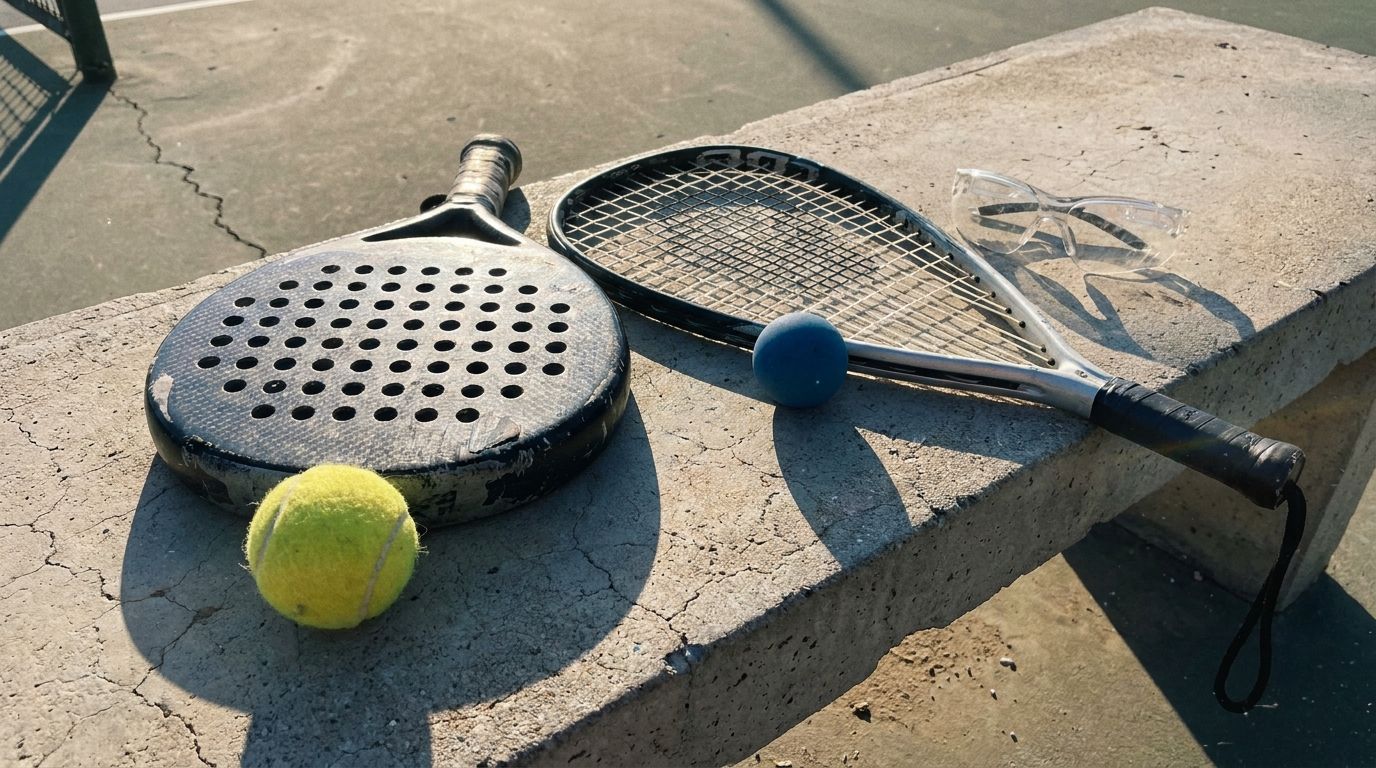
Padel uses a solid perforated racket and a lower-pressure felt-covered ball. Racquetball uses a strung racquet and a hollow rubber ball built for faster wall rebound.
| Equipment | Padel | Racquetball |
| Implement | Solid perforated racket | Strung racquet |
| Max length | 45.5 cm | 22 inches (55.9 cm) |
| Typical weight | 340-380 g | 150-185 g strung |
| Ball | Lower-pressure felt-covered ball | Hollow rubber ball |
| Ball speed | Moderate | Fast, especially off drive serves |
| Eye protection | Uncommon | Required in sanctioned play |
| Footwear | Padel or clay-court shoes | Non-marking indoor court shoes |
The serve: placement vs pressure
In padel, the server stands behind the service line, bounces the ball, and hits an underhand serve at or below waist height into the diagonal service box. Two serves are allowed. The serve starts the point. It rarely wins the point by itself.
In racquetball, the server bounces the ball once, then hits it into the front wall. The ball must rebound past the short line.
A good drive serve can put immediate pressure on the receiver, and advanced players build entire point patterns around serve placement.
For beginners, padel's serve is easier to make legal. Racquetball's serve takes more time because power, height, angle, and return depth all matter from the start.
Rules and scoring
Padel uses tennis scoring: 15, 30, 40, deuce, advantage, game. Sets usually go to 6 games, with a tiebreak at 6-6. The winner of each rally wins the point.
Racquetball scoring depends on the rule set. Traditional amateur play commonly uses games to 15, best of 3, with a tiebreaker to 11. International competition has moved toward rally scoring formats, according to the International Racquetball Federation rulebook.
The rhythm feels different. Padel has longer game arcs because tennis scoring can stretch deuce games. Racquetball points feel more abrupt because the ball moves faster and the court gives the attacker more finishing angles.
Padel uses tennis scoring. Racquetball commonly uses games to 15, with exact scoring format depending on whether you are playing recreational, USA Racquetball, or IRF competition rules.
Wall and ceiling rules
In padel, the ball must land in the opponent's court before it can rebound off the glass or mesh and remain live. Players use the back glass to defend, reset, and create attacking chances from awkward positions.
In racquetball, the ball can use as many walls as needed during a rally, as long as it reaches the front wall before hitting the floor. Ceiling shots are a standard defensive tool under USA Racquetball play regulations.
The hinder rule
Racquetball has formal hinder rules because players share the same court space. If one player blocks the other's path or view, the rally can be replayed. If the obstruction takes away a clear scoring chance, the blocker can lose the rally.
Padel's net puts each team on its own side. Contact and obstruction still happen around movement, but the sport uses a much simpler shared-space rule structure.
| Rule | Padel | Racquetball |
| Scoring | Tennis scoring | Commonly games to 15 |
| Serve | Underhand bounce serve | Serve into front wall |
| Serves allowed | Two | Commonly two, with some elite one-serve formats |
| Ceiling | Out of play | Live surface |
| Wall play | Back and side walls after bounce | Walls and ceiling during rally |
| Net | Separates teams | No net |
| Hinder rule | Limited need because teams are separated | Formal hinder and penalty hinder rules |
Singles vs doubles
Padel is a doubles sport. The court size, serve pattern, wall play, and net positioning all assume 4 players. Singles padel exists in narrow specialty courts, but standard padel is built around partner coverage.
Racquetball is most commonly played singles. Two players share one court and cover every ball alone. Doubles racquetball exists, but the default experience is one-on-one.
For social players, padel is the easier fit. For solo players who want a hard workout against one opponent, racquetball fits better.
Coming from tennis
Tennis players usually settle into padel faster. The scoring is familiar, the net orientation makes sense, and doubles instincts transfer quickly. The wall game is new, but the rest of the court logic gives tennis players a foothold.
Racquetball transfers less directly from tennis. Players face the front wall, serve mechanics are different, and the ceiling changes defensive play. Tennis hand speed helps, but the court orientation takes time.
Players moving from tennis into padel should start with positioning. Padel court positioning is usually where tennis players need the fastest adjustment.
Which sport is right for you?
| Player type | Better fit | Why |
| Social player with a group | Padel | The sport is built around doubles and recurring club sessions. |
| Solo player chasing hard cardio | Racquetball | Singles forces one player to cover the whole court. |
| Tennis player switching sports | Padel | Scoring, net instincts, and doubles movement transfer faster. |
| Complete beginner | Padel | The underhand serve and slower ball make the first session easier. |
| Budget-conscious gym player | Racquetball | Many athletic clubs already have courts and rental gear. |
| Player chasing fast points | Racquetball | The ball speed and front-wall attack create quick finishes. |
| Player who wants organized club play | Padel | Padel growth is tied to clubs, socials, open play, and leagues. |
Padel is usually easier for beginners because the serve is underhand, the ball moves slower, and doubles reduces how much court each player must cover. Racquetball is faster and more physically intense from the first session.
Court access in the US right now
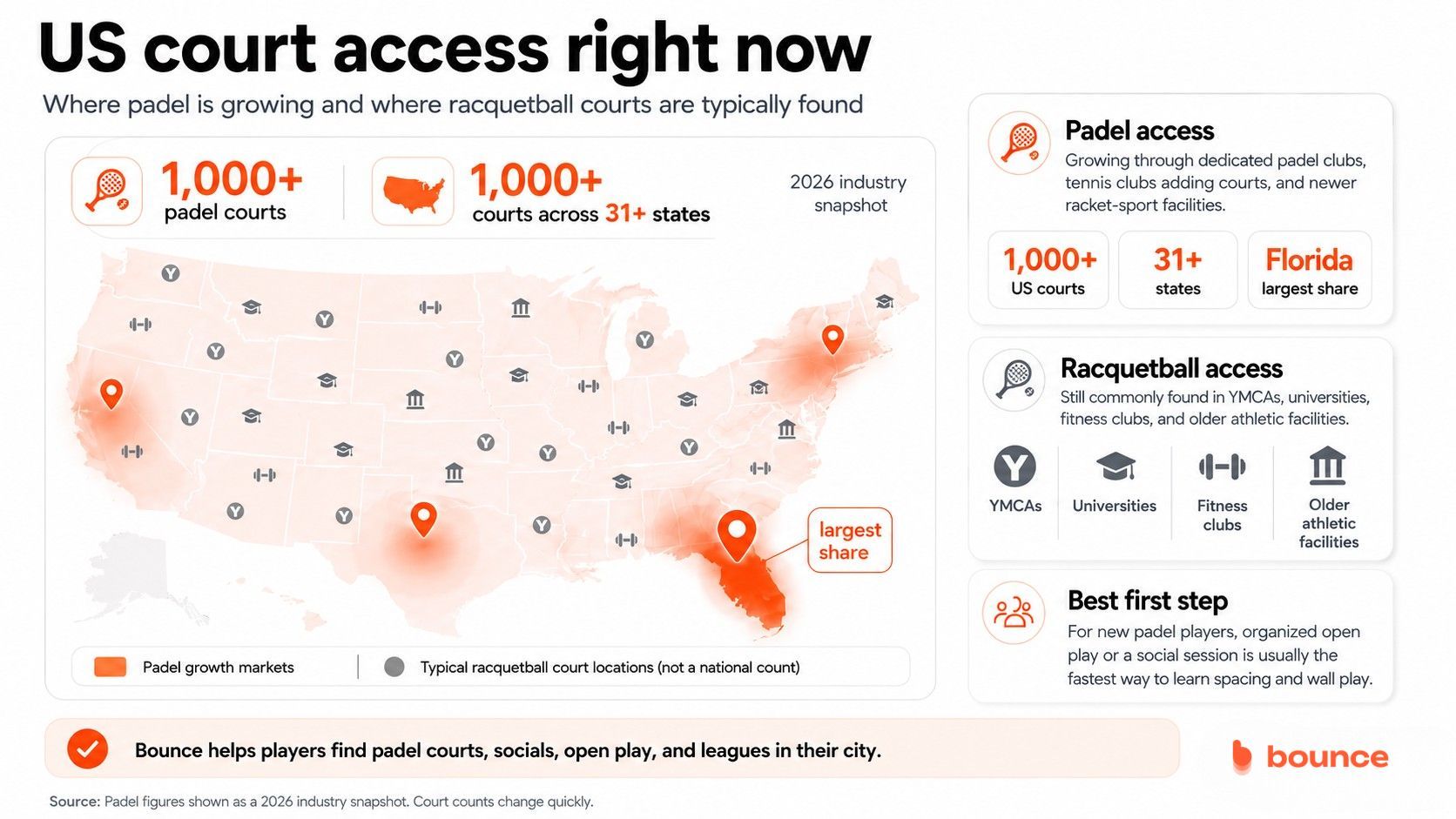
Racquetball courts are still common in YMCAs, universities, fitness clubs, and older athletic facilities. The sport has less new-club energy than it had in the 1980s, but access can be surprisingly good if your local gym kept its courts.
Padel access is growing through dedicated padel clubs, tennis clubs adding courts, and newer racket-sport facilities. Industry trackers reported more than 1,000 US padel courts across 37 states in 2026, with Florida holding the largest share.
Treat that as an industry snapshot, because padel court counts change quickly.
If you want to try padel, the fastest path is organized open play or a social session. Booking a court with 3 beginners can work, but the wall game clicks faster when one experienced player shows you spacing.
Bounce helps players find padel courts, socials, open play, and leagues in their city. You can check courts, socials, or open play sessions when you are ready to get on court.
Gear before your first session
Use the right gear on day 1. A racquetball racquet is the wrong tool for padel, and a padel racket will feel dead and clumsy in racquetball. The shoes matter too: padel rewards grip on turf and controlled slides, while racquetball needs non-marking indoor court traction.
If padel is the sport you are trying first, start with padel equipment: rackets, balls, shoes, and beginner gear without turning it into a shopping rabbit hole.
The bottom line
Padel and racquetball ask for different skills from the first rally. Padel rewards doubles positioning, patience, lobs, glass reads, and controlled attacks. Racquetball rewards serve pressure, hand speed, ceiling defense, and fast finishing shots.
Pick the one that matches how you want to play. If you want a social doubles sport with club programming, start with padel. If you want a fast singles workout in a four-wall room, racquetball still delivers.
For players building their game through structured coaching and organized play, Bounce connects you with coaches, courts, socials, open play, and competitive formats in your city.
Frequently asked questions
Is padel the same as racquetball?
Padel and racquetball share enclosed-court wall play, but the sports use different courts, equipment, scoring, and formats. Padel is usually doubles on a glass-walled court with a net. Racquetball is usually singles in a four-wall court with a live ceiling.
Which is harder to learn: padel or racquetball?
Padel is usually easier for a beginner's first session. The underhand serve is simpler, the ball moves slower, and doubles reduces court coverage. Racquetball becomes intense faster because the ball rebounds sharply in a smaller shared space.
Can you use a racquetball racquet for padel?
A racquetball racquet is the wrong tool for padel. Padel uses a solid perforated racket with no strings. Racquetball uses a lighter strung racquet built for a hollow rubber ball.
Which sport is better for cardio?
Racquetball singles usually creates a harder cardio load because one player covers the full court and the ball moves faster. Padel still gives a strong workout, especially at higher levels, but doubles shares the movement load.
Are there padel courts at gyms like racquetball courts?
Padel courts are usually found at dedicated padel clubs, tennis clubs, and newer racket-sport facilities. Racquetball courts are more common in older gyms, YMCAs, universities, and athletic clubs.
Can racquetball players switch to padel easily?
Racquetball players bring useful wall-reading skills, quick reactions, and comfort inside an enclosed court. The main adjustments are doubles spacing, underhand serving, net play, and learning how padel glass behaves after the bounce.