The padel origin story begins in 1969 in Acapulco, Mexico, with a small home court, a space problem, and a simple idea that turned into one of the world’s fastest-growing racket sports.
Enrique Corcuera wanted to build a tennis-style court at his home in Las Brisas, but he did not have enough room for a full tennis court. Instead of giving up, he created a smaller enclosed court with walls. That design changed how the ball moved, how rallies developed, and how players learned to use angles instead of pure power.
Quick answer: Padel was invented in 1969 by Enrique Corcuera at his home in Acapulco, Mexico. Unable to fit a full tennis court in his garden, he built a smaller 20 x 10 metre court with 3-metre walls and a central net. The rules were written by his wife, Viviana Corcuera, and presented to him as a birthday gift. The sport spread to Spain in the early 1970s and Argentina soon after, then gained international structure when the International Padel Federation (FIP) was founded in Madrid in 1991.
For readers who are still learning the basics, the history makes more sense after understanding what is padel and how the court, walls, scoring, and doubles format work together.
The garden in Acapulco: how padel was born
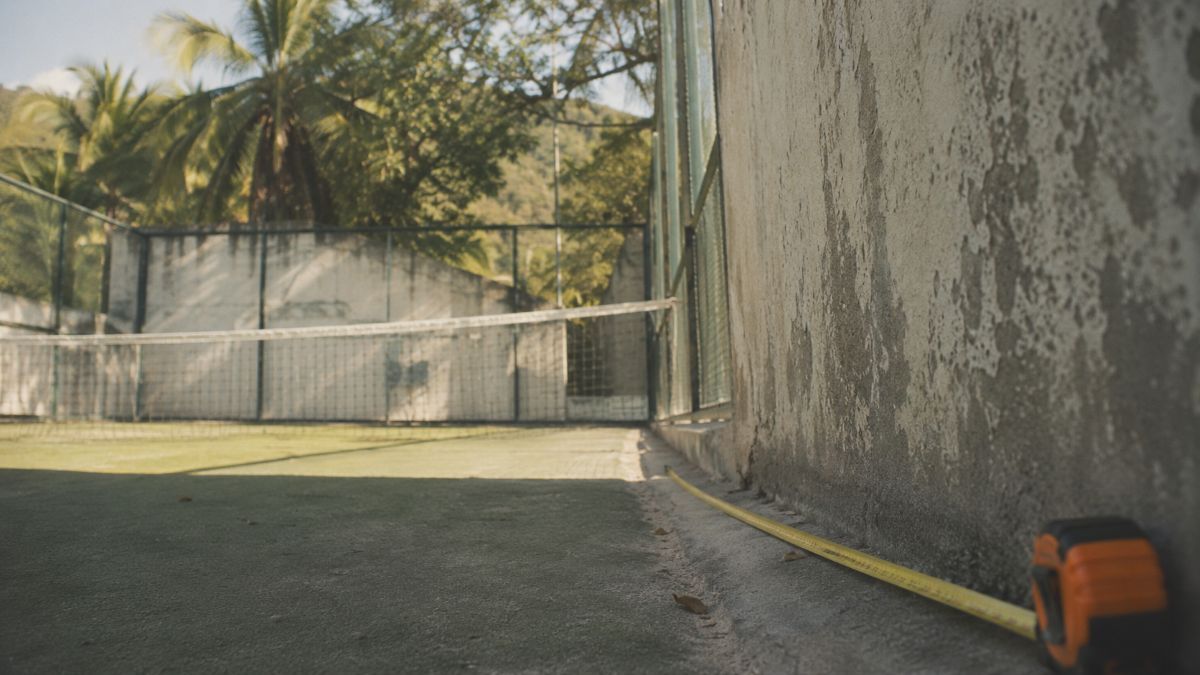
Enrique Corcuera was a Mexican businessman and tennis player with a practical problem. His garden at Las Brisas in Acapulco did not have enough space for a regulation tennis court.
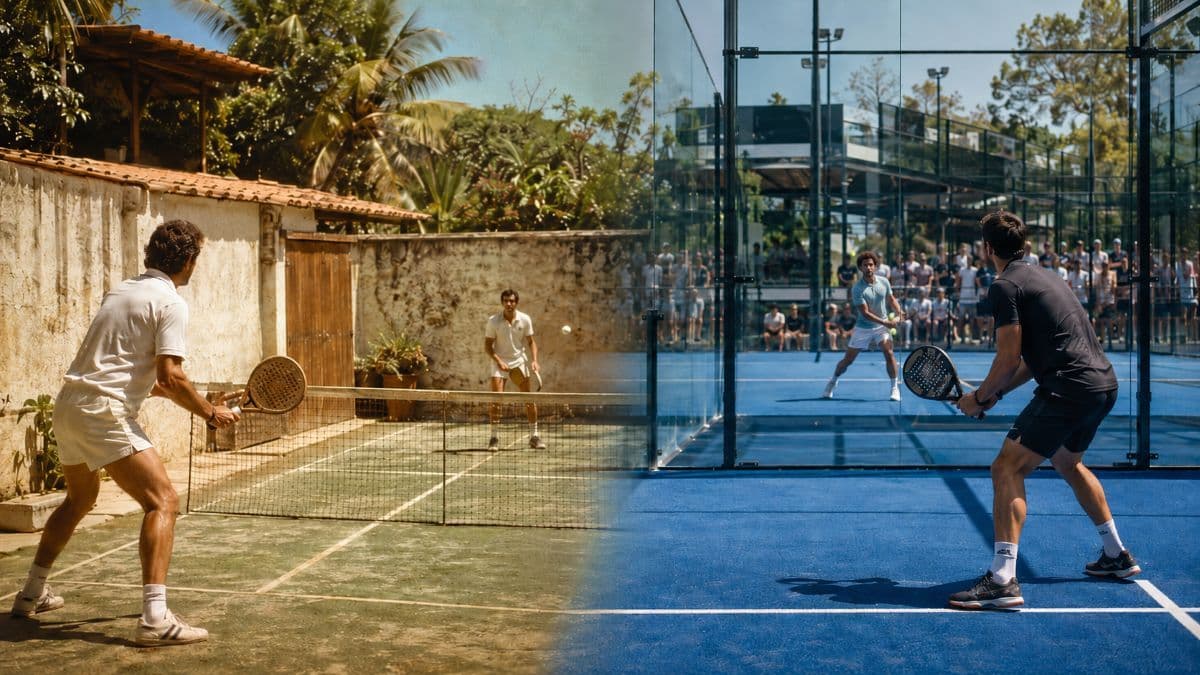
So he built a smaller court - a 20 x 10 metre court enclosed by 3-metre walls, with a tennis net in the middle. The wall was the accident that became the sport.
That detail matters because it explains why padel never became miniature tennis. The wall changed the rally. It gave players a second chance after the bounce, created angles tennis did not have, and made anticipation more important than raw hitting power.
There were earlier walled racket games. Platform Tennis started in Scarsdale, New York, in 1928 and used screens to keep the ball in play. Corcuera’s version was different: a compact court, solid walls, a lower-powered ball, and a rhythm that made the wall central to every point.
The same design also explains why the sport needed its own rules. The scoring may feel familiar to tennis players, but serves, rebounds, walls, and court boundaries create a different rhythm.
This is where the sport’s history connects naturally with modern padel rules, especially for players who want to understand why the wall is part of the rally rather than an obstacle.
The rules came from Viviana Corcuera, Enrique’s wife and a former Miss Argentina. She watched the game turn into argue-as-you-go family play and gave it structure.
“I wrote the first rules of padel tennis... and I wrote a little booklet.”
That line, drawn from a Viviana Corcuera interview, is the human center of the origin story. Enrique created the court. Viviana gave the game its first working rulebook, known as “Paddle Corcuera.”
From Acapulco to Marbella: padel reaches Europe
In the early 1970s, Alfonso of Hohenlohe-Langenburg visited the Corcuera home in Acapulco and played the new game. He saw the appeal immediately.
Hohenlohe was the Spanish-German founder of the Marbella Club, one of Europe’s most visible social clubs. When he returned to Spain, he built padel courts at the Marbella Club Hotel in Andalusia.
The setting mattered. Padel arrived in Spain through a club where celebrities, aristocrats, and wealthy travelers mixed. Spain gave it status before it had a formal competitive structure.
That social start shaped its growth. Padel was easy to learn, played mostly as doubles, and fit naturally into club culture. A player could finish a match, stay for lunch, and book again the next week. That was the distribution engine.
Manolo Santana, the Spanish tennis champion and 4-time Grand Slam singles winner, became one of the early sporting names attached to padel in Spain. His presence helped give the game credibility beyond the Marbella social circle.
Argentina: where padel became a national sport
Argentina is the chapter that explains why padel became more than a club curiosity. Julio Menditeguy, an Argentine member of the Marbella Club, played padel in Spain and brought it back to Buenos Aires around 1975.
The fit was immediate. Argentina already had deep club-sport culture, especially around families, weekend gatherings, and neighborhood recreation. Padel needed less space than tennis, was cheaper to build, and worked beautifully in dense urban areas.
That mix gave padel a different identity in Argentina. In Spain, it entered through elite coastal clubs. In Argentina, it became a middle-class social habit. It belonged beside the weekend asado, club membership, and neighborhood match.
By 1988, Oscar “Cacho” Nicastro and a group of organizers founded the Argentine Padel Association. By the early 1990s, Argentina had more than 10,000 courts and millions of players. Argentina made it popular at a scale Spain had not yet matched.
Padel’s social roots, club culture, recurring play, and weekend habits, are still visible today. Bounce brings that same structure to cities across North America by connecting players with organized sessions, coaches, and local communities.
That club-to-community pattern is familiar across newer racket-sport formats. The same logic appears in open play formats, where access, rotation, and social rhythm matter as much as the score.
The International Padel Federation and the first World Championship
By the early 1990s, padel had two major centers of gravity: Spain and Argentina. It needed international structure if it was going to move beyond national scenes.
On 12 July 1991, representatives from Argentina, Spain, and Uruguay founded the International Padel Federation (FIP) in Madrid. The founding countries were not random. Spain and Argentina had the largest player bases, and Uruguay gave the federation a wider South American base.
In 1992, the first World Padel Championship was held in Spain, with matches in Madrid and Seville. Argentina won. That result fit the era: Spain had become the European home of the sport, but Argentina had already turned padel into a national habit.
The FIP gave padel a calendar, a rule authority, and a route toward professional competition. FIP gave it structure. Later circuits, including Padel Pro Tour, World Padel Tour, and Premier Padel, all sit downstream of that decision.
Padel history timeline
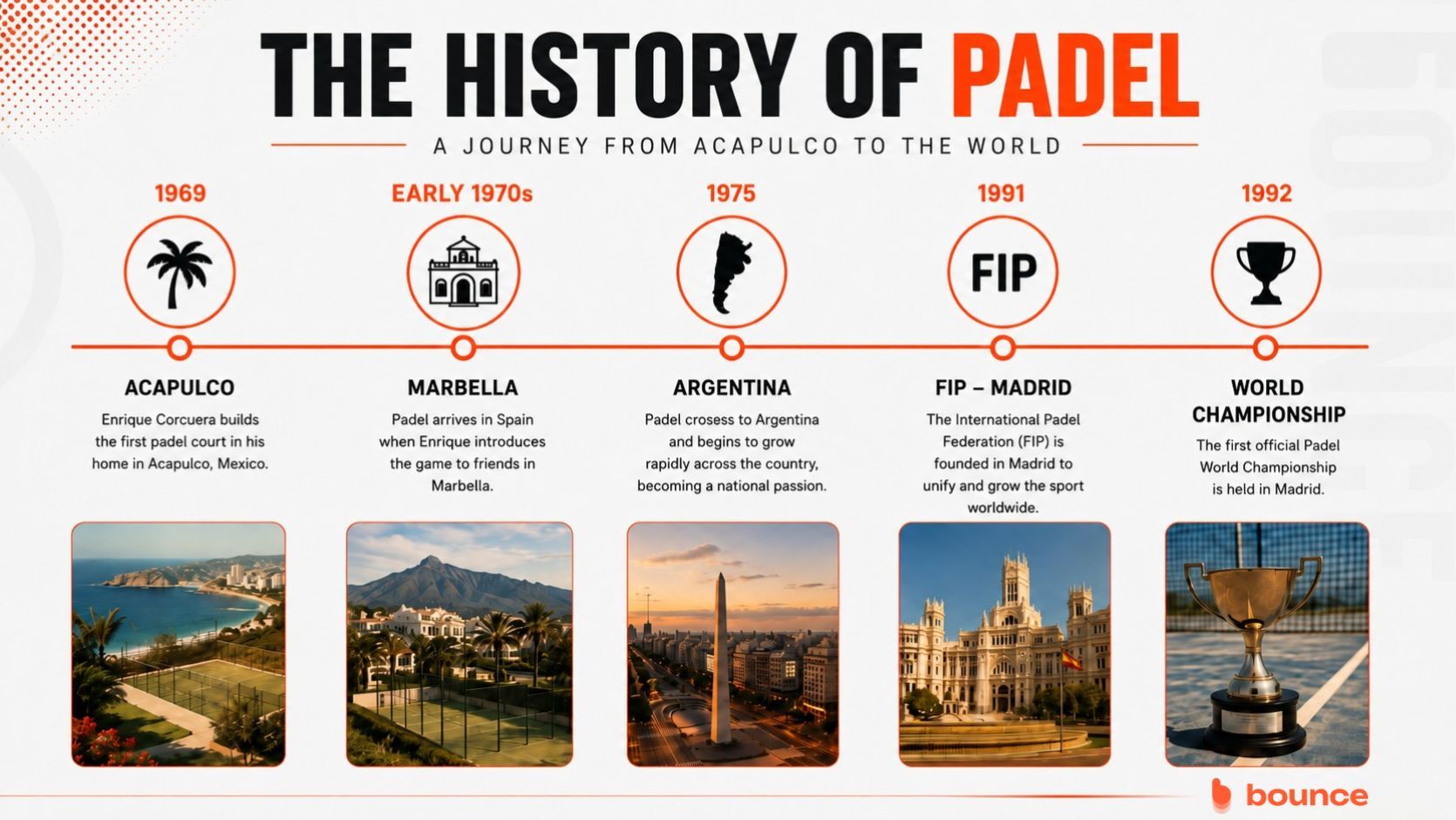
| Year | Milestone | Why it mattered |
| 1969 | Enrique Corcuera built the first padel court in Acapulco. | The smaller walled court created the sport’s basic shape. |
| 1969 | Viviana Corcuera wrote the first rules. | The game moved from improvised family play to a repeatable format. |
| Early 1970s | Alfonso of Hohenlohe-Langenburg brought padel to Marbella. | Spain became the sport’s first European base. |
| 1975 | Julio Menditeguy brought padel to Buenos Aires. | Argentina turned padel into a mass social sport. |
| 1991 | The International Padel Federation was founded in Madrid. | Padel gained a global rule authority. |
| 1992 | The first World Padel Championship was held in Spain. | International competition gave the sport a world stage. |
From club sport to global racket sport
For a long time, padel was still concentrated in Spain, Argentina, and nearby markets. Then court building accelerated across Europe and beyond.
The 2000s gave the sport a more serious professional layer. In 2005, the Padel Pro Tour began, creating a formal elite circuit. World Padel Tour followed in 2013. Premier Padel launched in 2022 under FIP governance and later became the main global professional tour.
The amateur base grew even faster. The FIP World Padel Report 2025 reported strong global growth in clubs, courts, and federation members.
The FIP’s current history page puts the scale plainly: 100 national federations, more than 150 countries, and approximately 35 million amateur players as of 2026.
That growth did not require a complicated origin myth. Enrique Corcuera solved a space problem. Viviana Corcuera solved the rule problem. Spain gave the sport social status. Argentina gave it mass participation. FIP gave it international order.
Whether you live in a city where padel has been around for years or one where courts are still opening, Bounce helps you find nearby sessions, coaches, and players without guessing where to start.
How Padel Became Different From Tennis
Padel shares some familiar features with tennis, including the net, scoring style, and racket-sport roots. Still, its origin created a game that feels very different.
The smaller court makes movement shorter and quicker. The walls keep rallies alive. The underhand serve makes points easier to start. Doubles is the standard format, which makes communication and teamwork central to the game.
These differences explain why tennis players often enjoy padel but still need time to adjust. Padel rewards patience, placement, and court awareness more than raw hitting power.
That is why a direct padel vs tennis comparison is useful in this history. The two sports share some DNA, but padel’s first walled court in Mexico created a separate playing style from the beginning.
What the origin story tells us about padel
The origin of padel explains why the sport feels the way it does. It was built from a smaller court, fixed walls, doubles play, and social repetition. Those details created a game that rewards positioning, patience, and shared court sense.
This is why padel spread so easily through clubs. New players can join quickly. Experienced players still have years of tactical depth ahead of them. A single court can carry steady use all day because doubles, rotation, and social play are baked into the format.
That is the part worth remembering. Padel grew because people played it once, brought a friend back, and kept returning to the same small court.
How Beginners Can Connect Padel History to Playing Today
Knowing the history helps beginners understand the game faster. The walls are not an unusual extra feature. They are the reason padel exists.
A beginner who understands that will stop treating the wall like a problem and start seeing it as part of the rally. The same idea applies to doubles positioning, slower shots, and tactical lobs. These are not side details. They come from the sport’s original design.
Once the history is clear, the next step is learning how those ideas work during a point. A practical guide on how to play padel fits naturally here because it shows how serving, movement, wall rebounds, and basic rally patterns connect to the sport’s original design.
FAQs
Who invented padel?
Padel was invented by Enrique Corcuera in 1969 in Acapulco, Mexico. His wife, Viviana Corcuera, wrote the first rules, so both played an important role in the sport’s beginning.
Where did padel originate?
Padel originated at Las Brisas, Enrique Corcuera’s home in Acapulco, Mexico. The first court was built in a garden that was too small for a full tennis court.
When was padel invented?
Padel was invented in 1969. That is the year Enrique Corcuera built the first court and Viviana Corcuera wrote the first rules.
Why was padel created?
Padel was created because Enrique Corcuera wanted a tennis-style court at home but did not have enough space. The smaller court and surrounding walls became the foundation of a new sport.
How did padel spread to Spain?
Padel spread to Spain after Alfonso of Hohenlohe-Langenburg played it at Corcuera’s home in Mexico. He later built padel courts at the Marbella Club Hotel in Andalusia.
How did padel become popular in Argentina?
Padel became popular in Argentina after Julio Menditeguy brought the sport from Spain to Buenos Aires. Argentina’s club culture, family recreation habits, and urban court demand helped the sport grow quickly.
Is padel older than pickleball?
Yes. Padel was invented in 1969, while pickleball was invented in 1965, so pickleball is slightly older. However, the two sports developed in different places, with different courts, rules, and playing styles.
Is padel the same as tennis?
No. Padel uses a smaller enclosed court, walls, solid rackets, and underhand serves. Tennis and padel share some scoring similarities, but the gameplay is very different.
Conclusion
Padel began in 1969 in a walled garden in Acapulco. It moved from Mexico to Marbella, from Marbella to Buenos Aires, and from there into the international structure that turned it into a global racket sport.
The story works because every chapter added something. Enrique Corcuera built the court. Viviana Corcuera wrote the first rules. Spain made padel fashionable. Argentina made it popular. FIP gave it a world stage.
If you are one of the millions discovering padel for the first time, Bounce connects you with courts, certified coaches, and organized sessions in your city.