Pickleball hand signals look excessive until your partner runs the wrong direction after a return.
Then the point gets ugly fast.
The returner is sprinting toward the kitchen. The net player is sliding across the court. The third shot is already coming back. If both players read the plan differently, the open court is huge.
Want a quick answer? Pickleball hand signals are silent cues used by the non-returning partner before the return of serve in doubles. Most teams use an open hand for switch, a closed fist for stay, and a pre-agreed fake signal such as a talking hand or 2 fingers. Agree on the meanings before the game, signal every return point, and acknowledge the signal before the serve comes in.
This guide explains what each signal means, where to aim your return, how signals connect to stacking, and how to recover when the system breaks down.
Why hand signals exist in doubles pickleball
The return of serve is where doubles teams lose their shape. One player hits the return and runs forward. The other player slides, holds, or hesitates. Both players hesitate over who is covering which side.
Hand signals make the decision before the ball moves.
The player already near the kitchen line has the cleaner view of the court. They can see the server, the returner, the matchup, and the side their team wants after the return. The hidden signal gives the returner that plan without telling the opponents.
Research on nonverbal behavior in team sports helps explain why silent cues matter when distance, court noise, and timing make verbal calls unreliable. The source is soccer, so the transfer to pickleball should stay modest: silent cues help teams coordinate when speech is slow or hard to hear.
This matters most when your team is stacking in pickleball, because stacking depends on choosing sides on purpose. Signals also help non-stacking teams. A simple stay signal can prevent two players from drifting toward the same ball.
When pickleball hand signals are used
Use these signals before the return of serve in doubles. The non-returning partner gives the signal from the kitchen line while the returner is near the baseline.
That timing matters. The returner needs to know where to go after contact. A late signal is almost useless because the returner is already reading the serve and preparing the swing.
Signals also belong on the receiving side. The serving team can use its own planned calls, but the classic behind-the-back switch/stay/fake system is built around the return team deciding its post-return formation.
Use them at every return point. If you only signal when switching, the opponents can read your movement before the point starts. A closed fist on a routine stay point keeps the system invisible.
The 4 signals worth knowing
| Signal | Gesture | Basic meaning | Return placement |
| Switch | Open hand | Net player changes sides after the return | Down-the-line |
| Stay | Closed fist | Both players hold their current sides | Cross-court |
| Fake | Talking hand or 2 fingers | Net player sells a switch, then holds or returns | Usually cross-court |
| Directional | Thumb left, center, or right | Returner aims to a target area | Per the thumb direction |
Open hand: switch
An open hand means switch. The net player moves laterally to the opposite side after the return, and the returner runs forward to the side the net player vacated.
This is the signal you use when you want a specific player on a specific side after the return. Maybe you want a stronger forehand in the middle. Maybe one opponent has a weaker third shot from a certain angle. Maybe your stacking setup needs to restore your preferred formation.
When you receive a switch signal, aim the return down-the-line. A cross-court return gives the opponent a cleaner angle into the space you are running toward. A down-the-line return buys the switch a little more time.
Closed fist: stay
A closed fist means stay. The net player holds their side, and the returner runs straight forward to the open kitchen spot.
Stay is the default for many recreational teams because it keeps movement simple. It is also the right call when the serve pulls the returner wide or when your team is already in the side formation you want.
When you receive a stay signal, a cross-court return usually gives you the best recovery window. You are moving straight forward, and the longer diagonal path gives you an extra beat to reach the kitchen.
Fake signal: agreed deception
A fake signal tells the net player to sell a switch, then hold or return to the original side. The point is to make the opponents read movement that disappears by the time they hit the third shot.
Fake signals vary more than switch and stay. Some teams use a talking hand. Some use 2 fingers. Some skip the fake because it adds confusion before the first two signals are automatic.
The returner should treat most fake signals like stay unless the team has agreed on something different. Move straight forward, fill the open kitchen spot, and let the net player create the deception.
Directional thumb: aim the return
A directional thumb is an add-on. The net player points left, center, or right to show where they want the returner to aim.
This helps when one opponent has a weak backhand, stands too far inside the court, or leaves a return lane open. Add it after switch and stay feel automatic. A team that cannot execute 2 basic signals does not need a fourth cue yet.
Hand signals are team agreements
Pickleball hand signals are common conventions rather than official rules.
That distinction matters. USA Pickleball publishes the official pickleball rules, but switch/stay/fake signals are partner systems. Open hand for switch and closed fist for stay are widely understood. Fake signals vary by team.
Before your first game with a new partner, define the system in 20 seconds.
| Gesture | Team meaning to confirm |
| Open hand | Switch sides after the return |
| Closed fist | Stay on current sides |
| Talking hand or 2 fingers | Fake a switch, then hold or return |
| Thumb left, center, or right | Aim return to that target area |
The exact gesture matters less than shared meaning. If both players read it the same way, the signal works.
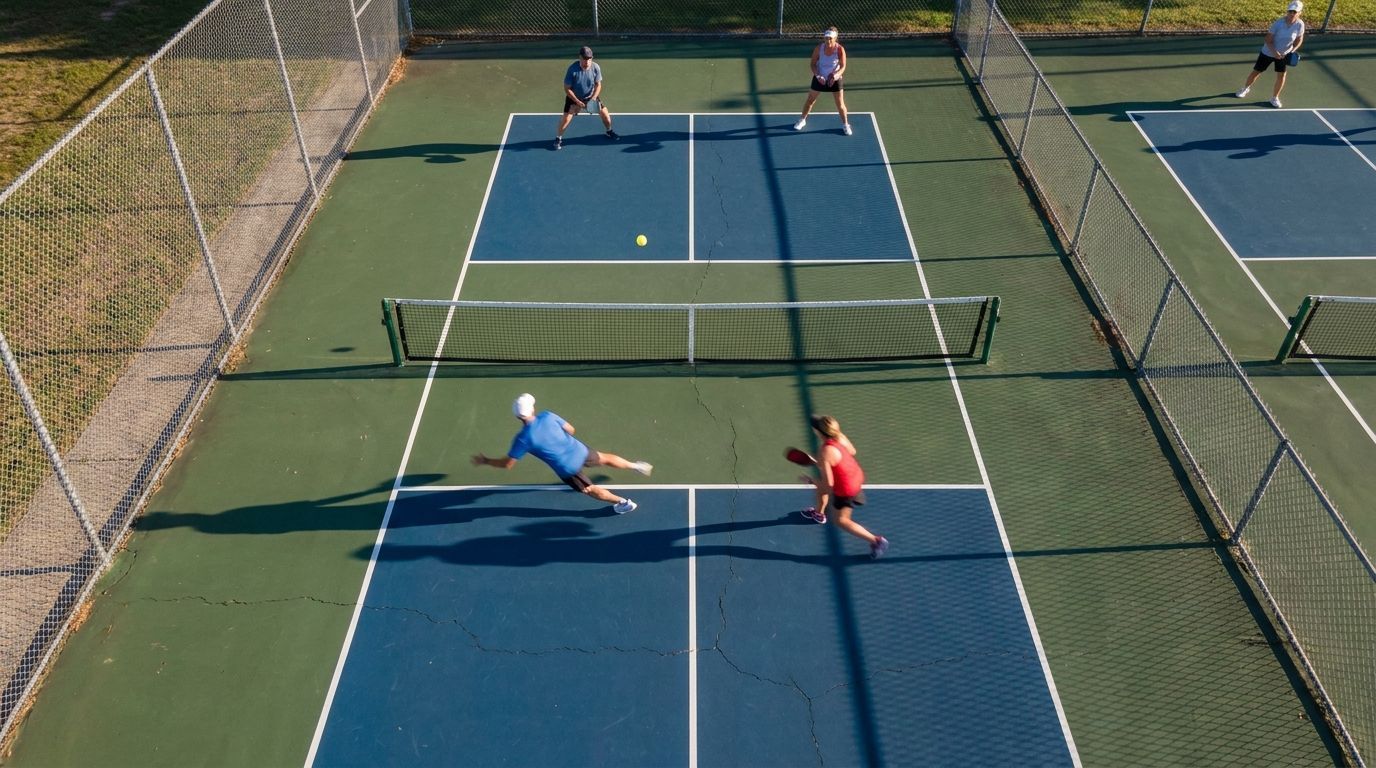
Switch signals and poaching use different systems
Switch/stay/fake signals happen before the return of serve. Poaching happens during live play, when the net player crosses to intercept a ball that would normally belong to their partner.
The two systems can overlap in advanced doubles, but beginners should separate them. A behind-the-back signal sets return positioning. A poach needs a verbal call, a pre-planned rally cue, or enough partner history that both players know the move is coming.
USA Pickleball separates planned and opportunistic poaching. Planned poaching is coordinated before the point or pattern. Opportunistic poaching happens when the net player reads a ball during the rally and takes it.
That distinction keeps your team from mixing systems. Hand signals set the return shape. Live calls save the rally when the point changes faster than the plan.
The broader pickleball doubles strategy layer is built on the same idea: both players need to know who owns the middle, who is moving, and who is covering the ball after contact.
How to aim your return after each signal
The signal tells you where to move. It also tells you where the return should go.
| Signal | Returner movement | Best return target | Why it works |
| Switch | Diagonal run to the vacated side | Down-the-line | Reduces the third-shot angle into the space you are crossing. |
| Stay | Straight run to the kitchen | Cross-court | Gives the returner more time to reach the kitchen. |
| Fake | Usually straight run to the kitchen | Cross-court or pre-agreed target | Lets the net player create movement while the returner keeps the shape stable. |
| Directional | Based on switch or stay call | Thumb target | Targets a player, backhand, or open court area. |
This is where many teams lose the point. They understand the gesture, then hit a return that fights the movement. A switch paired with a lazy cross-court return gives the opponent a lane. A stay paired with a rushed down-the-line return can erase your recovery time.
Lefty-righty teams need signals sooner
A left-handed and right-handed doubles team has a useful formation available: both forehands can face the middle.
The left-hander usually wants the right side. The right-hander usually wants the left side. That puts both forehands toward the center, where most pressure balls arrive.
The problem is that pickleball doubles rules place players in fixed return positions based on the score. The score may put the returner on the wrong side for the forehand-middle setup.
Signals solve the rotation fast. The net player signals switch when the team needs to restore the preferred formation. They signal stay when the score already has both players in the right spots.
How to give and receive signals cleanly
The signal should be hidden behind your back or flat against the paddle face. Hold it long enough for your partner to read it. Then wait for acknowledgment.
The returner should say “yes,” “ok,” or “got it.” If the returner cannot execute the signal because the serve pulls them wide, they should say “no” and default to stay. The returner gets the last-second read on the serve. Respect it.
For Bounce open play sessions where partners rotate often, make the signal check part of your pre-game routine. Ask one question: “Open hand switch, fist stay?” That is enough for most pickup games.
With regular partners, be stricter. Signal every return point. Acknowledge every signal. Review missed signals after the game, not during the point.
When signals break down
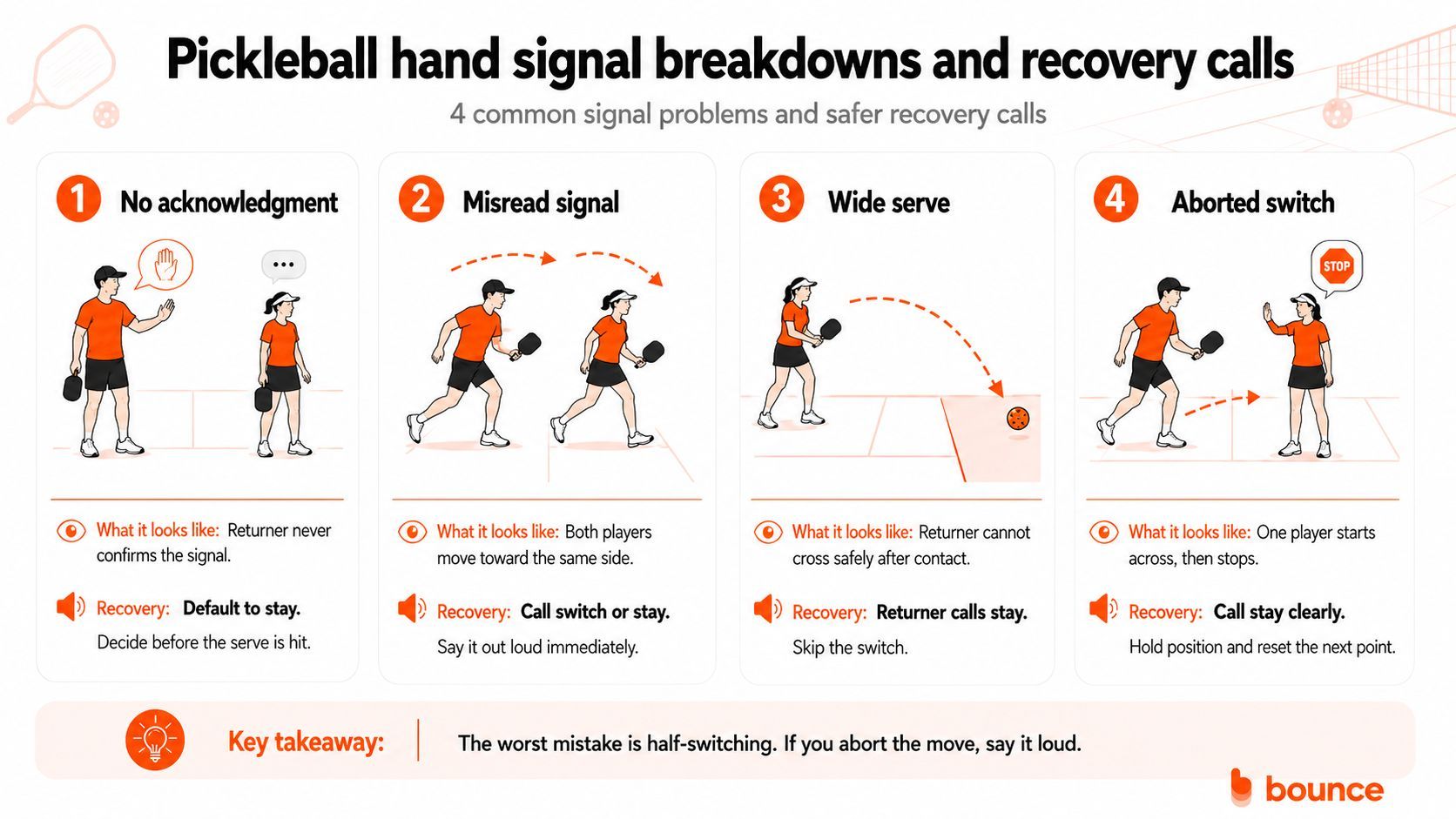
Signals fail for predictable reasons. The fix is usually simple.
| Breakdown | What it looks like | Recovery call |
| No acknowledgment | The returner never confirms the signal | Default to stay before the serve arrives. |
| Misread signal | Both players move toward the same side | Call “switch” or “stay” out loud immediately. |
| Wide serve | Returner cannot cross safely after contact | Returner calls “no” or “stay.” |
| Late fake | Net player starts deception too late | Hold position and reset the next point. |
The worst mistake is half-switching. One player starts across, changes their mind, and says nothing. That creates the giant open lane opponents are waiting for. If you abort the move, say it loud.
When to start using hand signals
Start using hand signals around the 3.0 to 3.5 level, especially if you play organized doubles with a regular partner.
Below 3.0, most players need cleaner returns, safer serves, and faster kitchen movement first. A signal system adds mental load before the basics are stable.
At 3.5 and above, repeated partner patterns matter more. Research on shared mental models in elite sport supports the broader idea that teams coordinate better when they share expectations before the action happens. In pickleball terms, that means your partner should know the switch before you start running.
Build the system in layers. Use switch and stay for 4 to 6 sessions. Add fake only when both players acknowledge the first 2 signals automatically. Add the directional thumb last.
For teams preparing for league or tournament play, Bounce lessons and clinics give you a cleaner way to practice this under pressure. A coach can spot the movement error faster than a rotating open-play partner will.
Quick-reference signal table
| Signal | Gesture | Net player action | Returner action | Return target |
| Switch | Open hand | Slides to the opposite side | Runs to the vacated side | Down-the-line |
| Stay | Closed fist | Holds current side | Runs straight to the kitchen | Cross-court |
| Fake | Talking hand or 2 fingers | Sells switch, then holds or returns | Usually treats it like stay | Cross-court or agreed target |
| Directional | Thumb left, center, or right | Shows target preference | Aims return as shown | Thumb direction |
Conclusion
Pickleball hand signals work because they remove the guessing from doubles movement. The returner knows where to go. The net player knows whether to slide, hold, or sell movement. Both players reach the kitchen with a shared plan.
Start with switch and stay. Use them every return point. Add fake and directional cues only after the first 2 feel boring. Boring is good here. It means the system is working.
For players building doubles communication through structured reps, Bounce connects you with clinics, lessons, and competitive formats in your city.
FAQ
What are pickleball hand signals?
Pickleball hand signals are silent cues used by doubles partners before the return of serve. They tell the returner whether the team will switch sides, stay on current sides, fake movement, or aim the return to a specific target.
What does an open hand mean in pickleball?
An open hand usually means switch. The net player moves to the opposite side after the return, and the returner runs forward to the side the net player vacated. When switching, a down-the-line return usually gives your team the safest movement path.
What does a closed fist mean in pickleball?
A closed fist usually means stay. The net player holds their current side, and the returner runs straight forward to the open kitchen spot. A cross-court return usually gives the returner more time to get set.
What does a fake signal mean in pickleball?
A fake signal tells the net player to sell a switch, then hold or return to their starting side. The exact fake gesture varies by team. Agree on it before the game so both players read the same cue.
Are pickleball hand signals official rules?
Pickleball hand signals are team communication conventions rather than official gameplay rules. USA Pickleball rules govern serving, scoring, faults, court position, and other rulebook issues. Partner signals sit inside your team strategy.
What is the difference between a switch and a poach in pickleball?
A switch is planned before the return of serve and sets where both players move after the return. A poach happens during live play, when the net player crosses to intercept a ball. Switch signals are pre-return cues; poaches need live communication or a pre-planned rally cue.