Pickleball elbow is one of the most common injuries in the sport, and it catches a surprising number of players off guard. The condition is clinically identical to tennis elbow, formally known as lateral epicondylitis, a painful overuse injury affecting the tendons on the outside of the elbow.
It develops gradually through repetitive paddle swings, tight gripping, and wrist loading, and it does not always announce itself with a dramatic moment of injury.
The first sign is often a dull ache on the outer elbow that players dismiss as general soreness after a long session. Left unaddressed, the symptoms can progress to persistent pain that affects everyday tasks like lifting a bag, turning a door handle, or shaking hands.
This guide covers what pickleball elbow is, how to recognize it, what causes it, how to treat it, the exercises that support recovery, and what to change in your game and equipment to prevent it from coming back.
What Is Pickleball Elbow?
Pickleball elbow is a tendon injury affecting the common extensor tendon where it attaches to the lateral epicondyle, the bony bump on the outside of the elbow. It develops when the wrist extensor muscles, which control wrist and finger extension, are repeatedly overloaded faster than the tendon can repair itself.
In pickleball, the forearm extensor muscles are engaged on nearly every shot. The backhand stroke places the greatest strain on these muscles because the wrist must load and snap through contact without the energy absorption that a strung tennis racket provides.
The solid pickleball paddle transfers impact directly to the arm, concentrating stress at the lateral epicondyle with every swing.
Research from Harvard Medical School identifies gripping a paddle tightly for long periods and repeatedly twisting the wrist through shots as the primary drivers, with pain and tenderness concentrated at the lateral epicondyle and often radiating into the forearm and wrist.
Pickleball Elbow Symptoms: How to Know If You Have It
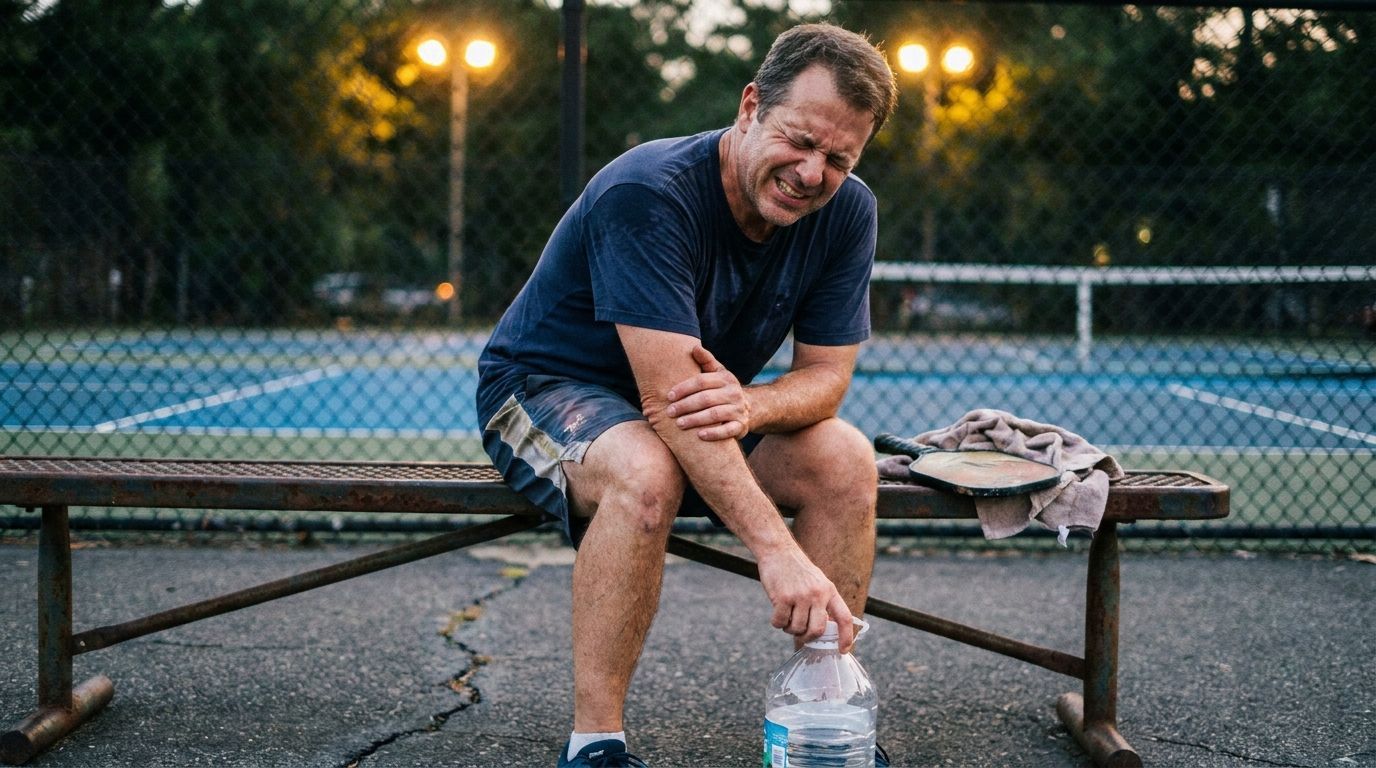
Recognizing symptoms early gives you the best chance of managing the condition before it becomes a significant setback. Symptoms develop gradually in most cases, which makes it easy to rationalize them as temporary post-session soreness until the pain becomes persistent.
Pain and tenderness on the outer elbow
The most consistent symptom is pain or tenderness directly on or near the lateral epicondyle, the bony protrusion on the outside of the elbow.
The pain is often described as burning, aching, or sharp depending on the stage of the condition and the activity that triggers it. Pressing on the area directly almost always produces tenderness even when the elbow is at rest.
Pain during and after play
Many players notice the pain flares during backhand strokes, serves, or volleys that require wrist extension against resistance. It often intensifies after a session and remains elevated for hours or days afterward.
As the condition progresses, pain begins appearing earlier in a session rather than only after extended play.
Pain during daily activities
Pickleball elbow is not limited to court activities. Lifting a coffee cup, turning a door handle, shaking hands, or gripping a steering wheel all engage the wrist extensor muscles and can trigger pain in the affected tendon.
This is a reliable diagnostic signal that the injury is present and not simply generalized muscle soreness.
Reduced grip strength and stiffness
As the condition worsens, grip strength decreases noticeably, and you find yourself unable to generate your usual shot pace. Morning stiffness around the elbow that loosens with movement is also a common early symptom.
In more advanced cases, objects may be dropped unexpectedly during daily tasks.
When to seek medical evaluation
Mild discomfort that resolves within a day or two of rest may be basic fatigue rather than lateral epicondylitis.
Persistent pain lasting more than two weeks, pain that wakes you at night, or significant loss of grip strength all warrant evaluation by an orthopedic physician or physical therapist who can confirm the diagnosis and rule out other conditions such as nerve impingement or elbow arthritis.
What Causes Pickleball Elbow?
Pickleball elbow develops from a combination of mechanical stress and recovery deficit. Understanding the contributing factors makes prevention significantly more effective than treating the injury after it has set in.
Ramping up too quickly
Going from little or no paddle activity to hours of daily repetitive swings before the forearm tendons have adapted is the leading driver of this injury.
This is particularly common among adults who are generally fit but whose forearm tendons are not yet conditioned for racket sport loading. The tendons adapt more slowly than muscles, which means your fitness level can mask the risk.
Poor backhand technique
The backhand stroke is the primary mechanical culprit. Hitting a one-handed backhand with a wrist-dominant swing, late contact, or a drooping paddle face forces the wrist extensors to decelerate the paddle on every stroke rather than transferring load through the shoulder and core.
Over hundreds of repetitions this concentrates stress directly at the lateral epicondyle.
Grip that is too tight or the wrong size
A grip that is too narrow causes you to squeeze harder to maintain control, chronically tensing the forearm extensors throughout every rally. A grip that is too wide prevents full paddle control and also leads to compensatory gripping tension.
Matching grip size to hand dimensions is one of the most overlooked but impactful variables in elbow injury prevention.
Paddle weight and stiffness
Heavier paddles require more effort to swing and generate more impact vibration through the arm. Stiff paddle faces transfer more shock to the wrist and elbow than paddles with softer face materials.
Understanding how paddle weight and materials affect arm load is relevant not only for performance but for injury prevention, particularly for players in high-volume play or recovering from elbow issues.
Insufficient warm-up and recovery
Cold tendons are less elastic and more vulnerable to micro-tearing under load. Players who step directly onto the court without warming up the wrist extensors, forearm, and shoulder chain are at higher risk per session.
Inadequate recovery between sessions, particularly for older players whose tendon repair processes are slower, compounds cumulative tendon stress over time.
How to Treat Pickleball Elbow
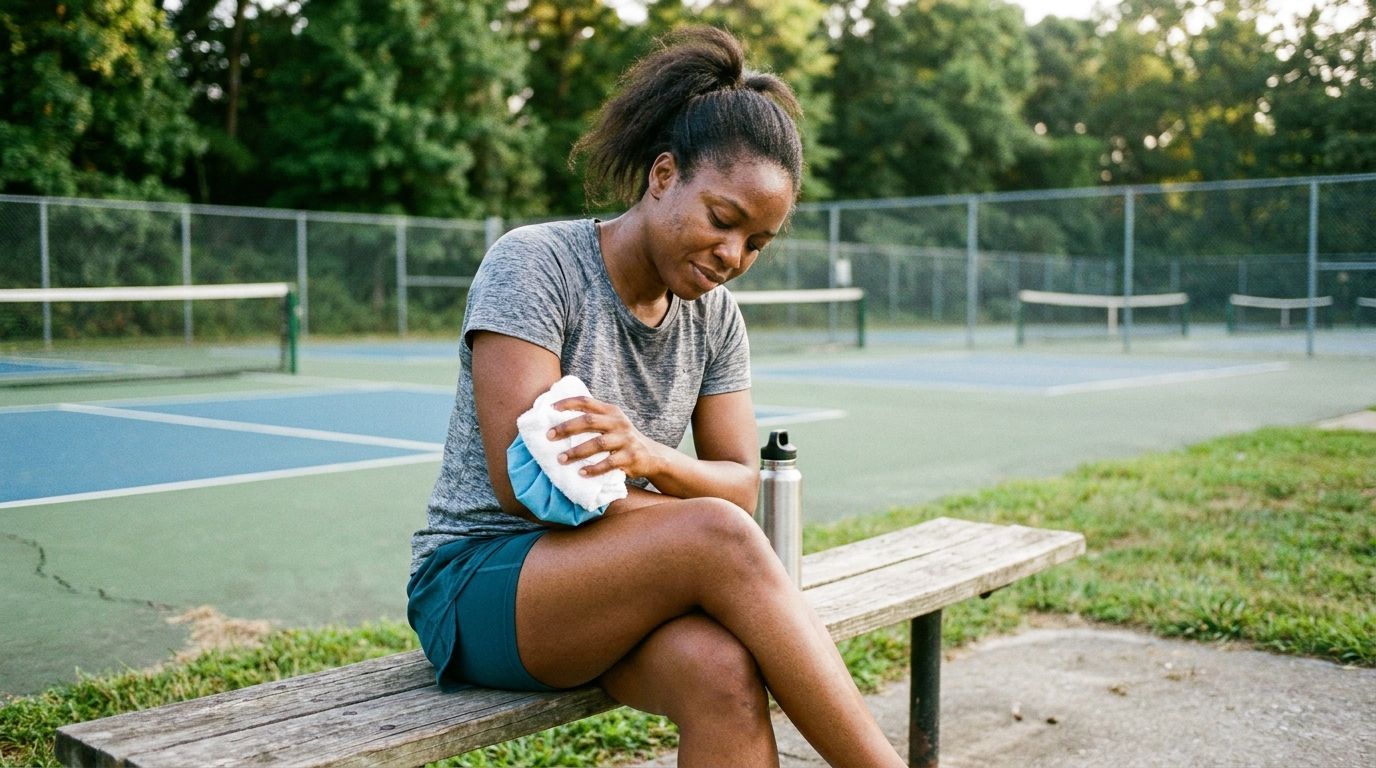
Treatment follows a progression from immediate pain management to active rehabilitation to return to play. The severity of the condition determines which stages are needed and for how long each applies.
Rest and activity modification
The first step is reducing or eliminating the activity that caused the injury. Complete rest from pickleball is appropriate for acute cases where pain is present even at rest.
If symptoms persist beyond two to four weeks of self-managed care, consulting a physical therapist or orthopedic physician is the right call.
Ice and anti-inflammatory management
Applying ice to the lateral epicondyle for 15 to 20 minutes several times per day reduces inflammation and provides temporary pain relief during the acute phase.
Over-the-counter anti-inflammatories such as ibuprofen can reduce pain and swelling in the short term but should not be used as a substitute for rest or rehabilitation. Icing after every session is a useful preventive habit even for players who have not yet developed symptoms.
Elbow brace
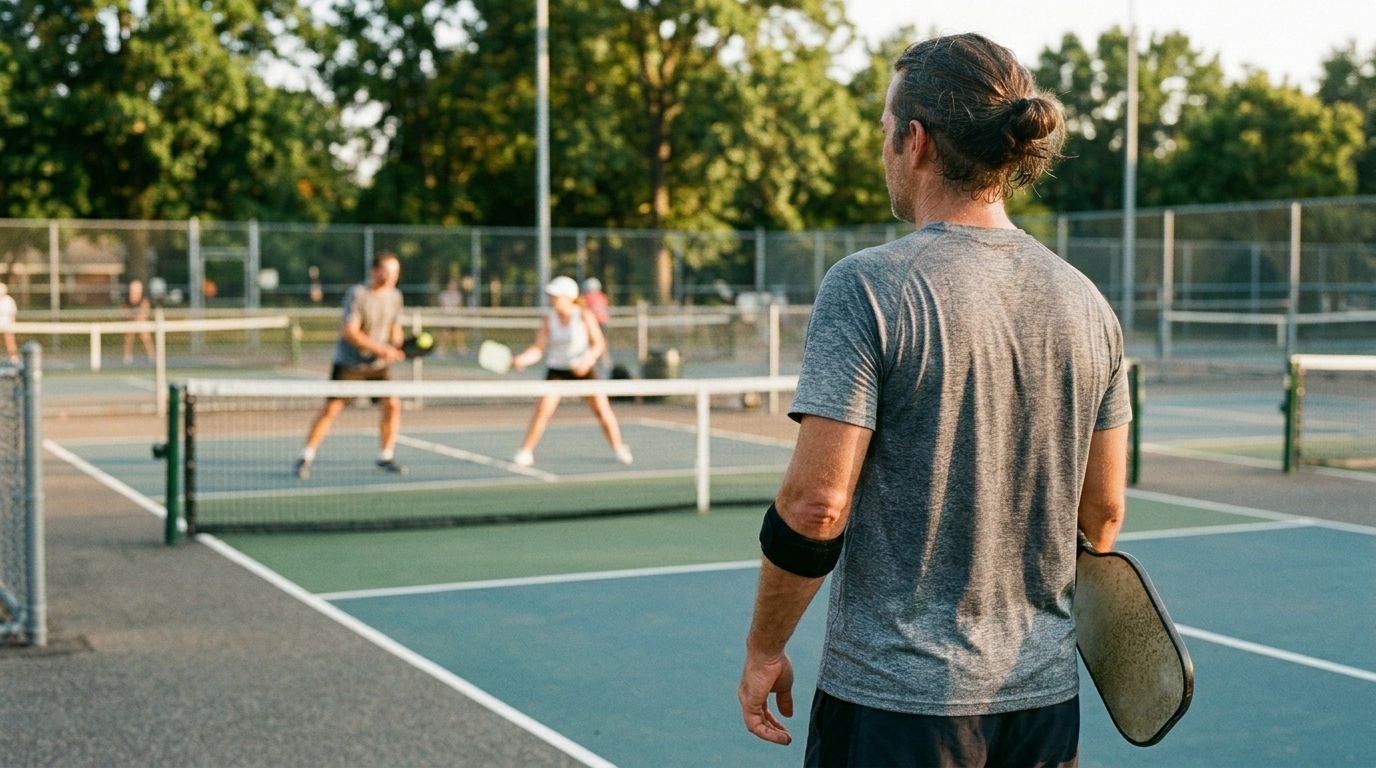
A counterforce strap, worn on the upper forearm just below the elbow, is one of the most commonly recommended short-term supports for managing lateral epicondylitis during activity.
It works by applying targeted compression that redirects mechanical load away from the inflamed tendon attachment point. It does not cure the condition but allows many players to manage symptoms while continuing modified activity.
A brace is most useful during the transition back to play while the tendon is still healing. Relying on it indefinitely without addressing the underlying strength deficits and technique issues that caused the injury will not produce lasting resolution.
Physical therapy and professional treatment
For cases that do not respond to self-managed care within two to four weeks, or for more severe presentations, physical therapy is the most evidence-supported treatment pathway.
A physiotherapist will assess grip strength, range of motion, and functional movement patterns and design a progressive loading program that rebuilds tendon capacity.
In some cases, corticosteroid injections are used for short-term pain relief, though research suggests these may impair long-term tendon healing outcomes compared to exercise-based rehabilitation.
Progressive loading through targeted exercise remains the most reliable path to full recovery.
Best Pickleball Elbow Exercises for Recovery
Targeted exercises form the foundation of effective rehabilitation. The goal is to progressively load the extensor tendon to stimulate repair and build capacity, rather than simply resting and waiting for improvement.
The following exercises represent the most commonly prescribed protocol for lateral epicondylitis.
Begin each exercise gently and at low resistance. Pain during an exercise is a signal to reduce range of motion or load, not to push through. Progress resistance only when the full set can be completed without pain.
If you are uncertain about any exercise, consult a physical therapist before proceeding.
Wrist extensor stretch
Extend the affected arm straight in front of you with the palm facing downward. Use the opposite hand to gently pull the fingers and hand downward and toward your body, bending the wrist.
Hold for 20 to 30 seconds and release, performing two to three repetitions per session, two to three times per day.
Eccentric wrist curls
Rest the forearm on a table with the palm facing downward, hand extending past the table edge. Hold a light weight of half a kilogram to one kilogram. Use the other hand to bring the wrist up, then slowly lower the weight through the full range of motion over three to four seconds using only the affected arm.
Perform three sets of 10 to 15 repetitions. The slow, controlled lowering phase is where the real work happens, and studies consistently show that this approach improves both pain levels and grip strength when done as part of a structured program.
Forearm pronation and supination
Hold a light dumbbell or hammer by the end of the handle so the weight is at one end. Starting with the palm facing up, slowly rotate the forearm to bring the palm downward, then return to the starting position.
Perform three sets of 10 to 15 repetitions, strengthening the rotational control muscles that support the extensor tendon under load.
Grip strengthening with a soft ball
Squeeze a soft therapy ball or rolled-up towel gently and hold for five seconds, then release fully. Perform three sets of 10 repetitions.
This rebuilds grip strength lost during the injury period without overloading the healing tendon, and can be progressed to firmer objects as strength returns.
Shoulder and upper arm strengthening
Weakness in the shoulder rotators, biceps, and scapular stabilizers forces the forearm to compensate during shots, which is one of the structural contributors to lateral epicondylitis in players who have not developed whole-arm strength.
Resistance band exercises targeting internal and external shoulder rotation, rows, and bicep curls build the supporting chain that distributes force away from the elbow during every swing.
Recovering from pickleball elbow and rebuilding proper mechanics at the same time is significantly more effective with structured guidance than self-managed rest alone.
Bounce connects players with certified coaches who can assess technique, identify the mechanical contributors to elbow stress, and provide session formats that allow players to rebuild their game safely during recovery.
How to Prevent Pickleball Elbow
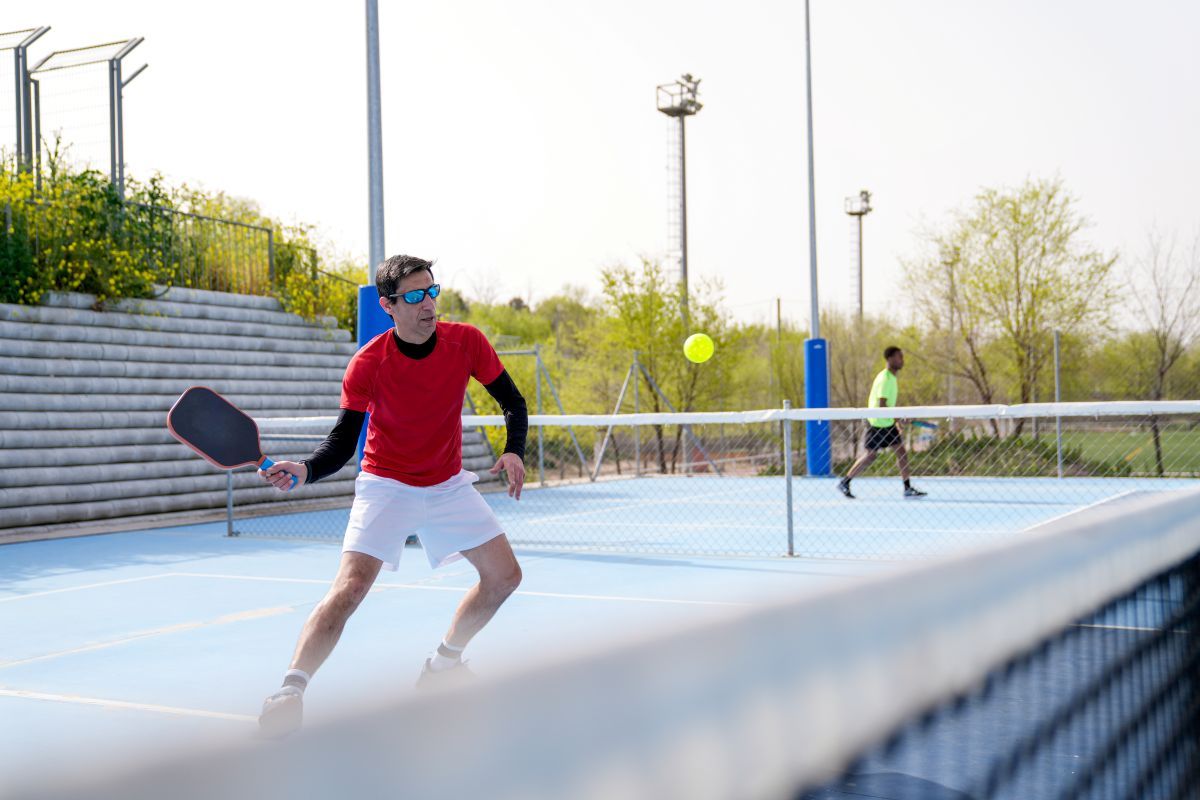
Prevention is meaningfully more efficient than treatment when it comes to lateral epicondylitis. Most cases are avoidable with the right approach to load management, technique, and equipment.
Build volume gradually
The single most effective preventive measure is avoiding rapid increases in playing frequency or session duration. If you are new to pickleball or returning after a break, start at two to three sessions per week of no more than one hour each and add volume over weeks rather than days.
The forearm tendons adapt more slowly than muscles, and they will lag behind your cardiovascular fitness in terms of readiness for sustained load.
Prioritize backhand technique
Work on generating backhand power through body rotation and shoulder drive rather than wrist snap. A two-handed backhand distributes load across both arms and significantly reduces stress at the lateral epicondyle of the paddle arm.
Finding a coach to assess your mechanics is the most reliable way to identify and correct the technical habits that cause elbow stress before they produce injury.
Match your paddle to your arm
Choose a paddle weight in the range of 7.5 to 8.5 ounces. Heavier paddles increase arm fatigue and impact stress with every swing.
Check that your grip size fits your hand correctly: when you grip the paddle, there should be space to fit one finger between your fingertips and the base of your thumb.
Understanding how paddle fit connects to common pickleball injuries is an important part of equipment selection, especially when you are playing at high volume.
Warm up before every session
Spend five to ten minutes before stepping on the court with light arm circles, wrist flexion and extension, forearm stretches, and shoulder mobility work. Cold tendons under sudden load are far more vulnerable to micro-tearing than warmed, supple tissue. Warm-up is not optional if you play regularly.
Ice and stretch after every session
Apply ice to the outer elbow for ten to fifteen minutes after each session, even when it feels fine. Post-session stretching of the wrist extensors and forearm reduces residual tension before it accumulates into chronic tightness.
These habits take less than ten minutes combined and have a material impact on tendon health over a full season of play.
Returning to Play After Pickleball Elbow
Returning too quickly is the most common reason pickleball elbow becomes a recurring problem rather than a one-time injury. Pain resolving is not the same as the tendon being fully healed and ready for the original playing load.
Return to play should follow a structured progression. Begin with soft hitting at reduced intensity, focusing on form and avoiding backhand-heavy drills. Use a counterforce strap during early return sessions to offload the tendon while it continues to adapt.
Limit session length to 30 minutes initially and monitor symptoms for 24 to 48 hours after each session before increasing duration.
If pain returns during a session, stop immediately and return to rest. Full return to competitive play should only happen when the affected arm can perform all required movements pain-free and grip strength has returned to at least 80 to 90 percent of the unaffected side.
Players who want to return with their technique improved rather than simply restored to its pre-injury state benefit most from working with a coach during recovery.
Bounce makes it easy to find a verified coach in your city who understands the physical demands of pickleball and can build a return-to-play plan that addresses both fitness and mechanics.
Pickleball Elbow vs Other Common Elbow Conditions
Lateral elbow pain in pickleball players is not always pickleball elbow. Knowing how the conditions differ helps you seek the right treatment rather than applying a generic protocol to the wrong problem.
| Feature | Pickleball Elbow (Lateral Epicondylitis) | Golfer's Elbow (Medial Epicondylitis) | Elbow Bursitis |
| Pain location | Outside of elbow | Inside of elbow | Back tip of elbow |
| Cause | Wrist extensor overuse | Wrist flexor overuse | Repeated pressure or impact |
| Aggravated by | Backhand strokes, gripping, lifting | Forehand strokes, wrist flexion | Leaning on elbow, direct impact |
| Common in pickleball | Very common | Less common | Uncommon |
| Primary treatment | Eccentric exercises, rest, brace | Flexor strengthening, rest, brace | Rest, drainage if severe, padding |
| Typical recovery | 6 to 12 months with treatment | Similar timeline | Weeks to months |
Conclusion
Pickleball elbow is a genuinely common injury, but it is also one of the most preventable conditions in the sport when you understand how it develops and take the right precautions early.
The combination of rapid volume increases, backhand-dominant play, incorrect paddle fit, and insufficient warm-up creates the conditions for lateral epicondylitis to develop at every experience level.
Addressing symptoms early, following a structured exercise program, and modifying technique before returning to full play produces significantly better outcomes than playing through the pain.
The tendon responds to progressive loading rather than complete inactivity, which means the right exercises are as important as rest in the recovery process.
If you want to get your technique right before elbow issues develop, or you are returning from injury and want to rebuild your game on a better mechanical foundation, Bounce connects players with certified coaches and structured programs in their city. Play longer, recover faster, and build a game that is sustainable well beyond a single season.
FAQs
What is pickleball elbow?
Pickleball elbow is the informal name for lateral epicondylitis, an overuse tendon injury affecting the wrist extensor muscles where they attach to the outside of the elbow. It is clinically identical to tennis elbow and develops from repetitive paddle swings, tight gripping, and wrist loading during play.
How do I know if I have a pickleball elbow?
The primary signs are pain or tenderness on the outer elbow, pain during backhand strokes or gripping activities, and discomfort during daily tasks like lifting, turning a doorknob, or shaking hands.
If symptoms persist for more than two weeks, seek evaluation from an orthopedic physician or physical therapist.
How long does pickleball elbow take to heal?
With consistent treatment including rest, targeted exercises, and activity modification, most cases show meaningful improvement within six to twelve weeks. Severe or long-standing cases can take six to twelve months to fully resolve.
Returning to full play too soon is the most common cause of delayed recovery.
Can I still play pickleball with a pickleball elbow?
In mild cases with modified activity, some play may be possible. Continuing to play at full intensity significantly prolongs recovery and risks converting an acute injury into a chronic condition.
Reducing session frequency, avoiding heavy backhand play, and using an elbow brace are the most common accommodations when complete rest is not an option.
What exercises help pickleball elbow?
Eccentric wrist curls are the most evidence-supported exercise for lateral epicondylitis recovery. Wrist extensor stretches, forearm pronation and supination exercises, grip strengthening with a soft ball, and shoulder strengthening exercises all contribute to a complete rehabilitation program.
Does an elbow brace help with pickleball elbow?
Yes. A counterforce strap worn on the upper forearm redirects mechanical load away from the inflamed tendon attachment point and reduces pain during activity. It is most useful during return to play as a temporary support tool rather than a permanent solution, and should be combined with rehabilitation exercises and technique correction.
What paddle changes help prevent pickleball elbow?
Choosing a paddle in the 7.5 to 8.5 ounce range reduces impact load per swing. Ensuring correct grip size prevents chronic over-gripping tension. Paddles with softer face materials or built-in vibration dampening transfer less shock to the elbow than stiff, high-power paddles.
Is pickleball elbow the same as tennis elbow?
Yes. Pickleball elbow and tennis elbow are the same clinical condition: lateral epicondylitis. The name differs based on the sport that caused or aggravated it.
The anatomy, symptoms, treatment protocol, and recovery timeline are identical regardless of whether the injury was triggered by a pickleball paddle or a tennis racket.