You did not lose that point because your technique broke down. You lost it because your legs were already gone.
It happens in game three. The split-step slows. The reach to a wide dink comes up short. The third-shot drive that felt effortless an hour ago is now arming. The physical ceiling shows up before the skill ceiling does, and most players have no plan for it.
Close to 7 in 10 players report some type of pickleball injury each year, according to a nationwide study of 1,758 pickleball players. Many of those injuries are preventable with better conditioning, smarter recovery, and less guessing.
Quick answer: A complete pickleball workout routine targets lower body strength for court coverage, rotational core work for shot power, agility drills built around real court movement patterns, and a conditioning circuit calibrated to the sport's energy system. This guide covers all four, with a 7-day schedule you can fit around your play days.
Why most fitness work does not transfer to pickleball
Most players who train off-court do one of two things: they run, or they do generic gym work. Both have value. Neither solves the specific physical problems pickleball creates.
- Pickleball movement is primarily lateral. The kitchen-line battle, the recovery after a lob, the retreat and reset after a speed-up exchange: all of it is side-to-side. Running three miles three times a week builds a cardiovascular base.
It does not build the lateral hip strength that keeps you stable in those movements.
- Rallies are short and explosive. The average pickleball rally lasts 8–15 seconds. The physical demand is repeating short explosive efforts with 10–20 seconds of recovery between them, not sustaining aerobic output. Steady-state cardio trains the wrong energy system.
Your gas tank gets bigger, but the engine that actually powers your game stays the same.
- Shot power comes from the ground up. The kinetic chain in pickleball runs from ground force through your legs, into hip rotation, through your core, into your shoulder, and out to the paddle.
Players who skip rotational core training end up arming the ball. And they usually end up with elbow problems.
- Most injuries happen during deceleration. Stopping quickly after a sprint to the kitchen is harder on your joints than the sprint itself.
Strength training that ignores deceleration training (which is most of it) misses the mechanism behind the most common pickleball injuries. Understanding how prevalent these injuries are makes the case for training them directly.
The 5 physical demands of pickleball
Before you build a workout around the sport, you need to know what the sport actually demands.
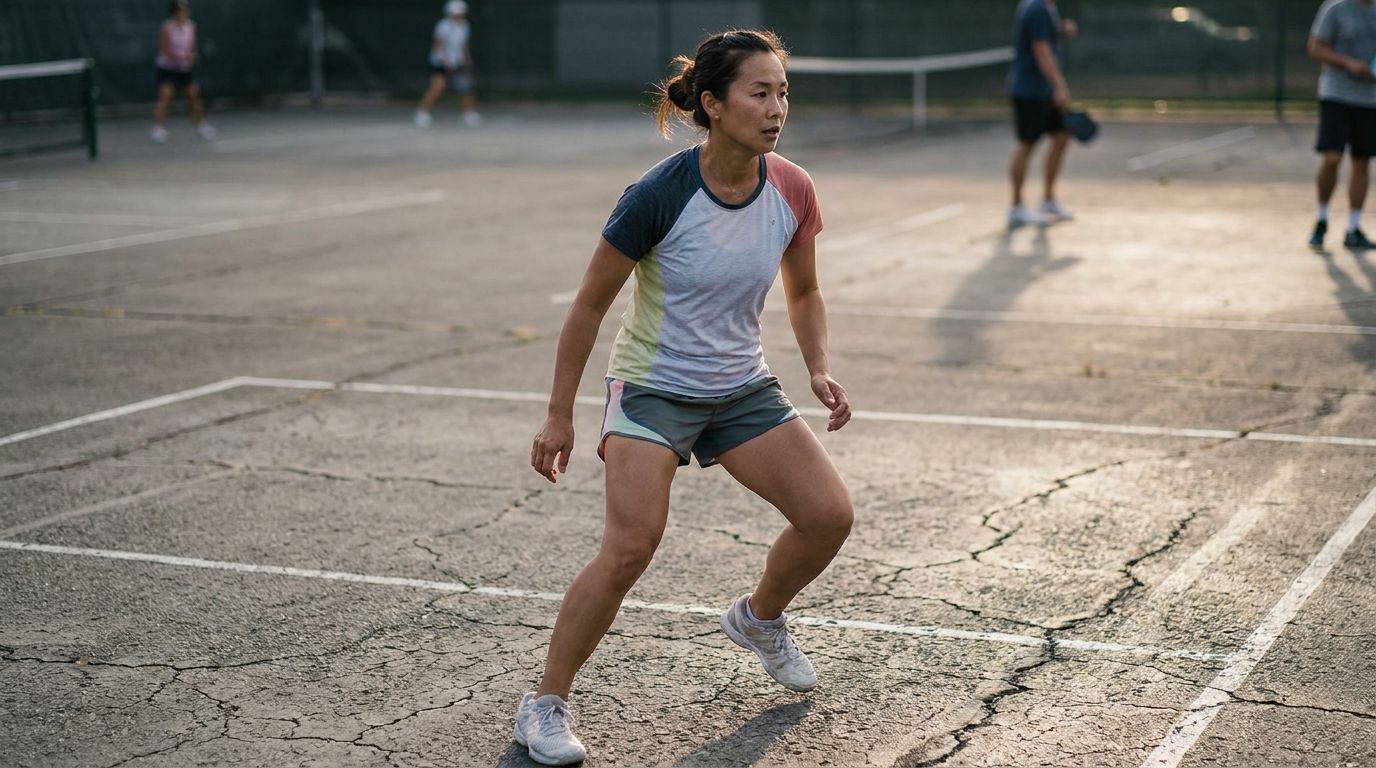
- Lateral speed and direction change. Kitchen-line battles and wide dinks require quick side-to-side movement and sharp stops. This is the most sport-specific physical demand and the one most players neglect entirely.
- Explosive start power. The split-step is the foundation of every rally. Players who have not trained explosive lower body power are always half a step late on reaction shots and short-ball attacks.
- Rotational core strength. Every drive, two-handed backhand, and overhead shot is powered by hip and core rotation before the arm gets involved. Weak rotation means weak shots and overloaded elbow joints.
- Repeated-effort endurance. Sustaining your output across game two and three is not about how far you can run. It is about how quickly you recover between short explosive efforts. That is a trainable quality, and the conditioning circuit below targets it directly.
- Balance and deceleration. Staying stable at the non-volley zone, recovering after a wide sprint, landing under control after an overhead: all of it requires balance and the ability to absorb force efficiently. This is where most injury prevention training belongs.
Warm-up: 10 minutes before every session
Static stretching before play can reduce strength and power output. Save longer static holds for after you play, and use dynamic movement before the first rally. Save the static work for after you play.
A dynamic warm-up fits the sport better because it raises temperature, moves the joints through active ranges, and prepares the body for quick starts and stops.
Cleveland Clinic gives the same basic sequence: dynamic work before activity, static holds after. Every exercise in it has a direct court application.
| Exercise | Duration | Why it matters |
| Leg swings (forward/back) | 30 sec per leg | Hip mobility for lateral coverage |
| Leg swings (side-to-side) | 30 sec per leg | Groin and hip flexor activation |
| Arm circles | 30 sec each direction | Shoulder prep for overhead shots |
| Hip circles | 30 sec each direction | Lower back and hip rotation |
| High knees in place | 60 sec | Heart rate elevation, hip flexor activation |
| Lateral shuffles | 4 × 5 yards | NVZ movement pattern activation |
| Split-step practice | 10 reps | Court-specific reactive movement |
The split-step practice is the one most players skip. It is also the one that transfers fastest. Ten controlled split-steps before you play wires the pattern before a real ball is coming at you.
Your first 5 minutes should prep the joints you actually use on court. These pickleball stretches cover the full pre-match and post-match routine.
If you are unsure where your movement gaps actually are, a certified coach can assess your footwork patterns and point you toward the right training priorities. Bounce connects you with certified pickleball coaches in your city who work with players at every level.
Lower body strength: the foundation of court movement
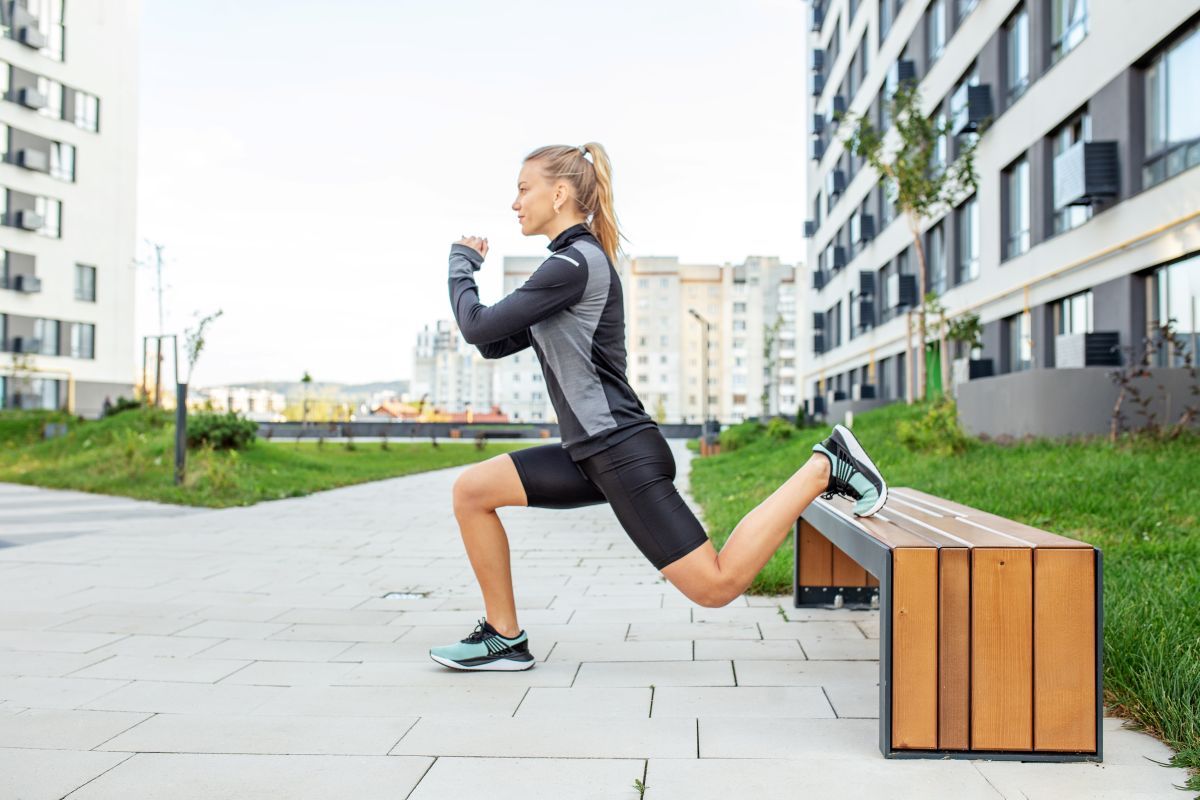
Every explosive movement on a pickleball court starts with the legs. The lateral band walk, the split-step, the push-off to reach a wide ball: all of it is ground force before it is anything else.
These four exercises have the highest court-transfer value of anything in the lower body category. For each one, the table shows what court situation it directly trains.
| Exercise | Sets × Reps | Rest | Court application |
| Lateral band walks | 3 × 12 per side | 60 sec | NVZ lateral coverage, side-to-side fatigue reduction |
| Bulgarian split squats | 3 × 8 per leg | 90 sec | Split-step explosion off the back foot |
| Single-leg Romanian deadlift | 3 × 10 per leg | 90 sec | Balance and control reaching for wide dinks |
| Single-leg calf raises | 3 × 15 per leg | 60 sec | Push-off power for kitchen approach |
The one cue that matters for each:
- Lateral band walks: Keep your hips level. The moment you hitch to one side, the hip stabilizers stop working.
- Bulgarian split squats: Drive the front foot into the floor, not the back foot off the pad.
- Single-leg RDL: Focus on the hip hinge, not the knee bend. The loaded leg stays nearly straight.
- Single-leg calf raises: Full range, all the way down before each rep. Partial reps do not build the ankle resilience you need.
Skip bilateral squats and leg press. Their court-transfer value is low relative to the time they take. The exercises above train the unilateral stability and lateral hip strength that pickleball actually requires.
Progressive overload note: Increase weight only when you can complete every set with the same form. For recreational players, spend 3 months building consistent form before adding significant load.
Core and rotation: where shot power actually comes from
Power in pickleball is generated from the ground up. The kinetic chain is legs into hip rotation into core into shoulder into paddle. Players who skip rotational core training are capping their shot ceiling and loading their elbow joint to compensate.
This section is not about abs. It is about rotation and anti-rotation: the ability to generate force through your core and the ability to resist unwanted movement when you do not want it.
| Exercise | Sets × Reps | Rest | Court application |
| Pallof press | 3 × 12 per side | 60 sec | Anti-rotation stability on volleys and blocks |
| Cable or band rotations | 3 × 15 per side | 60 sec | Third-shot drive mechanics, forehand topspin |
| Dead bug | 3 × 8 per side | 60 sec | Core stability on off-balance dinks |
| Russian twist (with weight) | 3 × 12 per side | 60 sec | Two-handed backhand power, overhead placement |
A note on planks: they train anti-extension, not rotation. They are useful. They are not the core of this section. Include them as supplemental work if you have time, but do not build your rotation training around them.
Shoulder stability: protecting the most vulnerable joint
If your shoulder feels tight after longer sessions, clean up the warm-up first. These pickleball stretches cover the mobility work most players skip before and after they play.
| Exercise | Sets × Reps | Why |
| Band external rotation | 3 × 15 per arm | Rotator cuff protection for overhead shots and serves |
| Face pulls | 3 × 15 | Rear delt and upper back for paddle control and posture |
| Narrow push-ups | 3 × 10–15 | Tricep and shoulder pressing for smash power |
If you feel any shoulder soreness after play (tightness, an ache that lingers into the next morning), prioritize this section above everything else in the workout.
Pickleball still loads the shoulder through serves, overheads, volleys, and repeated reaching. Sports medicine literature on pickleball specifically flags rotator cuff strains as a shoulder concern, even though the sport uses more underhand play than tennis.
Agility drills: training the movement patterns that actually happen on court
Ladder drills are everywhere in pickleball fitness content. They are a useful foot speed and coordination tool. They are not a court-pattern tool. Use them in your warm-up. Do not build your agility training around them.
The drills below are built around real pickleball movement sequences.
| Drill | Reps or Duration | Court pattern it trains |
| T-drill | 3 reps each direction | Kitchen-line to baseline transition and recovery |
| Lateral shuffle with hard stop | 4 × 10 yards | NVZ coverage with deceleration emphasis |
| Split-step into lateral shuffle | 4 × 8 reps | Reactive movement from return position |
| 5-10-5 cone drill | 3 reps | Change of direction on a wide or unexpected ball |
Deceleration is the gap most training plans miss. Most players drill acceleration and ignore stopping under load. Stopping quickly after a sprint to the kitchen is exactly what causes ankle sprains and knee injuries.
The "hard stop" variation in the lateral shuffle drill is there specifically to train this.
Change-of-direction training improves the exact skill this section is built around: braking, redirecting, and accelerating again. A systematic review found that several training methods can improve change-of-direction performance, which supports using controlled stop-and-go drills before increasing speed.
Conditioning circuit: built for pickleball's energy system
Pickleball is built around short bursts. Match analysis of elite pickleball has reported rally durations around 10.6 seconds with rest periods around 11.4 seconds, which is why repeated-effort conditioning fits the sport better than long, slow cardio.
That pattern repeats for 2–3 hours across a session or tournament.
Steady-state cardio builds a useful aerobic base. It does not train the repeated short-burst pattern that pickleball actually demands. The circuit below does.
Sample 20-minute pickleball conditioning circuit:
Round structure: 10 seconds work / 20 seconds rest
- Lateral shuffle sprint: 5 rounds
- Split-step into cone sprint: 5 rounds
- Forward/back sprint to kitchen line: 5 rounds
Rest 90 seconds, then repeat the full sequence once more.
Progression:
- Weeks 1–3: rest as written (20 seconds)
- Weeks 4–6: reduce rest to 15 seconds
- Week 7+: add a third round
Run this circuit 1–2 times per week. Never on the same day as a heavy strength session. Never the day before a competition.
When your conditioning starts matching your game, the next step is putting it to work in real competitive formats. Bounce offers leagues and organized play in your city, structured formats where you will feel the difference your training has made.
How to fit training into your week
Training only improves your game if you can recover from it. If you played 3 hours on Saturday, Sunday is not a strength day.
The schedules below are built around play frequency. Play comes first. Training fits around it.
For players who play 2–3 times per week:
| Day | Activity |
| Monday | Strength: lower body + core |
| Tuesday | Play |
| Wednesday | Agility + conditioning circuit |
| Thursday | Rest or light mobility |
| Friday | Strength: core + shoulder stability |
| Saturday | Play |
| Sunday | Rest |
For players who play 4–5 times per week:
Play takes priority. Fit strength training on 2 non-consecutive, non-play days. Reduce the conditioning circuit to once per week. The body cannot adapt to a training stimulus it cannot recover from. More volume is not better when recovery is already stretched.
Two rules that apply regardless of schedule:
- Never lift heavy the day before a competition.
- Never do the conditioning circuit the day after a 3-hour match.
Recovery: the part most players skip
Recovery is training. The adaptation to your workout happens during recovery, not during the workout itself. Most players under-invest in it and plateau or get injured as a result.
Sleep: 7–9 hours per night. There is no substitute and no workaround. This is when the body repairs the tissue you stressed in training.
Post-session cool-down: 10 minutes of static stretching after every session. Target hamstrings, hip flexors, chest, and shoulder. Do it every time, not occasionally.
The players who skip the cool-down are the same players who spend 3 weeks managing tightness that could have been avoided.
Active recovery days: Light walking or swimming on rest days. Not full inactivity. Moving lightly keeps blood flow through the muscles, reduces soreness, and accelerates the repair process.
Load management: If you played hard the day before, today is not a high-intensity day. That applies to both training and play.
Training load matters because injury risk rises when players add too much volume too quickly. Treat weekly pickleball and gym work as one combined load, then increase it gradually instead of stacking hard sessions back to back.
Conclusion
Court performance has a physical ceiling. The workout routine above is how you raise it.
If you do nothing else, start with two things: lower body strength twice a week and a 10-minute dynamic warm-up before every session. Those two changes alone will be noticeable within 4–6 weeks. Lateral coverage improves.
You recover faster between points. The third game starts to feel like the first game.
Add the core rotation work and the conditioning circuit when the strength sessions feel consistent. Layer in the agility drills when you want to sharpen court-specific movement. The weekly schedule keeps it all organized around the play days that matter most.
For players who want to connect their off-court training to structured coaching and competitive play, Bounce connects you with certified pickleball coaches and organized formats in your city.