If you have spent any time around pickleball courts, you have probably heard the phrase “rally scoring” come up. Maybe a league organizer mentioned it before a session, or a player suggested switching to keep games moving faster.
Either way, understanding rally scoring is useful for any player who wants to know the full picture of how pickleball is played across different formats and settings.
Rally scoring is not the standard. Most recreational games and all sanctioned tournaments use traditional side-out scoring, where only the serving team can earn a point.
Rally scoring changes that by awarding a point on every single rally, regardless of who served. That one change has a surprisingly large impact on pace, strategy, and how you think about each exchange.
This guide breaks down exactly how rally scoring works, where it shows up, what changes strategically, and how to handle the switch if you have only played traditional scoring until now.
What Rally Scoring in Pickleball Actually Means
In standard pickleball, a point can only be scored by the serving team. If the receiving team wins a rally, they do not earn a point. They earn the serve instead, which gives them the opportunity to score.
Rally scoring removes that restriction entirely. Under rally scoring:
- Every rally produces a point, regardless of who served.
- If the serving team wins the rally, they score and keep the serve.
- If the receiving team wins the rally, they score and gain the serve.
This means no rally is ever wasted on the scoreboard. Every exchange counts directly toward the final score, which is why rally-scored games tend to run faster and feel more continuous high-stakes from the first serve to the last.
Where Rally Scoring Comes From
Rally scoring is not a new concept invented for pickleball. Sports like volleyball and badminton have used it for decades.
In volleyball, the switch from side-out scoring happened in 1999, and research on match data confirmed that it made game duration significantly shorter and more predictable. Pickleball borrowed the concept for similar reasons.
Badminton has used rally scoring in its official format for years, as outlined in the BWF simplified rules, where every rally produces a point regardless of which side served. The logic is the same across all three sports: scoring on every rally makes games more predictable in length and easier to follow.
As pickleball grew and more players began organizing recreational leagues and timed open play sessions, rally scoring became a practical tool for controlling how long games last.
It lets organizers plan sessions around specific time windows and ensures players cycle through more games in a set period.
The format has also gained official recognition at the competitive level. According to the USA Pickleball official rulebook, tournament directors at sanctioned events now have the option to use rally scoring for doubles round-robin, team play, and singles double-elimination formats.
This marks a meaningful shift, moving rally scoring from a purely recreational tool into a recognized competitive option.
How Rally Scoring Works in Practice
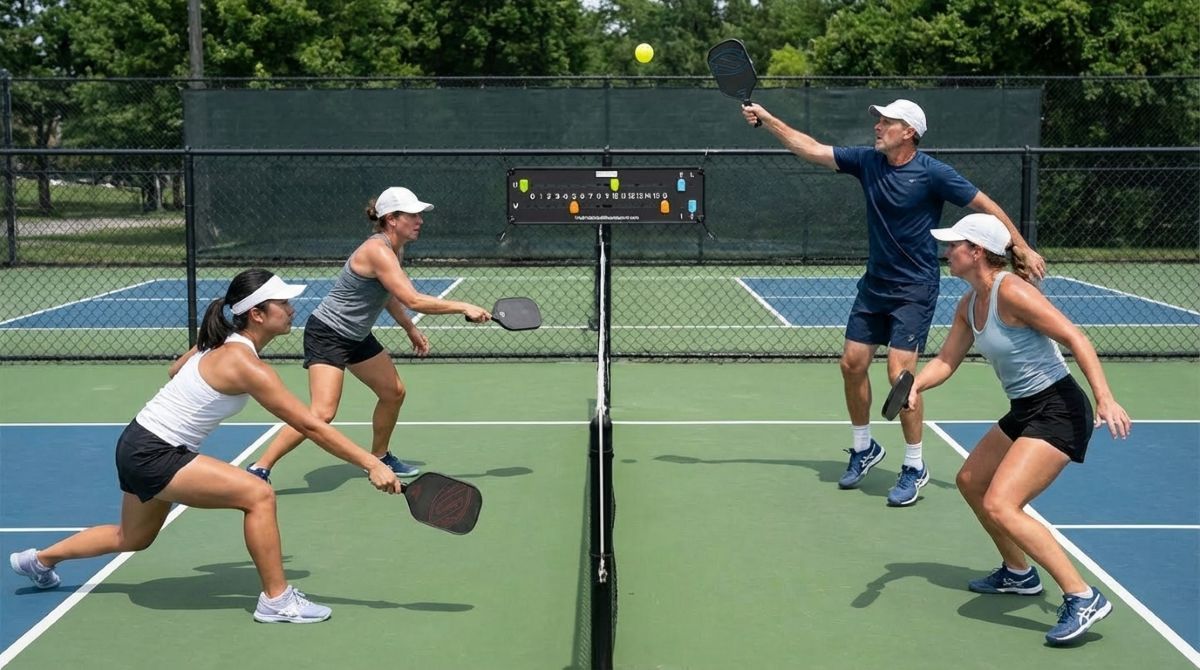
The mechanics of rally scoring are straightforward once you understand the key difference from traditional scoring. Here is how a typical rally-scored game plays out.
Serving still happens the same way
The serve in rally scoring follows exactly the same rules as traditional pickleball. It must be underhand, made below the waist, and delivered diagonally crosscourt. Foot position requirements, kitchen rules, and legal serve mechanics are all unchanged.
If the serve is faulted, the other team scores a point and gains the serve. A poor serve in rally scoring hands the opponent an immediate point, not just a change of possession, which raises the cost of serve errors compared to traditional play.
Scoring on every rally
After the serve is in play, the rally proceeds exactly as it would in any other game. The only difference appears at the end of the rally. Whoever wins it earns one point, and if the receiving team wins, they also take over the serve for the next point.
Game targets and win conditions
Rally-scored games are often played to 15 or 21 points rather than the traditional 11, because points accumulate faster. The winning team must also win by a two-point margin, and the game-winning point must be won by the server.
The specific point target depends on the organizer or league.
Doubles serving rotation under rally scoring
In traditional doubles play, each team has two servers per service turn before a side-out occurs. If you want a full breakdown of how that rotation works, the pickleball doubles rules guide covers it in detail. Rally scoring simplifies that rotation considerably.
There is no second server in rally scoring doubles. Each team serves until they lose a rally, at which point the opponent earns a point and takes the serve. This makes the serve sequence easier to track, especially for newer players.
Rally Scoring vs Traditional Scoring: The Key Differences
Understanding how the two formats compare side by side makes it easier to see why each exists and when each makes sense.
| Category | Traditional Scoring | Rally Scoring |
| Who scores | Serving team only | Either team on any rally |
| Serve importance | Very high - controls scoring | Moderate - serve does not control scoring |
| Game pace | Variable, often longer | Faster and more predictable |
| Common target | First to 11, win by 2 | First to 15 or 21, win by 2 |
| Strategy emphasis | Consistency, serve retention, patience | Aggression, rally control, error awareness |
| Official standard | Yes, used in all sanctioned play | Approved for select tournament formats |
| Serve rotation (doubles) | Two servers per team before side-out | One server, switches on rally loss |
| Momentum shifts | Slower, tied to serve retention | Faster, every rally affects the score |
| Win condition | Server or receiver can win final point | Game-winning point must be won on serve |
Where Rally Scoring Is Actually Used
Rally scoring is not used everywhere, but it shows up in enough contexts that you will likely encounter it at some point. Knowing when to expect it helps avoid confusion when the format is announced before a game.
Time-limited recreational sessions
This is the most common use case. Open play sessions, club nights, and social pickleball events often run on a fixed schedule. Organizers need games to rotate at a consistent rate.
Rally scoring solves the problem of games running long and disrupting session flow. With a point on every rally, game length becomes predictable, which makes scheduling much simpler.
Beginner and instructional settings
Some coaches and clinics use rally scoring with newer players because it keeps games moving and reduces the frustration of long stretches where neither team scores. When players are still learning to serve consistently, traditional scoring can create lopsided games where momentum stalls.
Rally scoring keeps the score moving, which helps players who are still building the basics stay engaged even when their serve mechanics still need work.
Sanctioned tournament formats
USA Pickleball has provisionally approved rally scoring for specific sanctioned tournament formats, including doubles round-robin, team play, and singles double-elimination.
This means competitive players may encounter rally scoring in organized events and should understand the format before they show up to play under it.
What rally scoring is not used for
Rally scoring is not the default format in sanctioned tournament play. Standard bracket and elimination rounds still use traditional scoring for the majority of competitive events.
If you are preparing for rated play or working toward improving your competitive game, traditional scoring matters most.
For players looking to build consistency across both formats, Bounce connects players with certified coaches, organized clinics, and local leagues where real play in both traditional and rally-scored environments helps build a more complete game.
How Rally Scoring Changes Strategy

The scoring format you play under shapes how you think about risk, aggression, and patience. Rally scoring does not just speed up the game. It genuinely changes what smart play looks like.
The serve matters less as a scoring weapon
In traditional scoring, holding the serve is everything. You cannot score without it, so losing it directly threatens your ability to build a lead. In rally scoring, the serve changes hands constantly and no longer functions as a gatekeeper to scoring.
This reduces the strategic pressure around the serve and shifts focus toward winning individual rallies regardless of who initiated them.
Receiving becomes more aggressive
Under traditional scoring, the receiving team plays conservatively because winning a rally only earns them the serve, not a point. Under rally scoring, the receiving team has a direct scoring incentive on every rally.
This tends to push returning players toward more aggressive returns and faster transitions toward the kitchen. The double-bounce rule still applies, but the mindset behind the return changes significantly.
Errors become immediately costly
In traditional scoring, an unforced error while receiving is painful but does not show up on the scoreboard for your team. In rally scoring, every error scores for the opponent. This raises the stakes on every shot and pushes players toward higher-percentage shot selection across the board.
Patience and consistency become even more important because there is no error that goes unpunished.
Momentum shifts happen faster
In traditional scoring, a team can go on a long service run and build a large lead before the other team has a chance to score. Rally scoring prevents that kind of lopsided stretch because both teams are always scoring. Comebacks are easier and leads are less stable.
This makes rally scoring feel more volatile in the short term, but it also means that consistency across a full game matters more than a single hot streak.
The win condition adds a final-point twist
One detail that makes rally scoring strategically distinct is the win condition. The game-winning point must be won by the serving team. If the receiving team wins a rally when their opponent is at game point, no point is awarded. It is simply a side-out.
This creates an unusual endgame dynamic where holding the serve late matters more than it does during the rest of the game. It rewards experience and composure under pressure.
Tips for Transitioning Between Scoring Formats
If you have mostly played traditional scoring and suddenly find yourself in a rally-scored game, a few adjustments help you get comfortable quickly.
- Stay aggressive on returns. You have a direct scoring incentive now. A safe, deep return followed by a quick move toward the kitchen is even more valuable under rally scoring than it is in traditional play.
- Do not treat the serve defensively. A well-placed serve can start you on the front foot, but losing it does not end your scoring opportunity the way it does in traditional scoring.
- Raise your error awareness. Because every mistake scores a point for the opponent, unforced errors are more damaging. Slow down before making low-percentage shots.
- Adjust your mental pace. Rally-scored games feel faster even when the actual shot quality is similar. Stay calm and focus on each rally rather than the scoreboard.
- Remember the endgame rule. The game-winning point must be won on serve. When you are close to winning or your opponent is at game point, this rule prevents confusion and shapes how you play the final points.
Players who want structured feedback on how their game holds up across both formats benefit most from working with a certified coach. Bounce makes it straightforward to find a verified pickleball coach in your city who can help you build the habits that translate well regardless of which scoring system you encounter on the court.
Should You Play Rally Scoring?
The honest answer is that it depends on your goals. Rally scoring is a useful and enjoyable format for the right situations. It is not a replacement for traditional scoring for anyone who plays or plans to play competitive pickleball.
Rally scoring is a good fit if:
- You are playing in a time-limited open session and need games to move at a predictable pace.
- You are newer to the game and want a format that keeps the score moving and stays engaging.
- You are entering a tournament that uses rally scoring for its round-robin or team play bracket.
Traditional scoring is the better choice if:
- You are preparing for or participating in standard competitive or rated events.
- You want your games to reflect the strategy and rhythm of most competitive pickleball.
- You are working with a coach or tracking improvement against rated players.
Many players enjoy both. Recreational rally-scored games can be a fun, high-energy way to stay active and sharp, while traditional-scored league play provides the structure and competitive context that leads to real skill development.
Playing across both formats keeps the game fresh and builds adaptability.
Conclusion
Rally scoring in pickleball is a practical and enjoyable format that serves a clear purpose in recreational settings, timed sessions, and now select sanctioned tournament formats. It makes games faster, keeps the score moving, and puts scoring pressure on every single rally.
At the same time, traditional scoring remains the foundation of most competitive pickleball and the format where strategy, serve management, and consistency matter most.
Players who understand both systems and can adapt between them are better positioned for whatever format they encounter.
If you want to explore both formats, improve your game, and find the courts and communities where pickleball is played well, Bounce is the place to start. Search your city, book a lesson, or join a league and step onto the court with a clearer sense of how the game works.
FAQs
Is rally scoring used in official pickleball tournaments?
Yes, in select formats. USA Pickleball has provisionally approved rally scoring for doubles round-robin, team play, and singles double-elimination at sanctioned events. Standard bracket and elimination rounds still use traditional scoring.
What score do rally-scored pickleball games go to?
Common targets are 15 or 21 points, win by two. The specific target depends on the organizer or tournament format. The game-winning point must also be won by the serving team.
Do the pickleball rules change under rally scoring?
The core rules stay the same. Serve mechanics, kitchen rules, the double-bounce rule, and fault definitions are all unchanged. Only the point-awarding system and the win condition are different.
Does rally scoring affect player ratings like DUPR or VAIR?
Rally-scored recreational games typically do not count toward DUPR ratings, which are based on traditional-scored competitive match results. VAIR, the AI-powered rating system, uses an adaptive assessment model and is the official rating system for NCPA and USWPA events.
Official VAIR ratings are also drawn from structured events rather than casual rally-scored sessions.
Is rally scoring better for beginners?
It can be in the right context. Rally scoring keeps the score moving and prevents long stretches where one player or team cannot score due to serve struggles. For instructional and recreational beginner settings, it often makes games more engaging.
Can rally scoring be used in doubles pickleball?
Yes. Rally scoring applies to both singles and doubles. In doubles, each team has one server at a time rather than the two-server rotation used in traditional scoring. The serve switches to the opposing team any time the serving team loses a rally.