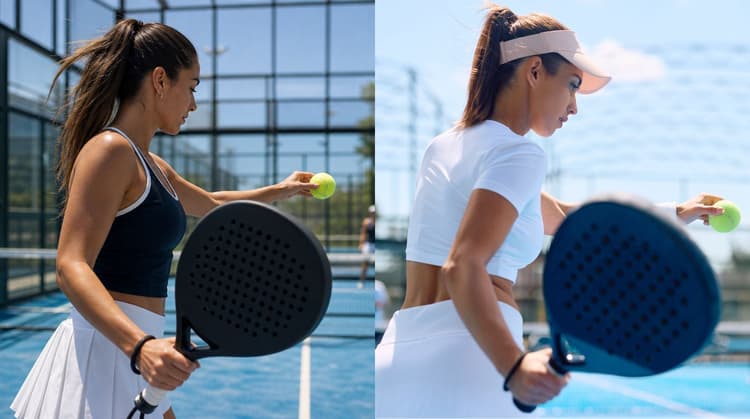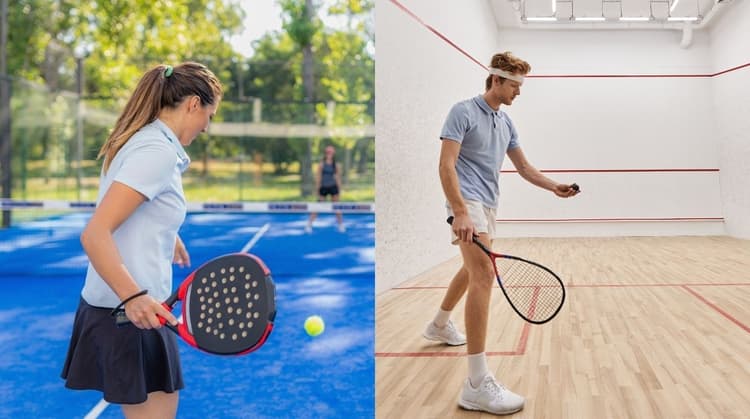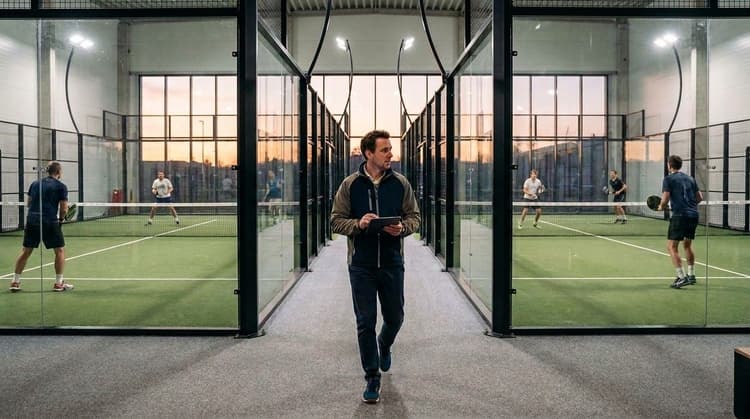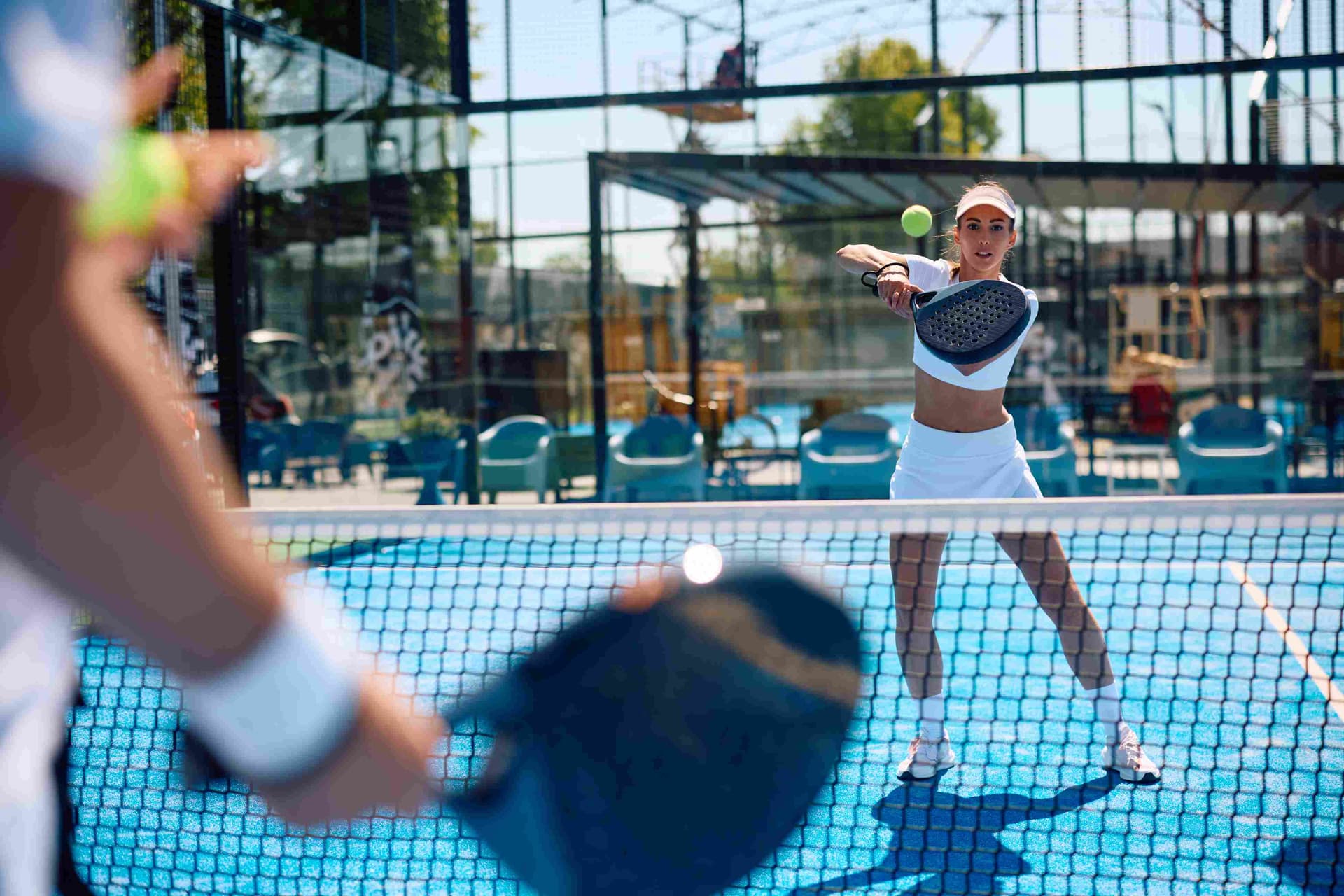
Padel is expensive in the US because the court has to be built for padel. A court needs a 20-by-10-meter enclosure, glass or solid walls, artificial turf, lighting, drainage, and regular maintenance. That setup costs far more than painting pickleball lines on an existing slab.
Court time is the main expense. Equipment matters, but a beginner can start with a useful racket in the $120 to $170 range. A weekly prime-time court habit will cost more than the gear.
Want a quick answer? Padel is expensive because it needs a purpose-built glass court, and many US markets still have more player demand than court access. Most players can cut the cost by using open play, off-peak hours, four-player court splits, and recurring socials.
Your total cost comes down to court fees, padel equipment, coaching, and how often you play. Shared sessions and rental gear keep the first few weeks cheaper while you work out what you actually need.
Why padel costs more than tennis or pickleball
Padel costs more because it needs a purpose-built enclosed court.
The official padel court is 20 meters long by 10 meters wide, with a net across the middle and walls that are part of play. The International Padel Federation rules define the court size, enclosure, surface, lighting requirements, and racket specs. A facility has to build the enclosure before it can sell a single hour of court time.
Tennis has decades of public courts across US cities. Pickleball can use school gyms, tennis courts, driveways, and community centers.
Padel usually starts with steel, glass, turf, lighting, doors, booking systems, insurance, and cleaning. Players feel that buildout every time they book.
Court construction drives much of the cost
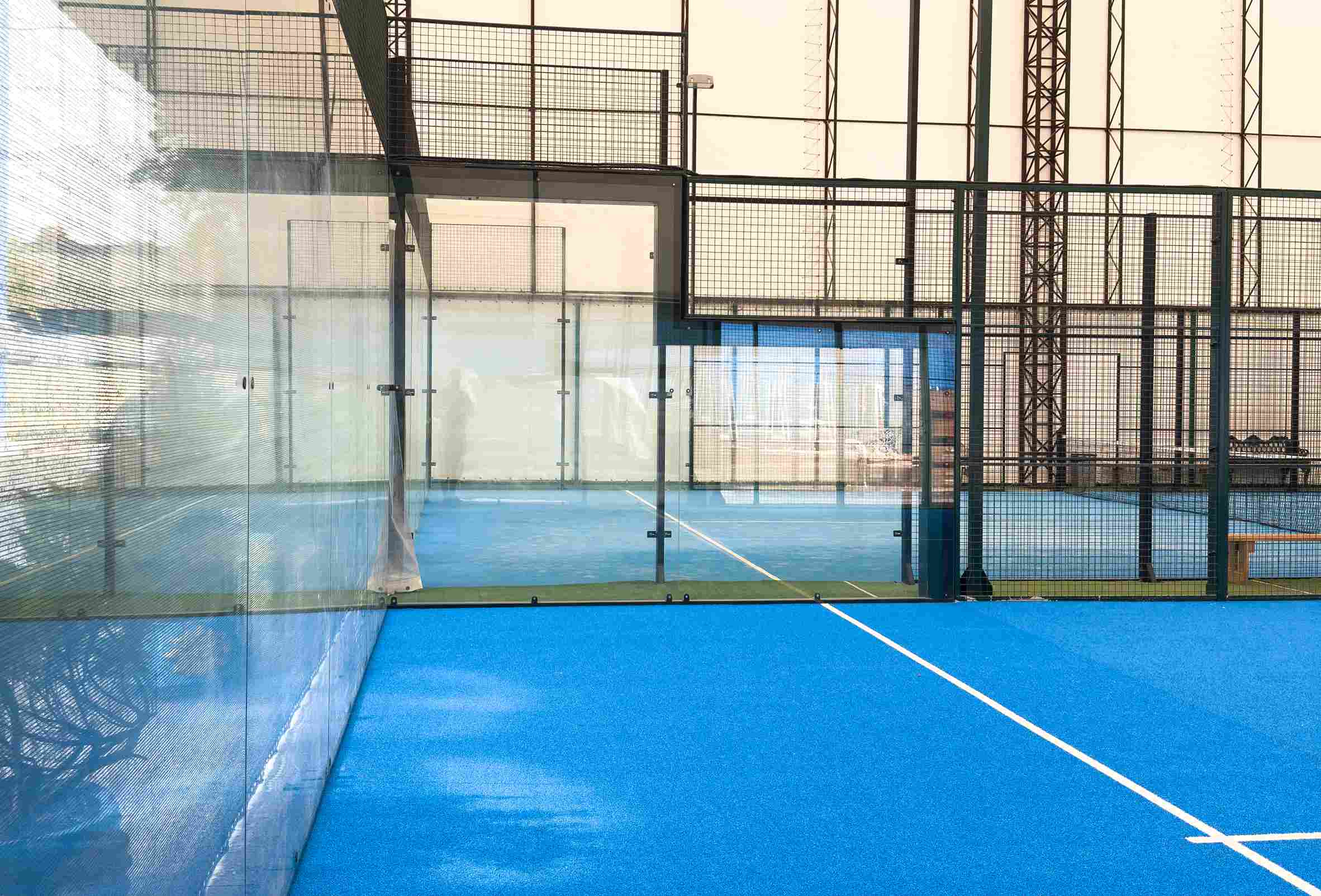
A complete padel court costs much more than the steel-and-glass kit. The Lawn Tennis Association’s Facility Loan Scheme uses approximate planning costs of £75,000 for a floodlit outdoor padel court and £130,000 for a covered court in Great Britain.
A Hexham Tennis Club project documented by Northumberland County Council received £91,000 from an S106 Housing Developers Fund, plus club funding, to cover the completed court. These figures show how the full project budget can extend beyond the court kit itself.
These are documented UK figures rather than U.S. averages. U.S. labor, freight, permits, land, and site conditions will produce different totals.
| Cost area | Why it adds cost | How it can affect players |
| Steel frame and wall system | The enclosure must withstand play and provide a consistent rebound. Glass courts also require compliant tempered panels and structural support. | The large upfront investment can contribute to higher booking fees |
| Surface, base, and drainage | The base must be level, stable, and able to remove water. Artificial turf also needs installation and ongoing care. | Surface care, repairs, and eventual replacement become part of venue overhead |
| Lighting and electrical work | Indoor and evening sessions need uniform lighting positioned to avoid obstructing play or players’ vision. | Installation and electricity add to the venue’s operating costs |
| Freight, installation, and site work | Court parts may require specialist transport, lifting equipment, foundations, permits, drainage, and local contractors. | Booking prices can vary sharply between locations and construction sites |
Limited US supply keeps session prices high
US prices stay high because clubs are still absorbing buildout costs while player interest is growing faster than court access in many cities.
The FIP World Padel Report 2025 says active players have passed 35 million worldwide. It also reports 77,300 courts across 150 nations and 20 dependent territories. Global supply is growing fast, but the US is still early compared with Spain, Argentina, and other mature padel markets.
USA Padel’s 2024 annual report describes the US as an emerging padel market with growing infrastructure and more clubs serving new players. That is the stage where court time stays expensive: interest arrives before enough courts do.
Padel’s history followed the same pattern. First a small number of clubs. Then wider adoption. Then lower friction for regular players.
Prices should soften as more clubs open. New US markets are still in the awkward part: high curiosity, member demand, limited court count, and expensive buildouts.
Equipment is the smaller part of the budget
Padel gear feels expensive at the start because the racket is a full replacement item.
A tennis racket can be restrung. A padel racket has a solid face over an EVA foam core. When the core loses feel or the face cracks, the racket gets replaced.
What a padel racket costs
Padel rackets usually run from entry-level fiberglass models to higher-priced carbon models. A new recreational player should usually start in the middle.
A $120 to $170 racket is enough for the first year if you are playing recreationally. A $250 racket makes more sense once your swing and contact point are repeatable.
Amasport’s manufacturing overview explains the basic build: carbon fiber or fiberglass layers, an EVA foam core, compression molding, drilling, finishing, and quality checks. Treat that as manufacturing background rather than governing-body authority.
The cost-per-use math is the useful part. A $150 racket used for 100 sessions costs $1.50 per session. One $40 court booking split by 2 players costs $20 per person in a single hour.
Court time is where the money goes.
Balls, shoes, and replacement costs
Balls, overgrips, and shoes are the normal ongoing gear costs.
A practical starter setup looks like this: one racket, one pair of court shoes, balls, and overgrips. The first month may sting because several items arrive at once. After that, your spending depends mostly on how often you book courts.
A beginner should rent a racket for the first few sessions. Then buy once you know whether you want comfort or a firmer feel.
What it actually costs to play padel in the US
Use these figures as planning ranges. Your city, facility, booking time, membership, and session length will change the final price.
| Cost item | Timing | Typical U.S. planning range | Practical note |
| Padel racket | One-time | $75–$375 | A beginner model around $100–$170 is enough for your first season |
| Court shoes | One-time | $60–$180 | Choose lateral support and tread suited to the facility’s court surface |
| Padel balls | Recurring | $7–$10 per 3-ball can | Replace the can when pressure and rebound begin to fade |
| Court rental | Per player, per hour | $10–$35 | A full court generally totals $40–$140 when four players book together |
| Open play or social | Per session | $25–$55 per player | Sessions commonly last 90–120 minutes and include organized rotations |
| Group clinic | Per session | $24–$60 per player | Membership, coach, group size, and session length affect the price |
| Private coaching | Per hour | $75–$160 | Confirm whether the listed price covers one player or the full lesson |
| Club membership | Monthly | $60–$250 for standard tiers | Premium or unlimited plans can cost $350–$450 per month |
Your first month includes the one-time racket and shoe purchases. Rental rackets can reduce that initial cost while you decide how often you’ll play.
Using a four-week month, two $30 open-play sessions each week cost about $240 per month. A $120 court split among four players also costs $30 each, producing the same monthly total at two bookings per week.
Membership value depends on what the fee includes. Some plans provide booking credits or discounted sessions, while higher tiers can include unlimited court time. Compare your expected monthly bookings with the membership fee before joining.
Why padel coaching can feel expensive
Padel coaching can cost more because trained coaches and court access are both limited.
A coach needs a padel court to teach padel properly. That court carries the same booking economics as normal play. The coach also has to understand the parts that transfer poorly from tennis: glass defense, bandejas, viboras, lob patterns, and net recovery.
Private lessons make sense once you have played enough to know where you are stuck. Group clinics are better for the first few months because you get technical correction and live reps at a lower per-player price.
Spend the first coaching dollars on wall movement and serve return. Those skills cut wasted points fast.
Is padel more expensive than tennis?
Yes, padel is usually more expensive than public tennis in the US.
Tennis has free municipal courts, high school courts, public parks, and decades of club infrastructure. Padel is newer here and usually sits inside private facilities. That difference changes the price before anyone talks about rackets.
The gap shrinks when you compare private tennis to private padel. A paid tennis clinic in Miami or New York can cost as much as a padel clinic. A free public tennis court is the piece padel lacks.
Pickleball shows the other side of the curve. As court supply expands and more facilities compete, session prices get more flexible. The same pattern explains why pickleball costs can look very different from padel in the same city.
How to reduce padel costs without cutting corners
The cheapest way to play padel is to change the format.
- Split courts with 4 players. A $60 court becomes $15 each. That is the simplest fix.
- Use off-peak hours. Morning and midweek slots are usually easier to find and cheaper.
- Start with open play. Open play gives you games without organizing 4 people yourself. Bounce lists open play options for players who want recurring sessions instead of one-off court hunts.
- Compare nearby facilities. A single club’s price gives you only one data point. Bounce’s court finder helps players compare padel courts and facilities by location.
- Rent before you buy. Use a rental racket for your first few sessions.
- Buy mid-range first. A $120 to $170 racket is the right start for most recreational players.
A cheaper session that gets you on court twice per week beats expensive gear that sits in a closet.
When padel is worth the cost
Padel is worth the cost when you play enough for the social and skill benefits to stack.
The sport is built around doubles. That makes it easier to meet people, rotate partners, find games, and keep a weekly schedule. The walls also make rallies longer for newer players than tennis rallies usually are.
That matters. A sport you play every week usually beats a cheaper sport you never book.
Use 4 sessions as the test. Rent a racket, join open play, split a court with 4 players, and write down what you spent. If you want a fifth session, the sport probably has you.
Cost comparison: where the money goes
| Question | Lower-cost choice | Higher-cost choice |
| How should I book court time? | Open play, off-peak booking, or a full court split between 4 players | Prime-time court booking split between only 2 players |
| What racket should I buy? | A beginner-friendly racket around $100 to $170 | A $250-plus performance racket before you know your preferred weight and shape |
| How should I learn? | A beginner clinic, regular games, or one introductory lesson | Several private lessons before you’ve identified the parts of your game that need work |
| When should I join a club? | After your weekly playing routine is consistent and the membership saves money | Before you know how often you’ll play or what the fee includes |
Buying the expensive version of every option at once pushes up your first-month cost. Start with rental equipment and shared sessions. Buy your own racket or join a club once your playing routine makes the expense easy to justify.
Conclusion
Is padel overpriced?
Padel costs more than most racket sports because the infrastructure is genuinely expensive to build. A single court runs $80,000–$150,000+: steel frames, reinforced glass walls, artificial turf, permanent lighting. Split four ways, a $100 court hire is $25 per person. In Spain and Argentina, where courts are abundant, prices are already lower.
Is padel a rich man's sport?
Padel has an elite reputation, but the cost per session isn't unusually high. Divided among 4 players, court hire runs $10–$25 per person. The real barrier is availability. Where courts are scarce, prices stay elevated. In Spain, with over 20,000 courts, it's as accessible as public tennis.
Is padel growing or declining?
Padel is the fastest-growing racket sport in the world. As of 2025, it has an estimated 25 million players across 90+ countries, with US court construction up over 40% year-over-year. In markets like the UK, the US, and Australia, supply is still catching up to demand. That's what keeps prices elevated, for now.
Why do all F1 drivers play padel?
Padel fits the F1 athlete profile: intense cardio with almost no injury risk. Carlos Sainz and Fernando Alonso are regulars. The sport embedded itself in Spanish football and motorsport culture in the 2000s, and that association spread globally. When the world's highest-paid athletes are photographed playing something, clubs price it accordingly.
Is padel just a fad?
Padel has been Spain's dominant racket sport for over 20 years. It overtook tennis in registered Spanish players by 2021. Private equity has poured in. Professional tours are running. Court construction in the US is up 40%+ year-over-year. Sports with that kind of institutional infrastructure don't fade.
Is padel more popular than pickleball?
Globally, padel has a wider reach than pickleball. The World Padel Report estimates 25 million players across 90+ countries. Pickleball has around 36 million players, but nearly all of them are in the United States. Padel leads in Europe and Latin America by a wide margin. By court count and federation size, it's the larger sport internationally.