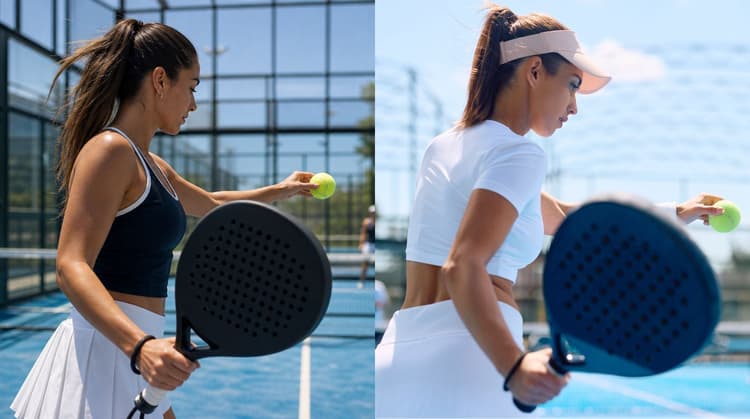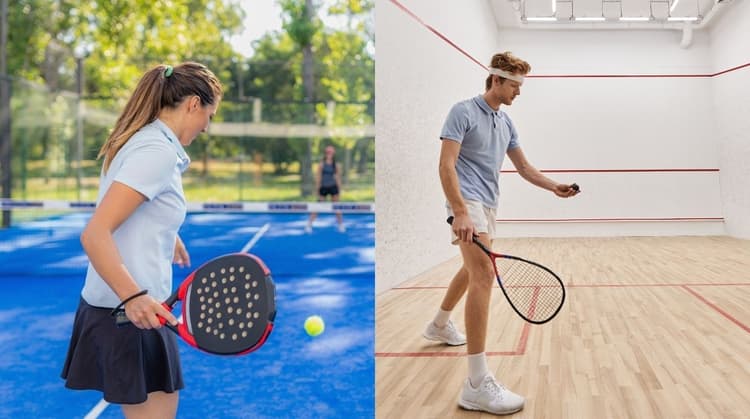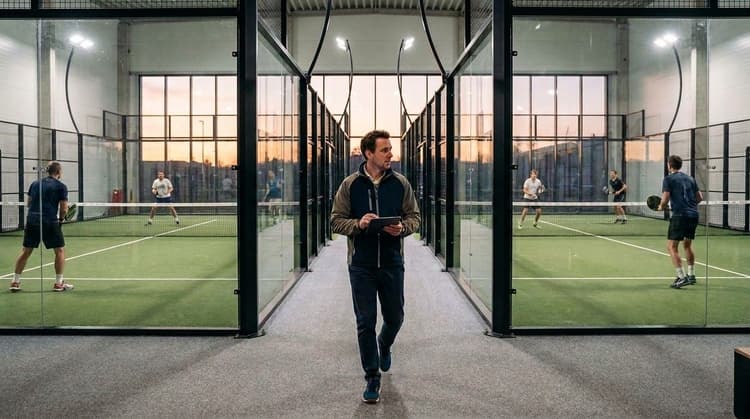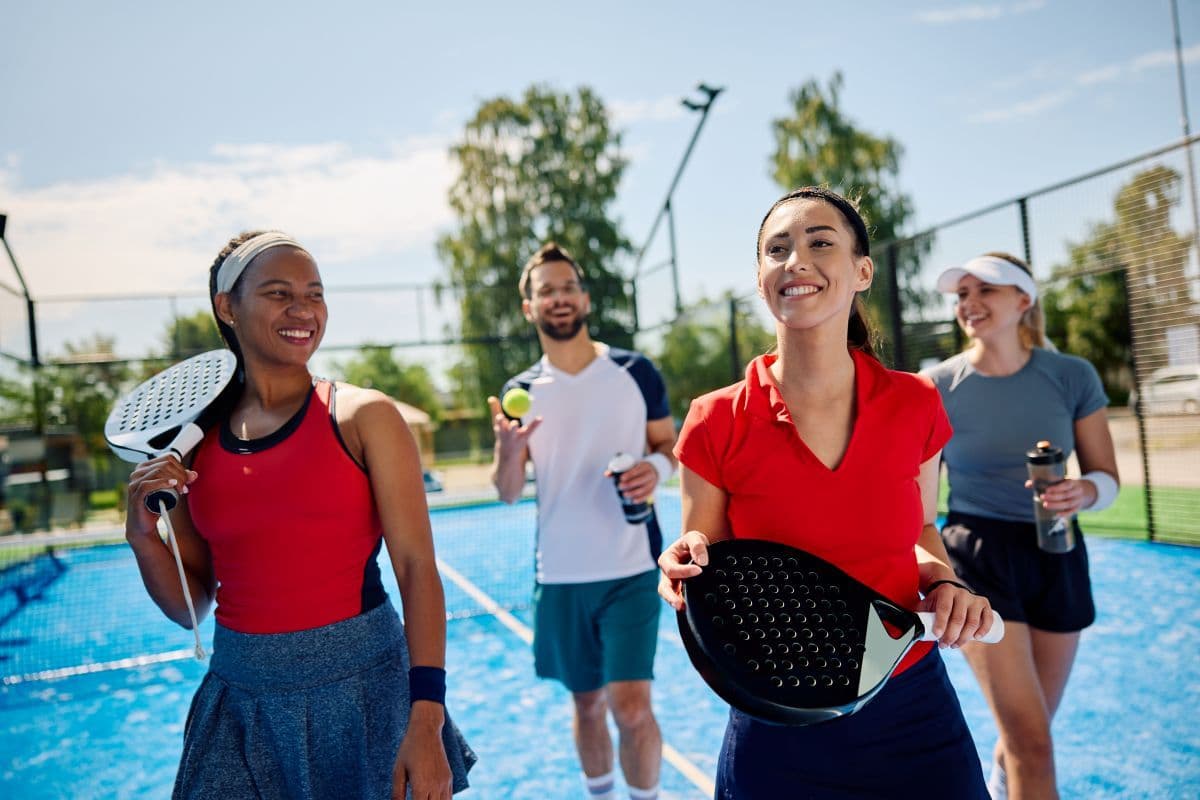
Padel gets easier once you stop thinking of the glass as background noise. The walls are part of the point, and they are the reason beginners can keep rallies alive sooner than they expect.
If you want to learn how to play padel, start with the core rhythm: serve underhand, score like tennis, let the ball bounce once, and use the glass after the bounce. The sport looks chaotic for about 10 minutes. Then the logic starts to settle in.
Quick answer: Padel is a doubles racket sport played on a 20m x 10m enclosed court with glass walls. You serve underhand, score like tennis, and use the walls once the ball bounces. Most beginners can start rallying in their first session, but the glass usually takes 2 to 3 sessions to feel natural.
What padel is
Padel is a doubles racket sport played with a solid, perforated racket and a lower-pressure ball on an enclosed court. It shares tennis scoring, but the glass walls change how rallies work. The ball can rebound off the walls after it bounces, which gives players more time to defend and creates longer, more social points.
The official rules sit with the International Padel Federation, and the current rule documents are available through the official FIP Rules of Padel.
For a fuller overview of the sport before stepping on court, the what is padel guide covers the court, equipment, and how padel compares to other racket sports.
What you need to play padel
You need 3 things: a padel racket, padel balls, and shoes that can handle side-to-side movement.
A padel racket is solid and perforated, with no strings. Padel balls look close to tennis balls, but they are lower pressure and play a little slower. Shoes matter more than beginners think. Running shoes are built for forward motion. Padel asks you to stop, split step, turn, and push sideways.
You do not need to buy everything before your first session. Most clubs rent rackets, and a first hit should be about learning the game, not building a gear bag.
| Item | What to use | Beginner note |
| Racket | Solid perforated padel racket | Start with control. Power can wait. |
| Ball | Padel ball | It is lower pressure than a tennis ball. |
| Shoes | Court shoes with lateral support | Avoid soft running shoes if you plan to play regularly. |
| Players | 4 players total | Standard padel is doubles. |
The court: what you're looking at
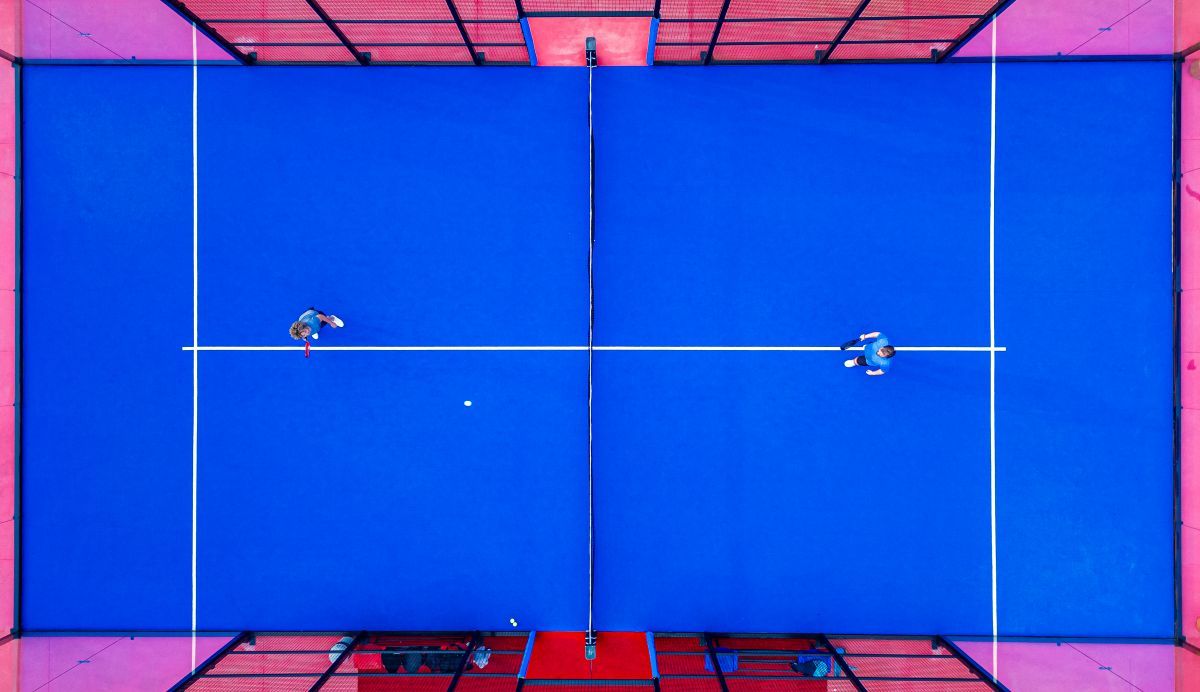
A regulation padel court is 20m long and 10m wide. The net runs across the middle, with a service line and center line dividing the back part of each side into service boxes. The net height is 0.88m in the center.
The court is enclosed by glass and mesh. The back glass is where most beginners first feel lost, because the ball can bounce, hit the glass, and still be live. The side doors also matter. On courts built for out-of-court play, a ball that bounces in and exits through the opening can still be chased down outside the court.
LTA’s beginner padel guide gives a clean overview of the court, equipment, and basic play for new players who want a second plain-language reference.
| Court feature | What it means for play |
| 20m x 10m court | Smaller than a tennis court, built for 4 players. |
| Glass walls | The ball can rebound after it bounces. |
| Mesh fencing | Creates awkward rebounds during rallies. |
| Service boxes | Only matter during the serve. |
| Side doors | Can allow out-of-court returns on approved courts. |
How to play padel: the basic rules
The rules are simple when you separate the point into 4 parts: serve, return, rally, and fault.
| Part of the point | Beginner rule |
| Serve | Bounce the ball, hit underhand at or below waist height, and serve diagonally. |
| Return | Let the serve bounce once before returning it. |
| Rally | The ball must be hit before it bounces twice. |
| Walls | The ball must bounce in the court before hitting the opponent’s wall or fence. |
| Fault | A point ends when a player breaks a rule, hits out, or lets the ball bounce twice. |
The serve
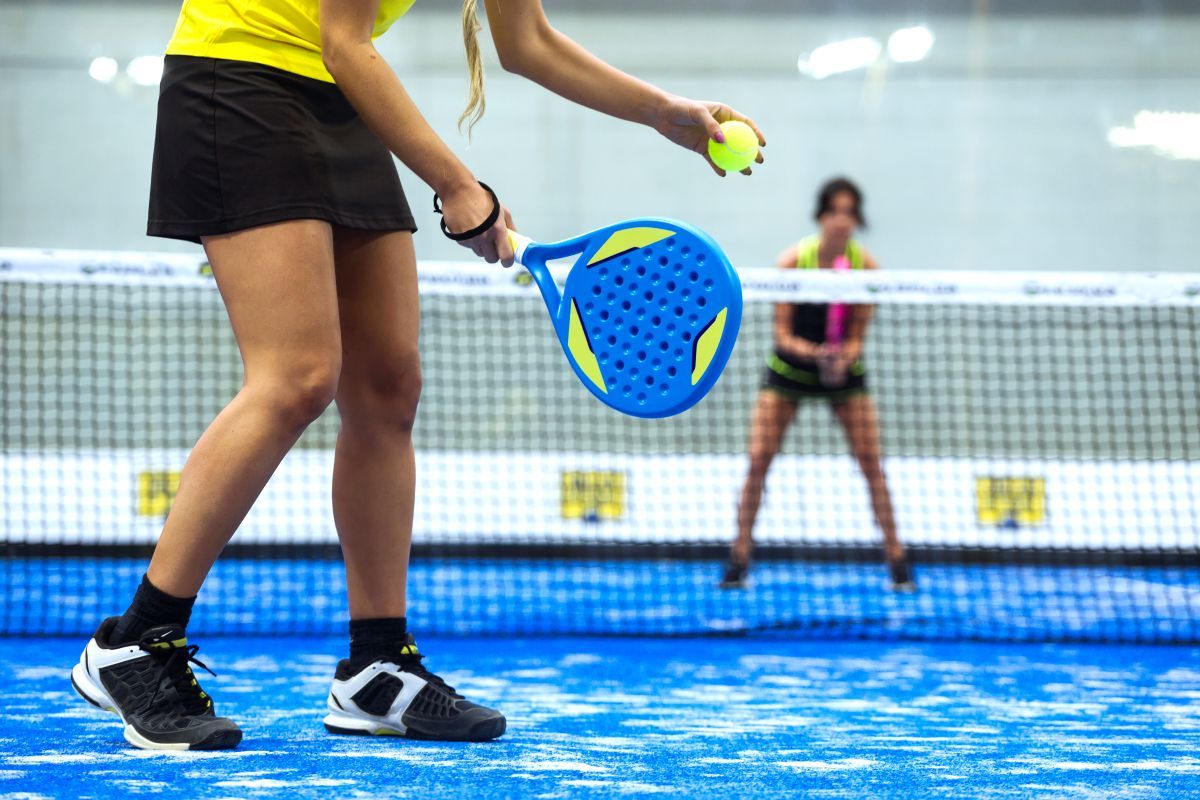
The serve starts behind the service line. Stand between the center line and the side wall. Bounce the ball, then hit it underhand at or below waist height. The serve must travel diagonally into the opposite service box.
You get 2 attempts. If the ball touches the net and still lands correctly, it is a let and the serve is replayed. If the serve lands in the service box and then touches the back glass, it is still good. If it touches the side mesh after landing, it is a fault.
That last detail causes arguments. On the serve, back glass after the bounce is fine. Mesh after the bounce is not.
Scoring
Padel scoring follows tennis: 15, 30, 40, game. A set is usually first to 6 games with a 2-game lead. At 6-6, most formats use a tiebreak to 7 points, with a 2-point lead required.
Matches are usually best of 3 sets.
At 40-40, some formats use golden point, where one deciding rally wins the game. The receiving team chooses which side receives. The 2026 FIP rules also list Star Point as a scoring option, so always check the club, league, or event format before you start.
| Score | Meaning |
| 15 | 1 point won |
| 30 | 2 points won |
| 40 | 3 points won |
| Game | Usually 4 points won, unless the score reaches deuce |
| Golden point | One deciding point at 40-40 in formats that use it |
| Set | First to 6 games, win by 2 |
For a full breakdown of how scoring, sets, and tiebreaks work in padel, including the different formats you'll encounter at clubs and tournaments, see the padel rules guide
Wall rules
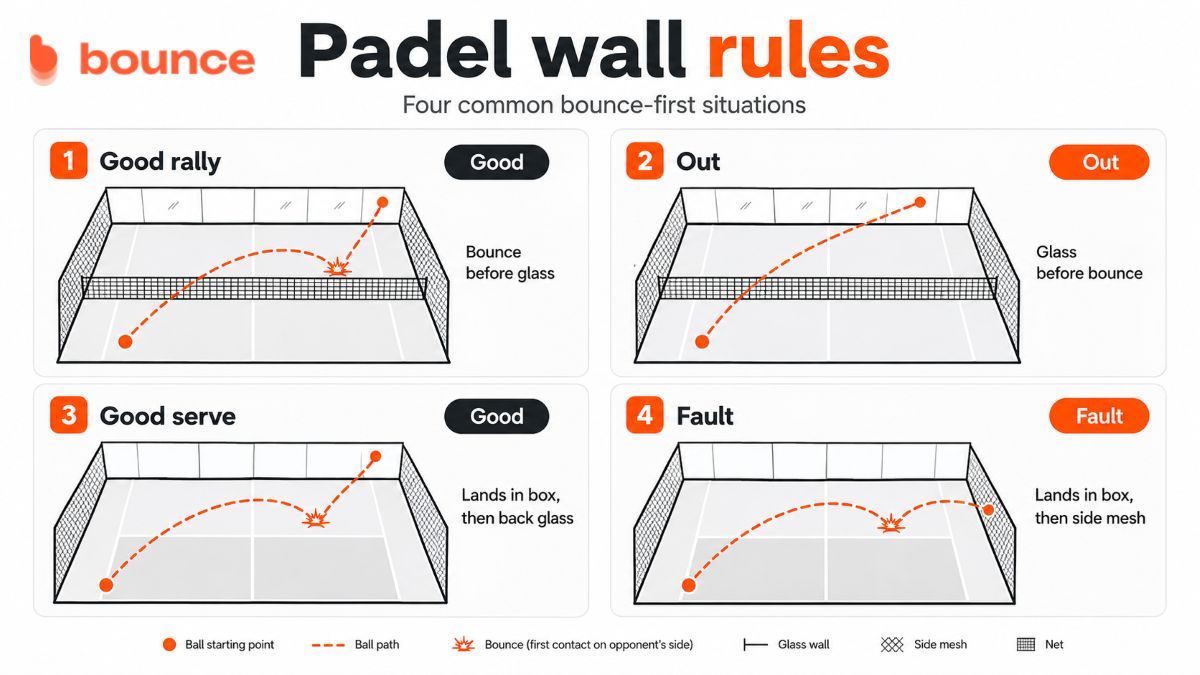
Wall play is the heart of padel. The ball has to bounce in the opponent’s court before it touches the opponent’s glass or fence. If your shot flies straight into their back glass, side glass, or mesh without bouncing, you lost the point.
After the ball bounces on your side, you can let it hit your glass and then return it. You can also hit the ball into your own glass so it rebounds over the net, as long as it lands in the opponent’s court.
Official padel rules says: the ball must clear the net and bounce in the court before it hits the wall or cage to be in.
| Scenario | Call |
| Your shot lands in the opponent’s court, then hits glass | Good |
| Your shot hits opponent’s glass before bouncing | Out |
| Opponent’s shot bounces, hits your glass, and you return it | Good |
| Serve lands in the box, then hits back glass | Good |
| Serve lands in the box, then hits side mesh | Fault |
| Ball bounces twice on your side before you hit it | Point lost |
Common faults
Most beginner faults come from tennis habits or panic near the glass.
- Touching the net with your racket or body while the ball is live.
- Serving overhead or serving without a bounce.
- Returning the serve out of the air instead of letting it bounce.
- Hitting the ball before it crosses to your side.
- Double-hitting the ball.
- Hitting the opponent’s glass before the ball lands in their court.
The shots to learn first
Do not start with the highlight shots. The bandeja, vibora, and smash can wait. Beginners need the 3 shots that keep rallies alive and help them understand court position.
| Shot | Why it matters first |
| Forehand and backhand groundstrokes | They are the base of every rally. Aim for control and placement. |
| The lob | It moves opponents off the net and resets the point. Height and depth matter more than pace. |
| The volley | Padel is won at the net. Start with a short block volley, not a big swing. |
Forehand and backhand groundstrokes are your base. Hit through the ball with a compact swing. You do not need a tennis-size backswing. The court is smaller and the walls give players a second chance, so controlled depth beats wild pace.
The lob is the most useful beginner shot in padel. When you are stuck near the back glass, a high deep lob pushes the other team away from the net and gives you time to move forward.
The volley matters because net position wins points. Keep the racket up, bend your knees, and block the ball into space. A clean short volley does more for a beginner than a forced smash.
Once you're comfortable with those 3, the padel tips guide covers the next layer: positioning habits, lob timing, and how to start reading the glass instead of reacting to it.
Positioning: the one rule that changes everything
The team that controls the net controls the match. That is the simplest tactical rule in padel. You and your partner should move as a pair. If one player is at the net and the other is trapped near the back glass, the middle of the court opens up.
| Situation | Where to stand | What to avoid |
| After a good serve | Move forward together toward the net | Sprinting in after a weak serve |
| Defending deep | Stand about 2 to 3m in front of the back glass | Pressing your heels against the glass |
| After a successful lob | Advance together | Watching the lob instead of taking space |
| When lobbed | Retreat together | One player staying forward alone |
After a solid serve, move forward together. Do not rush blindly. Move when the serve creates enough pressure that the return is likely to come up.
When defending, give yourself space from the back glass. Beginners often back up too far and get jammed. Standing 2 to 3m in front of the glass gives the ball room to bounce, rebound, and come back into your strike zone.
If you want structured coaching on court positioning, wall play, and net movement, Bounce connects players with certified coaches and organized racket-sport sessions in their city.
What to expect in your first session
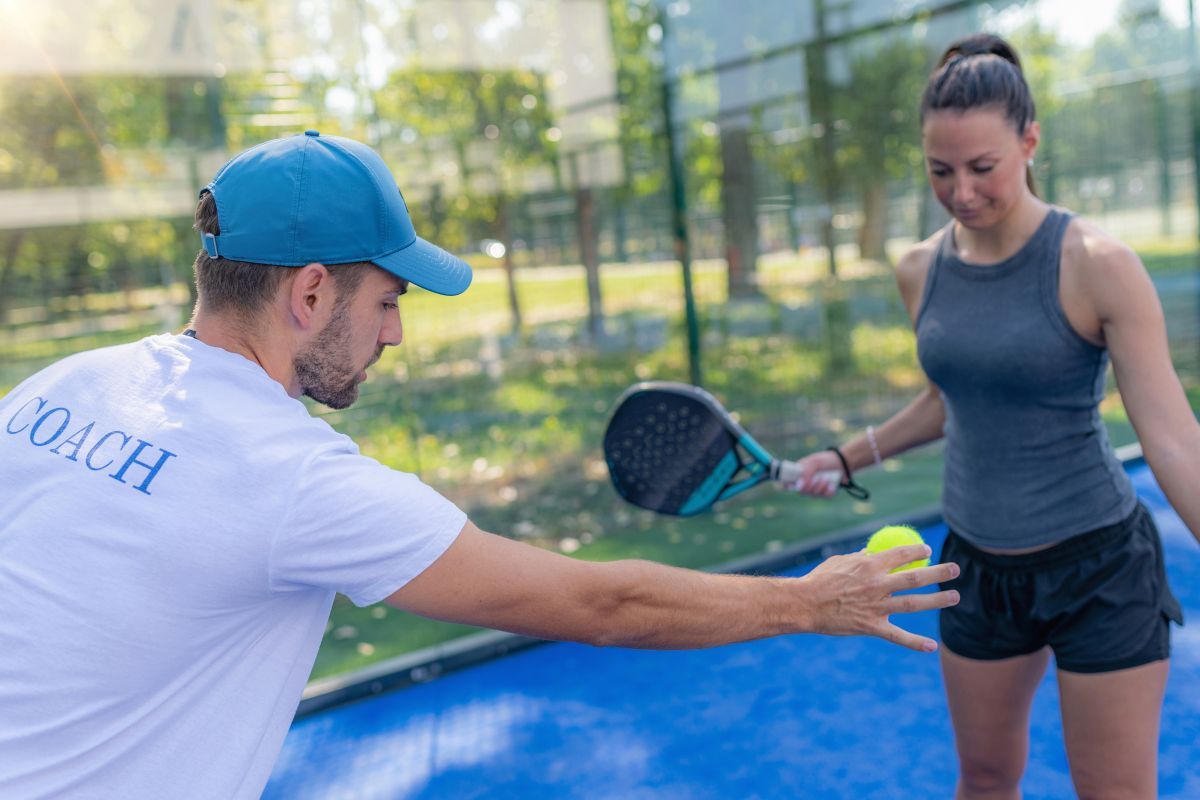
Most beginners can rally in their first session. That does not mean the game feels natural immediately. The first awkward phase is reading the back glass. You will move toward balls that are actually coming back to you, and you will swing too early on rebounds that need another half-second.
That is normal. The glass usually takes 2 to 3 sessions to feel less strange.
If you play tennis, resist the overhead serve and the full-speed drive. If you play pickleball, expect more movement through the back half of the court. The closest shared habit is patience: build the point, take the net when the chance appears, and stop trying to win every ball with one swing.
For organized sessions, social play, and beginner-friendly programs near you, Bounce helps players find local options by city, skill level, and schedule.
Beginner tips that actually matter
- Use shorter swings: The court is compact and the ball comes back off glass. Big swings make timing harder.
- Aim low over the net: A low ball forces opponents to hit up, which gives you time to move forward.
- Practice lobs early: The lob is your reset button when you are under pressure.
- Call yours and mine: Padel doubles gets crowded fast. Communication prevents easy middle-ball errors.
- Let the glass help: You do not need to panic every time the ball gets behind you. If it bounces first, the glass can give you more time.
If you're figuring out your first few sessions, the guide to getting started in padel covers what to bring, where to find courts, and how to find players when you don't have a full group yet.
Padel vs tennis for new players
Tennis players usually recognize the scoring, volleys, lobs, and basic strokes. The serve and walls are the bigger reset. Padel starts with an underhand serve after a bounce, and the back glass can help you defend instead of ending the point.
Our padel vs tennis guide explains the court and equipment differences clearly, including the 20m x 10m court and the lower-pressure padel ball.
| Skill area | Tennis instinct | Padel adjustment |
| Serve | Overhead serve | Underhand serve after a bounce |
| Groundstroke | Bigger swing for pace | Compact swing for control |
| Defense | Recover in open court | Use the glass after the bounce |
| Tactics | Create open space with depth and pace | Take the net and move as a pair |
Conclusion
Padel becomes simple when you learn the order of the point. Serve underhand. Return after one bounce. Keep the ball from bouncing twice. Use the glass after the ball lands. Move with your partner and take the net when the point gives you the chance.
That is enough to play your first match without stopping every 30 seconds.
The next step is repetition. Wall reads, lobs, and net movement make more sense once you feel them on court. For players who want structured coaching and organized play, Bounce connects you with certified coaches and competitive formats in your city.
FAQs
How long does a padel game last?
A casual padel match usually lasts 60 to 90 minutes. A single set can be much shorter, depending on the scoring format and the level of the players.
Can you play padel singles?
Standard padel is played as doubles. Singles padel exists on narrower courts in some places, but the normal court, tactics, and competitive formats are designed for 4 players.
Is padel easier to learn than tennis?
Padel is usually easier for beginners to start because the serve is underhand, the court is smaller, and the walls can keep rallies alive. Tennis has more space to cover and a harder serve motion to learn.
What is the golden point in padel?
Golden point is a deciding point at 40-40. Instead of playing deuce and advantage, one rally decides the game. Some competitions use different scoring formats, so confirm the format before the match.
Do I need special shoes to play padel?
You can try padel in regular athletic shoes, but court shoes are better if you plan to keep playing. Padel requires lateral stops and quick turns, so shoes with side support reduce slipping and improve balance.
Can the ball go out of the court in padel?
Yes, on courts designed for out-of-court play. If the ball bounces in the court and exits through the side opening or over the fence, a player may be able to leave the court and return it legally.
How do I find people to play padel with?
Most clubs run open sessions, mix-ins, and beginner nights where the venue fills the court for you. You can also join local padel groups on WhatsApp or Facebook, or use a platform like Bounce to find organized racket-sport sessions and beginner leagues in your city.
What is the difference between padel and tennis?
Padel uses a smaller enclosed court with glass walls, a solid perforated racket, an underhand serve, and almost always doubles format. Tennis uses a larger open court, strung rackets, an overhead serve, and is commonly played singles. Both use the same scoring system.