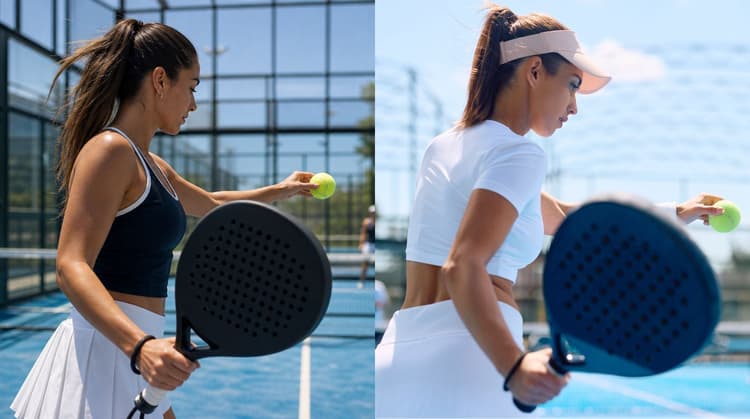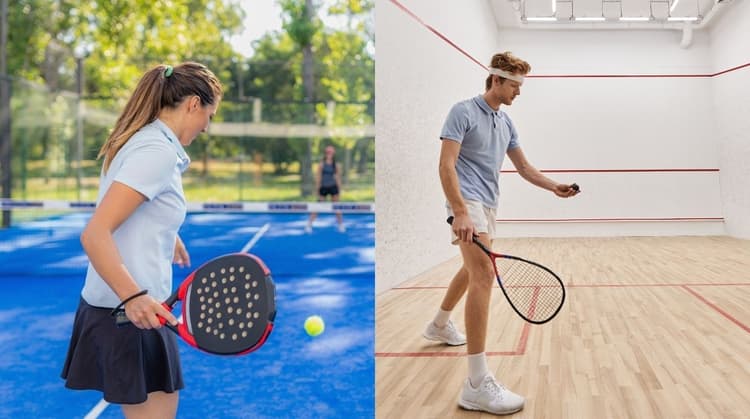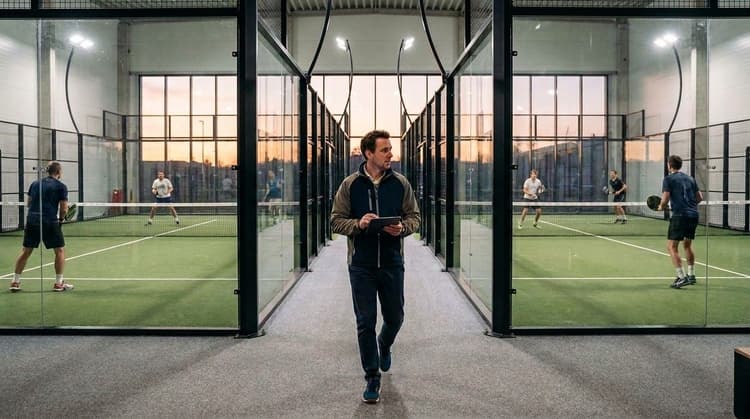
Padel looks familiar at first. Four players, a net, a ball, and a scoring system that feels close to tennis.
Then the ball hits the back glass, comes back into play, and everyone freezes.
That is where most beginners get stuck. The basic padel rules are easy enough: serve underarm, play doubles, let the ball bounce once, and score like tennis. The hard part is knowing when the walls keep the point alive and when they make the shot out.
Want a quick answer? Padel is usually played as doubles on a 20m x 10m enclosed court. The serve is underarm, must bounce first, and must land diagonally in the opposite service box. During rallies, the ball can hit the glass or fence after it bounces in the court, but if it hits the wall or fence before bouncing, the shot is out.
This guide breaks down the rules that actually matter in a real match: serving, scoring, wall play, faults, positioning, and the common mistakes that slow beginners down.
What is padel?
Padel is a doubles racket sport played on an enclosed court with glass walls and metal fencing. The court is smaller than a tennis court, but the walls change the rally pattern completely.
The official court is 10 meters wide and 20 meters long, divided by a net. The official FIP Rules of Padel list the net at 0.88 meters high in the center and up to 0.92 meters at the ends. The court also needs clear overhead space, with FIP listing a 6-meter minimum height and recommending 8 meters for new facilities.
The easiest way to think about padel: tennis scoring, enclosed-court rebounds, and doubles-first positioning. If you want a fuller breakdown of the sport before diving into the rules, the what is padel guide covers the court, equipment, and how it compares to other racket sports.
The ITF statement on padel is useful background because it shows how national tennis organizations have had to decide where padel fits within the wider racket-sport structure. For a beginner, that context matters less than this: padel uses familiar scoring, but the walls make the sport play differently from tennis.
Basic padel rules at a glance
| Rule area | What beginners need to know |
| Format | Padel is normally played as doubles |
| Court | 20m x 10m enclosed court |
| Serve | Underarm, after a bounce, diagonally into the opposite service box |
| Serve attempts | 2 serves per point |
| Return of serve | The receiver must let the serve bounce once |
| Rally bounce rule | The ball must be hit before it bounces twice |
| Wall rule | The ball can hit glass or fence after bouncing in the court |
| Scoring | 15, 30, 40, game, usually best of 3 sets |
| Set format | First team to 6 games, win by 2 |
| Tiebreak | Usually played at 6-6, first to 7 points, win by 2 |
| Common fault | Hitting the opponent’s wall before the ball bounces on their side |
Padel court rules
A regulation padel court is enclosed. The glass and fence are part of the game, not background decoration.
The court has a net, service boxes, back glass or solid walls, side glass, metal fencing, and court access points. The court lines matter most during the serve. Once the rally is live, the ball can bounce anywhere inside the opponent’s court.
For court construction and official rule reference, the official FIP Rules of Padel are the primary source. The United States Padel Association also tells new facilities to become familiar with court specifications, safety regulations, and FIP Standards of Play in its guidance for new clubs.
How scoring works in padel
Padel uses tennis-style scoring: love, 15, 30, 40, and game. Under standard advantage scoring, 40-40 is deuce. A team must win 2 consecutive points from deuce to win the game.
A set is usually won by the first team to reach 6 games with a 2-game lead. If the set reaches 6-6, a tiebreak is usually played. The tiebreak is won by the first team to reach 7 points with a 2-point lead. Matches are commonly best of 3 sets.
Advantage, Star Point, and Golden Point
The 2026 FIP rules list 3 scoring options. Most casual games use standard advantage scoring unless the club, league, or tournament announces another format.
| Scoring method | How it works |
| Advantage | Standard deuce and advantage scoring |
| Star Point | A format where deuce can progress through advantage points before a final deciding point |
| Golden Point | No-advantage scoring where one deciding point is played at deuce |
Before a match starts, confirm the format. A 40-40 point feels very different when it is regular deuce compared with Golden Point.
Padel serving rules
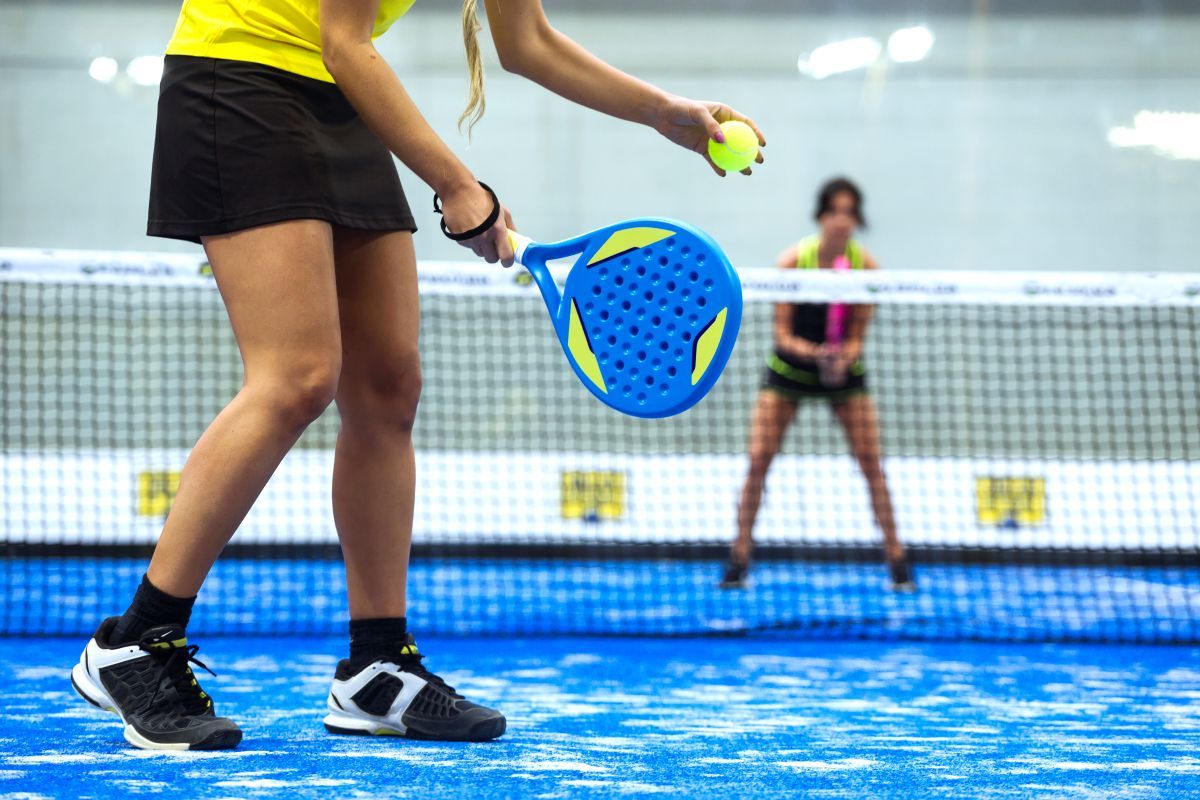
Every point starts with a serve. The serve looks simple, but beginners make the same mistakes: hitting too high, stepping over the line, or forgetting that the ball has to bounce before contact.
A legal padel serve must follow these rules:
- The server stands behind the service line.
- The ball must bounce on the ground before being hit.
- The ball must be struck at or below waist level.
- At least 1 foot must stay in contact with the ground.
- The serve must travel diagonally into the opposite service box.
- The ball must land inside the receiving service box or on its line.
- The server gets 2 attempts.
FIP rules also state that the ball is considered served when contact is made or when the player intentionally attempts to hit it. A complete miss counts as a serve attempt.
That miss rule catches new players. If you bounce the ball, swing, and miss, you do not get to pretend it was practice.
Where to serve from
The first serve of each game starts from the right side. After each point, the server alternates sides. The serve must go diagonally into the opposite service box.
The same player serves for the whole game. After that game, the serve passes to the other team.
If you want to understand how a full beginner match flows from serve to serve, the guide to getting started in padel covers what to expect in your first few sessions, including how serving and rotation actually feel in practice.
Padel return of serve rules
The receiver must let the serve bounce once before returning it. You cannot volley a serve.
After the serve bounces in the correct service box, the receiver must hit it before it bounces a second time. If the serve hits the receiver or the receiver’s racket before bouncing, the point goes to the server.
The receiver can stand anywhere on their side of the court. So can the receiver’s partner. But the receiver must follow the correct receiving order once that order is set for the set.
When is a padel serve a fault?
A serve is a fault when:
- the server breaks the serve motion rules
- the server misses the ball
- the ball lands outside the diagonal service box
- the ball hits the server, the server’s partner, or their equipment
- the ball lands in the service box and touches the metal fence before the second bounce
- the ball bounces out through an unauthorized gate or opening
The line is good on a serve. If the ball clips the correct service box line, the serve counts.
The fence rule is the one most players need to remember. On a serve, glass after the bounce is fine, fence after the bounce is a fault.
Let serves in padel
A serve is replayed if it touches the net or net post, lands in the correct service box, and does not touch the metal fence before the second bounce.
That is a let.
If the let happens on the first serve, the server repeats the first serve and still has 2 serves. If it happens on the second serve, the server repeats the second serve only.
Wall rules in padel
Wall rules are where padel starts to feel different from tennis and pickleball.
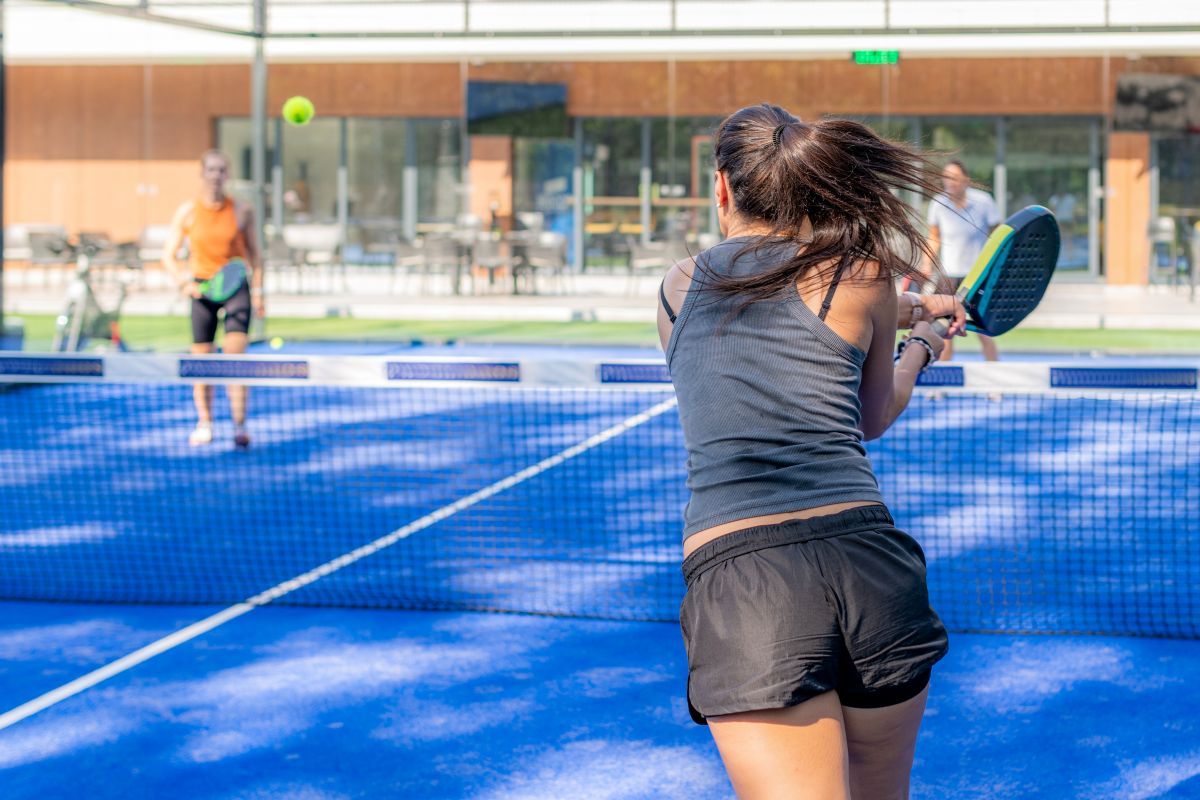
The ball must land in the opponent’s court first. Bounce before glass or fence. If your shot goes straight into the back wall, side wall, or fence, it is out.
If your shot lands in the court first, then hits the glass or fence, the point stays alive.
You can use your own glass
You can hit the ball off your own glass to send it back over the net.
Example: your opponent hits deep, the ball bounces, then hits your back glass. You can wait for the rebound and play it back.
You can also hit the ball directly into your own back glass or side glass so it rebounds over the net into the opponent’s court. That is legal as long as it eventually lands in their court.
What you cannot do is hit the ball into the opponent’s wall before it bounces on their side.
Fence rebounds are different
The metal fence creates irregular rebounds. That is part of the sport.
During a rally, a ball that bounces in the opponent’s court and then hits the fence is still in play. On a serve, that same fence contact is a fault if it happens before the second bounce.
That small difference explains a lot of arguments.
What counts as a good return?
A return is good if the ball:
- lands directly in the opponent’s court
- hits your own wall first, then lands in the opponent’s court
- bounces in the opponent’s court and then hits their wall or fence
- touches the net, then lands in the opponent’s court
- bounces in the opponent’s court and exits the court, when out-of-court play is allowed
FIP also allows certain out-of-court returns when the court has the required access and safety area. That is the clip where a player runs out the door and hits the ball back into play. It is legal only when the court setup allows it.
For beginners, do not build your game around that shot. Learn the basic glass reads first.
What makes you lose a point in padel?
You lose the point if:
- the ball bounces twice on your side
- you hit the ball twice
- both partners hit the ball consecutively
- you touch the net while the ball is live
- you hit the ball before it crosses the net
- your return hits the opponent’s wall or fence before bouncing
- the ball hits you or your partner after you strike it
- you throw your racket at the ball
- you jump over the net during the point
- you serve 2 faults in a row
- your safety cord breaks or you drop your racket during the point
That last one is easy to miss. Under the FIP rules, the racket safety cord is mandatory, and a dropped racket or broken cord during a point means the pair immediately loses the point.
A loose wrist cord is not a small equipment detail. It can cost you a point.
Player positioning in padel
Padel is normally played with 2 players per team. You and your partner can move anywhere on your side, but you need to respect the service and return order.
During the serve, the server serves diagonally, the receiver is the player diagonally across, and both partners can stand anywhere on their side. After the return, the rally is live and both players can cover the full court.
Good padel positioning is about moving as a pair. If one player gets pulled wide, the other player has to close the middle. If both players drift too far back, the other team gets control of the net.
For players who want structured reps instead of guessing through open play, Bounce helps players find coaching, lessons, and organized racket-sport sessions in their city. Padel rewards pattern recognition, and a coach can usually clean up positioning faster than another month of random matches.
Change of sides
Players change sides after the 1st, 3rd, and every following odd game in a set.
In a tiebreak, players change sides every 6 points. FIP rules also list 90 seconds for changeovers and 120 seconds between sets in match play.
In casual games, nobody is usually timing this closely. But the odd-game changeover rule still matters, especially outdoors where sun and wind can affect play.
Padel equipment rules
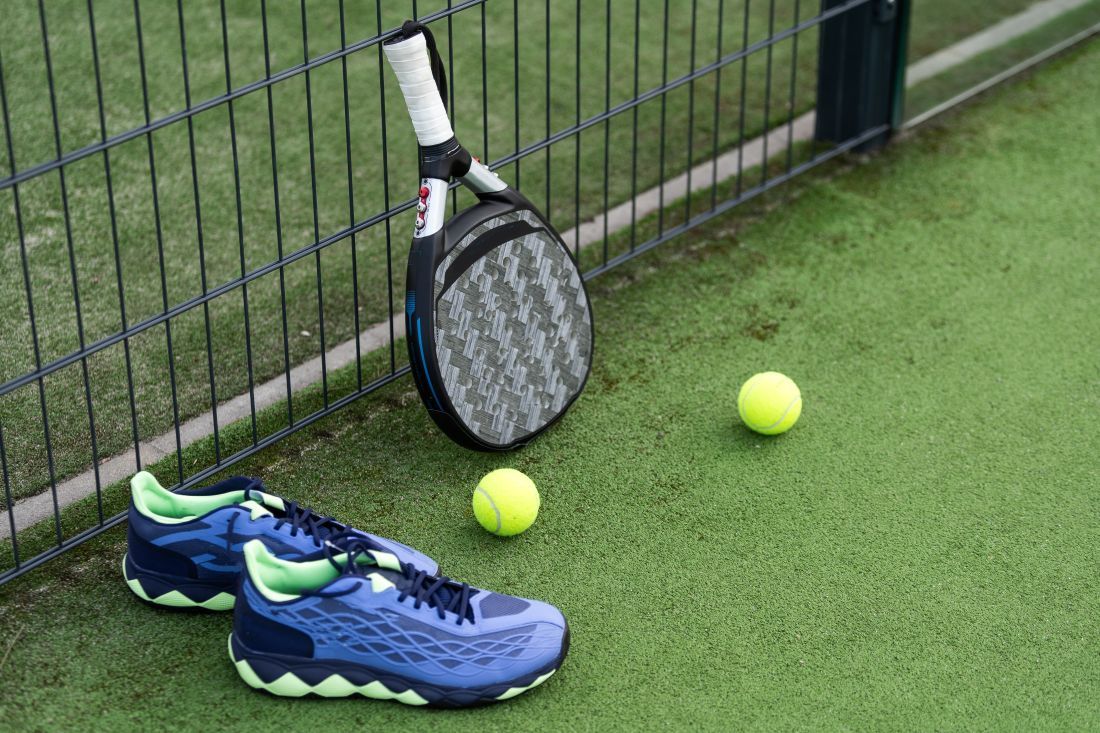
A padel racket is solid, perforated, and shorter than a tennis racket. FIP rules list a maximum total length of 45.5 cm, maximum width of 26 cm, and maximum thickness of 38 mm. The racket must also have a non-elastic wrist cord with a maximum length of 35 cm, and wearing it is required.
The ball is similar to a tennis ball but built to padel specifications. FIP lists official ball measurements and pressure requirements, including a diameter of 6.35 to 6.77 cm and weight of 56.0 to 59.4 grams.
For casual players, the takeaway is simple: use a real padel racket, wear the wrist cord, and don't assume a tennis ball will behave the same way. If you're shopping for gear before your first session, the padel equipment guide covers rackets, balls, and shoes in one place.
Padel rules vs tennis rules
| Rule | Padel | Tennis |
| Main format | Doubles | Singles or doubles |
| Court | Enclosed with walls and fence | Open court |
| Serve | Underarm after a bounce | Overhead without bounce |
| Walls | Part of live play after a bounce | No wall play |
| Scoring | Tennis-style scoring | Tennis scoring |
| Racket | Solid perforated racket | Strung racket |
| Serve return | Must bounce | Must bounce in the service box before return |
| Out-of-court play | Possible on approved courts | No standard equivalent |
Padel borrows tennis scoring, but the rally logic is wall-based. The serve starts the point. The glass shapes the point.
That's why tennis players can pick up the scoring quickly but still struggle with court position. The racket skills transfer. The rebound reads take time. For a side-by-side look at how the two sports differ in practice, the padel vs tennis comparison breaks down the key differences in rules, equipment, and court feel.
Padel rules vs pickleball rules
| Rule | Padel | Pickleball |
| Court | Enclosed 20m x 10m court | Smaller open court |
| Format | Usually doubles | Singles or doubles |
| Serve | Underarm after bounce | Underhand or drop serve |
| Scoring | Tennis-style scoring | Side-out or rally scoring, depending on format |
| Walls | In play after a bounce | No walls |
| Volley restriction | No kitchen rule | Non-volley zone limits volleys |
| Main beginner challenge | Reading rebounds | Kitchen and two-bounce rule |
Pickleball asks you to manage the non-volley zone. Padel asks you to manage depth, glass, and pair movement.
If you play both sports, the overlap is still useful. Touch, patience, and smart shot selection carry across. The differences are easier to understand once you've had a few sessions in each sport.
Common padel rules mistakes beginners make
Hitting the ball straight into the opponent’s glass
This is the most common beginner error. The ball has to land in the opponent’s court first. If it hits glass before the court, it is out.
Volleying the return of serve
The serve return must bounce. After the return, volleys are allowed.
Treating the fence like the glass on a serve
During rallies, fence rebounds can stay live after the ball bounces. On the serve, a ball that lands in the service box and hits the fence before the second bounce is a fault.
Standing too close to the glass
Beginners back up until they are trapped by the wall. That makes rebounds harder, not easier. Give yourself space to read the bounce, turn, and hit through the ball.
Forgetting the second bounce rule
You get 1 bounce. If the ball bounces twice on your side, the point is over. The wall does not reset that count.
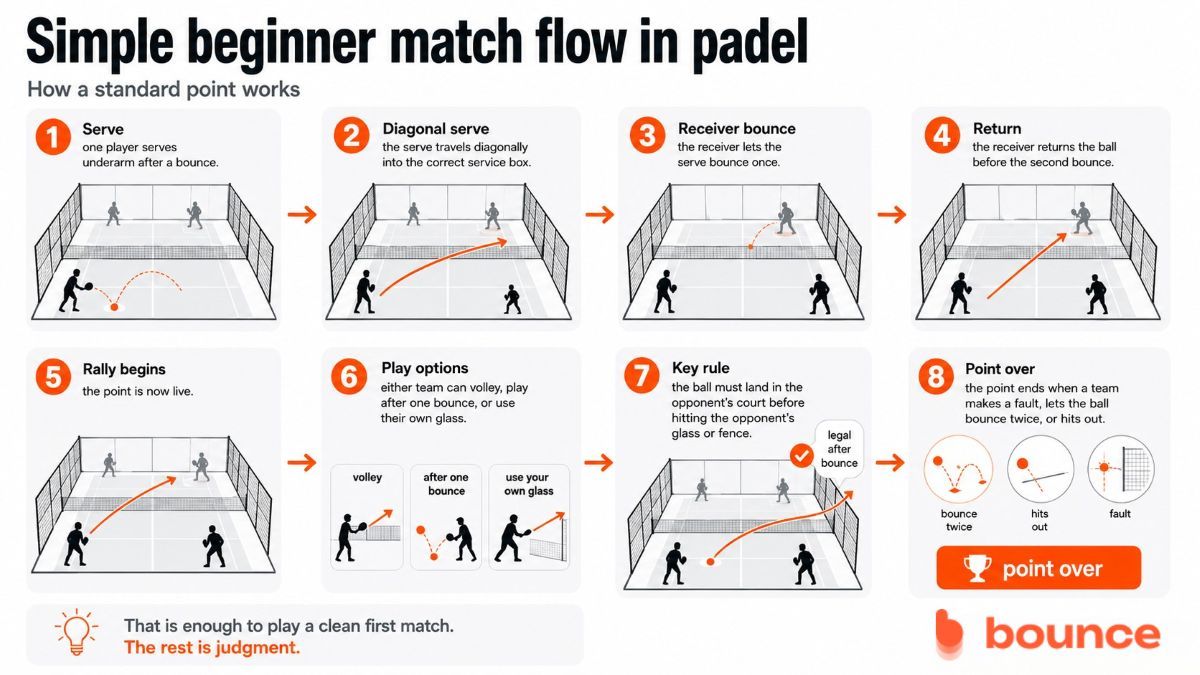
Simple beginner match flow
Here is how a standard point works:
How to learn padel rules faster
Rules make more sense when they are tied to situations. Do not memorize every edge case first. Start with the patterns that happen every game.
Focus on these 5 first:
- Serve diagonally and below the waist
- Return of serve must bounce
- One bounce only
- Opponent’s wall before bounce is out
- Your own glass can help you return the ball
Once those are automatic, start learning the finer details: let serves, fence contact, out-of-court play, tiebreak order, and scoring formats.
Players coming from tennis or pickleball usually need a few sessions to stop rushing. Padel rewards the team that controls the rebound and wins position. If you are trying to build that faster, Bounce can help you find structured coaching and organized play instead of piecing the sport together one confusing point at a time.
For U.S. tournament players, check the USPA rules and regulations before entering sanctioned events, since competition documents can add event-specific procedures on top of the core FIP rules.
Conclusion
Padel rules are easier when you treat the walls as part of the court.
The ball has to land in the opponent’s court before it hits their glass or fence. You can use your own glass to return the ball. The serve is underarm, diagonal, and hit after a bounce. Scoring mostly follows tennis.
That gets you through most points.
The next layer is positioning. Padel is a doubles game built around space, patience, and rebounds. The team that understands where the ball is going after the glass usually looks calmer, even when the rally speeds up.
For players who want to move from knowing the rules to knowing where to stand, Bounce connects players with lessons, coaches, courts, and organized racket-sport sessions in their city.
FAQs
What are the basic padel rules?
Padel is played on an enclosed court, usually as doubles. The serve is underarm, hit after a bounce, and must land diagonally in the opposite service box. During a rally, the ball must bounce in the opponent’s court before it hits their wall or fence.
Is padel scoring the same as tennis?
Yes, standard padel scoring uses 15, 30, 40, deuce, advantage, and game. Sets are usually first to 6 games with a 2-game lead, and matches are commonly best of 3 sets. Some competitions use Golden Point or Star Point scoring instead of standard advantage scoring.
Can you use the walls in padel?
Yes. You can let the ball bounce, hit your glass, and then return it. You can also hit the ball off your own glass so it travels into the opponent’s court. Your shot must land in the opponent’s court before it touches their wall or fence.
Can you volley in padel?
Yes, volleys are allowed during rallies. The main exception is the return of serve. The receiver must let the serve bounce once before hitting it.
How many serves do you get in padel?
You get 2 serves. If the first serve is a fault, you get a second serve. If the second serve is also a fault, the point goes to the receiving team.
What happens if a padel serve hits the net?
If the serve touches the net or post, lands in the correct service box, and does not touch the metal fence before the second bounce, it is a let and the serve is replayed. If it clips the net and then lands out or hits the fence first, it is a fault.
Is padel played as singles or doubles?
Padel is normally played as doubles. Singles versions exist in some places, but standard padel rules, courts, and competitive formats are built around 2 players per team.
Can the ball hit the fence in padel?
During a rally, yes, if it bounces in the court first. On a serve, a ball that lands in the service box and then hits the metal fence before the second bounce is a fault.
Do you have to wear the racket wrist cord in padel?
Yes, under FIP rules the racket must have a non-elastic safety cord, and wearing it is required. If a player drops the racket or the cord breaks during a point, that pair loses the point.