Try booking an outdoor pickleball court in New York City or Los Angeles on a weekday evening. Both cities are 98% below the national average for dedicated courts per 10,000 people, according to SFIA and Pickleheads infrastructure research.
That is the detail the growth headlines usually miss. Pickleball added 4.5 million U.S. players between 2024 and 2025. It has been named the fastest-growing U.S. sport for four consecutive years. More than 70% of U.S. courts are still temporary setups on borrowed surfaces that can disappear when another sport books the slot.
Pickleball is growing faster than the systems built to support it. Player demand is rising, but court access, organized formats, coaching availability, and city-level planning are still catching up. That gap is the real story behind the numbers.
Quick Answer
Want the short version? Pickleball is still growing fast, and the story now reaches far beyond player count. The sport is younger, more global, more commercial, and more constrained by court supply than the headline numbers suggest.
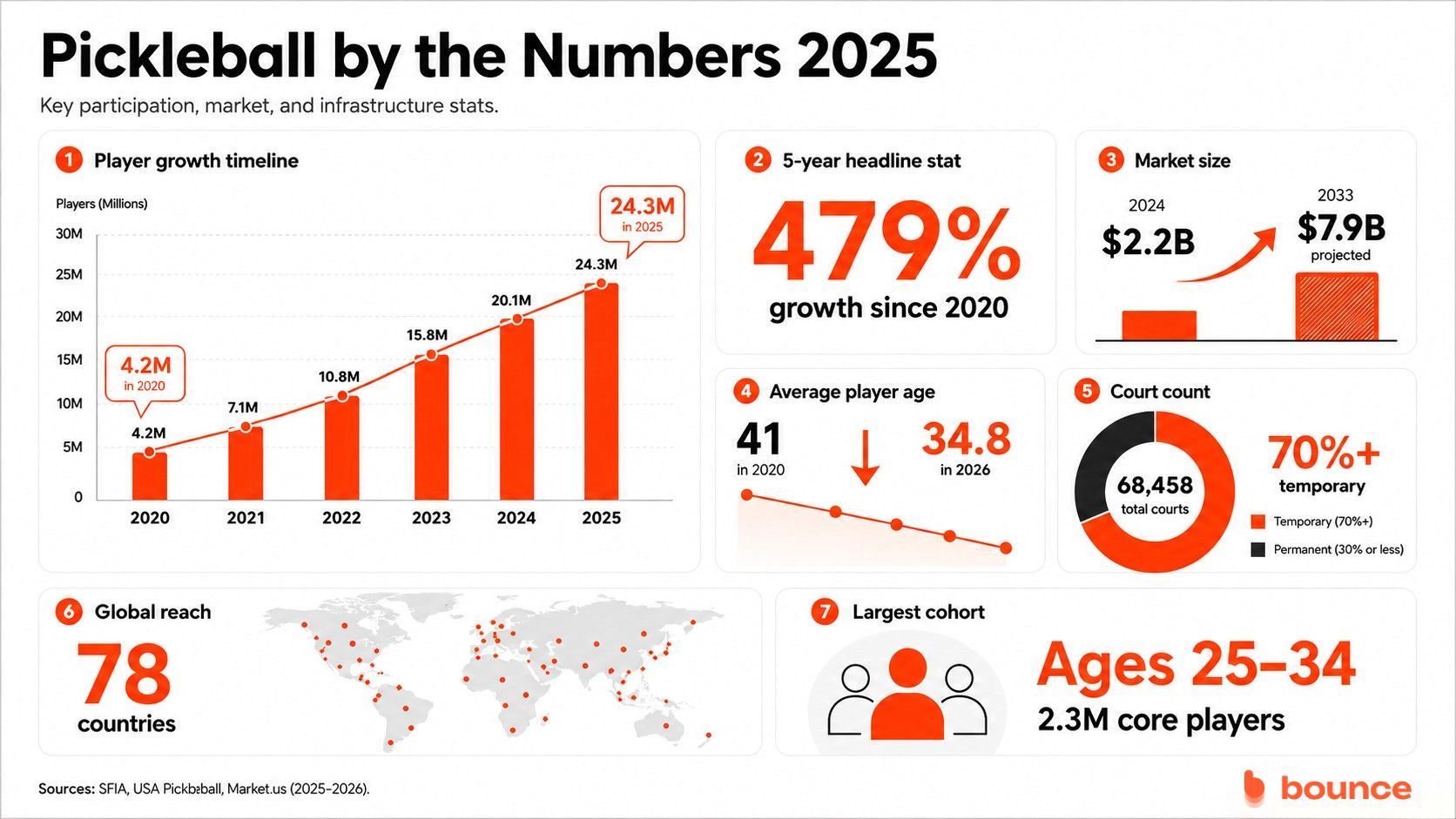
- 24.3 million U.S. players played pickleball in 2025.
- U.S. participation grew 479% in 5 years, from 4.2 million in 2020 to 24.3 million in 2025.
- SFIA estimated the sport needs 25,000 new dedicated courts and roughly $900 million in investment.
- The average player is now 34.8 years old, down from 41 in 2020.
- Asia is showing huge participation signals, including 282 million monthly players across 12 territories in UPA Asia and YouGov research.
- The biggest growth question now is capacity: courts, coaches, leagues, ratings, and local programming.
Pickleball growth by the numbers
The trajectory matters more than the single-year figure.
Pickleball had 4.2 million U.S. players in 2020. By 2022, that was 8.9 million. By 2023, it hit 13.6 million. The 2024 count reached 19.8 million, and the 2025 count landed at 24.3 million, a gain of 4.5 million players in 1 year. SFIA puts the 5-year total at 479% growth and the 3-year rate at 171.8%.
Year-over-year growth from 2024 to 2025 came in at 22.8%. That is lower than the 2022 to 2023 spike, which makes sense as the base expands. A sport growing 22.8% on nearly 20 million players is still adding more people in a year than many racket sports have in total.
Search demand points the same way. Glimpse estimates pickleball search interest at roughly 8.4 million U.S. searches per month, up 42% over the past year. Search data is not participation data, but it shows the same mainstream pull: people are looking for courts, rules, lessons, equipment, and local play.
The market has followed. Market.us valued the global pickleball market at $2.2 billion in 2024 and projected it to reach $7.9 billion by 2033 at a 15.3% CAGR. Equipment has its own track: GM Insights estimated the pickleball equipment market at $480.6 million in 2025, with paddles accounting for a large share of revenue.
The useful question is what those numbers mean for someone trying to play this week. Growth creates opportunity. It also creates crowded courts, uneven skill matching, long waitlists, and a bigger need for organized local systems.
US player participation by year
| Year | Players | YoY growth | Source |
| 2020 | 4.2 million | — | SFIA |
| 2022 | 8.9 million | +112% | SFIA |
| 2023 | 13.6 million | +52.8% | SFIA |
| 2024 | 19.8 million | +45.6% | SFIA |
| 2025 | 24.3 million | +22.8% | SFIA |
Who is driving pickleball's growth
The average pickleball player is 34.8 years old. In 2020, that number was 41. In 2021, it was still 38. The demographic center has shifted an entire generation in 5 years.
Players aged 25 to 34 are now the largest single cohort, at approximately 2.3 million core players. The 18 to 24 bracket makes up 18% of frequent monthly players, according to the APP participation report. SFIA also reported that every age group saw participation growth in 2023, the third straight year that happened.
That changes what the sport needs to deliver. Younger players are used to finding everything on demand. They expect to find a rated game this week, book a lesson with a certified coach, and understand how their skill level compares with other players nearby.
Rating systems like DUPR and VAIR are part of that shift. Players want objective match data, not a vague sense that they are “intermediate.” For a deeper breakdown, this guide to pickleball ratings explains how rating systems shape leagues, tournaments, and skill-based play.
Growth is easier to understand once you feel it locally. Bounce helps players find certified coaches, leagues, rated play, and organized formats near them.
The gender split sits at 57% male and 43% female, narrower than many competitive sports. The South Atlantic region added 2.8 million players in 2023 alone, a 50% year-over-year increase, according to SFIA. The growth is national, with strong signals far beyond the largest coastal metros.
Pickleball global expansion: 78 countries and counting
The U.S. gets most of the headlines. The international numbers are harder to ignore.
The history of pickleball starts in a backyard on Bainbridge Island, Washington in 1965. Sixty years later, the sport has active national organizations, tournaments, coaching programs, and participation data across multiple regions.
DUPR reported that the top 5 countries by player count are the United States, Canada, Australia, the United Kingdom, and Malaysia.
Asia is the most aggressive growth signal. A 2025 UPA Asia and YouGov study reported that about 812 million people across 12 Asian territories had played pickleball at least once, with 282 million playing at least once a month.
These figures use broader participation methodology than SFIA. Even with that caveat, they point to mass awareness and trial across large markets.
Global growth creates a different kind of pressure. A recreational boom needs courts. An international sport needs ratings that travel, coach education that scales, and competition formats that make sense across countries.
That is why governance matters. The sport is still sorting out the structure needed for Olympic recognition and consistent international play.
Top countries by pickleball participation
| # | Country | Notable context |
| 1 | United States | 24.3M players (2025); 68,458 courts |
| 2 | Canada | 1.54M players; up 57% since 2022 |
| 3 | Australia | PAA membership doubled in 12 months |
| 4 | United Kingdom | EPF member; growing club network |
| 5 | Malaysia | Top 5 by DUPR global player data |
The pickleball court shortage behind the growth numbers
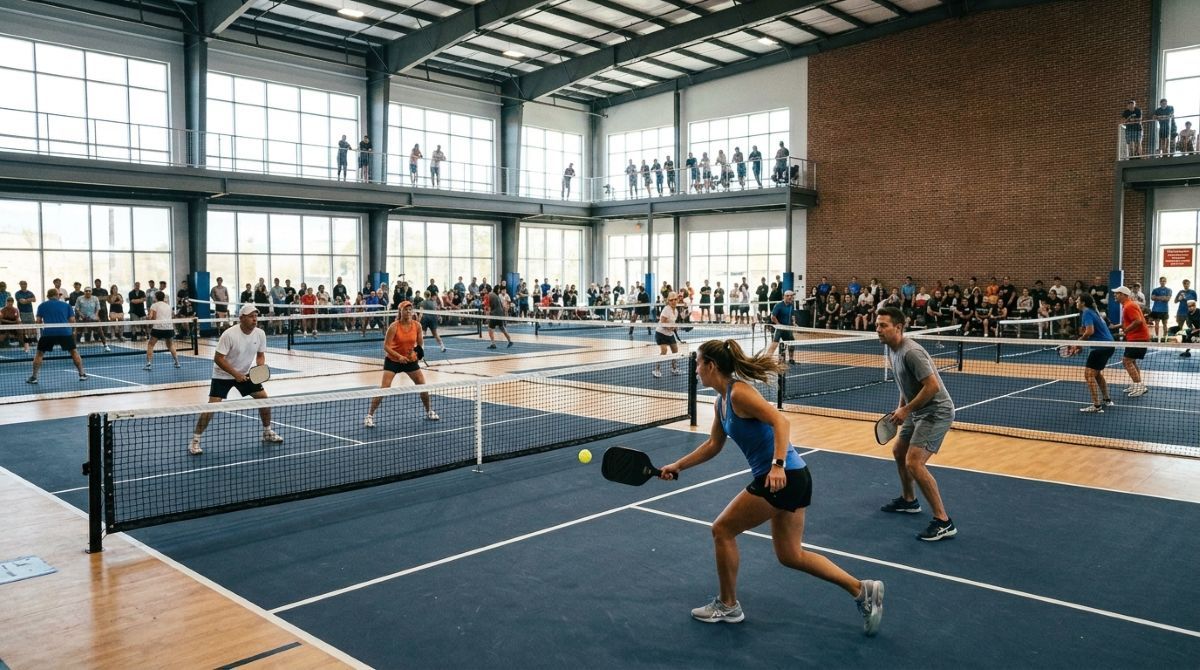
The USA Pickleball Annual Growth Report cites 68,458 pickleball courts in the U.S. That number sounds large until you put it next to participation.
Over 70% of those courts are temporary: painted lines on tennis courts, shared gym surfaces, converted parking lots, or mixed-use spaces. They help access, but they do not behave like dedicated capacity. They vanish when the primary user books the space.
SFIA infrastructure research estimated that 25,000 new dedicated courts and roughly $900 million in investment are needed to keep up with current demand. Dedicated facilities grew 55% year-over-year in 2024, according to SFIA. That is meaningful. It still trails the player curve.
New York and Los Angeles make the problem obvious. Both are 98% below the national average for dedicated courts per 10,000 people. The cities with the most potential players can have the worst court-to-player ratios.
Court dimensions explain why the shortage is frustrating. A regulation pickleball court is 44 by 20 feet. Four pickleball courts can fit in the footprint of a single tennis court. The court layout is compact. The barrier is usually space access, permitting, facility operations, and money.
This is the honest tension in the growth story. Millions of players are looking for games, while many local systems still depend on temporary lines, crowded rotations, and one-size-fits-all open play.
When court demand gets messy, structure matters. Bounce helps players find courts, coaches, leagues, and organized play formats that fit their week.
What $225 million in pickleball investment actually means
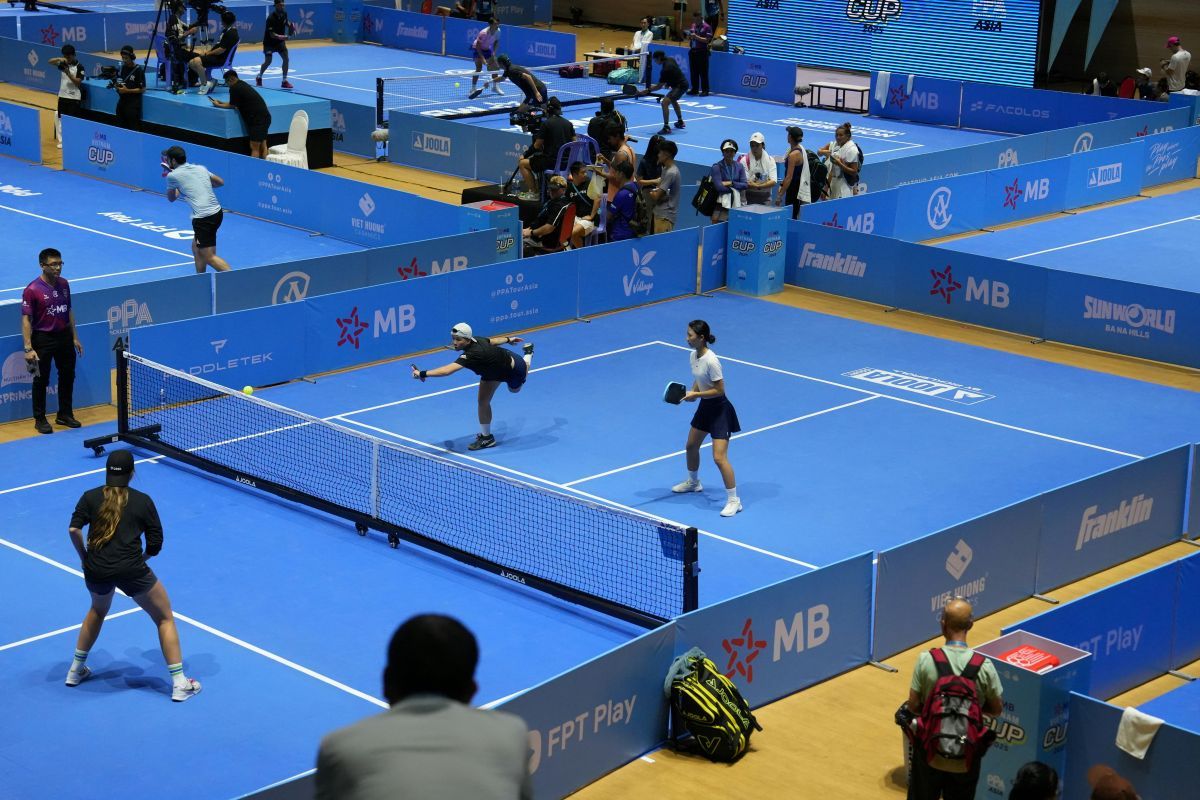
The professional side of pickleball has become serious fast.
The Association of Pickleball Professionals secured TV deals with CBS Sports and ESPN, including 12 hours of live coverage on CBS Sports Network, recap coverage on ESPN2, and more than 200 hours of streaming across ESPN+ and APP TV.
Major League Pickleball added celebrity and athlete investors, including LeBron James, Tom Brady, Kim Clijsters, Draymond Green, Kevin Love, Drew Brees, and James Blake. Celebrity money is a visibility signal. Capital follows attention, and pickleball has enough attention to draw serious buyers.
In May 2026, Apollo Sports Capital and Dundon Capital Partners backed Pickleball Inc. with a $225 million investment, reported as the largest investment in the sport’s history. USA Pickleball also reported 62,260 registered members in its 2024 Annual Growth Report, giving the organized competitive ecosystem a measurable base.
The question is whether professional investment reaches the recreational player. TV deals build audiences. Celebrity ownership creates attention. Capital can help with media, events, software, equipment, and facilities. The local test is simpler: does it make it easier for regular players to find a court, a coach, or a competitive match after work?
For players trying to move from recreational games into stronger formats, the gap is real. The players closing it are the same younger adults pushing growth: they want coaching, ratings, better matches, and organized play that does not depend on knowing the right person at the park.
Conclusion
Pickleball growth is real, sustained, and increasingly global. The SFIA numbers, court-demand estimates, Asian participation research, and new investment all point in the same direction: pickleball has moved past the novelty stage.
The next pressure point is capacity. Courts, coaching supply, rated formats, leagues, clinics, and local programming have to catch up with a player base that already expects structure.
That is where the sport gets harder to build. A viral participation curve can happen quickly. Reliable courts, trained coaches, fair ratings, and organized weekly play take more work.
For players building that kind of structured game in their city, Bounce helps you find certified coaches, courts, leagues, and organized play without waiting for the local system to figure itself out.
Frequently asked questions
How many people play pickleball worldwide?
Estimates depend on methodology. The U.S. had 24.3 million players in 2025 per SFIA. In Asia, UPA Asia and YouGov estimated 282 million monthly active players across 12 territories, though that count uses broader participation criteria than the U.S. figures.
What is the fastest-growing age group in pickleball?
The 25 to 34 age group is now the largest cohort, at approximately 2.3 million core U.S. players. The 18 to 24 bracket has become one of the most important growth signals, making up 18% of frequent monthly players in the APP participation data.
How many pickleball courts are there in the U.S.?
USA Pickleball cited 68,458 courts in its 2024 Annual Growth Report, based on the Pickleheads database. More than 70% are temporary or shared-use courts rather than dedicated pickleball facilities.
Which countries have the most pickleball players outside the U.S.?
Canada, Australia, the United Kingdom, and Malaysia follow the United States in DUPR global player data. Asia is the fastest-rising participation story because awareness and trial have jumped quickly across several large markets.
Is pickleball's growth slowing down?
The percentage growth rate is moderating because the base is larger. Growth from 2024 to 2025 was 22.8%, down from the 2022 to 2023 spike. On a base of nearly 20 million players, 22.8% still adds millions of participants in 1 year.
Could pickleball become an Olympic sport?
It could, but Olympic recognition requires more than popularity. Pickleball needs wider national federation adoption, stable governance, international competition standards, and a clear global pathway. Those pieces are developing, and governance will matter as much as participation.