Platform tennis players can let the ball hit the back fence and still win the point. Pickleball players stand inside a zone where they cannot even touch the ball in the air. These sports are built around completely different ideas of what a rally should be.
If you are trying to choose between them, or you already play one and want to understand the other, the comparison goes deeper than court dimensions and equipment.
Quick answer: Platform tennis uses tennis scoring, a raised heated court with 12-foot wire screens, and overhand serves. It is a winter-ready doubles sport built for strategy and patience.
Pickleball usually uses side-out scoring to 11, win by 2. It is played on a flat hardcourt with a 7-foot non-volley zone and underhand serves. It is faster to learn, easier to find in most cities, and better suited for year-round public play.
The courts: same dimensions, completely different game
Both courts measure 44 feet long by 20 feet wide with a net at 34 inches in the center. That is where the similarity ends.
The American Platform Tennis Association’s official rules define the court as 44 feet long by 20 feet wide, enclosed by 12-foot screens, which is why screen play is built into the sport rather than treated as an out-of-bounds accident.
Those screens are active playing surfaces. A ball that lands in bounds and bounces into the screens can still be played. Shots that would be clean winners in pickleball become extended rallies in platform tennis.
Pickleball uses a flat hardcourt with no fencing. It can be played indoors or outdoors. USA Pickleball court specifications place the court at 20 feet by 44 feet, with the non-volley zone extending 7 feet from the net on both sides.
This one design choice created the dinking game, the kitchen line battle, and most of what makes pickleball strategy interesting at the 3.0 level and above.
| Feature | Platform Tennis | Pickleball |
| Court dimensions | 44' x 20' | 44' x 20' |
| Surface | Raised aluminum deck, grit texture | Flat hardcourt, usually asphalt or concrete |
| Net height at center | 34" | 34" |
| Wire screens | Yes, active in play | No |
| Non-volley zone | None | 7 ft from net on both sides |
| Indoor option | No | Yes |
| Heated for winter | Yes | No |
For more on pickleball court specs and layout, see how pickleball courts compare with tennis courts.
Equipment: paddles, balls, and what the weight difference actually means
The specs are worth knowing, but the feel is what tells you which sport suits your game.
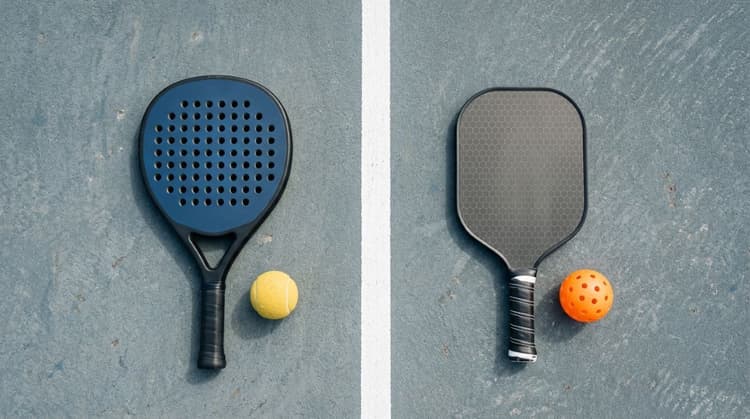
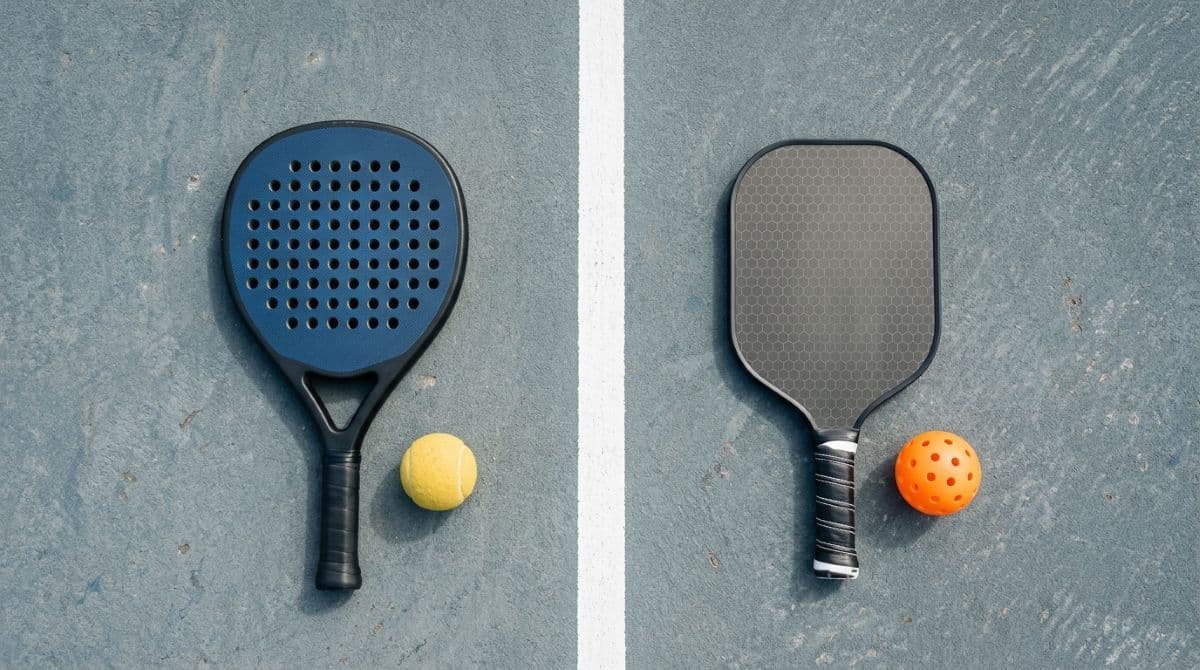
Paddles: Platform tennis paddles max out at 18 inches, with a solid perforated face. The holes reduce wind resistance in cold outdoor conditions and add spin bite at contact. The construction is heavier composite or graphite with a foam core.
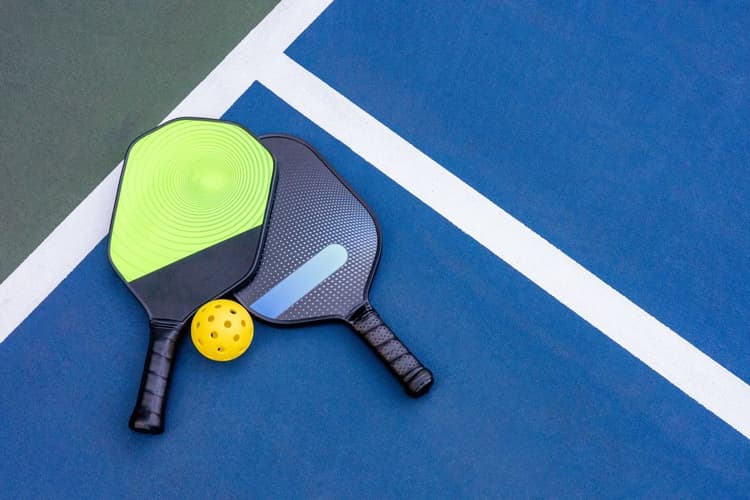
Pickleball paddles have a maximum 17-inch hitting surface, are lighter overall, and use a carbon fiber or graphite face over a polypropylene honeycomb core. Pickleball paddles can use textured surfaces, but they must stay within USA Pickleball equipment limits, which keeps spin production more regulated than platform tennis.
Balls: Platform tennis uses a dense rubber ball with flocking that must meet APTA ball performance standards, including a 2.4- to 2.5-inch diameter and 2.4- to 2.7-ounce weight.
Its density is exactly why screen play works: the ball does not die on contact with wire. Pickleball uses a perforated plastic ball, hollow and lighter, that bounces predictably on flat courts. Outdoors, wind affects it more.
The practical consequence: a heavier paddle plus a denser ball means platform tennis groundstrokes require more arm and body involvement, closer to full tennis mechanics. Pickleball's lighter setup rewards wrist speed and compact hand exchanges, the kind of quick controlled strikes that win points at the kitchen line.
Platform tennis players often wear gloves for warmth and grip in cold weather. Pickleball has no equivalent.
Finding the right equipment setup depends on your current game and how you play. Bounce coaches can help connect gear choices with technique, especially if you are moving between tennis, platform tennis, and pickleball.
Serving rules: the first thing that trips players up
The serve tells you everything about the strategic personality of each sport.
Platform tennis serve: Players get one serve only, no second serve in standard play. The serve can be overhand or underhand, though overhand is standard. There is no let rule: if the ball clips the net cord and lands in, it is live. The ball must land in the diagonal service box, and screens cannot be used on the serve.
Pickleball serve: The serve must be underhand, with contact below the waist and the paddle arm moving upward at contact. It goes diagonally into the opposite service box and must clear the kitchen without landing in it. The two-bounce rule applies: the return must bounce once before the serving team can volley, which forces both teams to the baseline at the start of every point.
The one-serve format in platform tennis creates immediate pressure. Players go for safe, well-placed serves over power because there is no backup. The underhand pickleball serve removes ace potential almost entirely. Serves are how rallies start, rather than how points end.
Scoring: why the number on the board changes how you play
Platform tennis uses standard tennis scoring: love, 15, 30, 40, deuce. Win 6 games to win a set; win 2 sets to win the match. Anyone with a tennis background adapts immediately.
Pickleball usually uses side-out scoring to 11, win by 2. USA Pickleball’s rules summary states that points are scored only by the serving team in traditional play. Rally scoring has been provisionally approved as an option in some formats, but it should not be treated as the default version of the game.
In doubles, the score is called as three numbers: serving team score, receiving team score, server number. "4-2-2" means the serving team has 4 points, the receiving team has 2, and it is the second server’s turn. Singles uses a two-number call only.
The rhythm difference matters more than it sounds. Tennis scoring creates momentum swings: a player can recover from 0-40 down and change the feel of a set. Side-out scoring rewards patience because the receiving team has to win back the serve before it can add points.
For a full breakdown of pickleball scoring and the three-number system, the pickleball terms glossary covers it in plain language.
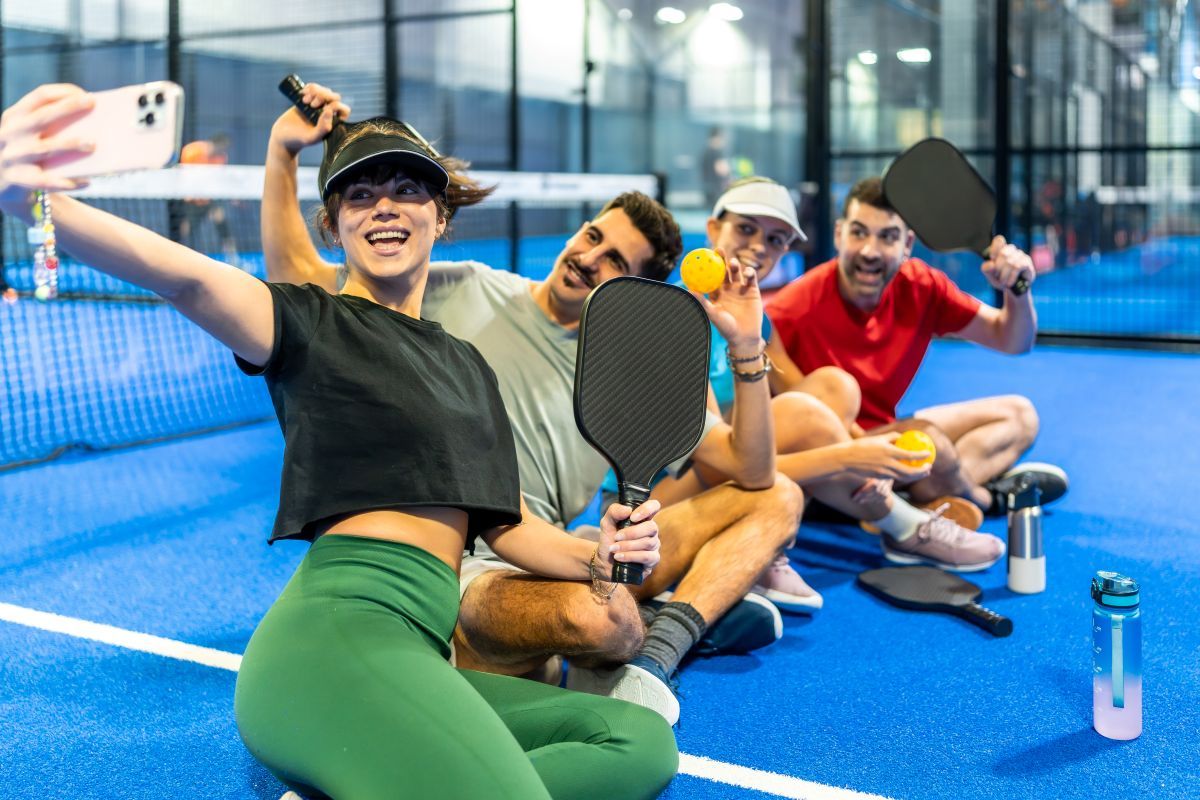
Gameplay and strategy: where the real difference lives
Here is what each sport actually feels like to play.
Platform tennis on the court
Points are long. Heavy lob usage is standard tactical play, rather than defensive scrambling. Driving the ball deep and pushing opponents back toward the screens is a core pattern at any skill level.
Screen play is the skill ceiling of platform tennis. Retrieving a ball off the back screens and redirecting it cross-court is a practiced skill that rewards positioning and anticipation over pure athleticism. Angles are compressed on a small, enclosed court, so the player who understands the geometry wins more than the player who hits harder.
Platform tennis is exclusively doubles. Partner coordination decides who takes the screen ball, who holds the net, and when to switch. Because it is played outdoors in cold weather, the post-match warmth and socializing are part of the tradition.
Pickleball on the court
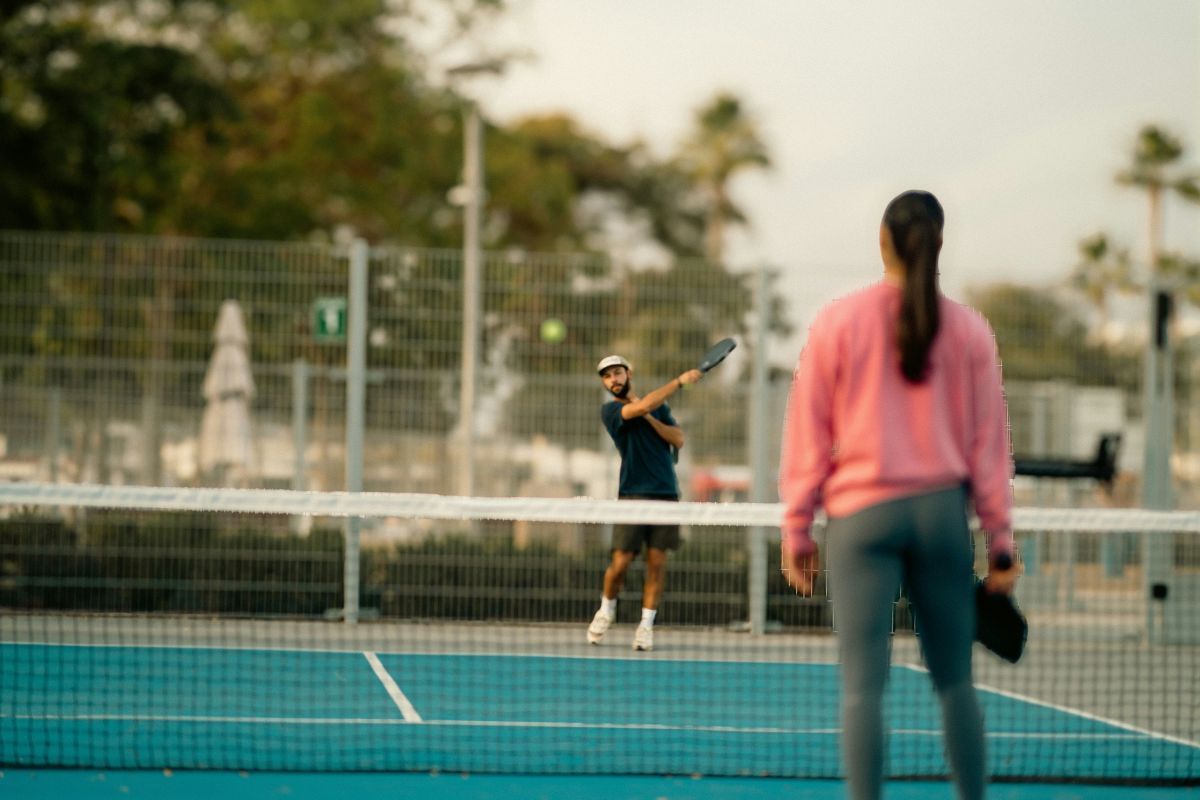
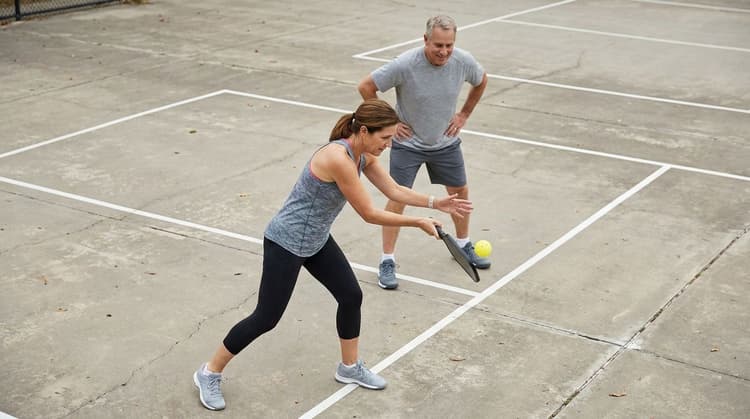
Rallies vary sharply by skill level. Beginners play long groundstroke exchanges from the baseline. Players above 3.5 are primarily at the net, dinking: placing the ball softly into the kitchen to force an error or create a ball to attack.
At that level, controlling the kitchen line and winning the dink exchange is what separates players.
The game is faster than platform tennis at competent levels. Quick hands, compact swings, rapid reactions at the net. The strategic depth is real: patient soft-game play beats power at every level above recreational.
For a closer look at how the dinking game works, Pickleball Dink: Beginner Guide to Mastering the Soft Game covers the mechanics and when to use them.
Skill transfer between sports
| Coming from | Transfers well | Needs rewiring |
| Tennis to platform tennis | Serve motion, scoring, most strokes | Smaller court, screen awareness |
| Tennis to pickleball | Net play instincts, court sense | Serve mechanics, kitchen rule |
| Platform tennis to pickleball | Soft hands, net touch, placement | Scoring, screen instinct, underhand serve |
| Pickleball to platform tennis | Shot placement, dinking touch | Scoring, screen play, overhand serve |
Who plays each sport and where you'll find courts
Platform tennis is concentrated in the Northeast and Midwest. Connecticut, New Jersey, Illinois, and Michigan are strongholds. It skews toward adult players with tennis backgrounds, and the culture is heavily club-based.
Courts are rare outside private clubs, country clubs, and cold-weather racket facilities. The season runs October through March in most regions.
Pickleball’s reach is much larger. SFIA’s pickleball participation reporting put the sport at 24.3 million U.S. players in 2025, with 171.8% growth from 2022 to 2025. Courts now show up in public parks, rec centers, YMCAs, schools, and dedicated indoor facilities.
The strongest demographic is still older adults, but younger players are joining through urban courts and social leagues at a pace that has changed the sport’s composition.
Geography often decides the question before you do. If you are in suburban Connecticut in January, platform tennis is accessible and has an active community. If you are in Austin or Phoenix, pickleball courts may exist within minutes, and platform tennis courts may not exist within 50 miles.
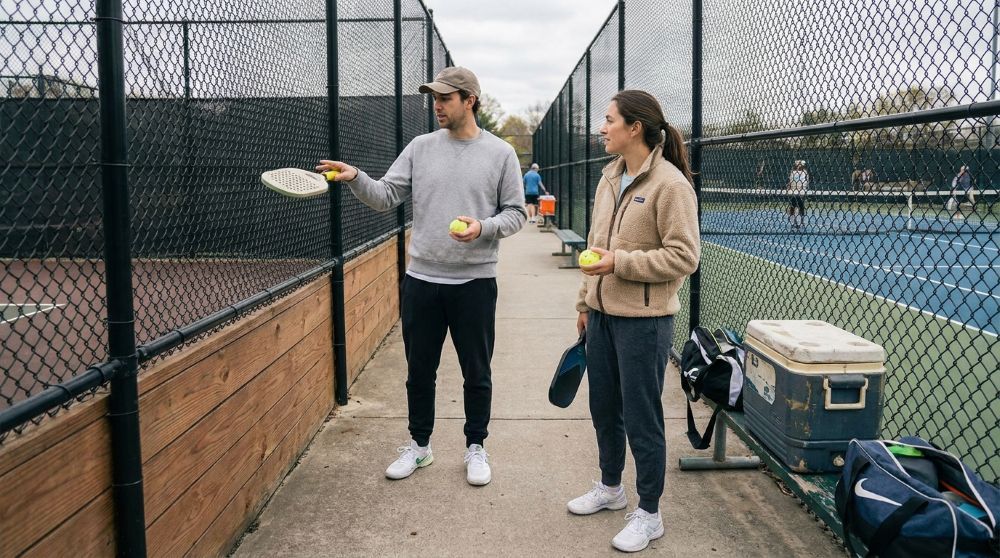
Which sport is right for you
| If this describes you | Play this |
| You already play tennis and want a winter outdoor alternative | Platform tennis |
| You live in the Northeast or Midwest with club access | Platform tennis |
| You are starting from scratch with no racket sport background | Pickleball |
| You want the largest community and easiest court access | Pickleball |
| You prefer strategic, patient rallies over fast hand exchanges | Platform tennis |
| You want to play and compete year-round, indoors or out | Pickleball |
| You love doubles partnership play and wire screen creativity | Platform tennis |
| You want structured coaching and organized leagues in your city | Pickleball |
Plenty of players in cold-weather regions play platform tennis in winter and pickleball from spring through fall. The skills transfer in both directions, and the sports fill different parts of the calendar rather than competing for the same slot.
If coaching or organized play is part of the decision, Bounce can help you compare local options by sport, city, and format.
Conclusion
Platform tennis and pickleball share the same court dimensions, but they reward different kinds of players.
Platform tennis is the better fit if you already have a tennis background, live in a cold-weather region with club access, and like long doubles rallies built around screens, lobs, and patient point construction.
Pickleball is the better fit if you want easier court access, a faster learning curve, and more year-round ways to play. The smaller public-court footprint, underhand serve, and kitchen line make it more approachable for new players while still giving advanced players plenty to work on.
If your region supports both, play both. Platform tennis sharpens patience, positioning, and doubles instincts. Pickleball rewards touch, compact swings, and quick decision-making at the kitchen line.
For players building their game through structured coaching and organized play, Bounce connects you with certified coaches and competitive formats in your city, whether you’re picking up a pickleball paddle for the first time or looking for a platform tennis ladder to join.