The first pickleball score call that makes new players fake confidence is 0-0-2.
A side out in pickleball is the reason that score exists. The "2" tells you the opening team is already on its last server. Lose that rally, and the serve goes straight to the other team.
Want a quick answer? A side out in pickleball happens when the serving side loses the right to keep serving. In singles, that happens after the server loses a rally. In doubles, it happens after server 2 loses a rally, except at the start of the game when the opening team begins at 0-0-2.
This guide covers side outs in singles and doubles, why 0-0-2 exists, how to call the score, which faults cause side outs, and how side-out scoring compares with rally scoring under current USA Pickleball guidance.
What a side out means
A side out is a change of serve.
Under traditional side-out scoring, only the serving side can score. USA Pickleball's official side-out scoring explainer says a singles point is awarded only to the server and doubles points are scored only on the serve.
So the receiving side has a clear job: win the rally and take over the serve. The score stays the same when the receiving side forces a side out under traditional scoring.
In doubles, the server number controls what happens next. If server 1 loses the rally, the serve passes to that player's partner. If server 2 loses the rally, the service turn ends and the other team serves.
How side outs work in singles
In singles, the side out is immediate. One player serves until they lose a rally. The opponent then serves.
Court position follows the server's score. When your score is even, you serve from the right side. When your score is odd, you serve from the left. USA Pickleball's side-out singles guidance uses that same even-right, odd-left pattern.
This is why singles scoring feels cleaner than doubles scoring. There is one server and one receiver. Lose the rally while serving, and the ball changes hands.
How side outs work in doubles
Doubles is where the rule starts to trip people up.
Each team gets two servers per service turn. Server 1 serves until the serving team loses a rally. Then server 2 serves. When server 2 loses a rally, the side out happens.
The player on the right side of the receiving team's court becomes server 1 for the next service turn. Their partner becomes server 2. The server number lasts for that service turn only, so a player does not carry "server 1" or "server 2" all game.
If you are still getting comfortable with pickleball doubles rules, this two-server rhythm is the part to drill first. Everything else gets cleaner after that.
| Situation | What happens | Score change under traditional side-out scoring |
| Singles server loses rally | Side out. Opponent serves. | Score stays the same. |
| Doubles server 1 loses rally | Partner becomes server 2. | Score stays the same. |
| Doubles server 2 loses rally | Side out. Other team serves. | Score stays the same. |
| Opening server loses at 0-0-2 | Immediate side out. Other team serves. | Score stays the same. |
Why doubles games start at 0-0-2
The opening score in doubles is 0-0-2. The first 0 is the serving team's score. The second 0 is the receiving team's score. The 2 means the opening server is treated as server 2.
That rule balances the first service turn. In a normal doubles service turn, each team gets two servers. At the start of the game, the opening team gets one server. When that player loses the rally, the serve transfers.
USA Pickleball calls this the first server exception. After that opening side out, every service turn follows the normal two-server pattern.
The practical effect is simple: the first serving team starts with a short turn. Make the serve and third shot count.
How to call the score after a side out
Before every serve, call the score.
In singles, use two numbers: server score, then receiver score. In doubles, use three numbers: serving team score, receiving team score, then server number.
USA Pickleball's side-out scoring page lists the doubles score sequence as server score, receiver score, and server number. That third number is either 1 or 2.
Here are the score calls new players need most:
| Score call | What it means | What happens next |
| 0-0-2 | Opening server at the start of the game. | If the serving side loses the rally, side out. |
| 5-3-1 | Serving team has 5, receiving team has 3, and server 1 is serving. | If the serving side loses the rally, the partner becomes server 2. |
| 5-3-2 | Serving team has 5, receiving team has 3, and server 2 is serving. | If the serving side loses the rally, side out. |
| 3-5-1 | New serving team has 3, opponent has 5, and server 1 is serving. | The service turn starts from the right side. |
Score confusion costs points because players stop checking position. Take 5 seconds before the serve. Confirm the score and server number before you play.
If score-calling keeps breaking down in casual games, a Bounce clinic gives you repeated, organized reps with a coach watching the habit. It is a small fix that saves a lot of dead-ball arguments.
Quick side out examples you can use on court
The fastest way to learn side outs is to map them to score calls.
| Example | Rally result | Correct next step |
| Singles score is 4-2 | Server loses the rally. | Side out. Opponent serves at 2-4. |
| Doubles score is 5-3-1 | Server 1 loses the rally. | Score stays 5-3. Partner serves as server 2. |
| Doubles score is 5-3-2 | Server 2 loses the rally. | Side out. Other team serves at 3-5-1. |
| Opening score is 0-0-2 | Opening server loses the rally. | Side out. Other team starts its first service turn. |
Those examples are enough to survive most beginner confusion. The rest is repetition.
Common faults that lead to a side out
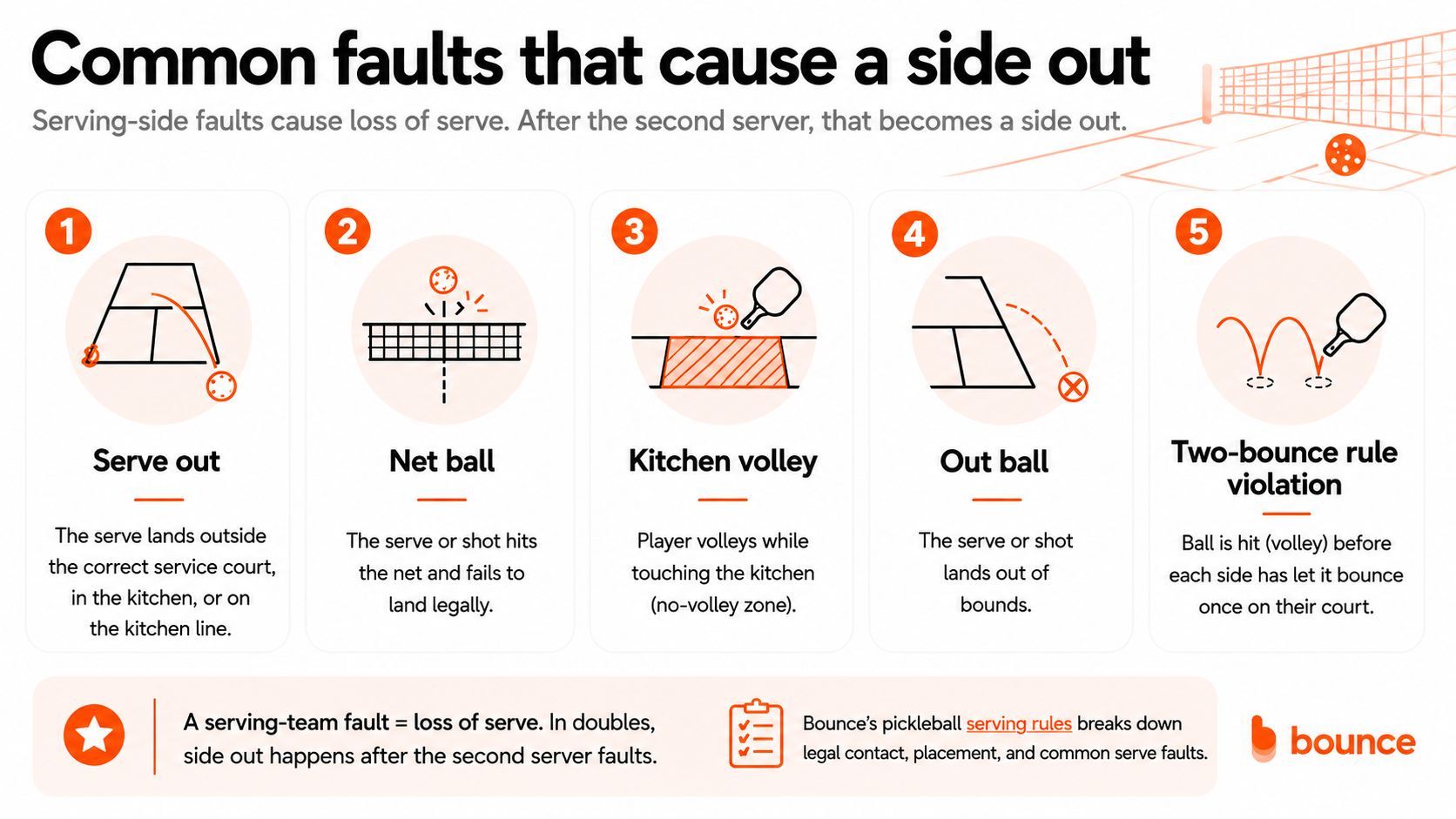
A side out starts with a fault by the serving side.
USA Pickleball's rules summary defines a fault as an action that stops play because of a rule violation. A receiving-team fault gives the serving team a point. A serving-team fault causes loss of serve or a side out.
Common serving-side faults include:
- Serve lands outside the correct service court.
- Serve clips the kitchen line.
- Shot lands out of bounds.
- Ball is hit into the net.
- Volley happens before the two-bounce rule is complete.
- Player volleys while touching the kitchen.
- Player touches the net while the ball is live.
- Service motion violates the serve rules.
Serve faults matter because they burn a service turn before the rally becomes useful. If your side outs are happening on the serve itself, tighten the basics before adding spin or pace. The Bounce breakdown of pickleball serving rules is a better next step than guessing from open play habits.
Side-out scoring vs rally scoring
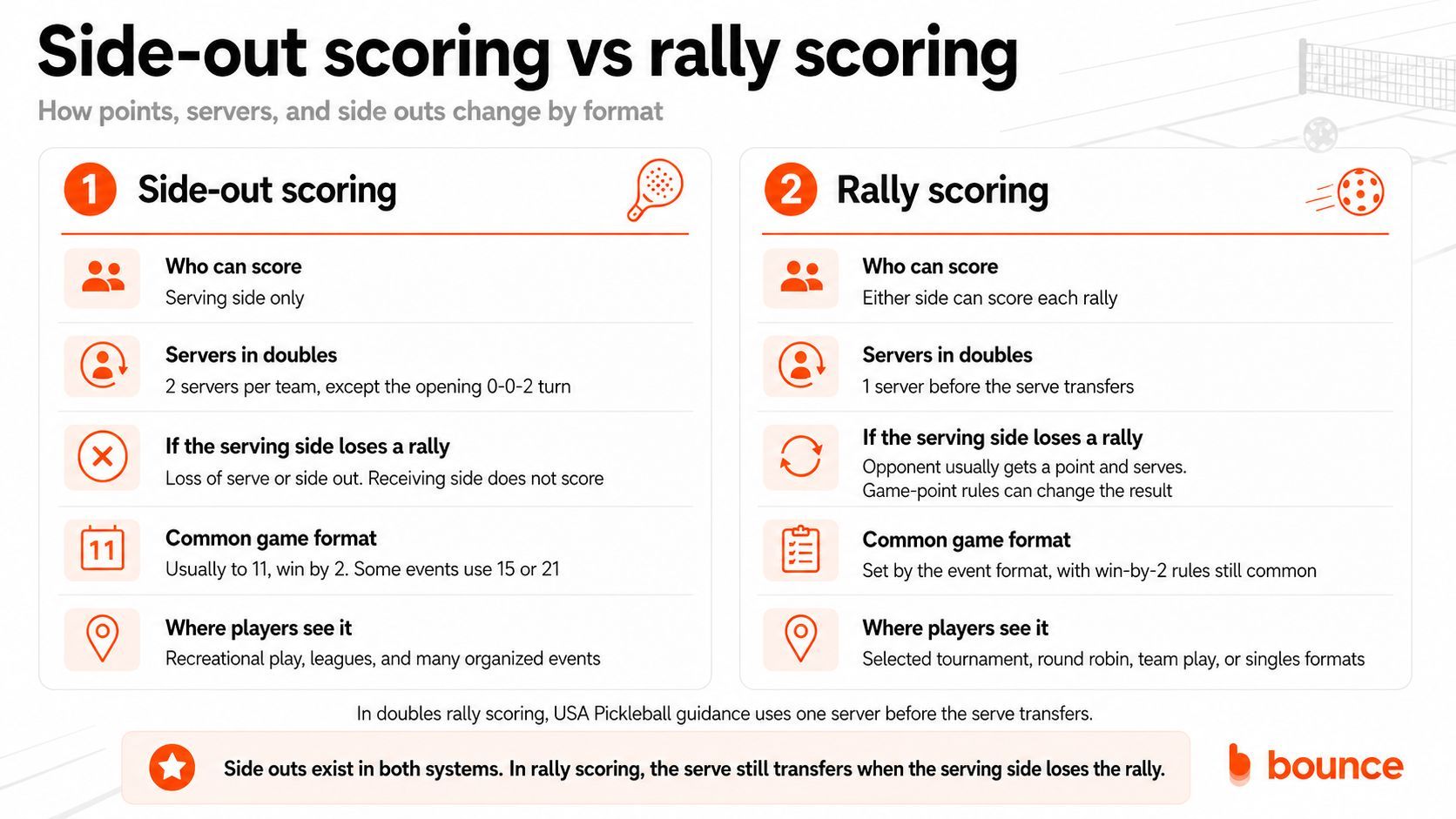
Traditional side-out scoring remains the main scoring system most players see. Under that system, the serving side scores points and the receiving side plays to win the serve back.
Rally scoring changes the reward. USA Pickleball's rally scoring guidance says a point is awarded to either the serving side or receiving side at the end of each rally in rally-scoring doubles. It also says rally-scoring doubles has one server before the serve transfers.
The correction that matters: side outs still exist in rally scoring. When the serving team loses a rally in USA Pickleball's rally-scoring doubles format, the opponent is awarded a point and serves. Game-point rules can also create side out situations where no point is awarded.
USA Pickleball's tournament scoring options list games to 11, 15, or 21, depending on format. Check the event format before you play.
| Category | Side-out scoring | Rally scoring |
| Who can score | Serving side only. | Either side can score on most rallies. |
| Doubles service turn | Two servers per team, except the opening 0-0-2 turn. | One server before the serve transfers. |
| Serving side loses a rally | Loss of serve or side out. Score usually stays the same. | Opponent usually gets a point and serves. Game-point rules can change the result. |
| Common game length | Usually 11, win by 2. Tournament games may use 15 or 21. | Set by the event format, with win-by-2 rules still common. |
| Where players see it | Recreational play, leagues, and many organized events. | Selected tournament, round robin, team play, or singles formats. |
| Side outs exist | Yes. Serve transfers after the service turn ends. | Yes. The term still appears in USA Pickleball rally-scoring guidance. |
What side outs change in real games
The rule is simple. The court decisions are sharper than the definition.
When you are receiving, your goal is to win the serve back. The smart return is deep, high enough to buy time, and aimed at a target you can repeat. A low-percentage winner that sails long gives the serving side another chance to score.
The best returners are reliable first. They make the serving team earn the next point.
When you are serving, the pressure changes. You are holding the scoring chance. A lazy third shot gives it away. Good serving teams build points with depth, controlled drops, safer resets, and patient kitchen entry.
In doubles, the side out is also a communication test. After every transfer of serve, you and your partner need to know the score and who is first server for that turn. Strong doubles strategy starts before the rally with clean positioning and a score call both players trust.
If you want to get sharper at holding serve and forcing side outs under pressure, Bounce lessons connect you with certified pickleball coaches who can work on serve consistency and third-shot selection in live reps.
The side out is the scoring switch
Side outs decide who has the right to score.
Once that clicks, 0-0-2 makes sense. The third number stops feeling random. Doubles rotation gets easier to track.
For players building their game through structured coaching and organized play, Bounce connects you with certified coaches and competitive formats in your city.
FAQ
What is a side out in pickleball?
A side out happens when the serving side loses the right to keep serving. In singles, it happens when the server loses a rally. In doubles, it usually happens when server 2 loses a rally.
Does a side out mean a point is scored?
Under traditional side-out scoring, a side out gives neither side a point. The serve transfers, and the score stays the same. Points are scored only by the serving side.
Why does every doubles pickleball game start at 0-0-2?
Every doubles game starts at 0-0-2 because the opening serving team gets one server in the first service turn. The 2 means the opening server is treated as server 2. When that player loses the rally, the serve transfers.
Who serves after a side out in doubles pickleball?
After a side out, the player on the right side of the receiving team's court becomes server 1 for that service turn. The partner becomes server 2. The server number resets every time the serve transfers.
How is side-out scoring different from rally scoring?
Side-out scoring gives points only to the serving side. Rally scoring awards a point after most rallies, and USA Pickleball's rally-scoring format uses one server in doubles before the serve transfers. The term side out stays in rally scoring.
What is the correct way to call the score in doubles pickleball?
Call three numbers before the serve: serving team score, receiving team score, server number. 0-0-2 starts the game. 5-3-2 means the serving team has 5, the receiving team has 3, and server 2 is serving.