People started playing pickleball because it felt fun and the barrier to entry was low.
Then the research started catching up.
Blood pressure. Mood. Balance. Cognitive function. Social connection. Pickleball keeps showing up in studies for reasons that make sense once you look closely at the sport: short bursts, fast decisions, constant movement, and real interaction with other people.
Want a quick answer? The health benefits of pickleball include better cardiovascular fitness, improved mood, stronger balance, sharper coordination, and more social connection. Research shows pickleball can qualify as moderate-to-vigorous exercise, and frequent players in the Apple Heart and Movement Study had 60.1% lower odds of reporting depressed mood.
This article covers the science behind those benefits, where the claims are strongest, and where players need to be honest about injury risk.
If you have cardiovascular disease, osteoporosis, balance issues, or you are returning after cancer treatment, surgery, or a long injury layoff, talk to a qualified clinician before increasing your play volume.
Research at a glance
The evidence is strongest when you look at pickleball as a repeatable health habit, not a one-off workout.
| Health area | What research shows | Practical takeaway |
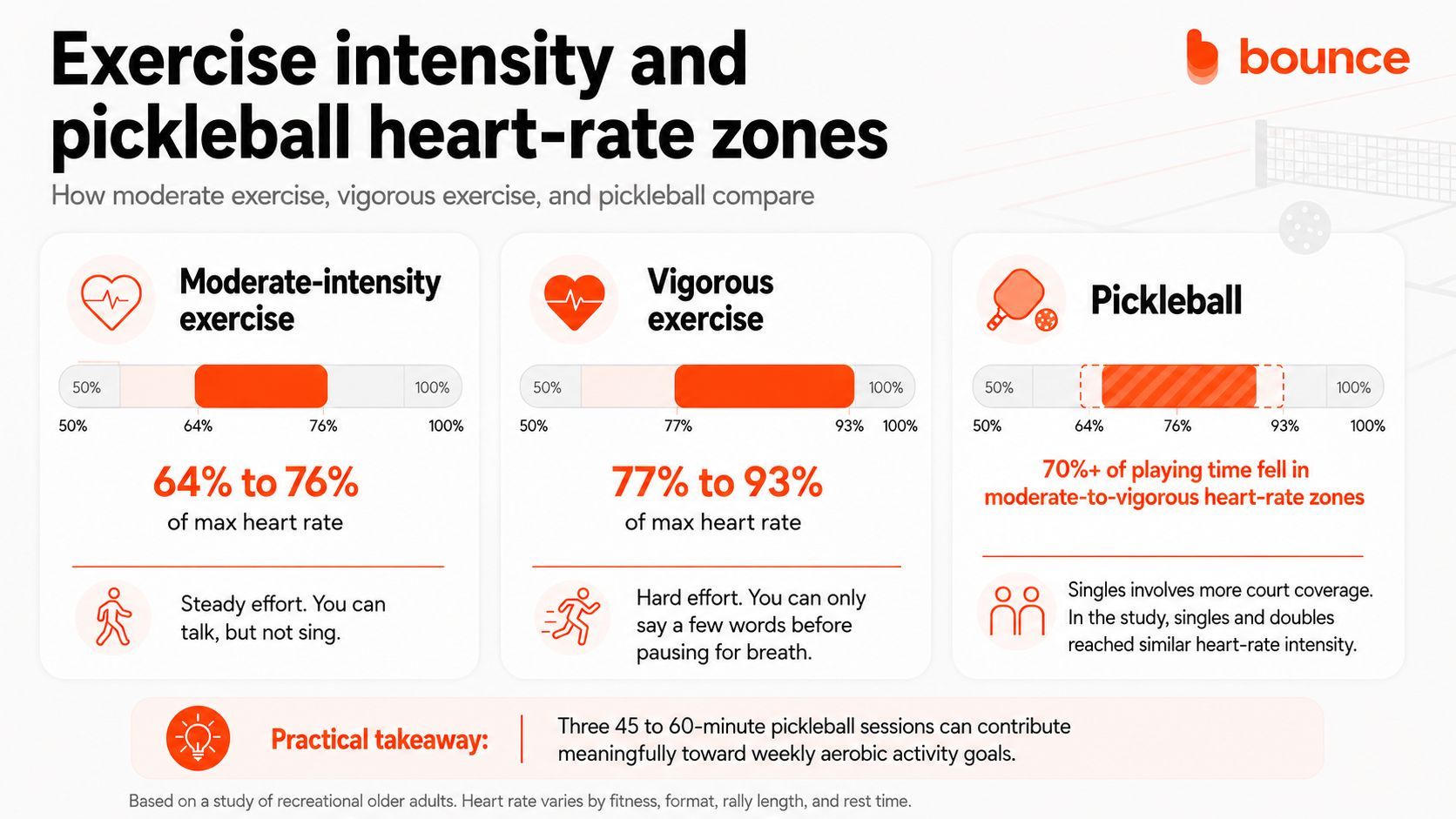
| Heart health | Singles and doubles pickleball can reach moderate-to-vigorous intensity, with more than 70% of play time in moderate-to-vigorous heart rate zones. | 3 sessions per week can help support weekly aerobic activity targets. |
| Mental health | Frequent pickleball players in the Apple Heart and Movement Study had 60.1% lower odds of a depressed mood screening result. | Regular social play may support mood better than exercise that disappears after 2 weeks. |
| Brain and coordination | Research links pickleball participation with cognitive and neuromuscular benefits, especially in older adults. | Rally play trains reaction time, balance, visual tracking, and decision-making. |
| Cancer survivorship | Moffitt Cancer Center reported physical and social well-being gains in a Project Rally pilot program for cancer survivors. | The game can be scaled down with doubles, shorter rallies, rest breaks, and coaching. |
| Injury risk | AAOS reported a 90-fold rise in pickleball-related fractures over 20 years, mostly in older players. | Warm up, use court shoes, avoid backpedaling, and build leg strength. |
What playing pickleball does to your heart
Pickleball looks casual from the fence.
On court, your heart gets a different message.
A study published in the Journal of Aging and Physical Activity measured singles and doubles pickleball players with wearable devices. The researchers found that both formats counted as moderate-to-vigorous physical activity, with players spending more than 70% of playing time in moderate-to-vigorous heart rate zones.
That matters because the CDC recommends at least 150 minutes of moderate-intensity aerobic activity each week for adults, plus 2 days of muscle-strengthening activity.
Pickleball can help fill that aerobic bucket.
It does that through repeated short rallies. You split step, shuffle, rotate, recover, and reset. Then you do it again 12 seconds later. Doubles gives you shorter bursts and more pauses. Singles pushes the heart rate higher because you cover the full court yourself.
The practical takeaway is simple: 3 sessions per week can put a recreational player within range of the weekly aerobic target, especially if each session lasts 45 to 60 minutes.
Players who want the deeper fitness breakdown can pair this with Bounce’s look at whether pickleball is good exercise, especially if the goal is building a repeatable weekly routine instead of treating every match like random activity.
Pickleball burns calories without feeling like a treadmill session
Calorie burn depends on format, body size, intensity, and how much dead time sits between points.
Recreational doubles sits closer to moderate activity. Singles and competitive doubles move higher because rallies, court coverage, and recovery demands all increase.
Most recreational players can use 300 to 450 calories per hour as a reasonable working range. Bigger players and competitive singles players can land above that. Casual doubles with long breaks will sit lower.
That makes pickleball useful for weight management because it is repeatable. A workout plan fails when you dread it. A sport you will actually play 3 days per week has a better chance.
Compared with walking, pickleball usually creates more starts, stops, lateral movement, and upper-body involvement. Walking is easier to recover from. Pickleball gives you more sport-specific intensity in the same 45 to 60 minutes.
The bigger health move is consistency. If pickleball replaces sitting, it helps. If it becomes your default way to move for 3 to 5 hours per week, the math starts to matter.
For players who want the numbers by weight, format, and session length, Bounce’s breakdown of calories burned playing pickleball gives a cleaner calculator-style view.
What muscles pickleball works
Pickleball uses your legs first. Quads, glutes, calves, adductors, and hamstrings handle the split steps, lateral shuffles, lunges, and recoveries.
Your core keeps the torso stable while you rotate through serves, drives, resets, and overheads. Shoulders, forearms, and grip muscles do the paddle work, especially on volleys, dinks, and spin shots.
The sport feels light because the court is small. The movement adds up because the changes of direction keep repeating.
The mental health data is stronger than most players expect
The Apple Heart and Movement Study looked at more than 250,000 participants and compared frequent pickleball players with the broader participant group. Frequent pickleball players had 60.1% lower odds of a depressed mood screening result. Tennis players also showed lower odds, at 51.3%.
That is a big number.
The researchers used the PHQ-2, a common 2-question screening tool used to flag possible depressed mood. A screening result flags risk. It does not diagnose depression.
A 2023 systematic review on pickleball and mental health also found consistent links between pickleball participation and better personal well-being, life satisfaction, happiness, stress, and depression-related outcomes.
The mechanism is probably layered.
Pickleball gives you moderate exercise, which affects sleep, stress, energy, and mood regulation. It also gives you a scheduled reason to leave the house and interact with people. That social layer matters. Solo exercise can help mood. Social exercise gives you movement plus connection.
This is where frequency beats intensity. One hard Saturday session is fine. Three ordinary sessions per week probably do more for mood because they create rhythm.
If you are trying to build that rhythm, Bounce open play gives players a way to find regular sessions without needing to organize every match from scratch.
Pickleball trains your brain while your body is moving
Pickleball forces decisions under mild pressure.
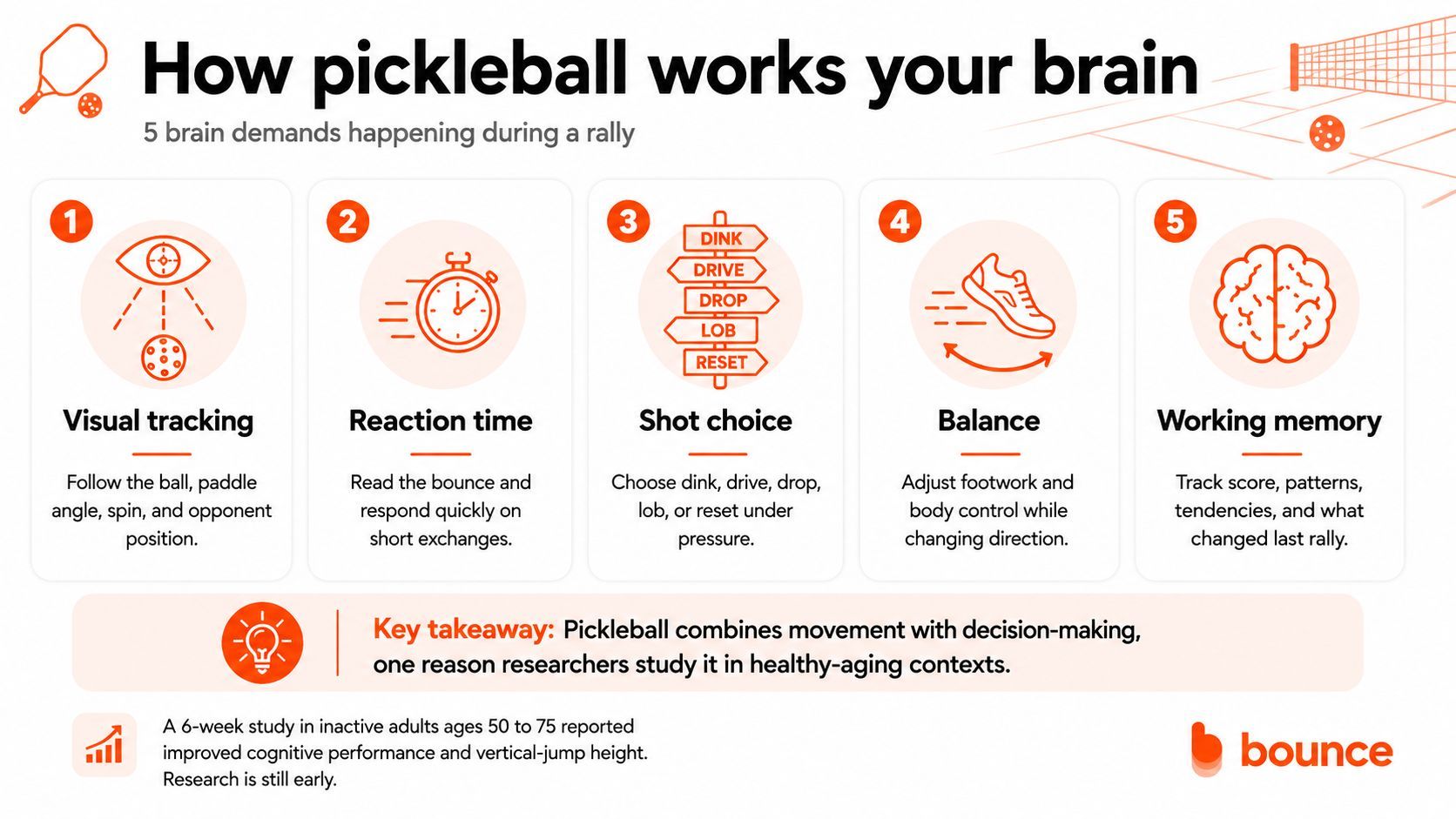
The ball comes slower than tennis, but the court is smaller. You have less time than you think. Every rally asks you to read spin, track position, choose a shot, and adjust your feet.
That is cognitive work.
You are using visual processing, reaction time, working memory, spatial awareness, and shot selection in one sequence. Then the next ball changes the problem.
This is why pickleball fits well into healthy aging conversations. The Alzheimer’s Association points to regular exercise, heart health, sleep, and social connection as habits tied to brain health. Pickleball touches several of those at once.
Pickleball adds a useful wrinkle: it combines movement with decision-making.
Walking is excellent. Strength training matters. Racket sports ask the brain to solve problems while the body is moving. That combination is one reason older adults often stick with the sport and feel mentally sharper after regular play.
A 2021 study on adults between ages 50 and 75 found improvements in cognitive function and neuromuscular coordination after a 6-week pickleball intervention. The research base is still young, but the direction is promising.
Balance and coordination are part of the health benefit
Pickleball rewards small movements.
Side steps. Split steps. Short recoveries. Controlled lunges. Shoulder turns. Paddle positioning.
That matters because balance and coordination are trainable skills. They decline faster when you stop challenging them.
For older adults, this is one of pickleball’s most useful traits. The health benefits of pickleball for seniors come from movement, social contact, balance practice, and repeatable aerobic work in the same session.
The key is control.
Most falls in pickleball happen when players chase a ball they should let go, backpedal instead of turning, or reach outside their base. Better footwork cuts risk and improves performance at the same time.
Players over 60 should treat footwork as health training. It is part of staying on court.
Bounce’s deeper look at pickleball for seniors covers joint-friendly ways to build confidence, protect balance, and stay on court longer.
Pickleball is lower impact than running, with a real injury tradeoff
Pickleball is easier on the body than running because the court is smaller, the jumps are limited, and most movement happens in short lateral bursts.
That is why many adults can play pickleball more often than they can run.
The injury picture still needs respect. The American Academy of Orthopaedic Surgeons reported a 90-fold increase in pickleball-related fractures over 20 years, with most fractures occurring in players ages 60 to 69.
The takeaway is participation has grown fast, older adults make up a large player base, and fall risk deserves attention.
The best injury-prevention work is boring:
- Warm up for 5 to 8 minutes before you play.
- Wear court shoes, not running shoes.
- Turn and run for overheads instead of backpedaling.
- Build leg strength twice per week.
- Stop lunging for balls when your weight is behind you.
- Increase playing volume gradually.
Most injuries come from a mismatch between enthusiasm and tissue readiness. Your brain remembers competition faster than your ankles do.
If injury prevention is a concern, Bounce’s pickleball injury statistics gives more depth on the patterns worth watching.
Bone strength gets a useful stimulus from court movement
Bone responds to load.
Pickleball gives the body repeated weight-bearing stress through starts, stops, lunges, pivots, and short accelerations. That type of loading can support bone maintenance, especially compared with seated activity or purely non-weight-bearing exercise.
This is most relevant for adults worried about bone density. The sport asks your legs, hips, and trunk to absorb force repeatedly.
The nuance matters. Pickleball can support bone health, but falls can cause fractures. The same population that benefits from weight-bearing activity may also carry higher fracture risk if balance, strength, or footwear is poor.
So the best version of pickleball for bone health includes strength work.
Two days per week of lower-body and core training changes the equation. Squats, step-ups, calf raises, carries, and balance drills make the sport safer and more useful.
The longevity case comes from racket sports and social exercise
The strongest longevity research comes from racket sports broadly. A large study in Mayo Clinic Proceedings using Copenhagen City Heart Study data found that different leisure-time sports were linked with different life expectancy gains. Tennis had the largest association among the sports studied.
Pickleball shares much of that profile.
It asks for aerobic work, coordination, power, reaction time, and social contact. It also has a strong adherence advantage. People keep playing because the game is competitive enough to be engaging and social enough to become part of the week.
The health intervention that people repeat wins.
Cancer survivor research gives pickleball a new clinical angle
One of the newer research angles comes from Moffitt Cancer Center. Its Project Rally pilot program reported improvements in physical and social well-being among cancer survivors through a community-based pickleball program.
This is early research. Treat it as a pilot, not a final answer.
But it fits a larger pattern in survivorship care: physical activity helps people rebuild capacity, reduce isolation, and reconnect with their bodies after treatment.
Pickleball works well here because the entry point is manageable. You can scale the game down. Shorter rallies. Slower pace. Doubles. More rest. Better spacing.
That flexibility matters for players returning from illness, injury, or long breaks from exercise.
How pickleball compares with running and tennis
| Category | Pickleball | Running | Tennis |
| Cardiovascular demand | Moderate to vigorous, depending on singles or doubles | Moderate to vigorous, depending on pace | Moderate to vigorous, often higher in singles |
| Joint impact | Lower than running, with lateral movement stress | Higher repeated impact | Higher court coverage and acceleration demands |
| Social connection | Strong, especially doubles and open play | Usually lower unless run clubs are involved | Strong in clubs, leagues, and doubles |
| Cognitive demand | High shot selection in a smaller court | Lower tactical demand during steady runs | High tactical and technical demand |
| Beginner access | Easy entry point | Easy entry point, harder for some joints | Steeper technical learning curve |
| Injury risk | Falls, strains, ankle and knee issues, fractures in older adults | Overuse injuries, shin splints, knee and hip load | Shoulder, elbow, calf, ankle, and knee injuries |
| Best fit | Players who want movement, competition, and social play | Players who like solo endurance work | Players who want higher technical depth and longer court coverage |
The best choice is the one you will repeat.
Running is efficient. Tennis is technically rich. Pickleball sits in a rare middle zone: social, approachable, competitive, and physically useful.
How much pickleball you need to play for health benefits
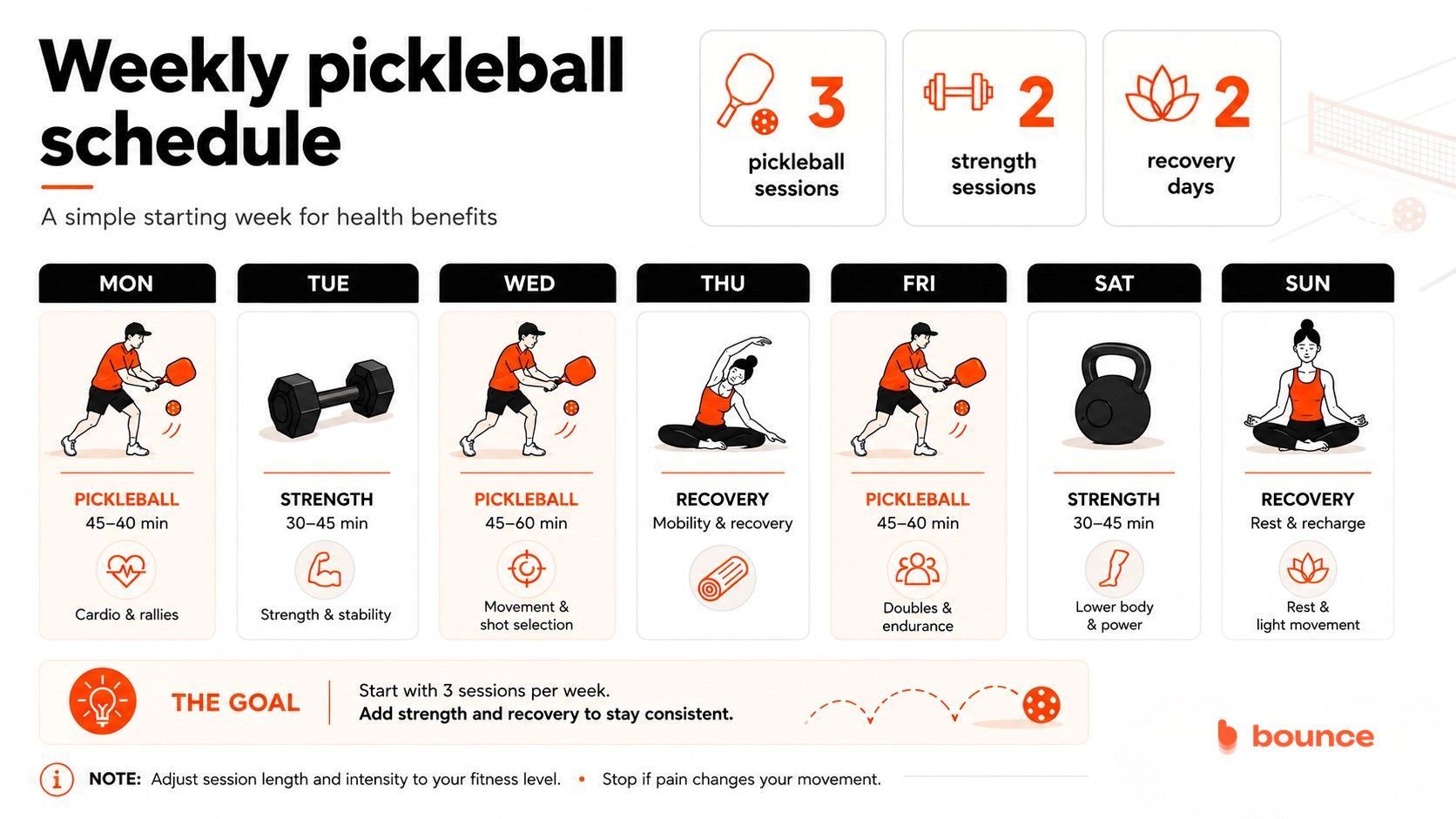
Start with 3 sessions per week.
That gives you enough frequency to build cardiovascular adaptation, mood effects, and skill development without overloading your body too quickly.
A good starting target looks like this:
| Goal | Weekly pickleball target | Extra work |
| General health | 3 sessions of 45 to 60 minutes | 2 short strength sessions |
| Weight management | 3 to 5 sessions of 60 minutes | Walking or strength work on off days |
| Better balance | 2 to 4 sessions of controlled doubles | Balance and lower-body strength |
| Competitive improvement | 3 playing sessions plus 1 lesson or drill session | Mobility and recovery work |
| Return to exercise | 2 easier sessions of 30 to 45 minutes | Medical clearance when needed |
If you are new, do not jump straight to 5 days per week. Your heart may tolerate it before your calves, Achilles, knees, or shoulders do.
Skill also changes the health outcome. Better players move more efficiently, sustain rallies longer, and avoid panic lunges. That makes coaching a health tool as much as a performance tool.
Players who want that structure can find pickleball lessons on Bounce with coaches who work with beginners, returning players, and competitive players refining their game.
The health benefits are strongest when pickleball becomes a habit
Pickleball works because people keep showing up.
That is the part health advice often misses. The physiology matters, but adherence decides the outcome.
A sport can have perfect lab numbers and still fail you if you quit after 2 weeks. Pickleball has a built-in advantage because it gives you feedback fast. You feel yourself reading the ball earlier. You start recognizing patterns. You meet people. You get pulled into the next game.
For players building their game through structured coaching and organized play, Bounce connects you with certified coaches, courts, lessons, and competitive formats in your city.
Use pickleball as exercise. Treat it like skill development. Respect the injury risks.
Then keep playing.
FAQ
What are the main health benefits of pickleball?
The main health benefits of pickleball are better cardiovascular fitness, improved balance, stronger coordination, better mood, and more social connection. Research also links pickleball participation with psychological well-being, life satisfaction, and healthy aging outcomes.
Is pickleball good for heart health?
Yes. Recreational pickleball can qualify as moderate-to-vigorous physical activity, depending on format and intensity. A study of older adults found that singles and doubles players spent more than 70% of playing time in moderate-to-vigorous heart rate zones.
Does pickleball help with depression?
Research suggests it can help. The Apple Heart and Movement Study found frequent pickleball players had 60.1% lower odds of reporting depressed mood compared with the broader participant group. Exercise, social contact, and consistent routines probably all contribute.
Is pickleball good for weight loss?
Pickleball can support weight loss when it helps you create a steady calorie deficit and move more often. Most recreational players can use 300 to 450 calories per hour as a reasonable range, but body size, format, and intensity change the number.
What muscles does pickleball work?
Pickleball works the quads, glutes, calves, hamstrings, adductors, core, shoulders, forearms, and grip muscles. The legs handle court movement, the core controls rotation, and the upper body manages paddle speed and control.
Is pickleball low impact?
Pickleball is lower impact than running because it has less repeated vertical pounding. It still has lateral cuts, lunges, pivots, and fall risk, so players need proper shoes, warm-ups, and strength work.
How many calories does pickleball burn?
Most recreational players burn about 300 to 450 calories per hour, depending on body size, format, and intensity. Competitive singles can burn more. Casual doubles with long breaks will burn less.
Is pickleball good for seniors?
Yes, pickleball can be a strong fit for seniors because it trains balance, coordination, aerobic fitness, and social connection. The main caution is injury risk, especially falls and fractures, so older players should use court shoes, warm up properly, and build lower-body strength.
How many times per week should I play pickleball for health benefits?
Three sessions per week is a strong starting target. That frequency can support aerobic health and mood benefits while giving your body recovery time. Add 2 short strength sessions per week for better joint support and injury prevention.