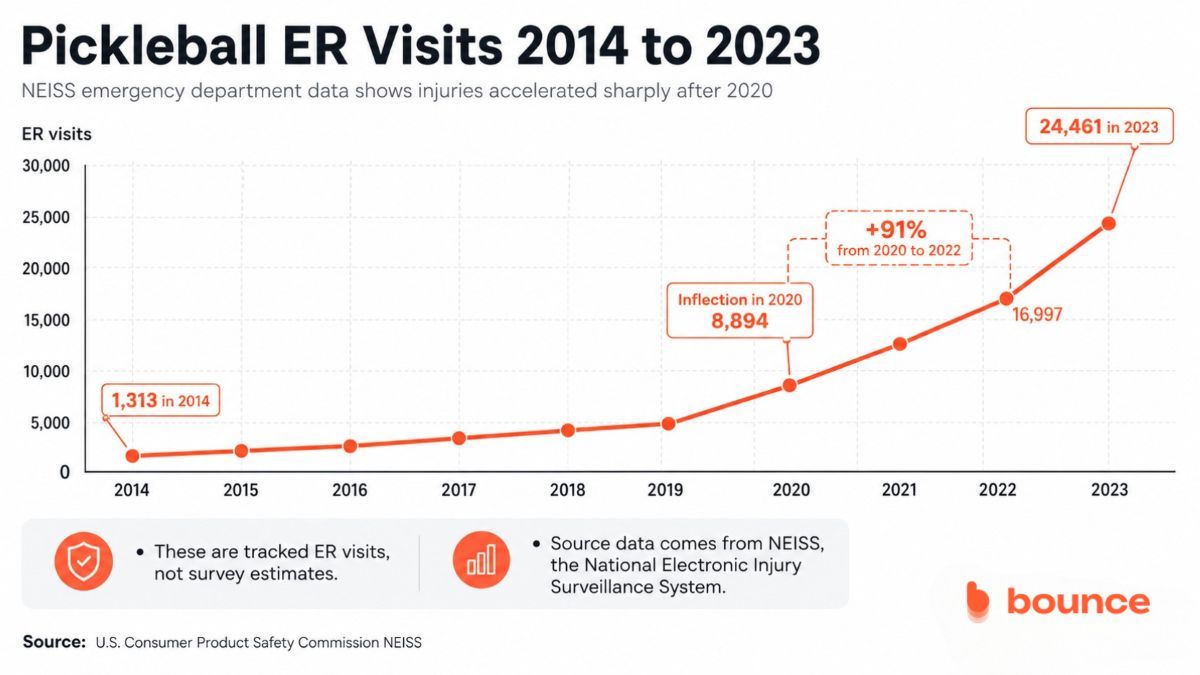
Pickleball injury statistics look ugly at first glance. Annual emergency department estimates rose from 1,313 cases in 2014 to 24,461 in 2023. That is an eighteen-fold jump in less than a decade.
The number needs context. More people are playing, more older adults are playing often, and many new players are entering the sport without the strength, balance, footwear, or recovery habits to match the volume.
The injury data does not say pickleball is a reckless sport. It says the sport is easy to start and physically demanding enough to punish players who treat it like a casual walk.
Quick Answer
Want the short version? Pickleball injuries are rising because more people are playing, but the risk is not evenly spread.
The serious ER cases are mostly a fall problem, especially for older players. The day-to-day pain players manage on their own is more often an overuse problem, especially in the shoulder, elbow, wrist, knee, ankle, and Achilles.
The practical takeaway is simple: most players do not need to fear pickleball. They need better balance, better warm-ups, better recovery habits, and better movement mechanics before the court teaches the lesson the hard way.
Pickleball injury statistics at a glance
| Data point | What the number says | Court-level meaning |
| ER injury growth | 1,313 in 2014 to 24,461 in 2023 | The sport added injuries as it added players, especially after the participation boom. |
| 2020-2022 ER growth | 91% increase | The pandemic-era surge brought more new bodies onto hard courts. |
| Hospital admissions | 257% increase from 2020 to 2022 | The serious end of the injury curve rose faster than ER volume. |
| Most common diagnoses | Fractures and sprains, about 27% each | Falls and quick direction changes create the biggest injury burden. |
| Fall mechanism | 65.5% of ER injuries | Backpedaling and poor balance matter more than most players think. |
| Self-reported injuries | 69% in 12 months | The real pain burden is larger than ER data shows. |
The numbers are bigger than most players realize
Emergency room visits, 2014-2023
The baseline comes from NEISS, the National Electronic Injury Surveillance System. Researchers use it to estimate injury cases seen at U.S. emergency departments. A 2025 epidemiology study found that annual pickleball-related ER injury estimates grew from 1,313 in 2014 to 24,461 in 2023.
Those are ER cases, not sore elbows, tight calves, or players who stayed home for a week. The serious end of the curve grew fast enough to matter on its own.
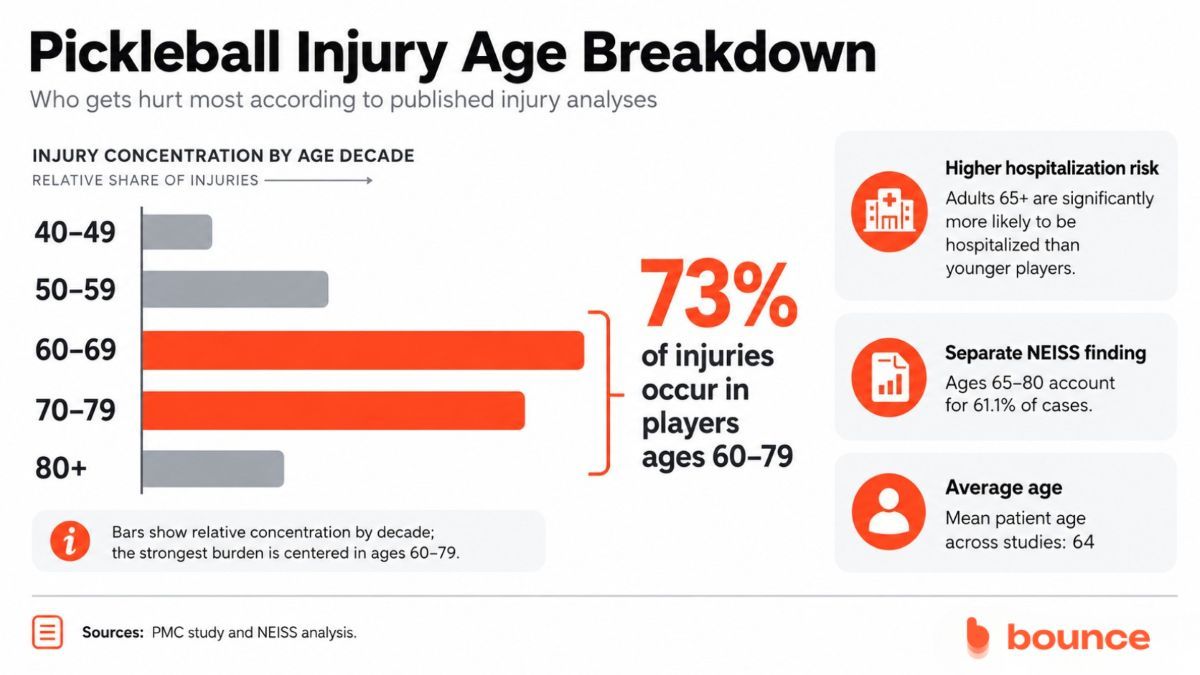
A separate national analysis covering 2013 to 2022 estimated 66,350 pickleball-related ER injuries. In that dataset, the mean patient age was 64, the 65 to 80 group accounted for 61.1% of cases, and falls were the leading mechanism.
Hospitalization is the severity signal
Injury volume rose quickly. Serious injury rose faster. From 2020 to 2022, pickleball-related ER visits increased 91%, from 8,894 to 16,997 cases. Over the same period, hospital admissions increased 257%, from 992 to 3,541.
That does not make every match dangerous. It does mean the injury curve includes more than bruises and pulled calves. A meaningful share of cases is serious enough for hospital admission, especially among older players.
The economic cost
A UBS analysis reported by CNN estimated $377 million in direct medical costs tied to pickleball injuries in 2023. The estimate included emergency visits, outpatient appointments, surgeries, and hospitalizations.
That number is useful because it translates injury risk into something outside the court. More players means more strain on clinics, orthopedics, imaging, surgery, physical therapy, and recovery time.
For players, the takeaway is not to avoid the sport. It is to treat pickleball like real physical activity, especially if you are playing multiple times per week.
A few lessons can clean up footwork, stroke mechanics, and movement habits before small aches turn into longer breaks. Bounce helps players find certified coaches and organize play in their city, so the path into the sport is built around better habits instead of just more court time.
Who gets hurt
The 60 to 79 age zone
The age pattern is hard to miss. In the 2020 to 2022 national database study, about 73% of estimated injuries occurred in players aged 60 to 79.
That age group is drawn to pickleball for good reasons. The court is smaller than tennis, doubles is social, and the game rewards touch as much as power. But a hard court does not care that the sport feels friendly.
For older adults, the risk profile is different: fall mechanics, bone density, balance, and recovery time matter more. Players who want the senior-specific version should use pickleball for seniors as a practical companion to the injury data.
Gender differences in injury type
The overall ER injury split is nearly even in the 2014 to 2023 epidemiology study: 51.2% men and 48.8% women. Fractures tell a different story. A 20-year fracture analysis found that 69.1% of pickleball-related fractures occurred in women.
Researchers connect that pattern to the age distribution of the sport and higher osteoporosis risk among older women. Women are more likely to fracture after a fall, especially in the wrist and hand. Men were 2.3 times more likely to be admitted after a fracture, which points to a different severity pattern once a fracture occurs.
Younger players are not immune
Older adults still account for most ER cases. Younger players are seeing a faster rate of increase. A 2025 study in The Physician and Sportsmedicine found the annual injury growth rate was 69.93% in younger players, compared with 50.08% in older players.
The injury types also change with age. Older players are more likely to fracture after falls. Younger players are more likely to report sprains and strains from cuts, lunges, quick stops, and longer rallies.
What active players actually report
ER data captures the cases that reach a hospital. It misses the shoulder that hurts for 3 weeks, the elbow that needs rest, and the Achilles soreness a player ignores until it changes how they move.
A 2025 nationwide study of 1,758 pickleball players found that 69% reported at least one injury or complaint in the past 12 months. Two in five had injuries that stopped play, and about 1 in 3 kept playing through pain.
That survey number may be the most useful stat for regular players. ER data shows what happens when injury gets serious. The survey shows how common pain and missed play are before the ER ever enters the picture.
The most common pickleball injuries
Fractures
Across national emergency department studies, fractures sit near the top of the diagnosis list. One 10-year national study reported fractures and sprains at roughly 27% each.
The mechanism is usually simple: a fall onto a hard court. In a 2013 to 2022 NEISS analysis, falls caused 65.5% of injuries. A wrist fracture is the classic outcome when a player reaches back or sideways to catch themselves.
The American Academy of Orthopaedic Surgeons has also flagged increased fracture risk among older players, especially older women. The court-level implication is plain: fall prevention belongs in pickleball training along with stroke training.
Sprains and strains
Sprains and strains are nearly as common as fractures. The sport asks for repeated short bursts: split step, lunge, recover, cut sideways, stop, repeat.
The smaller court can trick players into thinking the movement demand is light. The opposite shows up when a player adds a third or fourth weekly session without building the ankle, calf, hip, and core strength to support it.
Shoulder and rotator cuff
UC Davis Health points to repetitive swings, overhead motions, and quick court movements as common contributors to pickleball injury risk. Shoulder and upper arm complaints also appeared frequently in the nationwide player survey.
The rotator cuff takes a steady load from serves, drives, overheads, resets, and late contact points. Poor mechanics turn that load into irritation faster.
Players dealing with recurring shoulder pain should pair court adjustments with the mobility work in pickleball stretches, then get help if pain persists.
Pickleball elbow
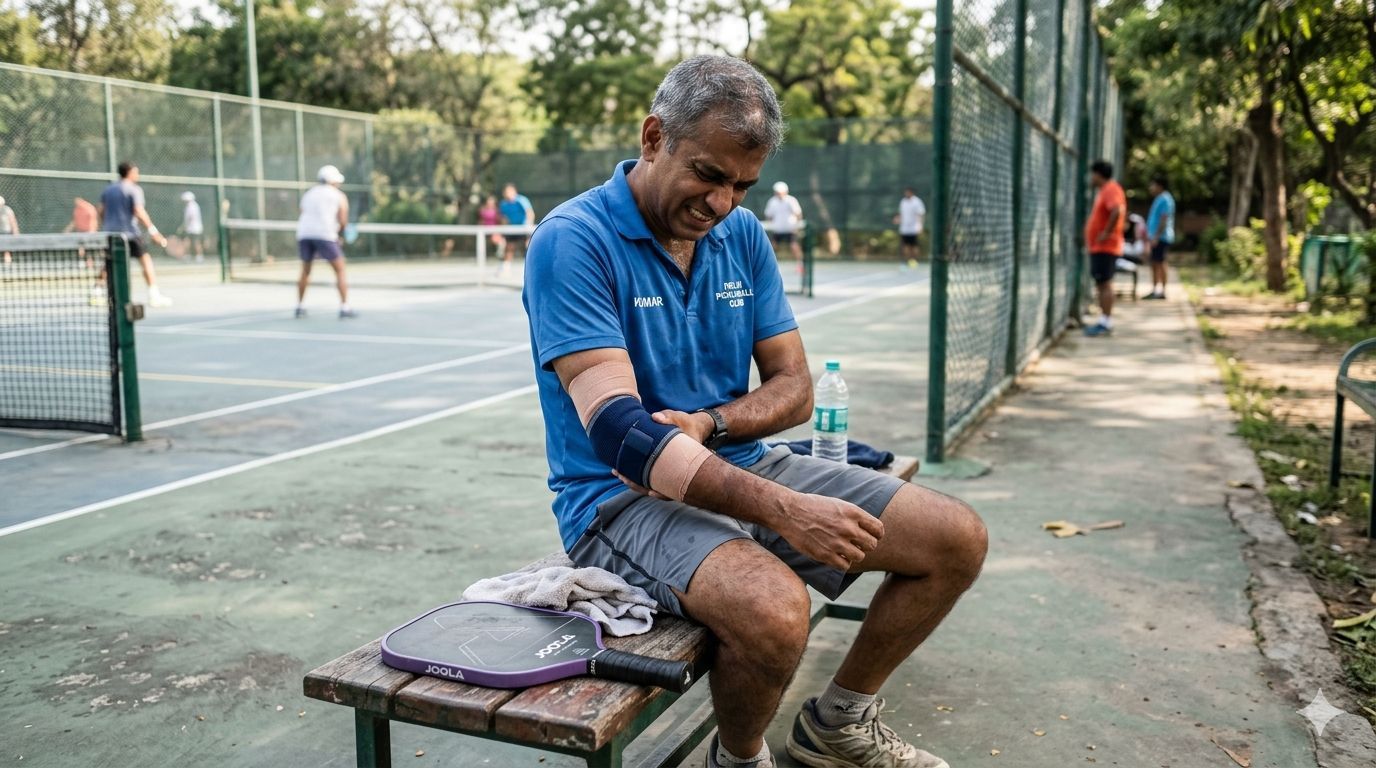
Lateral epicondylitis is the same condition players call tennis elbow in other racket sports. In pickleball, the repeated mix of gripping, wrist rotation, late contact, and mishits can irritate the tendons on the outside of the elbow.
A lighter paddle does not automatically protect the elbow. It can encourage faster, more frequent swings. More swings can mean more cumulative tendon load.
For a deeper breakdown of symptoms, causes, and recovery work, use the guide to pickleball elbow.
Lower body injuries: Achilles, ACL, ankle, knee
Lower-body injuries come from the same pattern repeated hundreds of times: sudden starts, lateral cuts, short decelerations, and reaching for a ball while the feet are late.
The Achilles tendon is especially exposed when players sprint forward, stop near the non-volley zone, and push back into position. The knee and ankle carry the same load when the foot plants awkwardly or the player reaches instead of taking one more step.
Understanding how much work pickleball actually demands helps explain why this happens. Calories burned playing pickleball vary by age, pace, and format, but intense doubles and singles can create a real training load.
Hand and wrist injuries
A 10-year hand and wrist study estimated 12,021 pickleball-related injuries to the hand, wrist, and fingers between 2013 and 2022. The number increased 765.6% over that period.
The mechanism was usually a fall. In that study, 90.5% of cases involved falling, and the most common patient profile was a white woman over 55.
Eye injuries
Eye injuries deserve more attention than they usually get. A JAMA Ophthalmology study found that pickleball-related ocular injury incidence increased by an estimated 405 injuries per year from 2021 to 2024.
Ball strikes caused about 43% of eye injuries, falls caused about 28%, and paddle strikes caused about 12%. This category is highly preventable. Protective eyewear is a small change with a clear upside.
Cardiovascular events in older players
A 20-year emergency department analysis found that older adults represented most pickleball-related ED visits, and acute cardiovascular events appeared alongside fractures as an important diagnosis category in that group.
Pickleball can deliver real cardiovascular benefit. The risk appears when older adults jump from low baseline activity into frequent play without building up gradually.
Why injury rates are rising
The short answer is volume. More players, more court hours, more older adults, more beginners, more hard-court exposure.
The player survey adds another layer: many injuries are not single traumatic events. A large share comes from overuse, and about 1 in 3 players reported continuing to play through pain.
Pickleball feels approachable. That is part of its appeal. The body still has to absorb lateral cuts, repeated swings, sudden stops, awkward reaches, and recovery demands between sessions.
For players coming back after years away from regular sport, 3 or 4 sessions per week can be too much too soon. The body may feel fine during the first few weeks. Tendons and connective tissue often complain later.
What the evidence says about prevention
The prevention advice is boring because it works. The same themes show up across sports medicine guidance: move well, warm up, build strength, recover, and address pain before it becomes your new normal.
- Avoid backpedaling. Falls drive a large share of ER injuries. Turn and move instead of shuffling backward for a lob.
- Start in a ready position. Wide feet, bent knees, and centered weight reduce late reaches and awkward falls.
- Take lessons early. Faulty grip, late contact, and poor shoulder mechanics can turn a fun sport into a recurring elbow or shoulder problem.
- Strength train off court. Calves, ankles, hips, shoulders, wrists, and trunk strength matter because the court asks for repeated deceleration.
- Rest at least weekly. Soreness clearing does not mean tendons have fully adapted. Recovery is part of training.
- Treat pain early. The survey data on players continuing through pain is the warning sign. A short break beats a long layoff.
- Use protective eyewear. Eye injuries are less common than sprains and fractures, but they are preventable enough to be taken seriously.
For players who want safer mechanics from the start, Bounce helps players find certified pickleball coaches in their city. That fits this article because a coach can catch the movement and swing habits that injury studies keep pointing back to.
A note on the data
Most hard injury statistics in this article come from NEISS, the National Electronic Injury Surveillance System. NEISS tracks injuries treated in a nationally representative sample of emergency departments, then researchers use that sample to estimate national injury totals.
That makes NEISS useful for serious injuries. It also means the data misses soreness, overuse pain, urgent care visits, physical therapy cases, self-managed injuries, and players who stop playing for a few weeks without seeing a doctor.
The 2025 player survey helps fill that gap. ER studies show the serious end of the injury spectrum. Survey data shows the day-to-day pain burden regular players actually feel.
Conclusion
The pickleball injury data tells a consistent story. Injuries are rising quickly, older players carry much of the ER burden, falls drive the serious cases, and overuse explains a lot of the pain that never reaches a hospital.
The practical lesson is simple: play, but prepare. Build strength away from the court. Warm up. Stop backpedaling. Use the right shoes and eyewear. Take pain seriously before it becomes the thing that decides your season.
The players who stay on court the longest are usually the ones who treat pickleball like a real sport, even when the first session feels easy.
For players building a more sustainable game, Bounce connects you with certified pickleball coaches, clinics, leagues, and organized play in your city.
FAQ
What is the most common pickleball injury?
Fractures and sprains are the most common diagnoses in national emergency department data, each accounting for roughly 27% of cases in one 10-year study. Falls are the leading mechanism, which is why balance, footwear, and avoiding backpedaling matter so much.
What percentage of pickleball players get injured each year?
A 2025 nationwide study of 1,758 active players found that 69% reported at least one injury or physical complaint in the previous 12 months. Two in five had injuries that stopped play, and about 1 in 3 kept playing through pain.
Are pickleball injuries more common in older players?
Yes. National ER data consistently shows that older adults account for most serious pickleball injuries. One 2020 to 2022 study found that roughly 73% of estimated injuries occurred in players aged 60 to 79.
Is pickleball more dangerous for women?
For fractures, women carry higher risk in the available research. One 20-year fracture analysis found that 69.1% of pickleball-related fractures occurred in women, likely connected to age distribution and osteoporosis risk. Men were more likely to be admitted after sustaining a fracture.
How can I reduce pickleball injury risk?
Avoid backpedaling, warm up before play, strength train off court, use court shoes, rest between sessions, take pain seriously, and learn correct mechanics from a coach. Protective eyewear also deserves more attention because eye injuries are rising.
Is pickleball safe for seniors?
Yes, with the right approach. Pickleball is accessible for adults over 60 and can support fitness, balance, and social connection. Seniors need to manage the higher fall and fracture risk with gradual conditioning, recovery time, fall-prevention habits, and medical guidance when needed.