Pickleball drills at home work because they remove the biggest practice excuse: waiting for another player.
A wall, a paddle, 4 balls, and 20 focused minutes give you cleaner reps than most casual games. The trick is matching the drill to the skill you are trying to fix.
Want a quick answer? The best pickleball drills at home are wall dinking, paddle taps, serve targets, third shot drop feeds, volley wall work, contrast dinking, shadow point patterns, and footwork blocks. Beginners should start with touch and consistency. Intermediate players should add placement targets and serve variety. Advanced players should train resets and pressure serves after their mechanics are stable.
This guide gives you the exact setup, rep targets, and a 30-minute solo pickleball practice routine you can run in a garage, driveway, hallway, or backyard.
The 8 drills I would prioritize
- Wall dinking
- Paddle taps
- Serve targets
- Third shot drop feeds
- Targeted wall dinking
- Volley wall work
- Contrast dinking
- Shadow point patterns
What you actually need to set up at home
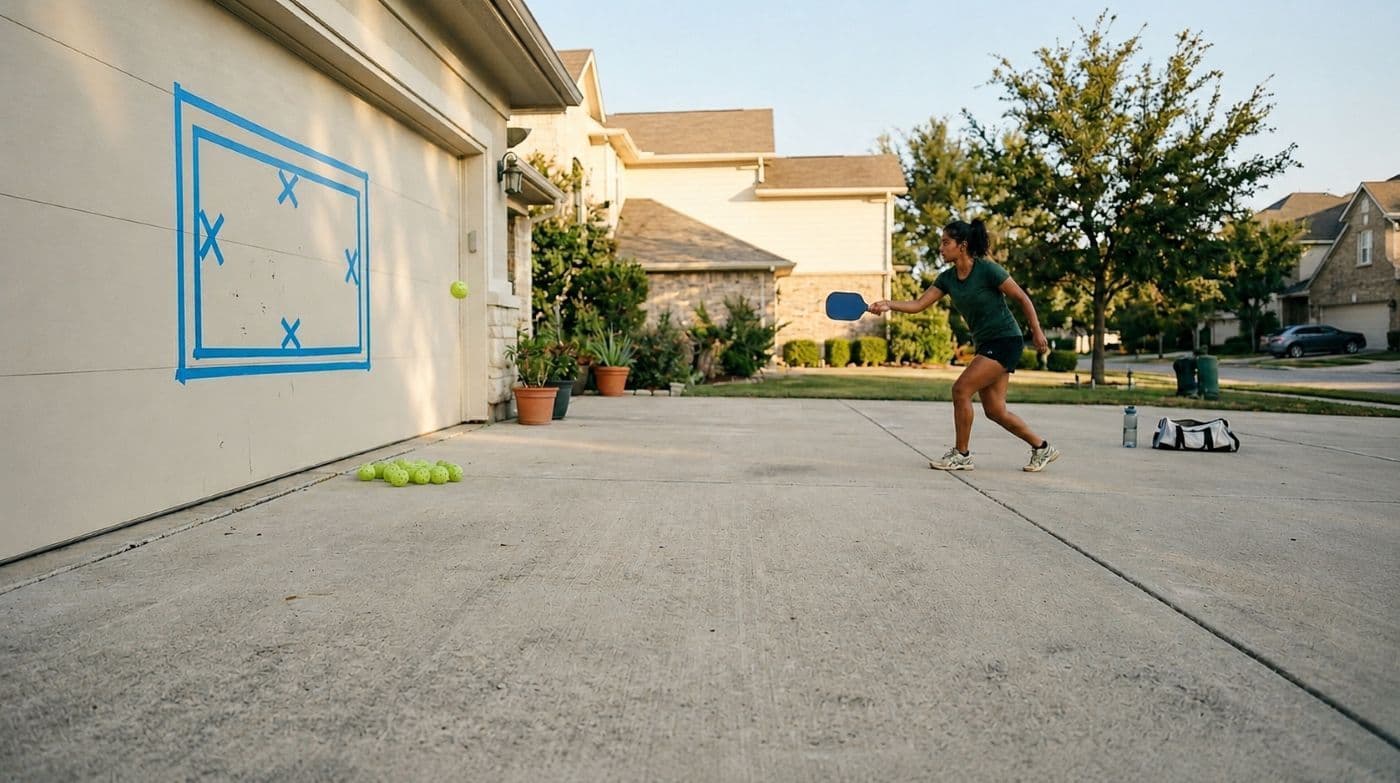
Start with a smooth wall. Concrete, painted drywall, a garage door, or a solid fence panel all work. If the surface gives you a predictable rebound, it is good enough.
Use painter's tape for 2 lines. One strip goes on the wall at net height. USA Pickleball lists a regulation net at 36 inches at the sidelines and 34 inches in the center, so 34 inches is the right home target for most wall work. USA Pickleball court construction standards confirm the official net height.
The second strip goes on the floor 7 feet from the wall. That recreates the non-volley zone, better known as the kitchen. For the full court layout, pickleball court dimensions gives the exact measurements and spacing.
Your full setup: paddle, 4 balls, painter's tape, water, and a notebook or phone note for tracking results. Cones and rebounders help, but they come later. Players who wait for perfect gear usually skip the reps that would have helped them most.
How to practice pickleball at home in a small space
A 10 by 15 foot area handles most pickleball practice at home with no court. That gives you enough room for wall dinks, compact volleys, paddle taps, and footwork patterns.
Indoor pickleball practice needs 4 rules. Use a foam or low-bounce ball if sound matters. Move rugs, glass, pets, and loose objects. Wear court shoes on slick floors. Keep overhead swings out of low-ceiling rooms.
Small-space work should feel controlled. If you are chasing balls into furniture or adjusting your swing to avoid a wall, shrink the drill. Better reps beat dramatic ones.
Beginner pickleball drills at home: touch and basic consistency
The first goal is clean contact. Speed comes later. Beginners improve fastest when they learn what soft contact feels like and stop over-swinging on balls that need touch.
Paddle taps for sweet-spot feel
Hold your paddle flat, face up. Bounce the ball off the paddle face 50 times on the forehand side, 50 times on the backhand side, 50 alternating, and 50 at knee height while you keep your feet still.
Treat this as a calibration drill. You are learning where the sweet spot is, how much the paddle face responds at contact, and how light grip pressure feels. Grip force research shows that hand control depends heavily on sensorimotor feedback during object manipulation, which is why hard squeezing works against touch shots. A 2023 Scientific Reports paper explains how grasp and manipulation force rely on different control mechanisms.
Keep your wrist quiet. Your grip should feel secure, not clenched.
Wall dinking: the foundation drill
Stand on the 7-foot tape line and dink the ball against the wall. Keep every rebound below the net-height tape line. Aim for 25 consecutive controlled contacts before you stop.
When you miss, reset the count to zero. That sounds harsh until you realize the wall is giving you cleaner feedback than a partner who keeps rescuing bad balls.
Do 4 sets per session with 30 seconds of rest between sets. When you can hit 50 in a row while alternating forehand and backhand, move to the intermediate wall drills.
Serve mechanics without a full court
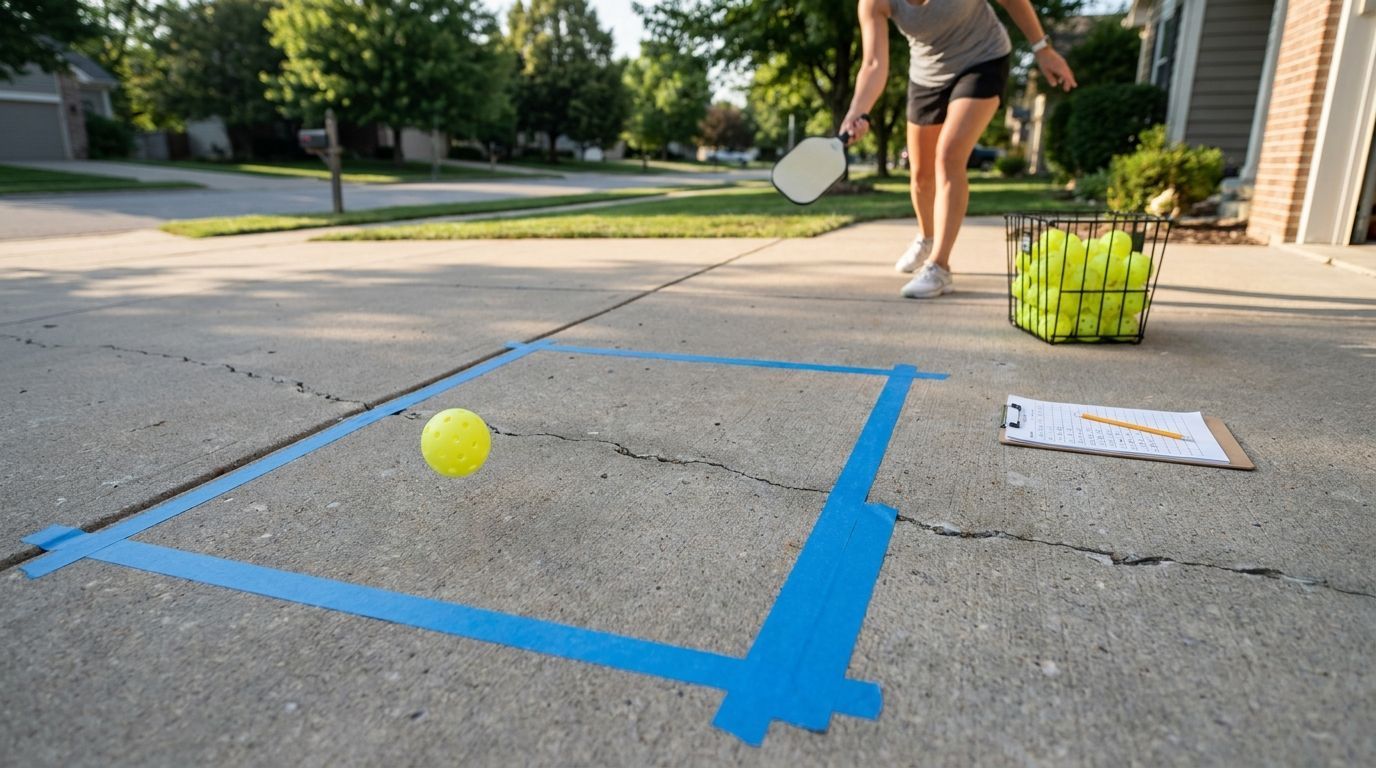
Tape a target box on your driveway or garage floor. Make it roughly 3 feet wide by 4 feet deep and place it diagonally from your serving position at the depth of a service box.
Hit 20 serves to that box. Count how many land in. Beginners should aim for 12 out of 20 before adding placement variety.
Focus on a smooth underhand motion, contact below the waist, and a paddle path that sends the ball forward with shape rather than a slap. The serve is the one shot you fully control, so it should be one of the first shots you measure. For the full breakdown, mastering the pickleball serve covers contact point, spin, depth, and placement.
Intermediate pickleball drills at home: placement and pressure
Intermediate players can already keep the ball in play. The next jump comes from putting the ball where it should go. Placement is a skill, and home practice is the easiest place to isolate it.
Targeted wall dinking with placement zones
Put 2 extra tape marks on the wall: one low and wide to your forehand side, one low and wide to your backhand side. Dink to the first target for 10 reps, then switch to the second for 10. Then alternate every ball.
This is the home version of cross-court control. In live doubles, the player who can redirect a dink to the weaker side wins more kitchen exchanges than the player who just keeps the ball alive.
Move from 7 feet to 12 feet when the targets become easy. The longer distance forces a higher arc and better touch.
Third shot drop practice alone
The third shot drop is the highest-yield home drill for intermediate players. A good drop lets the serving team move forward instead of getting pinned at the baseline. The pickleball drop shot breaks down the timing and paddle path in more detail.
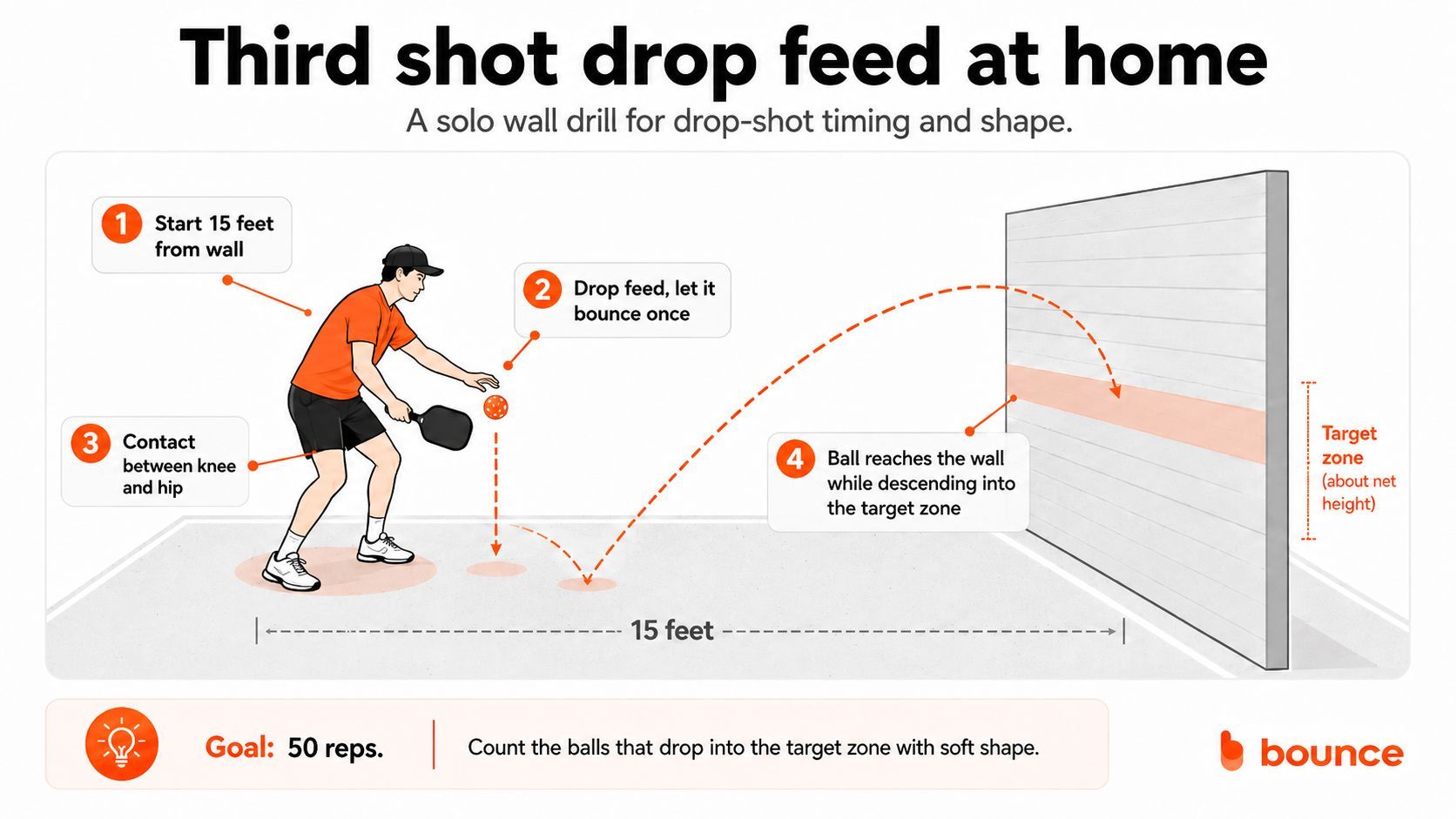
Stand 15 feet from the wall. Drop the ball from waist height, let it bounce once, and hit a soft arcing shot toward the wall. Aim for the ball to descend into the net-height target line.
Do 50 per session. Count how many have the right shape: soft contact, ball descending into the target zone, and no arm muscle. When 35 out of 50 look right, you have built a real foundation.
Why it matters: Getting to the kitchen and staying there decides a huge share of recreational doubles points. Solo third shot work strips away rally noise and shows you whether the miss is contact height, grip pressure, or paddle path.
Serve placement variety
Once your serve is reliable, add 4 targets inside the service box: deep backhand, deep forehand, body serve, and short angle. Hit 10 serves to each zone and track percentage by target.
Most intermediate players have one safe serve and one panic serve. Home practice is where you close that gap.
Volley wall work for hand speed
Stand 8 feet from the wall and volley continuously. Use a compact punch, keep the paddle in front of your chest, and stop the backswing from creeping behind your body.
Run 60 seconds forehand, 60 seconds backhand, 60 seconds alternating, and 60 seconds random. When 8 feet feels controlled, move to 6 feet.
If you use Bounce open play as your test environment, run this volley block before you go. You will know quickly whether your hands hold up when someone speeds the ball into your body.
Advanced pickleball drills at home: resets and match simulation
Advanced players already have basic mechanics. The work shifts toward decision speed, reset quality, and exposing weak patterns on purpose. If you need a broader point-construction framework, pickleball strategy connects these drills to the choices you make during rallies.
Contrast dinking: soft to speed-up to reset
Stand on the 7-foot line. Hit 5 controlled dinks, speed up the 6th ball, then block the fast rebound softly back into the target zone.
This trains the sequence that shows up constantly in kitchen play. A soft exchange turns into a speed-up, and your next shot has to absorb pace without popping up.
Do 6 sets of 10. Each set is 5 dinks, 1 speed-up, 1 reset, and 3 controlled dinks to finish. Rest 30 seconds between sets.
The shrinking target drill
Make 2 tape squares on the wall: 12 inches wide and 6 inches wide. Hit 10 balls into the 12-inch zone. Then hit 10 into the 6-inch zone.
Once you can hit 8 out of 10 in the 6-inch zone, cut the target to 3 inches. It should feel uncomfortable. Match pressure shrinks your real target, so training with smaller targets makes live targets feel more manageable.
Shadow point patterns
Shadow drilling trains footwork and shot sequence without a ball. Call out a point pattern and move through it: return, split step, transition, dink, reset, speed-up, recover.
Run 4 full points at 80% speed. Then change the pattern. This is useful on travel days, rest days, or apartment days when wall work would annoy everyone within 3 doors.
Fatigue-pressure serve training
Use fatigue serves only after your serve motion is stable. Fatigue can reveal whether a reliable motion holds up under pressure, but it is a bad time to learn new mechanics.
Do 20 high knees, then hit 10 serves to your target zones. Rest 45 seconds. Do 10 bodyweight squats, then hit 10 more serves. Your serve percentage under this protocol should stay within 10 percentage points of your rested number.
Stop the fatigue block if your form breaks. Muscle fatigue can harm motor-skill learning beyond the current session, which is why tired reps need a tight cap. eLife research on fatigue and motor-skill learning supports keeping new mechanics out of exhausted practice blocks.
If your drop still floats after a few weeks of wall work, Bounce lessons are the cleaner next step. A coach can see grip pressure, contact height, and paddle path in 5 minutes.
Pickleball drills without a partner or wall
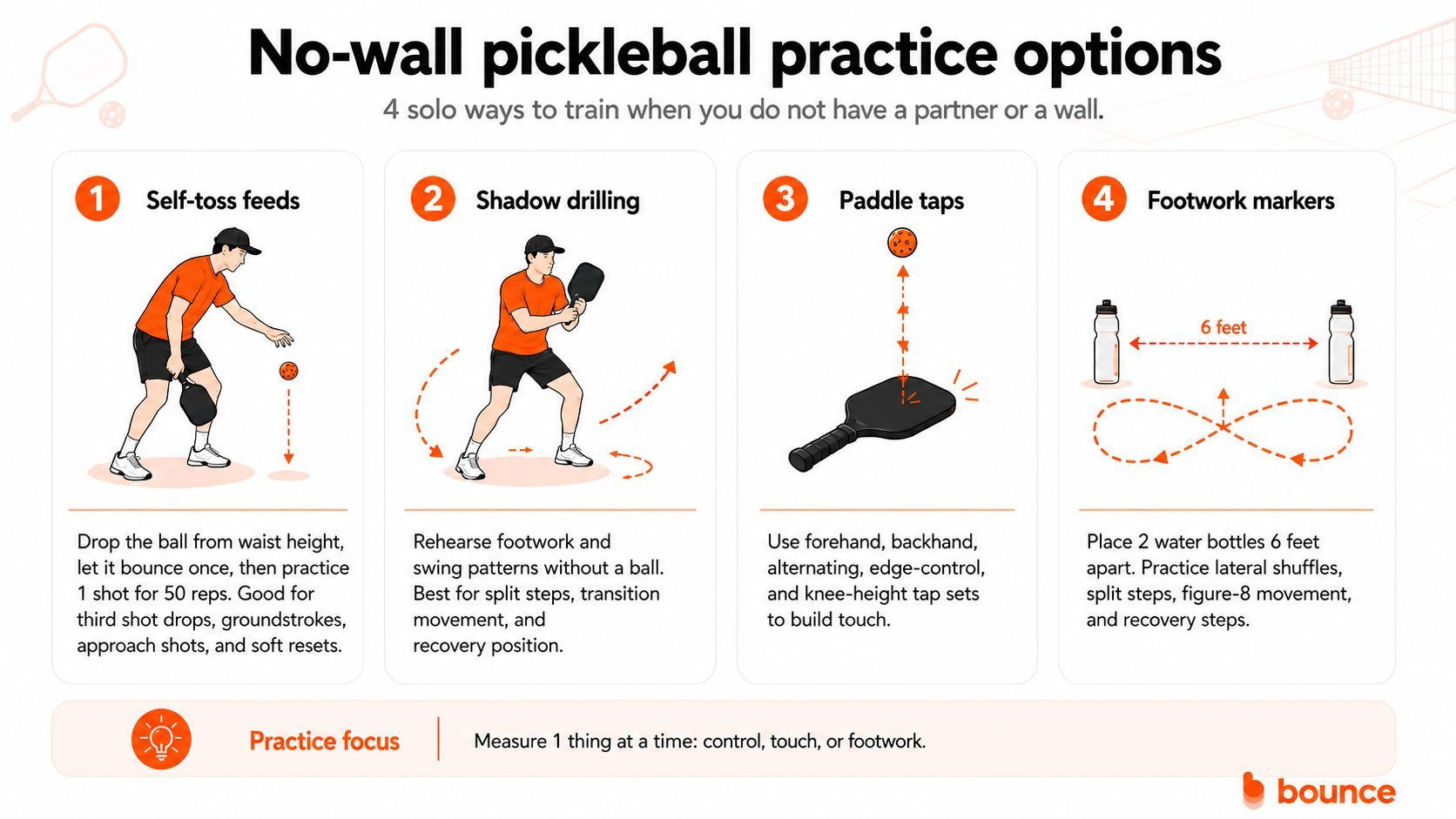
A smooth wall gives you the most feedback, but pickleball drills without a partner still work when a wall is unavailable. Keep the goal narrow and measure one thing at a time.
- Self-toss feeds: Drop the ball from waist height, let it bounce once, and practice one shot for 50 reps. Use this for third shot drops, groundstrokes, approach shots, and soft resets.
- Shadow drilling: Move through footwork and swing patterns without hitting a ball. This is the best no-wall option for split steps, transition movement, and recovery position.
- Paddle taps: Use forehand, backhand, alternating, edge-control, and knee-height tap sets to build touch.
- Footwork markers: Put 2 water bottles 6 feet apart and move through lateral shuffles, split steps, figure-8 movement, and recovery steps.
If you are still sorting out the difference between dinks, drops, drives, volleys, and resets, pickleball shots gives you the shot vocabulary before you start stacking drills.
The best pickleball solo practice routine: 30 minutes
Pick one priority per session. Rotate weekly. A 30-minute session with a target beats 90 minutes of random tapping.
| Block | Time | What to do | What to track |
| Warm-up | 5 minutes | Paddle taps: 50 forehand, 50 backhand, 50 alternating, 50 low taps | Clean sweet-spot contact |
| Skill block | 10 minutes | One level-specific drill from this guide | Consecutive reps or target hits |
| Serve block | 10 minutes | 30 to 40 serves to marked zones | Percentage by target |
| Finish | 5 minutes | One target drill you can complete well | End number and one note |
Keep a log. Write the date, drill, reps, result, and one thing you noticed. The players who track reps improve faster because they stop guessing.
Quick-reference drill table
| Skill level | Drill | Space needed | Target reps | Progress marker |
| Beginner | Paddle taps | No wall | 200 total taps | Consistent sweet spot |
| Beginner | Wall dinking | 7 ft from wall | 25+ in a row | 50 consecutive |
| Beginner | Serve to target | Driveway or garage | 20 serves | 12/20 in zone |
| Intermediate | Targeted dinking | 7 to 12 ft from wall | 10 per zone | Consistent placement both sides |
| Intermediate | Third shot drop feeds | 15 ft from wall | 50 per session | 35/50 correct trajectory |
| Intermediate | Volley wall work | 8 ft, then 6 ft | 4 rounds of 60 seconds | Clean blocks at 6 ft |
| Advanced | Contrast dinking | 7 ft from wall | 6 sets of 10 | Clean reset after speed-up |
| Advanced | Shrinking targets | 7 to 10 ft from wall | 10 per target | 8/10 in 6-inch zone |
| Advanced | Fatigue serves | No wall | 20 serves under fatigue | Within 10 percentage points of rested serve rate |
How to take home drills onto a real court
Home drilling gives you clean mechanics. Live play tests whether those mechanics hold when the ball arrives from a person who has plans of their own.
Use one simple rule: bring one home-drilled skill into each playing session. If you trained wall dinks, judge your session by dink height. If you trained serves, judge depth and target accuracy. If you trained third shot drops, judge whether your drop let you move forward.
For players building their game through structured coaching and organized play, Bounce connects you with certified coaches, open play, courts, clinics, leagues, and tournaments in your city.
Home practice works when the reps are measured
A wall, a target, and 30 minutes with one skill focus can do more for your game than a long session of unfocused rec play. The rep counts above are specific because vague practice creates vague improvement.
Start with one drill from your level. Run the full 30-minute session. Write down the number. Then beat it next time.
When the drill holds up at home, take it to a court and see what survives. That is where the work becomes real.
FAQ
What are the best pickleball drills at home?
The best pickleball drills at home are wall dinking, paddle taps, serve targets, third shot drop feeds, volley wall work, contrast dinking, shadow point patterns, and footwork markers. Beginners should start with paddle taps and wall dinks. Intermediate players should prioritize third shot drops and serve targets. Advanced players should add resets, shrinking targets, and pressure serves.
Can you actually improve at pickleball by practicing at home?
Yes. Home practice works best for isolated skills such as touch, serve accuracy, third shot shape, footwork timing, and compact volley mechanics. Ericsson, Krampe, and Tesch-Romer's deliberate practice paper describes skill growth as structured effort with clear feedback and specific improvement goals, which is exactly what good home drilling provides.
How can I practice pickleball alone?
Use a wall when you can. Mark net height with tape, stand 7 feet away for dinks, and move farther back for drops and volleys. Without a wall, use self-toss feeds, paddle taps, shadow point patterns, and footwork markers.
What pickleball drills can I do at home without a wall?
The best no-wall drills are self-toss third shot drops, paddle taps, shadow drilling, footwork markers, and serve target work if you have a driveway or open floor. Track one number per drill, such as target hits, clean reps, or serve percentage.
How long should a solo pickleball practice session be?
20 to 30 minutes is enough when the work is focused. Use 5 minutes for warm-up, 10 minutes for one main skill, 10 minutes for serves, and 5 minutes for target work. Stop while your form is still clean.
How often should I practice pickleball at home?
Two to 3 sessions per week is enough for visible improvement in 4 to 6 weeks if you track results. Add those sessions around open play or lessons so you get both clean reps and live decision-making.